Neo-Mannerist shōjo manga pictorial style of Ooya Chiki (大矢ちき): an experimental manga art style that uses historical decorative art styles as emotive expressions and present narrative atmosphere. [Gemini Nano Banana Pro]
{Link (The Legend of Zelda) enjoying a cheerful picnic with friends beneath the open sky} illustrated in the neo-Mannerist shōjo manga pictorial style of Ooya Chiki (大矢千枝子): {
Rooted in the experimental "Golden Age" of shōjo manga pioneered by the Year 24 Group (1970s–1980s), this work draws philosophical exaggeration from the Japanese Tanbi Aesthetic (Aestheticism/Decadence Movement) and its creed that "fiction is truer than reality." This hallucinatory colored manga spread consciously rejects photorealistic representation in favor of expressive distortion, where every visual decision—from figural rendering to spatial composition—serves the emotional and psychological truth of the narrative moment rather than objective reality.
This anti‑establishment approach manifests through a non-conventional, story‑driven decorative manga composition that achieves a monumental synthesis of Gothic Melancholia and Manic Pop‑Psychedelia. Inspired by 1970s psychedelic graphic design and Harajuku eclectic pop, the work employs cosmopolitan syncretism—a freestyle, non‑explicit yet purposeful, story‑adapted structural fusion of graphic compositions that span Art Nouveau, Japonisme/Ukiyo‑e, Rococo, the Secessionist movement, and Celtic/Insular art. The composition cinematically juxtaposes conventional dimensionality with compositional rhythms—ranging from spacious surreal dreamscapes to horror vacui—drawn from diverse stylistic graphic frameworks, creating a seamless art‑style collage that viscerally amplifies the playful, even hilarious, emotional tone of the narrative moment. This enables playful variation and striking uniqueness, aesthetically and emotively modulating fundamental graphic elements—visual flow, density, hierarchy, and contrast—much like display typography adapts to thematic context.
Within this decorative framework, characters manifest as bishōnen/bishōjo archetypes with stylistically hyperbolized figures characterized by eccentric mannerisms and appearances. Each character maintains identifiable uniqueness through specific visual characteristics and niche personal branding, achieved via free-spirited synthesis and adaptation of literature, pop culture references, and art history. This elevates archetypal personalities into symbolic surrealist personalities where character fidelity, visual style, and gesture drawing externalize internal psychological states via a visual collage of conflicting manga vocabularies. The character’s visual identity is rendered as a fluid stylistic adaptation, morphing their foundational Year-24 elegance into distinct artistic modes to externalize specific emotional states: adopting the netsuke-like bold simplification and dramatic staging of Osamu Tezuka to signal gravitas; channeling the folkish cartoon and Yōkai quirky charm of Shigeru Mizuki for moments of whimsical innocence; embodying the idealized, biased romantic excess of Yumiko Igarashi during lyrical melancholy; manifesting the psycho-atmospheric enigma of Yamagishi Ryoko and CLAMP for enigmatic allure; and utilizing the cartoon elasticity of Akira Toriyama to project comedic energy.
These modes coexist within the single composition as a stylistic collage, producing emotive tonal versatility. Appearance, clothing, and overall visual style rely on a static syncretism to express manic mood, creating deliberate surrealist cognitive dissonance between archetype and expression while preserving recognizable core identity. Highly responsive and expressive mannerisms supersede anatomical accuracy, creating a theater of symbolic hyperbolic archetypes in which fashion, emotion, and identity converge into decorative storytelling.
The resulting aesthetic evokes a doujinshi that channels the vibrant experimental exoticism of Harajuku street fashion culture and underground zines—eclectic, rebellious, and unapologetically theatrical. It showcases a playful mastery of style that breaks conventional boundaries to assert artistic freedom, employing synthesized and contrasting stylistic conventions that both poetically amplify and parody psychological depth and emotional authenticity, generating deliberate dissonance with striking narrative immediacy.
}


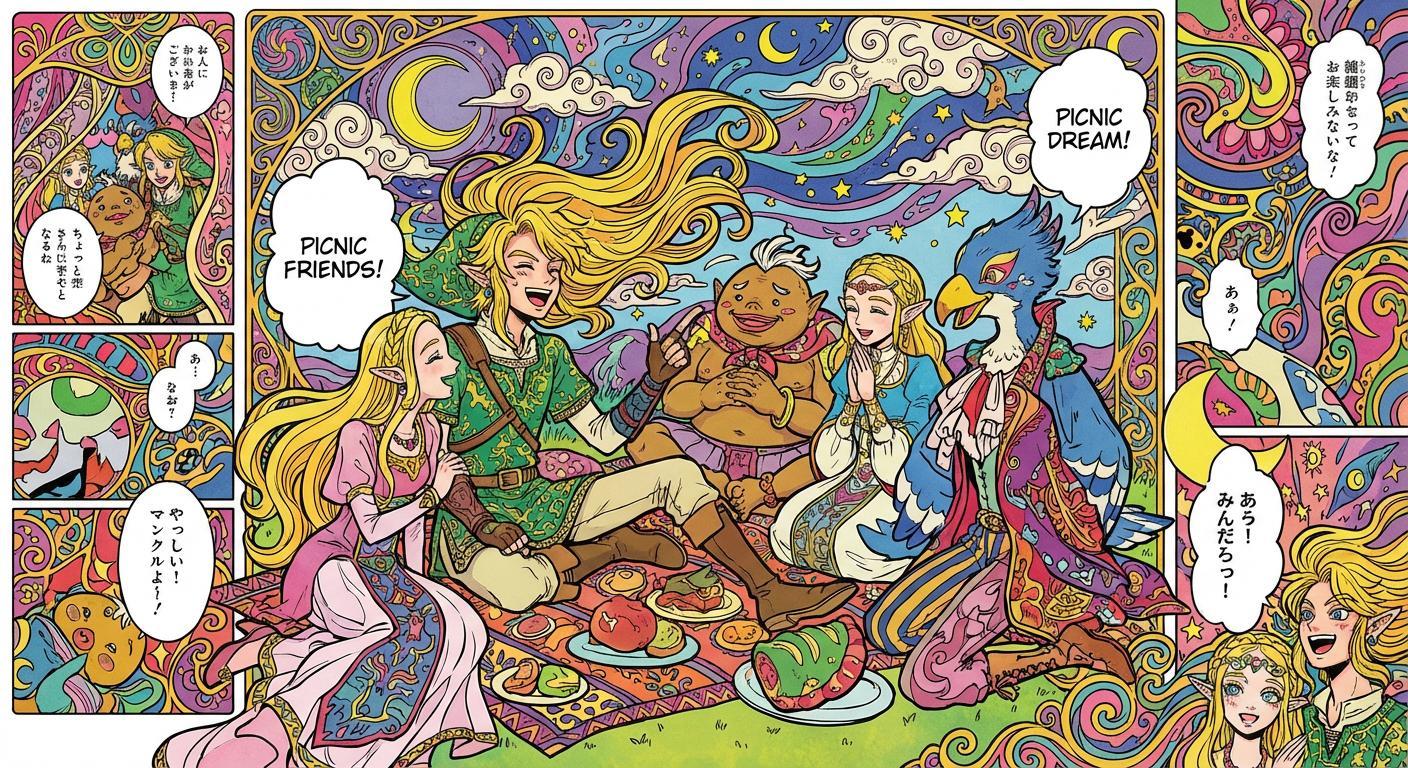
{Link (The Legend of Zelda) enjoying a cheerful picnic with friends beneath the open sky} illustrated in the neo-Mannerist shōjo manga pictorial style of Ooya Chiki (大矢千枝子): {
Rooted in the experimental "Golden Age" of shōjo manga pioneered by the Year 24 Group (1970s–1980s), this work draws philosophical exaggeration from the Japanese Tanbi Aesthetic (Aestheticism/Decadence Movement) and its creed that "fiction is truer than reality." This hallucinatory colored manga spread consciously rejects photorealistic representation in favor of expressive distortion, where every visual decision—from figural rendering to spatial composition—serves the emotional and psychological truth of the narrative moment rather than objective reality.
This anti‑establishment approach manifests through a non-conventional, story‑driven decorative manga composition that achieves a monumental synthesis of Gothic Melancholia and Manic Pop‑Psychedelia. Inspired by 1970s psychedelic graphic design and Harajuku eclectic pop, the work employs cosmopolitan syncretism—a freestyle, non‑explicit yet purposeful, story‑adapted structural fusion of graphic compositions that span Art Nouveau, Japonisme/Ukiyo‑e, Rococo, the Secessionist movement, and Celtic/Insular art. The composition cinematically juxtaposes conventional dimensionality with compositional rhythms—ranging from spacious surreal dreamscapes to horror vacui—drawn from diverse stylistic graphic frameworks, creating a seamless art‑style collage that viscerally amplifies the playful, even hilarious, emotional tone of the narrative moment. This enables playful variation and striking uniqueness, aesthetically and emotively modulating fundamental graphic elements—visual flow, density, hierarchy, and contrast—much like display typography adapts to thematic context.
Within this decorative framework, characters manifest as bishōnen/bishōjo archetypes with stylistically hyperbolized figures characterized by eccentric mannerisms and appearances. Each character maintains identifiable uniqueness through specific visual characteristics and niche personal branding, achieved via free-spirited synthesis and adaptation of literature, pop culture references, and art history. This elevates archetypal personalities into symbolic surrealist personalities where character fidelity, visual style, and gesture drawing externalize internal psychological states via a visual collage of conflicting manga vocabularies. The character’s visual identity is rendered as a fluid stylistic adaptation, morphing their foundational Year-24 elegance into distinct artistic modes to externalize specific emotional states: adopting the netsuke-like bold simplification and dramatic staging of Osamu Tezuka to signal gravitas; channeling the folkish cartoon and Yōkai quirky charm of Shigeru Mizuki for moments of whimsical innocence; embodying the idealized, biased romantic excess of Yumiko Igarashi during lyrical melancholy; manifesting the psycho-atmospheric enigma of Yamagishi Ryoko and CLAMP for enigmatic allure; and utilizing the cartoon elasticity of Akira Toriyama to project comedic energy.
These modes coexist within the single composition as a stylistic collage, producing emotive tonal versatility. Appearance, clothing, and overall visual style rely on a static syncretism to express manic mood, creating deliberate surrealist cognitive dissonance between archetype and expression while preserving recognizable core identity. Highly responsive and expressive mannerisms supersede anatomical accuracy, creating a theater of symbolic hyperbolic archetypes in which fashion, emotion, and identity converge into decorative storytelling.
The resulting aesthetic evokes a doujinshi that channels the vibrant experimental exoticism of Harajuku street fashion culture and underground zines—eclectic, rebellious, and unapologetically theatrical. It showcases a playful mastery of style that breaks conventional boundaries to assert artistic freedom, employing synthesized and contrasting stylistic conventions that both poetically amplify and parody psychological depth and emotional authenticity, generating deliberate dissonance with striking narrative immediacy. }