Monochromatic single wash drawing style and cinematic narrative realism of Władysław Theodor Benda (W.T. Benda) (1873-1948) [ChatGPT, Gemini Nano Banana Pro]
{Link and allies hanging together at the village tavern, bonding over shared journeys} illustrated in the monochromatic single wash drawing style and "cinematic narrative realism" of Władysław Theodor Benda (W.T. Benda): {
A gestural realism illustration with impactful storytelling immediacy and instantaneous dramatic tension, achieved through high-efficacy theatrical production mastery: a foundational understanding of lighting design, stage blocking, costume, and dramatic framing, alongside performing arts, facial mask designs, and costumery. Rendered monochromatically—primarily in charcoal, often accented with watercolor and colored pencil—it is portrayed in a fashionable, graphic-aware perspectival composition with an extremely wide tonal range that conveys various emphases of texture, atmosphere, and depth. The aesthetic is a "women's-perspective-centric," polished, intensely dramatic high-society tableau vivant pastiche that functions as a strategic synthesis of European Aestheticism and American Utility, merging the psychological realism of Robert Henri (Ashcan School)—grounded in direct observation and expression of contemporary urban life and emotional veracity—with the poster-art clarity of Edward Penfield (synthesizing Japanese Ukiyo-e and French Poster Art of Toulouse-Lautrec). The composition instantly attracts and communicates, dispelling reductive stereotyping and transforming viewers' shallow stereotypes into vivid present realism through striking close-ups, clear staging, and immediate visual communication, employing "virile linework" reminiscent of Josef Mánes that embodies the accessible, unpretentious vitality of the Czech National Revival.
The visual framework is derived from Benda's expertise in mask-making, costume, and stagecraft (papier-mâché autopoiesis as expressive frontier tools for visual culture), resulting in figures that possess archetypal expression, sculptural clarity, and sculptural modeling. Grounded in pedagogical approaches drawn from religious and historical paintings of the Pan-Slavic National Revival within the cultural unity of the Austro-Hungarian Empire, the style emphasizes chiaroscuro (akin to Caravaggio but softer), subdued gestural and ethnical expressiveness, folk-motif integration, and sympathetic cultural narrative illustration. It fuses the bucolic narrative realism and emphasis on simplicity, authenticity, and regional loyalty of Mikoláš Aleš with conceptual frameworks from musical theatre art direction. The artwork reflects the traditions of Slavic mask folk arts—characterized by realistic gestural dramaturgy, narrative archetypes, cinematic realism, and exoticized gender expressions in roleplay—balanced between aesthetic refinement and narrative utility, framed within a civilized atmosphere reminiscent of Rudolph Ruzicka.
The mise en scène, as exemplified in Benda's works for McClure's magazine covers, embodies a cinematic narrative realism inspired by the late 19th-century European Classical and Romantic repertoire, conveying authentic cultural elegance rooted in Czech religious and folkloric traditions, subconsciously mirroring Bohemian processions and national revivalist imagery. It is elevated by ephemeral yet dignified theatrical social customs with complex realism of joy and hardships, characterized by gestural dramaturgy with voluptuous glow in period/cultural costume and social warmth rather than explicit Gothic melodrama. Influenced by Polish folk art, it is richly layered with meaningful, personality-driven, gender-expressive gestures, conveyed through body language and meaningful gazes. The composition offers a more complex yet subtle social dynamism than Norman Rockwell's whimsical portrayals of rural American life, while providing a more relaxed atmosphere than Grant Wood's rigidly dramatized surrealism.
The figures are defined by intertextually rich social dynamics, creating a complementing interplay between illustration and novelistic narrative that clarifies readers' reductive archetypal/stereotyping biases:
The "Benda Girl": Portrayed as stylishly composed in slightly mid-gestures yet calculating, mysterious-but-genuine, and vulnerable—as if her social facade slipped for a moment. She is a languid, delicate ingénue with an independent life (akin to Alphonse Mucha but without explicit eroticism), featuring the elongated, almond-shaped eyes and exoticized features of Young Poland Symbolism. These are conveyed through realistic, evocative micro-expressions and gestures—rather than the sanitized, idealized homespun pretty, simply outspoken, or strong personalities of Charles Dana Gibson, Howard Chandler Christy, James Montgomery Flagg, and Harrison Fisher.
The Gentlemen: Depicted as idealized figures akin to J.C. Leyendecker.
The Interaction: The contrasting archetypal men and women engage in extroverted narrative participation (akin to Henry Patrick Raleigh but more extroverted and relatable) with congruent gestural acuity and meaningful gazes (akin to Clarence Underwood but without the rigid relationship idealization) and cohesive body language (akin to Joseph Clement Coll though in less intense scenarios, or Charles Nicholas Sarka though far more socially oriented). Each character is imbued with cultural depth, understanding, and sensitivity, creating a societal atmosphere marked by dynamic expressiveness akin to soap opera rather than self-aware, introspective stillness.
The scene is dramatized through signature mastery of "common lights" akin to live theatre drama, employing directional lighting and manipulation of light to create melodrama. This chiaroscuro approach (featuring Rembrandt Lighting and Film Noir Aesthetics) creates soft but deep shadows, psychological tension, and mystery, bringing impressive immediacy through spontaneity and relatable realism instead of emotionally distant, editorialized portrayals. Unlike N.C. Wyeth or Maxfield Parrish, the composition focuses on nascent, dynamic social narratives rather than environmental atmosphere. It utilizes "proscenium arch" framing and visual barriers to concentrate viewer attention and simulate a sudden "reveal" or dramatic stage entrance, resulting in a timeless period ephemera tableau vivant with an infectious, sentimental social atmosphere. The intricate detail achieves tangible, three-dimensional texture with photographic realism akin to early cinema stills, optimized for the Halftone Process.
}


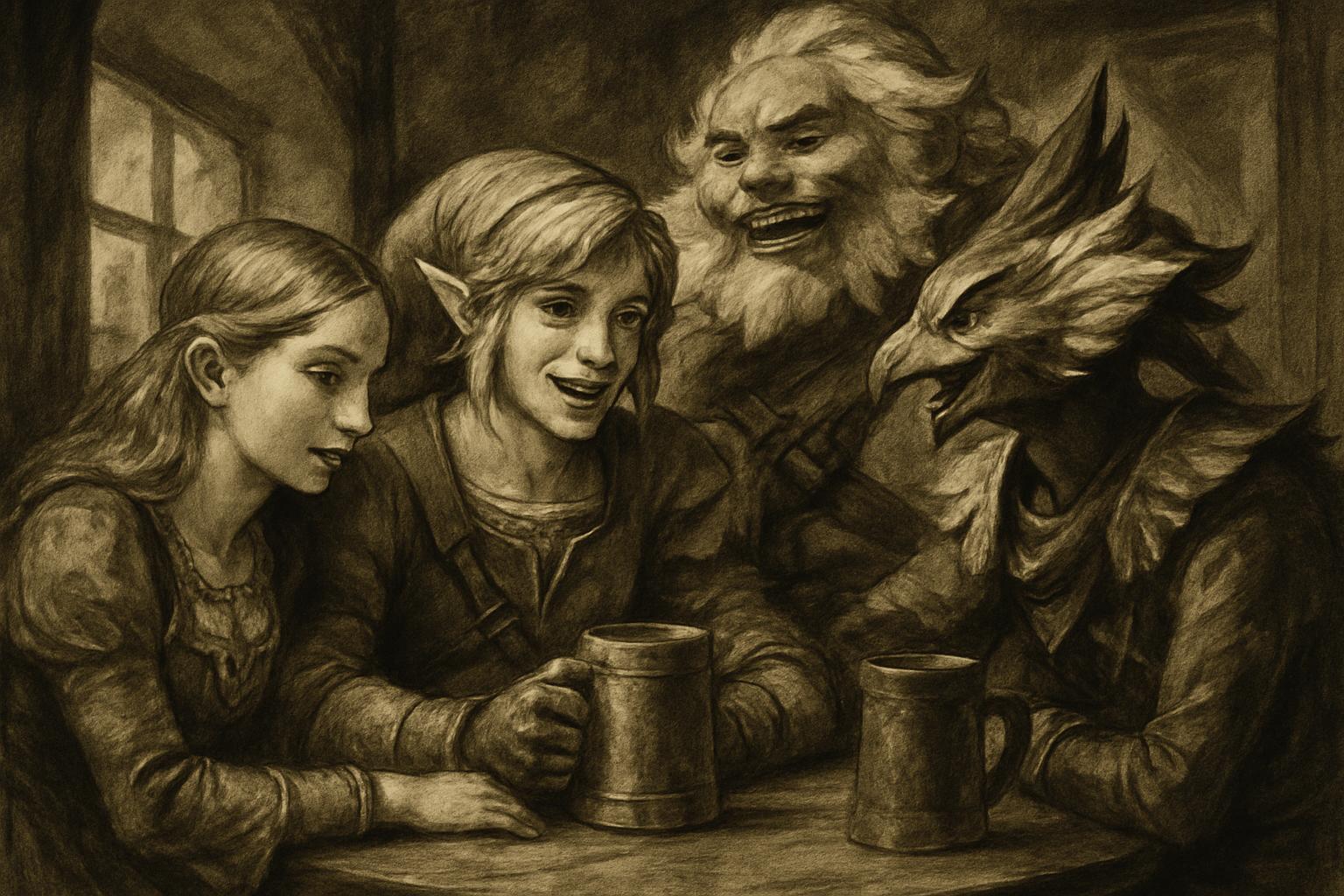
{Link and allies hanging together at the village tavern, bonding over shared journeys} illustrated in the monochromatic single wash drawing style and "cinematic narrative realism" of Władysław Theodor Benda (W.T. Benda): { A gestural realism illustration with impactful storytelling immediacy and instantaneous dramatic tension, achieved through high-efficacy theatrical production mastery: a foundational understanding of lighting design, stage blocking, costume, and dramatic framing, alongside performing arts, facial mask designs, and costumery. Rendered monochromatically—primarily in charcoal, often accented with watercolor and colored pencil—it is portrayed in a fashionable, graphic-aware perspectival composition with an extremely wide tonal range that conveys various emphases of texture, atmosphere, and depth. The aesthetic is a "women's-perspective-centric," polished, intensely dramatic high-society tableau vivant pastiche that functions as a strategic synthesis of European Aestheticism and American Utility, merging the psychological realism of Robert Henri (Ashcan School)—grounded in direct observation and expression of contemporary urban life and emotional veracity—with the poster-art clarity of Edward Penfield (synthesizing Japanese Ukiyo-e and French Poster Art of Toulouse-Lautrec). The composition instantly attracts and communicates, dispelling reductive stereotyping and transforming viewers' shallow stereotypes into vivid present realism through striking close-ups, clear staging, and immediate visual communication, employing "virile linework" reminiscent of Josef Mánes that embodies the accessible, unpretentious vitality of the Czech National Revival.
The visual framework is derived from Benda's expertise in mask-making, costume, and stagecraft (papier-mâché autopoiesis as expressive frontier tools for visual culture), resulting in figures that possess archetypal expression, sculptural clarity, and sculptural modeling. Grounded in pedagogical approaches drawn from religious and historical paintings of the Pan-Slavic National Revival within the cultural unity of the Austro-Hungarian Empire, the style emphasizes chiaroscuro (akin to Caravaggio but softer), subdued gestural and ethnical expressiveness, folk-motif integration, and sympathetic cultural narrative illustration. It fuses the bucolic narrative realism and emphasis on simplicity, authenticity, and regional loyalty of Mikoláš Aleš with conceptual frameworks from musical theatre art direction. The artwork reflects the traditions of Slavic mask folk arts—characterized by realistic gestural dramaturgy, narrative archetypes, cinematic realism, and exoticized gender expressions in roleplay—balanced between aesthetic refinement and narrative utility, framed within a civilized atmosphere reminiscent of Rudolph Ruzicka.
The mise en scène, as exemplified in Benda's works for McClure's magazine covers, embodies a cinematic narrative realism inspired by the late 19th-century European Classical and Romantic repertoire, conveying authentic cultural elegance rooted in Czech religious and folkloric traditions, subconsciously mirroring Bohemian processions and national revivalist imagery. It is elevated by ephemeral yet dignified theatrical social customs with complex realism of joy and hardships, characterized by gestural dramaturgy with voluptuous glow in period/cultural costume and social warmth rather than explicit Gothic melodrama. Influenced by Polish folk art, it is richly layered with meaningful, personality-driven, gender-expressive gestures, conveyed through body language and meaningful gazes. The composition offers a more complex yet subtle social dynamism than Norman Rockwell's whimsical portrayals of rural American life, while providing a more relaxed atmosphere than Grant Wood's rigidly dramatized surrealism.
The figures are defined by intertextually rich social dynamics, creating a complementing interplay between illustration and novelistic narrative that clarifies readers' reductive archetypal/stereotyping biases:
The scene is dramatized through signature mastery of "common lights" akin to live theatre drama, employing directional lighting and manipulation of light to create melodrama. This chiaroscuro approach (featuring Rembrandt Lighting and Film Noir Aesthetics) creates soft but deep shadows, psychological tension, and mystery, bringing impressive immediacy through spontaneity and relatable realism instead of emotionally distant, editorialized portrayals. Unlike N.C. Wyeth or Maxfield Parrish, the composition focuses on nascent, dynamic social narratives rather than environmental atmosphere. It utilizes "proscenium arch" framing and visual barriers to concentrate viewer attention and simulate a sudden "reveal" or dramatic stage entrance, resulting in a timeless period ephemera tableau vivant with an infectious, sentimental social atmosphere. The intricate detail achieves tangible, three-dimensional texture with photographic realism akin to early cinema stills, optimized for the Halftone Process. }