{The Legend of Zelda (1986) Nintendo game} illustrated in the gesturally anthropomorphized perspectival style of Virginia Lee Burton (1909–1968): {
A whimsical environmental storytelling illustration defined by a timeless storybook charm. The style shares the sinuous, rhythmic linework of Wanda Gág (1893-1946) but is executed with greater graphic design sensibilities. The rendering technique is key: forms are built with precise parallel-line modeling and cross-hatching, while tonal shading is achieved with a colored graphite texture—all dissipating into integrated white space to achieve the warm, accessible charm of mid-century children's book illustration such as Grandma Moses (1860-1961). The composition applies the Arts and Crafts 'unity-of-design' principle, creating a decorative harmony through dense yet not overwhelming, embroidery-like rhythmic patterning and clean parallel contours designed for the clarity of mid-century book printing.
Abstract calligraphic swashes and kinetic gestures form the gestural underdrawing—a foundational structure that establishes Burton's signature elongated perspectival framework, one that deliberately breaks conventional spatial logic.This approach employs sinuous, unfolding, or serpentine viewing angles that simultaneously present multiple vantage points—bird's-eye views that bend and wrap around the subject, creating impossible yet coherent spatial relationships. The perspective stretches and curves as if following the gestural flow itself, whether rendered as a distant view that flows in a multi‑fold serpentine trajectory, an intimate close-up that curves around its focus, or a wraparound panoramic spread that defies single-point perspective. These gestural underpinnings serve multiple compositional purposes simultaneously: as framing vignettes that contain and curve around the scene, as perspectival silhouettes with continuously shifting vantage points that guide the eye through impossible space, and as visual paths that choreograph element placement along elongated, sinuous trajectories across all scales. This layered approach creates visual hierarchy while underscoring narrative themes—isolation, transformation, or community cohesion—through both the directional character and the perspectival distortion of the gestures themselves.
This foundational gestural abstraction symbolizes the current fluid, living energy of the story that mirrors the tempo of dance, with moments of tension, climax, and resolution. The elongated, flowing perspective amplifies this kinetic quality—space itself appears to stretch, compress, and undulate in response to narrative emphasis. Crucially, instead of being painted over and hidden as in traditional illustration, these expressive gestures are respected and enhanced—remaining visible in the finished work. The illustrative elements are painted over the underdrawing in a way that adapts to its unconventional perspective framework and elongated spatial logic, achieving aesthetic and semantic symbiosis between the abstract gestural structure and the representational graphic elements layered above it. Objects and landscapes bend and stretch according to the gestural flow rather than optical realism.
This approach imbues the entire scene with cohesive, gesturally emotive anthropomorphization—the landscape itself appears alive, spatially responsive, and reflective of the story's emotional arc. The elongated perspective allows elements at different narrative distances to coexist within the same visual plane, creating temporal as well as spatial fluidity. Themed color palettes and varying levels of line fluidity or rigidity reinforce this effect, capturing atmospheric qualities while maintaining expressive stylization.
Modernist graphic sensibilities guide the strategic deployment of specific motifs (flowers, trees, architectural details) to streamline the scenic panorama into a monumental decorative composition. These elements follow the curved, elongated perspective, often appearing in rhythmic recession along draping paths or serpentine trajectories. Hard‑edged tonal gradations, dissolving into breathing white space, define planes and create depth through scaling and perspectival placement along curved viewing angles, while retaining the tactile charm and textured qualities of storybook crayon or colored pencil drawings. This synthesis enables visually rich composition with page-margin awareness and integrated breathing white spaces—creating elevated atmosphere without overwhelming complexity, allowing the scene to remain accessible and inviting despite its spatial impossibilities.
The result is an ephemeral, kinetic scene where subjects and objects gain character through their relationship to both the gestural flows and the elongated perspectival distortions—enhancing them, breaking against them, emerging as their focal point, or being carried along their curved trajectories through impossible space. The illustration's patterned, flowing visual cues act as a rhythmic orchestration, guiding the reader's eye along serpentine paths across and around the page. This reinforces narrative progression through the stylized, poetic alignment of compositional geometry, perspectival choreography, and storytelling rhythms—creating continuous visual interest and an engaging, immersive spectacle that invites prolonged viewing and discovery.
}
Sources
Virginia Lee Burton PowerPoint Presentation — SlideServe
At the Cape Ann Museum, A History of the Folly Cove Designers — Boston Art Review
The Unlikely Story of the Folly Cove Guild, the Best Designers You've Never Heard Of — Atlas Obscura


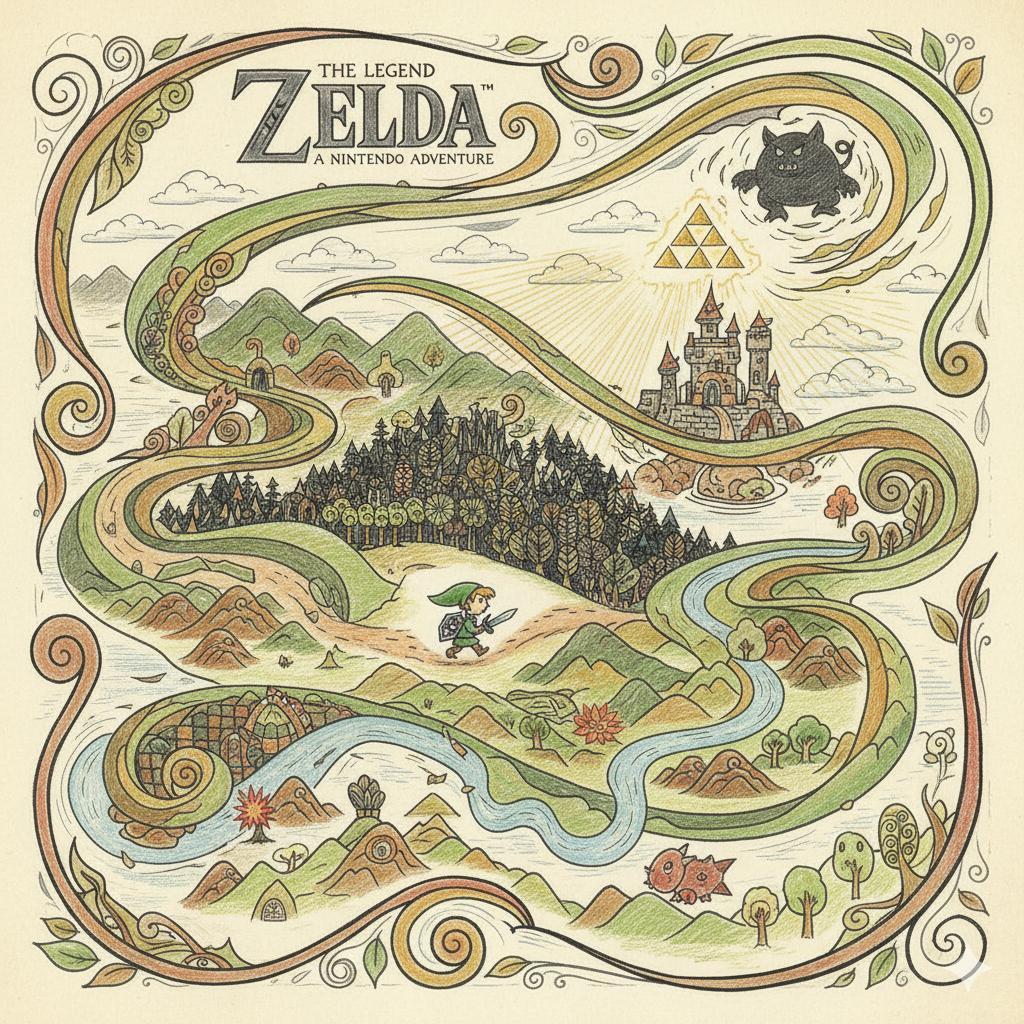
{The Legend of Zelda (1986) Nintendo game} illustrated in the gesturally anthropomorphized perspectival style of Virginia Lee Burton (1909–1968): {
A whimsical environmental storytelling illustration defined by a timeless storybook charm. The style shares the sinuous, rhythmic linework of Wanda Gág (1893-1946) but is executed with greater graphic design sensibilities. The rendering technique is key: forms are built with precise parallel-line modeling and cross-hatching, while tonal shading is achieved with a colored graphite texture—all dissipating into integrated white space to achieve the warm, accessible charm of mid-century children's book illustration such as Grandma Moses (1860-1961). The composition applies the Arts and Crafts 'unity-of-design' principle, creating a decorative harmony through dense yet not overwhelming, embroidery-like rhythmic patterning and clean parallel contours designed for the clarity of mid-century book printing.
Abstract calligraphic swashes and kinetic gestures form the gestural underdrawing—a foundational structure that establishes Burton's signature elongated perspectival framework, one that deliberately breaks conventional spatial logic.This approach employs sinuous, unfolding, or serpentine viewing angles that simultaneously present multiple vantage points—bird's-eye views that bend and wrap around the subject, creating impossible yet coherent spatial relationships. The perspective stretches and curves as if following the gestural flow itself, whether rendered as a distant view that flows in a multi‑fold serpentine trajectory, an intimate close-up that curves around its focus, or a wraparound panoramic spread that defies single-point perspective. These gestural underpinnings serve multiple compositional purposes simultaneously: as framing vignettes that contain and curve around the scene, as perspectival silhouettes with continuously shifting vantage points that guide the eye through impossible space, and as visual paths that choreograph element placement along elongated, sinuous trajectories across all scales. This layered approach creates visual hierarchy while underscoring narrative themes—isolation, transformation, or community cohesion—through both the directional character and the perspectival distortion of the gestures themselves.
This foundational gestural abstraction symbolizes the current fluid, living energy of the story that mirrors the tempo of dance, with moments of tension, climax, and resolution. The elongated, flowing perspective amplifies this kinetic quality—space itself appears to stretch, compress, and undulate in response to narrative emphasis. Crucially, instead of being painted over and hidden as in traditional illustration, these expressive gestures are respected and enhanced—remaining visible in the finished work. The illustrative elements are painted over the underdrawing in a way that adapts to its unconventional perspective framework and elongated spatial logic, achieving aesthetic and semantic symbiosis between the abstract gestural structure and the representational graphic elements layered above it. Objects and landscapes bend and stretch according to the gestural flow rather than optical realism.
This approach imbues the entire scene with cohesive, gesturally emotive anthropomorphization—the landscape itself appears alive, spatially responsive, and reflective of the story's emotional arc. The elongated perspective allows elements at different narrative distances to coexist within the same visual plane, creating temporal as well as spatial fluidity. Themed color palettes and varying levels of line fluidity or rigidity reinforce this effect, capturing atmospheric qualities while maintaining expressive stylization.
Modernist graphic sensibilities guide the strategic deployment of specific motifs (flowers, trees, architectural details) to streamline the scenic panorama into a monumental decorative composition. These elements follow the curved, elongated perspective, often appearing in rhythmic recession along draping paths or serpentine trajectories. Hard‑edged tonal gradations, dissolving into breathing white space, define planes and create depth through scaling and perspectival placement along curved viewing angles, while retaining the tactile charm and textured qualities of storybook crayon or colored pencil drawings. This synthesis enables visually rich composition with page-margin awareness and integrated breathing white spaces—creating elevated atmosphere without overwhelming complexity, allowing the scene to remain accessible and inviting despite its spatial impossibilities.
The result is an ephemeral, kinetic scene where subjects and objects gain character through their relationship to both the gestural flows and the elongated perspectival distortions—enhancing them, breaking against them, emerging as their focal point, or being carried along their curved trajectories through impossible space. The illustration's patterned, flowing visual cues act as a rhythmic orchestration, guiding the reader's eye along serpentine paths across and around the page. This reinforces narrative progression through the stylized, poetic alignment of compositional geometry, perspectival choreography, and storytelling rhythms—creating continuous visual interest and an engaging, immersive spectacle that invites prolonged viewing and discovery. }