{Link from The Legend of Zelda, joyfully exploring a festive Christmas town} illustrated in the illustrative realism art style of Chris Van Allsburg (1949-), which is a sculptural chiaroscuro with an engineered perspective disorientation through an optical illusion-like visual angle rendered in photoreal tonal modeling within a seamlessly blended modernist framework: {
Narrative Context and Fundamental Aesthetic Duality
An escapist, whimsical children’s book illustration that conveys an intriguing, open‑ended, and curious narrative through uncanny photorealism and a surreal stillness. The style presents a visual paradox of convincing mimetic detail from a distance that, upon close inspection, reveals a seamless modernist streamlining of architectural, reduced geometry without breaking realism. This dual register creates a subconscious visual dissonance: the image reads as convincingly real from afar, but its abstraction and formal reduction become evident in detail, exposing the underlying aesthetic discipline. This is achieved through tight, draftsmanship-driven edges, smooth value transitions, selective textural restraint, and an economy of color or muted palette where tonal values, not hue, carry the image's weight. The illustration employs playful stagecraft of forced, dream-logic perspective, where the relative size and placement of objects are manipulated to create illusions of depth or to suggest that space itself is behaving in unexpected ways, using angled perspectives such as 'Dutch tilt' to create subtle, non-Euclidean-like disorientation and unease that destabilizes lazy spatial reading. Suggested materials—including Prismacolor pencil, subtle watercolor/airbrush washes, and soft rubbings or blending stumps—achieve the sculptural surfaces characteristic of this style.
Chiaroscuro, Light, and Sculptural Form
A pristine, Edward Hopper-like chiaroscuro gives form a strong sculptural treatment, where light and shadow carve focal points into crisp, tangible presences that stand out against more reductive silhouettes. This effect is accomplished through a modernist discipline that uses flat directional lighting, juxtaposed scale, and sharp cast shadows to compress and segment classical chiaroscuro. The result is a clean, layered depth with varying levels of crispness and hazy luminosity, akin to stage-like depth planes. Despite the style's inherent disorientation, this technique preserves believability through deliberate spatial cues: clear foreground, midground, and background separations are established by value contrast, often featuring sharp silhouettes against a soft atmospheric recession to maintain clarity. The resulting luminous chiaroscuro, utilizing a cool/warm atmospheric palette and pristine gradients, ultimately underscores the narrative’s fable-like, ephemeral emotional tone—a chromatic study executed with the value control of a sculptor, ensuring the image translates cleanly into a powerful tonal reading.
Technical Execution and Visual Flow
It uses a range of shading techniques, including tonal shading, hatching, cross-hatching, and blending, with hard/soft edges and sharp transitions between light and shadow on some forms and gradual gradients on others. Modernist streamlining of organic patterns as contrasting texture and negative space directs visual flow and emphasizes focal points, while leaving enough for the imagination to fill in, with visual hierarchy defined by level of surface detail and contrast. This minimizes organic variability while creating a tableau-like, fluid visual flow.
Compositional Progression and Point of View
The composition employs tonal progression—the gradual shift from light to dark shading, or from calm to chaotic composition—to mirror the pacing of narratives, with symbolic interplay between narrative and sculptural form. The viewer's vantage is manipulated—sometimes placing the reader in the position of a character, at other times adopting an omniscient or even inhuman vantage—to create atmospheric point-of-view that intrigues viewers toward active immersive observations into the obscured, whimsy narrative and to fill in imaginative backstories.
Resulting Dissonance and Dreamlike Quality
This synthesis of techniques establishes a compressed visual hierarchy while simultaneously generating a Giorgio de Chirico-like dreamlike quality, where the boundaries between the real and the unreal constantly shift. This effect stems from a playful semantic dissonance: the organized, convincing photorealism is directly juxtaposed with seamless modernist stylization and a faux optical-illusion perspective. The tension is amplified by the distinct 'uncanny valley' impression produced by this seamlessly engineered realism, solidifying the image's sanitized yet whimsical charm.
}


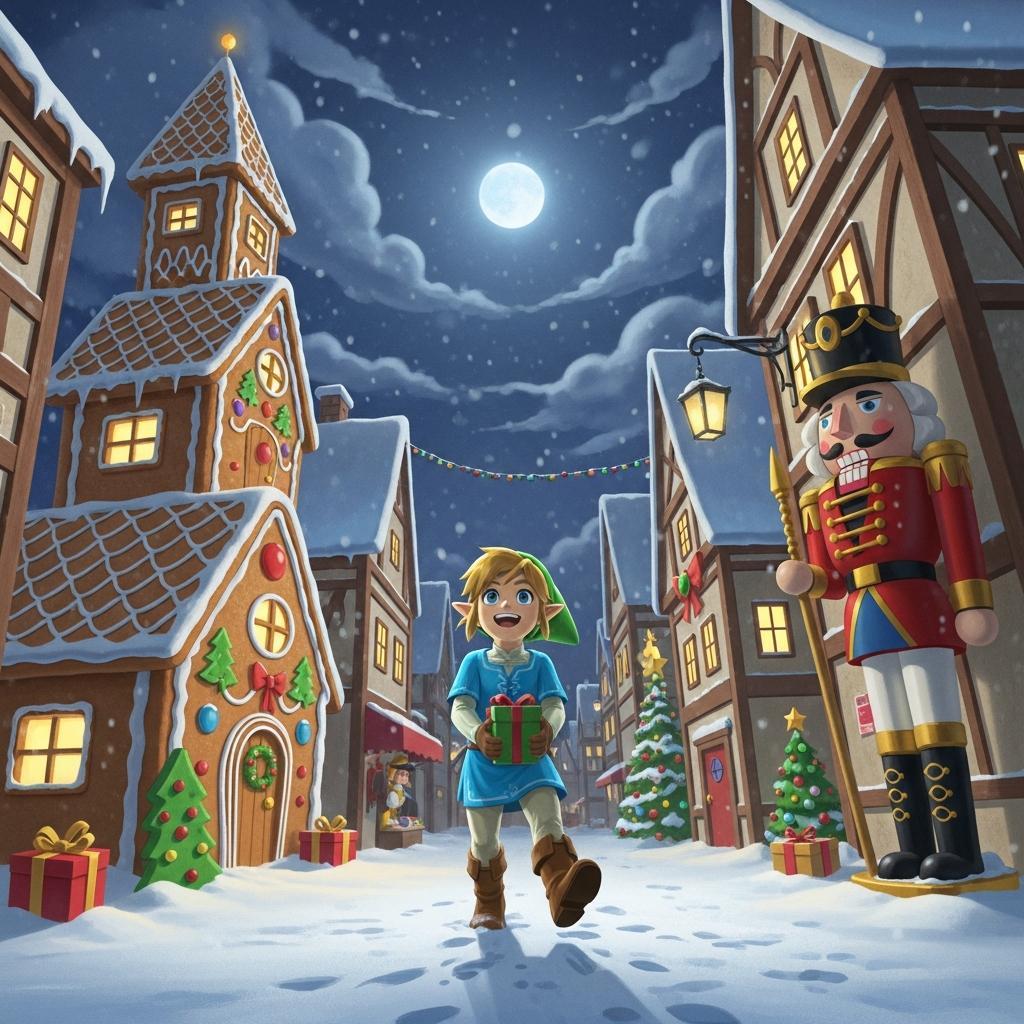
{Link from The Legend of Zelda, joyfully exploring a festive Christmas town} illustrated in the illustrative realism art style of Chris Van Allsburg (1949-), which is a sculptural chiaroscuro with an engineered perspective disorientation through an optical illusion-like visual angle rendered in photoreal tonal modeling within a seamlessly blended modernist framework: {
An escapist, whimsical children’s book illustration that conveys an intriguing, open‑ended, and curious narrative through uncanny photorealism and a surreal stillness. The style presents a visual paradox of convincing mimetic detail from a distance that, upon close inspection, reveals a seamless modernist streamlining of architectural, reduced geometry without breaking realism. This dual register creates a subconscious visual dissonance: the image reads as convincingly real from afar, but its abstraction and formal reduction become evident in detail, exposing the underlying aesthetic discipline. This is achieved through tight, draftsmanship-driven edges, smooth value transitions, selective textural restraint, and an economy of color or muted palette where tonal values, not hue, carry the image's weight. The illustration employs playful stagecraft of forced, dream-logic perspective, where the relative size and placement of objects are manipulated to create illusions of depth or to suggest that space itself is behaving in unexpected ways, using angled perspectives such as 'Dutch tilt' to create subtle, non-Euclidean-like disorientation and unease that destabilizes lazy spatial reading. Suggested materials—including Prismacolor pencil, subtle watercolor/airbrush washes, and soft rubbings or blending stumps—achieve the sculptural surfaces characteristic of this style.
A pristine, Edward Hopper-like chiaroscuro gives form a strong sculptural treatment, where light and shadow carve focal points into crisp, tangible presences that stand out against more reductive silhouettes. This effect is accomplished through a modernist discipline that uses flat directional lighting, juxtaposed scale, and sharp cast shadows to compress and segment classical chiaroscuro. The result is a clean, layered depth with varying levels of crispness and hazy luminosity, akin to stage-like depth planes. Despite the style's inherent disorientation, this technique preserves believability through deliberate spatial cues: clear foreground, midground, and background separations are established by value contrast, often featuring sharp silhouettes against a soft atmospheric recession to maintain clarity. The resulting luminous chiaroscuro, utilizing a cool/warm atmospheric palette and pristine gradients, ultimately underscores the narrative’s fable-like, ephemeral emotional tone—a chromatic study executed with the value control of a sculptor, ensuring the image translates cleanly into a powerful tonal reading.
It uses a range of shading techniques, including tonal shading, hatching, cross-hatching, and blending, with hard/soft edges and sharp transitions between light and shadow on some forms and gradual gradients on others. Modernist streamlining of organic patterns as contrasting texture and negative space directs visual flow and emphasizes focal points, while leaving enough for the imagination to fill in, with visual hierarchy defined by level of surface detail and contrast. This minimizes organic variability while creating a tableau-like, fluid visual flow.
The composition employs tonal progression—the gradual shift from light to dark shading, or from calm to chaotic composition—to mirror the pacing of narratives, with symbolic interplay between narrative and sculptural form. The viewer's vantage is manipulated—sometimes placing the reader in the position of a character, at other times adopting an omniscient or even inhuman vantage—to create atmospheric point-of-view that intrigues viewers toward active immersive observations into the obscured, whimsy narrative and to fill in imaginative backstories.
This synthesis of techniques establishes a compressed visual hierarchy while simultaneously generating a Giorgio de Chirico-like dreamlike quality, where the boundaries between the real and the unreal constantly shift. This effect stems from a playful semantic dissonance: the organized, convincing photorealism is directly juxtaposed with seamless modernist stylization and a faux optical-illusion perspective. The tension is amplified by the distinct 'uncanny valley' impression produced by this seamlessly engineered realism, solidifying the image's sanitized yet whimsical charm. }