Makartstil (Makart style), developed by Hans Makart (1840–1884): an opulent and theatrical form of Viennese Historicism that pioneered commercial interior painting attentive to its surrounding decor. [Gemini Nano Banana]
{Link (The Legend of Zelda)}, illustrated in the Makartstil painting style of Hans Makart (1840–1884): {
A Viennese variant of 19th-century Historicism that forged a proto-cinematic visual language through the fusion of Venetian colorism, Baroque movement, and operatic staging. Rooted in the Munich School under Carl Theodor von Piloty and drawing on Baroque, Renaissance, Gothic, and Rococo vocabularies, Makart elevated history painting into a Gesamtkunstwerk—painting, interior decor, costume, and civic pageantry conceived as one immersive spectacle. He transmuted mythic narratives (Nibelungen, Cleopatra, Bacchic processions) through opulent color and allegorical sensuality, infusing melodramatic tropes from popular theatre and Gothic literature—heightened emotion, moral dilemmas, episodic plotting—into painterly Romantic-Gothic Stimmung that diverged from the muted, spiritual vein of mainstream Viennese Historicism. His studio practice—live models posed amid velvet, brocade, armor, flowers, and costumes—fed canvases designed for Ringstraße interiors and processional display, foreshadowing Secession-era exhibition culture.
GESAMTKUNSTWERK PHILOSOPHY:
Central to this style is the total work of art: paintings function as keystones of immersive theatrical environments. Makart staged live models amid furnishings, textiles, flowers, and costumes so that canvases, interiors, and public pageants united into a single ornamental vision. Designed for the performative viewing culture of Vienna's Ringstraße era (c. 1860s–1880s), this saturated, dramaturgical approach deliberately disrupted the measured equilibrium of revivalist interiors—producing dynamic interplay between ornamental excess and classical restraint that transformed viewing rooms into stage-like spaces comparable to trophy-lined hunting chambers. Paintings were conceived at ceremonial distance, read as living tableaux within coordinated decorative ensembles.
VISUAL LANGUAGE & STYLISTIC ARCHITECTURE:
Baroque dynamism: Sweeping diagonals, serpentine S-curves, theatrical chiaroscuro, proscenium logic of parted curtains and deep backdrops
Chromatic intoxication: Lush, saturated palettes dominated by the famed "Makartrot" crimson, complemented by peacock and malachite greens, amber-gold, ivory flesh, and lacquered blacks; metallic flickers in jewelry and weaponry
Allegorical eroticism: Monumental sensuality fused with civic-processional energy—rejecting Pre-Raphaelite medievalist moralizing, cool daylight, and linear precision, as well as Rococo's intimate playfulness, instead favoring operatic sensuality, broad color masses, and warm varnished atmospheres
Decorative totality: Pattern-on-pattern—damask, fur, feathers, marble, bronze—unified as a single ornamental field extending into interior design and civic pageantry
Light as dramaturgy: Warm, varnished light; candle/torch glows and gilded reflections; spotlighted figures against recessive, atmospheric backdrops; smoke/gauze/drapery veiling secondary zones to control narrative focus
Color and light operate as symbolic articulations of a manifest worldview—mobilized through sinister foreshadowing, looming backdrops, halo-like spotlighting, and strategic vignettes to heighten narrative tension without overwhelming compositional unity.
TECHNICAL SYNTHESIS:
Makart synthesized diverse influences—Wilhelm Leibl's alla-prima realism, Gabriel von Max's controlled mystical precision, Hans Canon's Baroque admiration, Anselm Feuerbach's Neo-Classical rigor, Carl Schuch's analytic color rhythm and thick impasto—subordinating all to his decorative, theatrical, psychologically charged vision. Where Leibl pursued earthbound peasant realism and Feuerbach statuesque harmony, Makart repurposed their techniques for dramatic sensory impact.
Ground and layering:
Warm umber/sienna grounds; broad underpainting; multiple transparent glazes and selective scumbles for an enamelled sheen; overall varnish
Brushwork and surface:
Loose and open over dense, varnished, often pastose surfaces—diverging from von Max's control, less structured than Canon's muralist spontaneity, counter to Schuch's local-tone analysis
Complementary background harmonies stabilize intentionally imbalanced foregrounds; environmental color functions as psychological context
Whites warm and sparing; blacks used as velvet depth
Every mark, hue, and shadow serves the Gesamtkunstwerk logic, transforming painting into morbid, staged psychological and social drama.
COMPOSITIONAL DRAMATURGY:
Fantasy-Gothic staging grounded in Renaissance frameworks—idealized human form, compositional harmony, allegorical subject matter, integration with decorative schemes—elevated through Gothic melodrama's theatrical artistry (persecution of innocents, fallen grace). A Romantic historicism framed in non-literal, Gothic fantasy subtexts: staging Pre-Raphaelite-like angelic purity within nature's chaotic tender beauty, akin to arranged flowers (Makartbouquet) implying concealed primeval savagery through shadowy dark tones.
Structural principles:
Asymmetric pyramids pivoting on a leading diagonal; propped by columns, candelabra, lances, or banners
Tableau vivant staging: processional groupings on a dominant diagonal with counter-groups; bodies and fabrics articulated as rhythmic masses
Repoussoir draperies and deep scenic backdrops (ruins, colonnades, tapestries) create proscenium depth
Rhythm: flowing arcs of limbs and fabric countered by verticals and weaponry
Symbolic architecture:
Foreground-background juxtaposition of Renaissance angelic beauty signifying innocence against dark atmospheric zones that avoid plein-air light
Historical-mythic subjects (Nibelungen episodes, Cleopatra, Bacchic processions, Allegories of the Senses/Seasons) used chiefly to license sensual pageantry and monumental nudes
Gothicized medieval revival translating literature into expressionist staging and psychological allegory
Presentation context:
Gilt frames as part of the decorative ensemble
Saturated wall colors, coordinated textiles and floral arrangements
Frames conceived as extensions of the room's ornamental totality
Don't: Plein-air light; Impressionist broken color; moralizing Pre-Raphaelite line and cool daylight; Symbolist dream-vagueness; Expressionist distortion.
RESULTING AESTHETIC:
A historicist-decorative spectacle where color, costume, and staged movement converge into a lacquered, sensuous tableau—psychology delivered through placement, light, and chroma rather than introspective naturalism. A grounded fantasy-Gothic dramaturgy sustaining uneasy suspense through deliberate contrasts: tenderness against terror, aristocratic sterility against carnal wilderness, gilded interiors against shadowed lairs—symbolizing beastly power struggles and lusts beneath noble veneers. Innocence perpetually poised against carnal survival, grace and ferocity entwined in decadent drama, where fallen angels thrive as hunters in nature's battle-royales. The canvas becomes a morbid, sensuous unity—beauty's fragility elevated into monumental, processional grandeur.
}


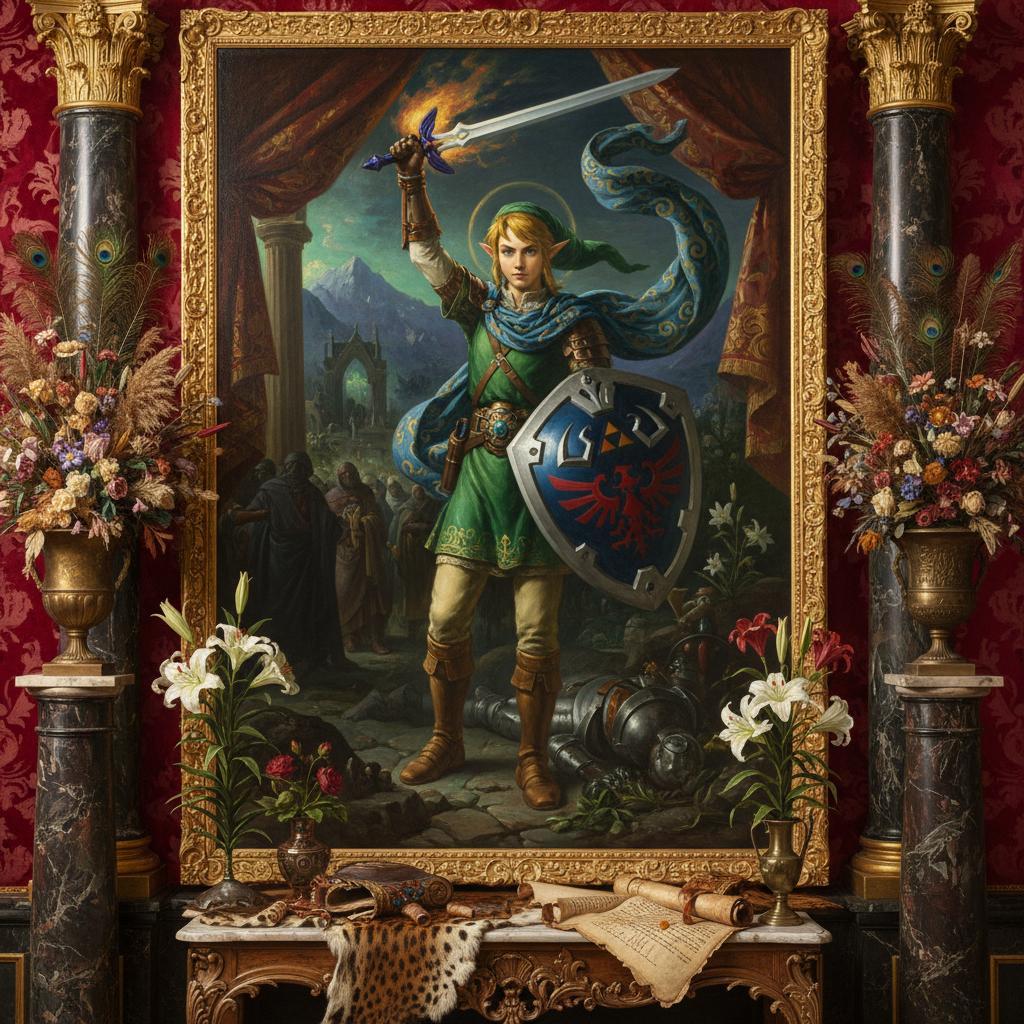
{Link (The Legend of Zelda)}, illustrated in the Makartstil painting style of Hans Makart (1840–1884): {
A Viennese variant of 19th-century Historicism that forged a proto-cinematic visual language through the fusion of Venetian colorism, Baroque movement, and operatic staging. Rooted in the Munich School under Carl Theodor von Piloty and drawing on Baroque, Renaissance, Gothic, and Rococo vocabularies, Makart elevated history painting into a Gesamtkunstwerk—painting, interior decor, costume, and civic pageantry conceived as one immersive spectacle. He transmuted mythic narratives (Nibelungen, Cleopatra, Bacchic processions) through opulent color and allegorical sensuality, infusing melodramatic tropes from popular theatre and Gothic literature—heightened emotion, moral dilemmas, episodic plotting—into painterly Romantic-Gothic Stimmung that diverged from the muted, spiritual vein of mainstream Viennese Historicism. His studio practice—live models posed amid velvet, brocade, armor, flowers, and costumes—fed canvases designed for Ringstraße interiors and processional display, foreshadowing Secession-era exhibition culture.
Central to this style is the total work of art: paintings function as keystones of immersive theatrical environments. Makart staged live models amid furnishings, textiles, flowers, and costumes so that canvases, interiors, and public pageants united into a single ornamental vision. Designed for the performative viewing culture of Vienna's Ringstraße era (c. 1860s–1880s), this saturated, dramaturgical approach deliberately disrupted the measured equilibrium of revivalist interiors—producing dynamic interplay between ornamental excess and classical restraint that transformed viewing rooms into stage-like spaces comparable to trophy-lined hunting chambers. Paintings were conceived at ceremonial distance, read as living tableaux within coordinated decorative ensembles.
Color and light operate as symbolic articulations of a manifest worldview—mobilized through sinister foreshadowing, looming backdrops, halo-like spotlighting, and strategic vignettes to heighten narrative tension without overwhelming compositional unity.
Makart synthesized diverse influences—Wilhelm Leibl's alla-prima realism, Gabriel von Max's controlled mystical precision, Hans Canon's Baroque admiration, Anselm Feuerbach's Neo-Classical rigor, Carl Schuch's analytic color rhythm and thick impasto—subordinating all to his decorative, theatrical, psychologically charged vision. Where Leibl pursued earthbound peasant realism and Feuerbach statuesque harmony, Makart repurposed their techniques for dramatic sensory impact.
Ground and layering:
Brushwork and surface:
Chromatic structure:
Every mark, hue, and shadow serves the Gesamtkunstwerk logic, transforming painting into morbid, staged psychological and social drama.
Fantasy-Gothic staging grounded in Renaissance frameworks—idealized human form, compositional harmony, allegorical subject matter, integration with decorative schemes—elevated through Gothic melodrama's theatrical artistry (persecution of innocents, fallen grace). A Romantic historicism framed in non-literal, Gothic fantasy subtexts: staging Pre-Raphaelite-like angelic purity within nature's chaotic tender beauty, akin to arranged flowers (Makartbouquet) implying concealed primeval savagery through shadowy dark tones.
Structural principles:
Symbolic architecture:
Scale and props:
Narrative pretexts:
Presentation context:
Do: Operatic staging; warm, glazed atmospheres; saturated crimson/green harmonies; monumental nudes; ornamental unity; proscenium draperies; civic-processional energy; theatrical chiaroscuro; varnished surfaces; complementary color schemes stabilized by warm neutrals.
Don't: Plein-air light; Impressionist broken color; moralizing Pre-Raphaelite line and cool daylight; Symbolist dream-vagueness; Expressionist distortion.
A historicist-decorative spectacle where color, costume, and staged movement converge into a lacquered, sensuous tableau—psychology delivered through placement, light, and chroma rather than introspective naturalism. A grounded fantasy-Gothic dramaturgy sustaining uneasy suspense through deliberate contrasts: tenderness against terror, aristocratic sterility against carnal wilderness, gilded interiors against shadowed lairs—symbolizing beastly power struggles and lusts beneath noble veneers. Innocence perpetually poised against carnal survival, grace and ferocity entwined in decadent drama, where fallen angels thrive as hunters in nature's battle-royales. The canvas becomes a morbid, sensuous unity—beauty's fragility elevated into monumental, processional grandeur. }