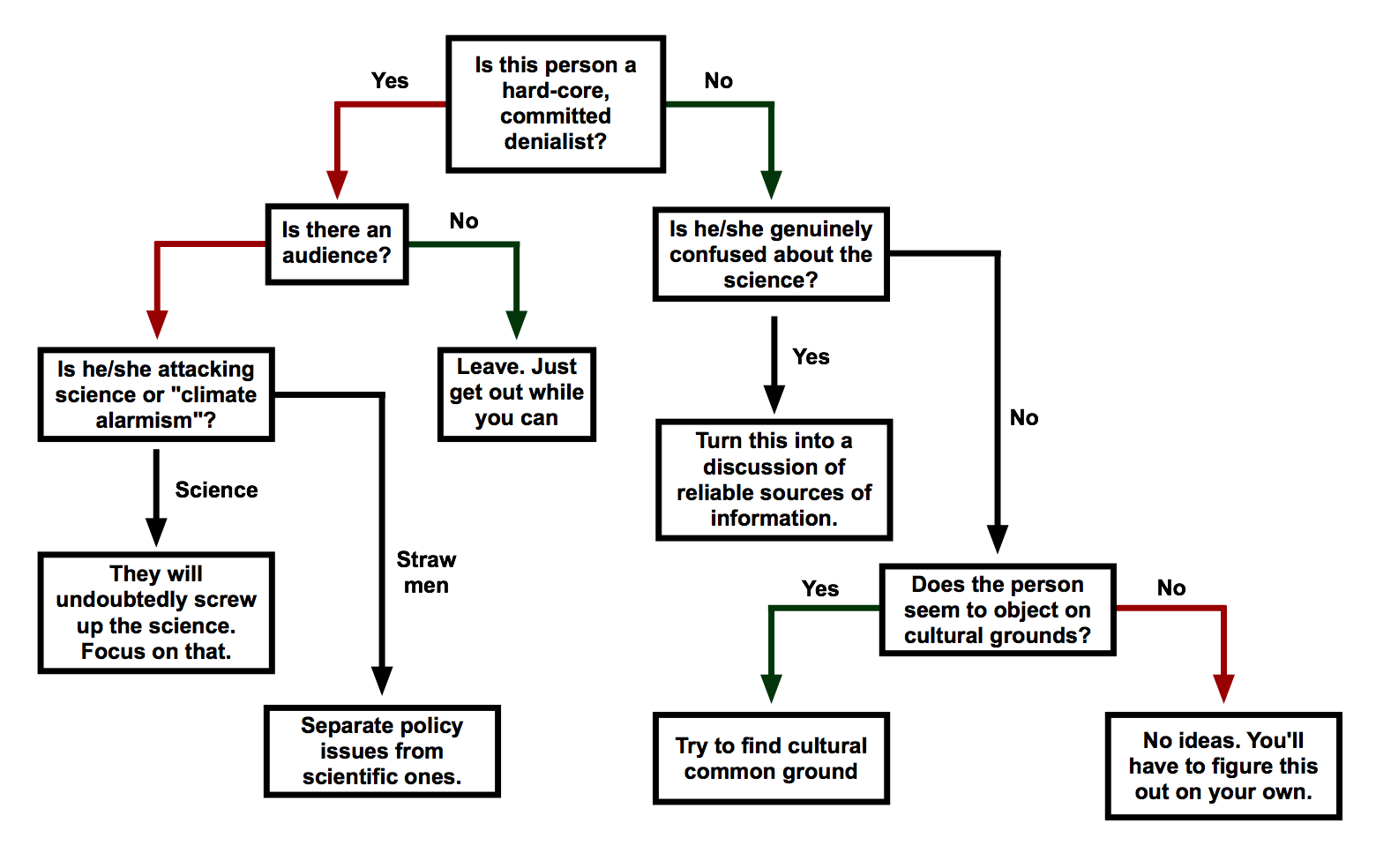
Someone asked how to deal with a denialist/skeptic on scientific topics. I think the process can be best explained using a flow chart.
The first question is whether you’re dealing with a fully committed denialist. You’re never going to get Peter Duesberg to admit HIV causes AIDS or someone from the Heartland Institute to accept that we’ve got over a century’s worth of science behind climate change. So if your first answer is “yes,” then you have to think about whether an audience is present or likely to ever see the conversation. If not, then there’s no point in engaging. You’re never going to get anywhere with the individual, and nobody is going to benefit from the time you will spend trying.
If an audience is present, then you have to be ready for the discussion to happen on the denialist’s terms. They’re going to nitpick every bit of evidence you have and throw out badly misinterpreted science faster than you can clarify it. Your opponent’s goal isn’t to help the audience to understand the science; it’s to make you look bad and, therefore, to make people less likely to accept what you understand.
Return the favor. They will say something absurd—it will either be something that’s wrong, or something with absurd consequences, or something that they don’t really understand. Latch on to that and don’t let it go. Force them to address it. Ken Miller, a biologist who’s involved in a lot of creationism/evolution debates, said his favorite tactic is to take some of the things that creationists say to their logical end. If creationists think that there was a global flood followed by an ice age, make them explain where the water came from, calculate where all the energy involved in freezing all that water went in a few hundred years—and then have them figure out where the energy that melted the ice came from.

 Loading comments...

