
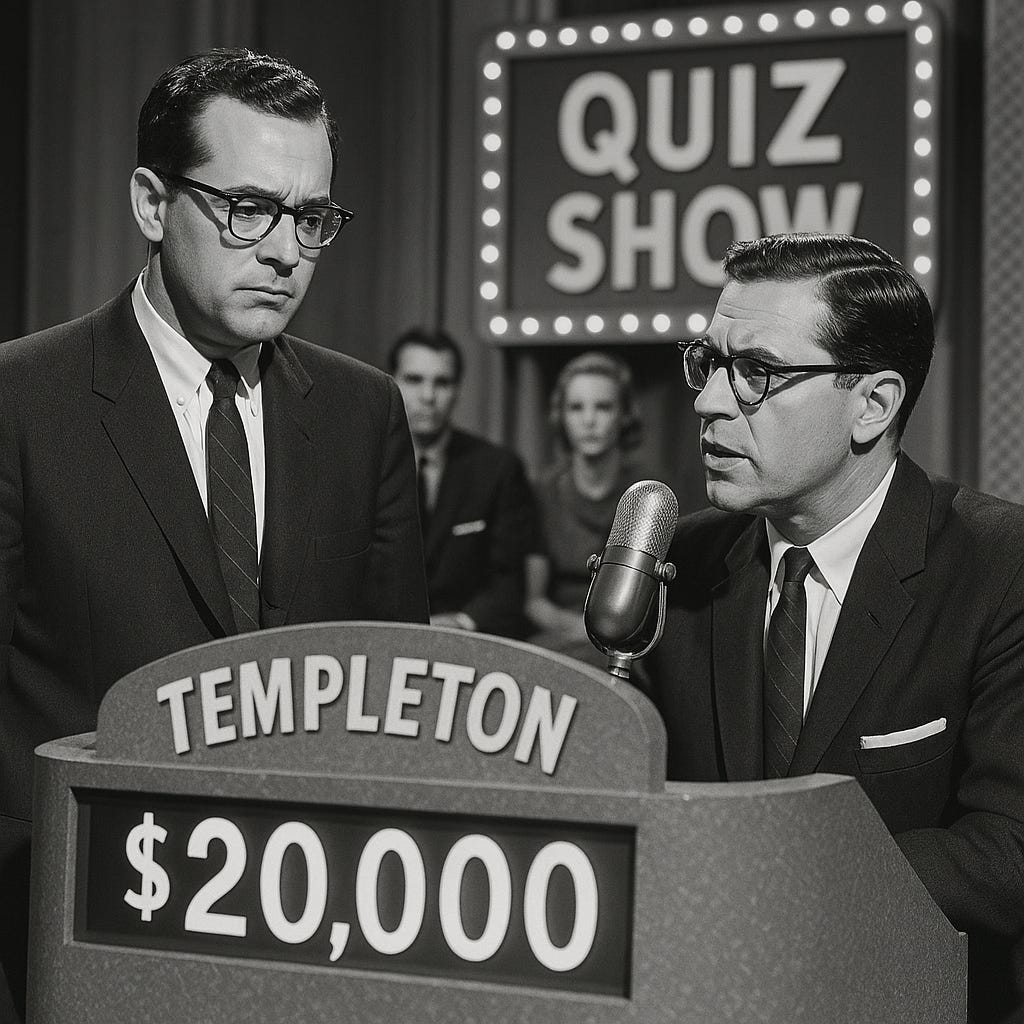
November 2, 1959, Washington, D.C.—Charles Van Doren, the golden boy of American television, stood before a packed congressional hearing room, his boyish charm replaced by a haunted pallor. For months, he had dodged subpoenas, fleeing to New England’s backroads as headlines screamed, “Where’s Charlie?” Now, under the glare of the House Subcommittee on Legislative Oversight, he confessed: “I was involved, deeply involved, in a deception.” The words cracked open a scandal that had simmered since 1958, exposing the rigged underbelly of TV quiz shows like Twenty-One and The $64,000 Question. To millions of viewers who had cheered Van Doren’s erudition, it was a gut punch—a betrayal that unraveled not just a game but a nation’s trust in its newest medium. This is the story of how ambition, greed, and a soundproof booth shattered America’s innocence.
In the 1950s, television was a miracle in every living room, a black-and-white portal to aspiration. Quiz shows, with their promise of life-changing prizes, were its crown jewels. The $64,000 Question, launched by CBS in 1955, drew 47 million viewers in weeks, turning cobblers like Gino Prato into folk heroes for knowing opera. Twenty-One on NBC pitted brains in isolation booths, offering $500 per point up to 21. These shows weren’t just entertainment; they were a patriotic flex, showcasing “the common man with uncommon knowledge” against Cold War fears of Soviet intellectual might. Sponsors like Revlon and Geritol poured millions into production, demanding drama to keep ratings high. Behind the scenes, producers like Dan Enright and Jack Barry saw contestants as pawns in a high-stakes script, where outcomes were choreographed to maximize suspense and profits.
Herbert Stempel, a bespectacled Bronx native with an IQ of 170, was one such pawn. In 1956, he stepped onto Twenty-One’s stage, coached to play the “average Joe.” Enright gave him answers, dictated his wardrobe—ill-fitting suits to sell humility—and even told him when to stutter for effect. Stempel won $49,500 over six weeks, but his rumpled charm didn’t fit Enright’s vision for a star. Enter Charles Van Doren, a Columbia University instructor from a literary dynasty, with cheekbones and erudition to spare. Enright saw in him a “bona fide egghead with sex appeal,” perfect for boosting Twenty-One’s cachet. Stempel was ordered to lose, instructed to flub a question he knew cold: the 1955 Best Picture Oscar winner, Marty, his favorite film. He answered On the Waterfront as told, tying Van Doren before losing in the next round. The stage was set for Van Doren’s meteoric rise.
Van Doren became a sensation, winning $129,000 and landing a $50,000-a-year NBC contract, a Time cover, and a spot on Today. But Stempel, cast aside, seethed. In 1958, he went public, accusing Twenty-One of rigging. His claims gained traction when Edward Hilgemeier, a standby contestant on Dotto, sent an affidavit to the FCC, alleging he’d found a notebook with answers scripted for contestant Marie Winn. Another Twenty-One player, James Snodgrass, mailed himself registered letters documenting coached responses, later testifying before Congress. These whistleblowers cracked the facade, revealing a pattern: producers fed answers to telegenic contestants, orchestrated ties for drama, and dumped “undesirables” to keep sponsors happy. By late 1958, Dotto was canceled, and quiz show ratings plummeted as public suspicion grew.
The scandal’s unraveling was messy. Manhattan District Attorney Joseph Stone, initially skeptical, launched a probe after Hilgemeier’s affidavit. A nine-month New York grand jury in 1959 heard from over 150 witnesses, including Van Doren, who denied wrongdoing, and Stempel, who detailed Enright’s manipulations. Contestants, fearing disgrace, perjured themselves; producers like Enright stonewalled to protect networks and sponsors. No indictments emerged, and the judge sealed the report—an unusual move that sparked cries of a cover-up. Public outrage, fueled by polls showing 87-95% awareness of the fraud, pushed Congress to act. In August 1959, Representative Oren Harris’s House Subcommittee began hearings, summoning Van Doren, Enright, and others. The nation watched, riveted, as the truth spilled out.
Van Doren’s November 2 confession was the scandal’s climax. “I have deceived my friends, and I had millions of them,” he told the committee, admitting he’d been coached to heighten drama and promote intellectualism. His fall was swift: NBC fired him, Columbia dropped him, and his family, led by Pulitzer-winning poet Mark Van Doren, grappled with shame. Stempel, vindicated, faded into obscurity, later working for New York’s transit system. Enright and Barry faced exile—Barry didn’t host again for a decade, and Enright fled to Canada. Yet no one went to jail. Rigging wasn’t illegal then, though perjury was; Van Doren and 17 others pleaded guilty to second-degree perjury, receiving suspended sentences. The lack of harsher punishment left many feeling justice was incomplete.
The scandal’s shockwaves reshaped television. CBS president Frank Stanton canceled Top Dollar, The Big Payoff, and Name That Tune in October 1959, citing the “impossibility of guarding against dishonest practice.” In 1960, Congress amended the Communications Act, making quiz show fixing a federal crime—a law that seems obvious now but was groundbreaking then. Networks distanced themselves from sponsors, reducing advertiser control over content. The fallout birthed Jeopardy! in 1964, its answer-first format a clever nod to the scandal, inspired by Merv Griffin’s wife, Julann, who quipped, “Why not give them the answers?” Public broadcasting also gained traction, with critics like Walter Lippmann pushing for a less commercial model, leading to PBS’s creation.
Culturally, the scandal was a gut check. In the 1950s, America trusted its institutions—government, media, business. Quiz shows, with their rags-to-riches narratives, embodied that faith. Their fraudulence, exposed amid Cold War paranoia about deception, felt like a personal betrayal. President Dwight Eisenhower called it “a terrible thing to do to the American people.” Consumer Reports questioned the FCC’s oversight, while Bob Hope joked about contestants facing one last question: “How do you plead?” Viewers, per a Miami Herald poll, were split—some wanted the shows back, shrugging, “Everything on TV is somewhat of a lie.” But the damage was done: television’s halo dimmed, and skepticism about media grew.
The human toll was stark. Van Doren retreated to rural Connecticut, later joining Encyclopaedia Britannica and writing books like A History of Knowledge. In a 2008 New Yorker essay, he wrestled with his infamy, saying, “The man who cheated on Twenty-One is still part of me.” Stempel, portrayed by John Turturro in Robert Redford’s 1994 film Quiz Show, died in 2020, proud of his whistleblowing but scarred by being labeled “the guy who destroyed Charles Van Doren.” Others, like psychologist Joyce Brothers, who won on The $64,000 Question, faced scrutiny but rebuilt careers. Producers like Enright later returned, launching The Joker’s Wild in the 1970s, their reputations partially restored.
Ethically, the scandal raises thorny questions. Contestants weren’t victims in the traditional sense—they profited, some handsomely. Yet many, like Van Doren, felt coerced by producers who framed rigging as “entertainment,” not fraud. Enright argued he was giving audiences what they wanted: drama, heroes, stakes. Networks claimed ignorance, with NBC’s president insisting they were “victims” too. But the real victim was the public, hoodwinked into believing in staged triumphs. Joseph Stone, in Prime Time and Misdemeanors, argued the true crime was the lie itself, not the money. Why did so many lie under oath? Fear of shame, loss of fame, or simple denial—a human instinct to cling to a crafted image.
Today, the scandal echoes in our media-saturated world. Reality TV thrives on manipulated narratives, from scripted “confessionals” to curated casts. Social media influencers stage authenticity for profit, blurring truth and performance. Misinformation spreads unchecked, eroding trust in digital platforms as quiz shows once dented faith in TV. Jeopardy! endures, its rigorous vetting a legacy of 1959’s lessons, but game shows remain a niche, overshadowed by streaming and viral content. The scandal’s warning—about ambition outpacing integrity—feels timeless. As Van Doren wrote, “It’s been hard to get away,” a reminder that deception, once exposed, leaves scars that linger.
Sixty-five years later, the quiz show scandal isn’t just a footnote. It’s a mirror, reflecting how we grapple with truth in an age of spectacle. From Van Doren’s booth to today’s screens, the temptation to script reality persists, challenging us to question what we see and whom we trust. In 1959, America learned a hard lesson: heroes can be made, and just as easily unmade, in the flicker of a cathode ray tube.


