
The Crisis of the Church and the Mystagogical Option
Dom Chautard, Saints Maximus and Dionysius on the Mystical Life and Christian Meditation

This is the third and final article in the series dedicated to the current crisis and possible solutions. The other two were, in order:
and
These articles are only sketches that need much more extensive and detailed development. Any comments and suggestions are welcome. Please share these posts and spread the word. Thank you!
The Holy Masters and the Path to Holiness
In 1907, the small work titled L’Apostolat des Catechismes et de la Vie Intérieure (“The Apostolate of Catechism and the Interior Life”) was published by the French Trappist monk, Jean-Baptiste Chautard (1858—1935). While the famous Institutions liturgiques (Liturgical Institutions) by the French Benedictine monk Prosper Louis Pascal Guéranger (1805—1875) represented the stronghold of liturgical theology, providentially raised to preserve the treasures of sacred rituals and sacraments, Father Chautard’s work, usually known as The Soul of the Apostolate,1 was perhaps the last great manual of Catholic spiritual theology.
Essentially, the work is built around the postulate of the absolute necessity of interior life based on the mystical presence of the Lord Jesus Christ in the souls of those dedicated to any form of apostolate. The supernatural life of divine grace, which is as vital for the soul as the existence of the soul itself is for the whole person, represents both the heart and the entire “circulatory system” meant to provide vital strength to Christians. This teaching is grounded in the Revelation transmitted to us by Saint John the Apostle, who teaches us in his Gospel that
God the Father does nothing except through His Son: All things were made through Him, and without Him nothing was made that was made (John 1: 3).
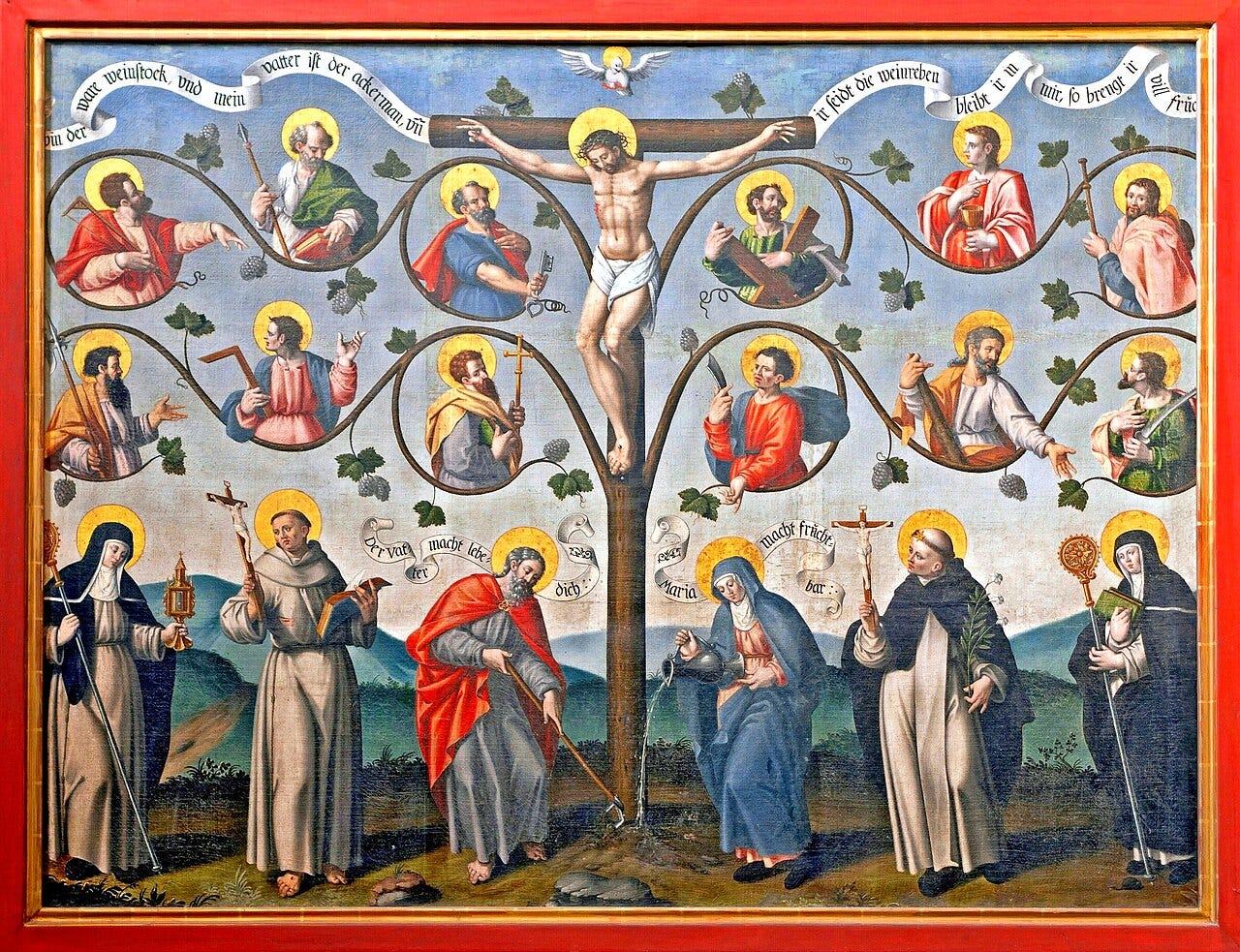
The proposed symbolic image is that of the vine stock, Jesus Christ, in which all the shoots—that is, baptized Christians—must be firmly rooted to partake in the supernatural life of grace, in order to transmit it to others. The small treatise The Soul of the Apostolate details the ways in which divine grace can be increased in the souls of Christians.
Here, we can recall the warning of Saint Bonaventure, that the one who primarily relies on his own intellect, on his own “natural light of reason” in the development of a philosophy, may lose sight of the fact that understanding the sacred mysteries of the Church cannot be solely grounded in our reason, which after all is deeply affected by the consequences of original sin. If we include in the discussion the definition of faith proposed by Saint Thomas Aquinas, who teaches us that faith “is an act of the intellect adhering to the Divine truth at the command of the will moved by the grace of God” (Summa Theologiae, II-II, q.2, 9), we realize that, in fact, we do not rely decisively on our own intellect but on the divine Intellect. The mind of the true Christian is subordinated to the mind of God. Consequently, we ought to rely not on our own intellect, but on God’s intellect. This subordination alone can grant us the grace of understanding the supernatural world, as well as an understanding of the natural world different from that of the modern sciences.
To grow in holiness and knowledge is to become mature and become fully human—“in the image and likeness of God” (Genesis 1: 26-27). The Saint Apostle Paul refers to this maturation process when he admonishes the Christians in Corinth that they have not advanced in their understanding of divine matters. Such an understanding requires patient pedagogical efforts to be transformed from “children” into perfect “men,” capable of being nourished with the “substantial food” of Holy Scripture. Such spiritual growth requires a pedagogy different from anything we can conceive without the guidance of the Holy Spirit. For He is—as demonstrated by Saints Augustine and Thomas Aquinas in their works titled De Magistro—the “inner teacher” who guides us according to the Savior’s promise, who says that
the Paraclete, the Holy Ghost (…) will teach you all things, and bring all things to your mind, whatsoever I shall have said to you (John 14: 26).
What exactly this pedagogical program of the Christian community looks like in practice, we know from Saint Dionysius the Areopagite’s work, On the Ecclesiastical Hierarchy.
The Classical Formation of Christians
First of all, before receiving Holy Baptism (which at that time, in most cases, was conferred mostly to adults), those who showed a serious intention to become Christians were encouraged to lead a virtuous life by observing the Ten Commandments. At the same time, fundamental catechesis began, in which the Catechumens were taught the Credo and provided with simple and clear explanations of the foundations of the Christian faith. In this period, catechesis could last up to three or even four years. Only after being “illuminated” through the sacrament of Baptism, did Christians receive the type of formation that has almost completely disappeared from religious practice today: mystagogical catechesis. Here, we have reached the first decisive point of any potential project for the recovery of the normative Christian mystical life.
Mystagogical catechesis involves initiation into the symbolic language of the biblical texts, then that of the sacraments and rituals of the Church, as well as those of the created cosmos itself. This type of initiation primarily focuses on the symbols in the sacraments of Baptism, Confirmation, and Holy Communion. Of course, the other sacraments can also be explained in the same manner.
Essentially, there are two axes of mystagogical formation for those who are already baptized. The first is the allegorical axis, in which the meaning of certain episodes from the Old Testament that find fulfillment in the New Testament and are found in the Christian Sacraments is explained. For example, the passage of the Jewish people guided by Moses through the miraculous division of the Red Sea, allegorically symbolizes the baptism of those who are saved, pursued by the armies of darkness that will ultimately meet their end in the unleashed waters. Similarly, those saved from the flood on Noah’s Ark allegorically symbolize all the Christians who are saved through the Church from the deluge that engulfs a world steeped in sin. The second axis of mystagogical formation involves the mystical interpretation and depiction of the effects of the holy Sacraments.
For example, the blessed baptismal water symbolizes the water at the beginning of creation over which the Holy Spirit soared (Genesis 1: 2). This interpretation, carefully meditated upon, reveals that all the baptized, in a mysterious yet no less true manner, are re-created (re-born) in a moral and even ontological condition that, from the perspective of purity, is similar to the “original justice/righteousness” in which Adam and Eve were before committing the original sin. This is clearly taught by the Council of Trent in the Fifth Session when it affirms that
in those who are born again, God hates nothing, because ‘there is no condemnation, to those who are truly buried together with Christ by baptism unto death’ (Romans 8: 1), who do not ‘walk according to the flesh’ (Romans 8: 1), but putting off ‘the old man’ and putting on the ‘new, who is created according to God’ (Ephesians 4: 22 ff.; Colossians 3: 9 ff.), are made innocent, immaculate, pure, guiltless and beloved sons of God, ‘heirs indeed of God, but co-heirs with Christ’ (Romans 8: 17), so that there is nothing whatever to retard their entrance into heaven (Denzinger, 792).
Keep reading with a 7-day free trial
Subscribe to Kmita’s Library to keep reading this post and get 7 days of free access to the full post archives.

