Understanding CLOs And The Makeup Of Their Distributions

Jul. 24, 2019 8:13 PM ETECC, OXLC
Alpha Male
522 Followers

Summary

  • Closed-end funds like ECC and OXLC are holding CLOs that pay big distributions, not necessarily all from income.
  • CLO investors must learn to read the financial statements given to them by management.
  • Do investors care about NAV decay, or do they just like the mailbox money?

With a recent uptick in popularity of Eagle Point Credit Company (ECC) and Oxford Lane Capital Corp. (OXLC), there’s an influx of new investors and coverage of these two closed-end funds. Due to the nature of the complex investments held within these funds (primarily the equity tranches of CLOs), there seems to be a lot of misconceptions regarding a few key elements, mainly distribution coverage. In this article we’ll try to breakdown the CLO structures a bit and highlight the easy ways for the average investor to see the key information within these funds’ annual and semi-annual reports.

Before diving into the details, a brief background on my experience includes over 10 years as a CPA working in middle office and back office roles in private equity and later, at a large debt firm that is also a CLO manager.

Cash Flows within a CLO structure

I'm using several excerpts from S&P Global and Ares Management Corp primers on CLOs; these types of educational materials are abundant on the web so if you're curious to learn more I'd definitely recommend doing an internet search of your own and looking through as many of these as you can. An overview of an example CLO structure is shown below, where you can see the underlying loan pool on the left side, the securities the CLO issues to investors on the right, with the CLO Manager (or "Loan Manager") at the top overseeing the structure.
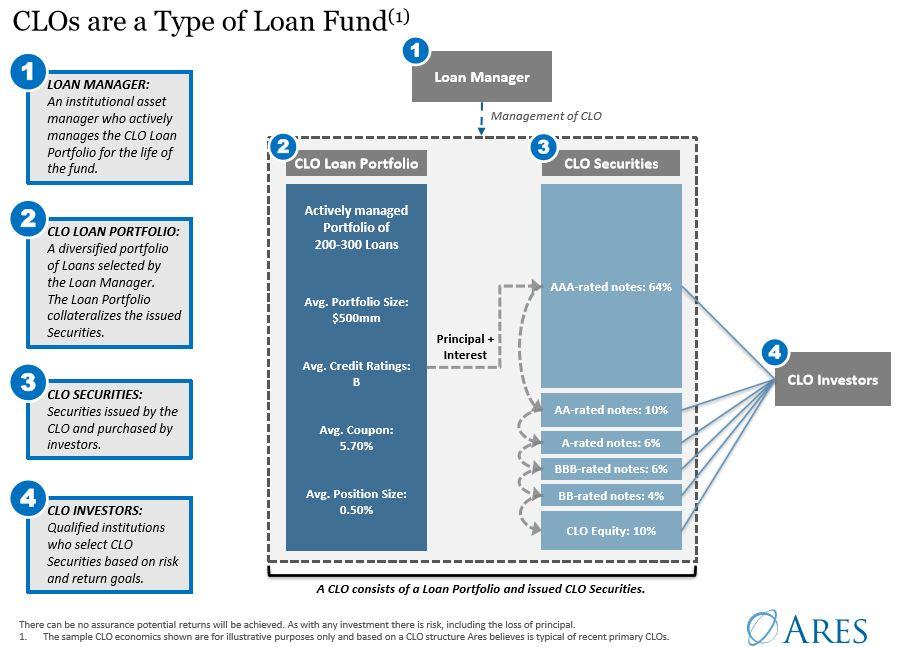
Source: Ares Management Co - CLO Primer

The next image shows a similar picture but adds details about the typical spread the underlying pool of bank loans earns, the layer of expenses that are subtracted from that, and what rates of interest each tranche of the CLO pays with the remaining cash flows. It also shows how much that could equate

This article was written by

522 Followers
My professional experience includes over 15 years as a CPA working in middle office and back office roles in private equity and later, at a large CLO manager. I have had in-depth exposure to the day-to-day workings of closed-end funds (CEFs) and exchange traded funds (ETFs), both on the operations and the financial reporting side, as well as the inner-workings of 1.0 and 2.0 CLOs.

Analyst’s Disclosure:I am/we are long OXLC, ECC. I wrote this article myself, and it expresses my own opinions. I am not receiving compensation for it (other than from Seeking Alpha). I have no business relationship with any company whose stock is mentioned in this article.

Seeking Alpha's Disclosure: Past performance is no guarantee of future results. No recommendation or advice is being given as to whether any investment is suitable for a particular investor. Any views or opinions expressed above may not reflect those of Seeking Alpha as a whole. Seeking Alpha is not a licensed securities dealer, broker or US investment adviser or investment bank. Our analysts are third party authors that include both professional investors and individual investors who may not be licensed or certified by any institute or regulatory body.

To ensure this doesn’t happen in the future, please enable Javascript and cookies in your browser.
Is this happening to you frequently? Please report it on our feedback forum.
If you have an ad-blocker enabled you may be blocked from proceeding. Please disable your ad-blocker and refresh.
Reference ID: f03bfdc0-a9ba-11f0-9650-87b32271641d