
1
Sorghastrum nutans (Indian Grass)
Sorghastrum nutans (Indian Grass) is a North American prairie grass. A vigorous native warm-season grass with rich gold-and-purple sprays of flowers that seeds in the fall. It grows in clumps, and attracts butterflies, songbirds and mammals, and provides nesting material. It provides pollen for bees. It is a larval host for the Pepper-and-Salt Skipper butterfly. It is drought tolerant and offers benefits of erosion control.
Scientific Name: Sorghastrum nutans
Common Name: Indian Grass
Function: Structural grass
Seasonal Interest: deciduous, upright form, seedheads, fall color
Height (ft): 3-5
Width (ft): 1-2
Exposure: Full sun
Soil Moisture: dry-avg
Provenance: Overhill Gardens
2
Panicum virgatum (Switch Grass)
Panicum virgatum (Switch grass) is generally noted for its stiff, columnar form, which typically grows to 3' tall, and typically retains its vertical shape throughout the growing season. When in flower, the panicles may bring total plant height to 6'. Switch grass is a warm-season grass with deep, fibrous roots, making it an outstanding plant for erosion control and soil stabilization. It features medium green leaves which turn yellow (sometimes with orange tints) in autumn, fading to tan-beige in winter. Foliage clump is topped in mid-summer by finely-textured, pink-tinged, branched flower panicles which hover over the foliage like an airy cloud. Panicles turn beige as the seeds mature in fall with the seed plumes persisting well into winter. It provides cover and nesting material for birds, and seeds are a food source for birds in winter. This is an essential larval host for most banded skippers and most of the satyrs. Grows primarily in clumps, but may flop in overly rich soils. It might slowly spread by slightly creeping rhizomes. Generally performs best in full sun. Cut back clumps to the ground in late winter to early spring. Plants may self-seed in optimum growing conditions, but cultivars may not come true from seed.
Scientific Name: Panicum virgatum
Common Name: Switch Grass
Function: Structural grass
Seasonal Interest: deciduous, upright form, seedheads
Height (ft): 3-6
Width (ft): 2-3
Exposure: Full - part sun
Provenance: NorthCreek Nurseries
3
Panicum virgatum (Switch Grass)

Panicum virgatum (Switch grass) is generally noted for its stiff, columnar form, which typically grows to 3' tall, and typically retains its vertical shape throughout the growing season. When in flower, the panicles may bring total plant height to 6'. Switch grass is a warm-season grass with deep, fibrous roots, making it an outstanding plant for erosion control and soil stabilization. It features medium green leaves which turn yellow (sometimes with orange tints) in autumn, fading to tan-beige in winter. Foliage clump is topped in mid-summer by finely-textured, pink-tinged, branched flower panicles which hover over the foliage like an airy cloud. Panicles turn beige as the seeds mature in fall with the seed plumes persisting well into winter. It provides cover and nesting material for birds, and seeds are a food source for birds in winter. This is an essential larval host for most banded skippers and most of the satyrs. Grows primarily in clumps, but may flop in overly rich soils. It might slowly spread by slightly creeping rhizomes. Generally performs best in full sun. Cut back clumps to the ground in late winter to early spring. Plants may self-seed in optimum growing conditions, but cultivars may not come true from seed.
Scientific Name: Panicum virgatum
Common Name: Switch Grass
Function: Structural grass
Seasonal Interest: deciduous, upright form, seedheads
Height (ft): 3-6
Width (ft): 2-3
Exposure: Full - part sun
Provenance: NorthCreek Nurseries
4
Carex pensylvanica (Pennsylvania Sedge)
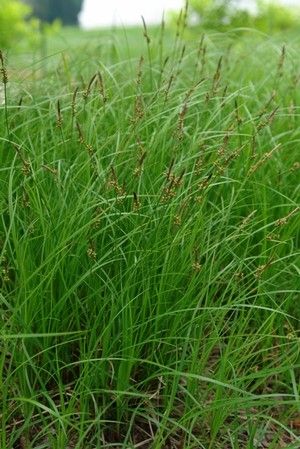
Carex pensylvanica (Pennsylvania Sedge) is a shade-loving perennial sedge that is native to thickets and dry woodland areas. Most sedges prefer moist to wet soils, but not this one. Spreads by rhizomes. This native is an excellent groundcover or lawn substitute for the shade garden. Foliage is fine textured and bright green, and the fountaining habit gives this sedge a soft appearance that is lovely. The plants provide erosion control and winter interest, and are deer resistant. Carex pensylvanica is a great native substitute for the popular Asian groundcovers Liriope muscari and Ophiopogon japonicus.
Scientific Name: Carex pensylvanica
Common Name: Pennsylvania Sedge
Function: Groundcover Layer-grassy
Seasonal Interest: Ground Cover, Naturalize, Rain Garden
Height (ft): 0.5-1
Width (ft): 0.5-1
Exposure: Part-full shade
Soil Moisture: dry-avg
Bloom Period: May
Bloom Color: Greenish
Provenance: Overhill Gardens
5
Schizachyrium scoparium var. scoparium (Common Little
Bluestem)

Schizachyrium scoparium var. scoparium (Common Little
Bluestem) is an herbaceous perennial in the Grass family (Poaceae). Common Little Bluestem occurs in prairies, in pastures, in open pine forests, and in woodland openings. Leaves are linear and usually glabrous. The leaf sheath is glabrous and keeled. Flowers are produced in pairs of spikelets arranged in a raceme. The spikelets are pubescent with long hairs. One spikelet of the pair is sessile, the other pedicellate. Sessile spikelets have 2 florets and the glumes exceed the florets in length. The upper floret is fertile and has 3 anthers. The lower floret is sterile and often consists of just a lemma. The lemmas have long twisted awns. The pedicellate spikelets lack a lemma. Pedicellate spikelets have one floret that is ether sterile or staminate. Pedicellate spikelets lack awns or have very short, straight awns. A clump bunchgrass with fine-textured foliage that forms very dense mounds 18-24 inches tall with a fibrous root system. Slender blue-green stems reach 3 feet by September and become radiant mahogany-red with white, shining seed tufts in the fall. Color remains nearly all winter. This mid-prairie species gets its name from the bluish color of the stem bases in the spring, but most striking is the plants reddish-tan color in fall, persisting through winter snows. The seeds, fuzzy white at maturity, are of particular value to small birds in winter. It was once a major component of prairie grasslands and of the Longleaf Pine/Wiregrass community. Common Little Bluestem is It is also available as seed and is recommended for a “filler” in wildflower meadows and prairie restoration projects. Common Little Bluestem tolerates a wide variety of soil and moisture types but does require full sun.
Scientific Name: Schizachyrium scoparium var. scoparium
Common Name: Common Little Bluestem
Function: Groundcover layer, nesting materials, pollution filter, drought and erosion tolerant
Seasonal Interest: Seasonal theme, showy flower, fall color
Height (ft): 2-4
Width (ft): 1-2
Exposure: Full sun
Soil Moisture: dry-avg
Bloom Period: Aug-Oct
Bloom Color: Purplish bronze
Provenance: NorthCreek Nurseries
6
Eragrostis spectabilis (Purple lovegrass)

Eragrostis spectabilis (Purple lovegrass) is a perennial, warm season grass that grows somewhat randomly in 10” clumps in the poorest of soils in full sun. The seed heads (or florets) bloom mid-summer in shades of light to bright purple, giving an overall purple haze to the landscape. The light green foliage turns a stunning bronze-red in autumn. This tough ornamental grass is a stunning addition to any rock garden or drier landscape, and is attractive throughout the growing season. This plant grows rhizomously and can spread and will reseed if seeds are allowed to ripen.
Scientific Name: Eragrostis spectabilis
Common Name: Purple Lovegrass
Function: Groundcover Layer
Seasonal Interest: Naturalize,Showy, Good Cut flower, drought tolerant
Height (ft): 1-2
Width (ft): 1-2
Exposure: Full sun
Soil Moisture: dry-avg
Bloom Period: July-August
Bloom Color: reddish-purple
Provenance: Overhill Gardens
7
Sorghastrum nutans (Indian Grass)

Sorghastrum nutans (Indian Grass) is a North American prairie grass. A vigorous native warm-season grass with rich gold-and-purple sprays of flowers that seeds in the fall. It grows in clumps, and attracts butterflies, songbirds and mammals, and provides nesting material. It provides pollen for bees. It is a larval host for the Pepper-and-Salt Skipper butterfly. It is drought tolerant and offers benefits of erosion control.
Scientific Name: Sorghastrum nutans
Common Name: Indian Grass
Function: Structural grass
Seasonal Interest: deciduous, upright form, seedheads, fall color
Height (ft): 3-5
Width (ft): 1-2
Exposure: Full sun
Soil Moisture: dry-avg
Provenance: Overhill Gardens
8
Schizachyrium scoparium var. scoparium (Common Little Bluestem)

Schizachyrium scoparium var. scoparium (Common Little Bluestem) is an herbaceous perennial in the Grass family (Poaceae). Common Little Bluestem occurs in prairies, in pastures, in open pine forests, and in woodland openings. Leaves are linear and usually glabrous. The leaf sheath is glabrous and keeled. Flowers are produced in pairs of spikelets arranged in a raceme. The spikelets are pubescent with long hairs. One spikelet of the pair is sessile, the other pedicellate. Sessile spikelets have 2 florets and the glumes exceed the florets in length. The upper floret is fertile and has 3 anthers. The lower floret is sterile and often consists of just a lemma. The lemmas have long twisted awns. The pedicellate spikelets lack a lemma. Pedicellate spikelets have one floret that is ether sterile or staminate. Pedicellate spikelets lack awns or have very short, straight awns. A clump bunchgrass with fine-textured foliage that forms very dense mounds 18-24 inches tall with a fibrous root system. Slender blue-green stems reach 3 feet by September and become radiant mahogany-red with white, shining seed tufts in the fall. Color remains nearly all winter. This mid-prairie species gets its name from the bluish color of the stem bases in the spring, but most striking is the plants reddish-tan color in fall, persisting through winter snows. The seeds, fuzzy white at maturity, are of particular value to small birds in winter. It was once a major component of prairie grasslands and of the Longleaf Pine/Wiregrass community. Common Little Bluestem is It is also available as seed and is recommended for a “filler” in wildflower meadows and prairie restoration projects. Common Little Bluestem tolerates a wide variety of soil and moisture types but does require full sun.
Scientific Name: Schizachyrium scoparium var. scoparium
Common Name: Common Little Bluestem
Function: Groundcover layer, nesting materials, pollution filter, drought and erosion tolerant
Seasonal Interest: Seasonal theme, showy flower, fall color
Height (ft): 2-4
Width (ft): 1-2
Exposure: Full sun
Soil Moisture: dry-avg
Bloom Period: Aug-Oct
Bloom Color: Purplish bronze
Provenance: NorthCreek Nurseries
9
Eragrostis spectabilis (Purple lovegrass)

Eragrostis spectabilis (Purple lovegrass) is a perennial, warm season grass that grows somewhat randomly in 10” clumps in the poorest of soils in full sun. The seed heads (or florets) bloom mid-summer in shades of light to bright purple, giving an overall purple haze to the landscape. The light green foliage turns a stunning bronze-red in autumn. This tough ornamental grass is a stunning addition to any rock garden or drier landscape, and is attractive throughout the growing season. This plant grows rhizomously and can spread and will reseed if seeds are allowed to ripen.
Scientific Name: Eragrostis spectabilis
Common Name: Purple Lovegrass
Function: Groundcover Layer
Seasonal Interest: Naturalize,Showy, Good Cut flower, drought tolerant
Height (ft): 1-2
Width (ft): 1-2
Exposure: Full sun
Soil Moisture: dry-avg
Bloom Period: July-August
Bloom Color: reddish-purple
Provenance: Overhill Gardens
10
Panicum virgatum (Switch Grass)

Panicum virgatum (Switch grass) is generally noted for its stiff, columnar form, which typically grows to 3' tall, and typically retains its vertical shape throughout the growing season. When in flower, the panicles may bring total plant height to 6'. Switch grass is a warm-season grass with deep, fibrous roots, making it an outstanding plant for erosion control and soil stabilization. It features medium green leaves which turn yellow (sometimes with orange tints) in autumn, fading to tan-beige in winter. Foliage clump is topped in mid-summer by finely-textured, pink-tinged, branched flower panicles which hover over the foliage like an airy cloud. Panicles turn beige as the seeds mature in fall with the seed plumes persisting well into winter. It provides cover and nesting material for birds, and seeds are a food source for birds in winter. This is an essential larval host for most banded skippers and most of the satyrs. Grows primarily in clumps, but may flop in overly rich soils. It might slowly spread by slightly creeping rhizomes. Generally performs best in full sun. Cut back clumps to the ground in late winter to early spring. Plants may self-seed in optimum growing conditions, but cultivars may not come true from seed.
Scientific Name: Panicum virgatum
Common Name: Switch Grass
Function: Structural grass
Seasonal Interest: deciduous, upright form, seedheads
Height (ft): 3-6
Width (ft): 2-3
Exposure: Full - part sun
Provenance: NorthCreek Nurseries
11
Sporobolus heterolepis (Prairie Dropseed)

Sporobolus heterolepis (Prairie Dropseed) is a tufted perennial grass with narrow fine textured leaves. Plants hold soil with their vigorous fibrous roots and expand slowly from short underground rhizomes. The fall color is a wonderful orange, changing to cream in winter. It is extremely tolerant of dry sites, and has a wonderful flowery fragrance when planted in mass. The seeds are relished by sparrows, juncos and other seed-eating songbirds. Sporobolis is from Greek words meaning "seed", and "throw" and refers to the dispersion of seeds. They grow 24” high with an 18” spread.
Scientific Name: Sporobolus heterolepis
Common Name: Prairie Dropseed
Function: Groundcover Layer - grass
Seasonal Interest: Ground Cover, naturalize, bird attractant, showy, winter interest
Height (ft): 2-3
Width (ft): 2-3
Exposure: Full sun
Soil Moisture: dry-avg
Bloom Period: Aug-Oct
Bloom Color: Pink/brown-tinted
Provenance: Overhill Gardens
12
Schizachyrium scoparium var. scoparium (Common Little
Bluestem)

Schizachyrium scoparium var. scoparium (Common Little
Bluestem) is an herbaceous perennial in the Grass family (Poaceae). Common Little Bluestem occurs in prairies, in pastures, in open pine forests, and in woodland openings. Leaves are linear and usually glabrous. The leaf sheath is glabrous and keeled. Flowers are produced in pairs of spikelets arranged in a raceme. The spikelets are pubescent with long hairs. One spikelet of the pair is sessile, the other pedicellate. Sessile spikelets have 2 florets and the glumes exceed the florets in length. The upper floret is fertile and has 3 anthers. The lower floret is sterile and often consists of just a lemma. The lemmas have long twisted awns. The pedicellate spikelets lack a lemma. Pedicellate spikelets have one floret that is ether sterile or staminate. Pedicellate spikelets lack awns or have very short, straight awns. A clump bunchgrass with fine-textured foliage that forms very dense mounds 18-24 inches tall with a fibrous root system. Slender blue-green stems reach 3 feet by September and become radiant mahogany-red with white, shining seed tufts in the fall. Color remains nearly all winter. This mid-prairie species gets its name from the bluish color of the stem bases in the spring, but most striking is the plants reddish-tan color in fall, persisting through winter snows. The seeds, fuzzy white at maturity, are of particular value to small birds in winter. It was once a major component of prairie grasslands and of the Longleaf Pine/Wiregrass community. Common Little Bluestem is It is also available as seed and is recommended for a “filler” in wildflower meadows and prairie restoration projects. Common Little Bluestem tolerates a wide variety of soil and moisture types but does require full sun.
Scientific Name: Schizachyrium scoparium var. scoparium
Common Name: Common Little Bluestem
Function: Groundcover layer, nesting materials, pollution filter, drought and erosion tolerant
Seasonal Interest: Seasonal theme, showy flower, fall color
Height (ft): 2-4
Width (ft): 1-2
Exposure: Full sun
Soil Moisture: dry-avg
Bloom Period: Aug-Oct
Bloom Color: Purplish bronze
Provenance: NorthCreek Nurseries
13
Panicum virgatum (Switch Grass)

Panicum virgatum (Switch grass) is generally noted for its stiff, columnar form, which typically grows to 3' tall, and typically retains its vertical shape throughout the growing season. When in flower, the panicles may bring total plant height to 6'. Switch grass is a warm-season grass with deep, fibrous roots, making it an outstanding plant for erosion control and soil stabilization. It features medium green leaves which turn yellow (sometimes with orange tints) in autumn, fading to tan-beige in winter. Foliage clump is topped in mid-summer by finely-textured, pink-tinged, branched flower panicles which hover over the foliage like an airy cloud. Panicles turn beige as the seeds mature in fall with the seed plumes persisting well into winter. It provides cover and nesting material for birds, and seeds are a food source for birds in winter. This is an essential larval host for most banded skippers and most of the satyrs. Grows primarily in clumps, but may flop in overly rich soils. It might slowly spread by slightly creeping rhizomes. Generally performs best in full sun. Cut back clumps to the ground in late winter to early spring. Plants may self-seed in optimum growing conditions, but cultivars may not come true from seed.
Scientific Name: Panicum virgatum
Common Name: Switch Grass
Function: Structural grass
Seasonal Interest: deciduous, upright form, seedheads
Height (ft): 3-6
Width (ft): 2-3
Exposure: Full - part sun
Provenance: NorthCreek Nurseries
14
Schizachyrium scoparium var. scoparium (Common Little Bluestem)

Schizachyrium scoparium var. scoparium (Common Little Bluestem) is an herbaceous perennial in the Grass family (Poaceae). Common Little Bluestem occurs in prairies, in pastures, in open pine forests, and in woodland openings. Leaves are linear and usually glabrous. The leaf sheath is glabrous and keeled. Flowers are produced in pairs of spikelets arranged in a raceme. The spikelets are pubescent with long hairs. One spikelet of the pair is sessile, the other pedicellate. Sessile spikelets have 2 florets and the glumes exceed the florets in length. The upper floret is fertile and has 3 anthers. The lower floret is sterile and often consists of just a lemma. The lemmas have long twisted awns. The pedicellate spikelets lack a lemma. Pedicellate spikelets have one floret that is ether sterile or staminate. Pedicellate spikelets lack awns or have very short, straight awns. A clump bunchgrass with fine-textured foliage that forms very dense mounds 18-24 inches tall with a fibrous root system. Slender blue-green stems reach 3 feet by September and become radiant mahogany-red with white, shining seed tufts in the fall. Color remains nearly all winter. This mid-prairie species gets its name from the bluish color of the stem bases in the spring, but most striking is the plants reddish-tan color in fall, persisting through winter snows. The seeds, fuzzy white at maturity, are of particular value to small birds in winter. It was once a major component of prairie grasslands and of the Longleaf Pine/Wiregrass community. Common Little Bluestem is It is also available as seed and is recommended for a “filler” in wildflower meadows and prairie restoration projects. Common Little Bluestem tolerates a wide variety of soil and moisture types but does require full sun.
Scientific Name: Schizachyrium scoparium var. scoparium
Common Name: Common Little Bluestem
Function: Groundcover layer, nesting materials, pollution filter, drought and erosion tolerant
Seasonal Interest: Seasonal theme, showy flower, fall color
Height (ft): 2-4
Width (ft): 1-2
Exposure: Full sun
Soil Moisture: dry-avg
Bloom Period: Aug-Oct
Bloom Color: Purplish bronze
Provenance: NorthCreek Nurseries
15
Schizachyrium scoparium var. scoparium (Common Little Bluestem)

Schizachyrium scoparium var. scoparium (Common Little Bluestem) is an herbaceous perennial in the Grass family (Poaceae). Common Little Bluestem occurs in prairies, in pastures, in open pine forests, and in woodland openings. Leaves are linear and usually glabrous. The leaf sheath is glabrous and keeled. Flowers are produced in pairs of spikelets arranged in a raceme. The spikelets are pubescent with long hairs. One spikelet of the pair is sessile, the other pedicellate. Sessile spikelets have 2 florets and the glumes exceed the florets in length. The upper floret is fertile and has 3 anthers. The lower floret is sterile and often consists of just a lemma. The lemmas have long twisted awns. The pedicellate spikelets lack a lemma. Pedicellate spikelets have one floret that is ether sterile or staminate. Pedicellate spikelets lack awns or have very short, straight awns. A clump bunchgrass with fine-textured foliage that forms very dense mounds 18-24 inches tall with a fibrous root system. Slender blue-green stems reach 3 feet by September and become radiant mahogany-red with white, shining seed tufts in the fall. Color remains nearly all winter. This mid-prairie species gets its name from the bluish color of the stem bases in the spring, but most striking is the plants reddish-tan color in fall, persisting through winter snows. The seeds, fuzzy white at maturity, are of particular value to small birds in winter. It was once a major component of prairie grasslands and of the Longleaf Pine/Wiregrass community. Common Little Bluestem is It is also available as seed and is recommended for a “filler” in wildflower meadows and prairie restoration projects. Common Little Bluestem tolerates a wide variety of soil and moisture types but does require full sun.
Scientific Name: Schizachyrium scoparium var. scoparium
Common Name: Common Little Bluestem
Function: Groundcover layer, nesting materials, pollution filter, drought and erosion tolerant
Seasonal Interest: Seasonal theme, showy flower, fall color
Height (ft): 2-4
Width (ft): 1-2
Exposure: Full sun
Soil Moisture: dry-avg
Bloom Period: Aug-Oct
Bloom Color: Purplish bronze
Provenance: NorthCreek Nurseries
16
Panicum virgatum (Switch Grass)

Panicum virgatum (Switch grass) is generally noted for its stiff, columnar form, which typically grows to 3' tall, and typically retains its vertical shape throughout the growing season. When in flower, the panicles may bring total plant height to 6'. Switch grass is a warm-season grass with deep, fibrous roots, making it an outstanding plant for erosion control and soil stabilization. It features medium green leaves which turn yellow (sometimes with orange tints) in autumn, fading to tan-beige in winter. Foliage clump is topped in mid-summer by finely-textured, pink-tinged, branched flower panicles which hover over the foliage like an airy cloud. Panicles turn beige as the seeds mature in fall with the seed plumes persisting well into winter. It provides cover and nesting material for birds, and seeds are a food source for birds in winter. This is an essential larval host for most banded skippers and most of the satyrs. Grows primarily in clumps, but may flop in overly rich soils. It might slowly spread by slightly creeping rhizomes. Generally performs best in full sun. Cut back clumps to the ground in late winter to early spring. Plants may self-seed in optimum growing conditions, but cultivars may not come true from seed.
Scientific Name: Panicum virgatum
Common Name: Switch Grass
Function: Structural grass
Seasonal Interest: deciduous, upright form, seedheads
Height (ft): 3-6
Width (ft): 2-3
Exposure: Full - part sun
Provenance: NorthCreek Nurseries
17
Panicum virgatum (Switch Grass)

Panicum virgatum (Switch grass) is generally noted for its stiff, columnar form, which typically grows to 3' tall, and typically retains its vertical shape throughout the growing season. When in flower, the panicles may bring total plant height to 6'. Switch grass is a warm-season grass with deep, fibrous roots, making it an outstanding plant for erosion control and soil stabilization. It features medium green leaves which turn yellow (sometimes with orange tints) in autumn, fading to tan-beige in winter. Foliage clump is topped in mid-summer by finely-textured, pink-tinged, branched flower panicles which hover over the foliage like an airy cloud. Panicles turn beige as the seeds mature in fall with the seed plumes persisting well into winter. It provides cover and nesting material for birds, and seeds are a food source for birds in winter. This is an essential larval host for most banded skippers and most of the satyrs. Grows primarily in clumps, but may flop in overly rich soils. It might slowly spread by slightly creeping rhizomes. Generally performs best in full sun. Cut back clumps to the ground in late winter to early spring. Plants may self-seed in optimum growing conditions, but cultivars may not come true from seed.
Scientific Name: Panicum virgatum
Common Name: Switch Grass
Function: Structural grass
Seasonal Interest: deciduous, upright form, seedheads
Height (ft): 3-6
Width (ft): 2-3
Exposure: Full - part sun
Provenance: NorthCreek Nurseries
18
Schizachyrium scoparium var. scoparium (Common Little Bluestem)

Schizachyrium scoparium var. scoparium (Common Little Bluestem) is an herbaceous perennial in the Grass family (Poaceae). Common Little Bluestem occurs in prairies, in pastures, in open pine forests, and in woodland openings. Leaves are linear and usually glabrous. The leaf sheath is glabrous and keeled. Flowers are produced in pairs of spikelets arranged in a raceme. The spikelets are pubescent with long hairs. One spikelet of the pair is sessile, the other pedicellate. Sessile spikelets have 2 florets and the glumes exceed the florets in length. The upper floret is fertile and has 3 anthers. The lower floret is sterile and often consists of just a lemma. The lemmas have long twisted awns. The pedicellate spikelets lack a lemma. Pedicellate spikelets have one floret that is ether sterile or staminate. Pedicellate spikelets lack awns or have very short, straight awns. A clump bunchgrass with fine-textured foliage that forms very dense mounds 18-24 inches tall with a fibrous root system. Slender blue-green stems reach 3 feet by September and become radiant mahogany-red with white, shining seed tufts in the fall. Color remains nearly all winter. This mid-prairie species gets its name from the bluish color of the stem bases in the spring, but most striking is the plants reddish-tan color in fall, persisting through winter snows. The seeds, fuzzy white at maturity, are of particular value to small birds in winter. It was once a major component of prairie grasslands and of the Longleaf Pine/Wiregrass community. Common Little Bluestem is It is also available as seed and is recommended for a “filler” in wildflower meadows and prairie restoration projects. Common Little Bluestem tolerates a wide variety of soil and moisture types but does require full sun.
Scientific Name: Schizachyrium scoparium var. scoparium
Common Name: Common Little Bluestem
Function: Groundcover layer, nesting materials, pollution filter, drought and erosion tolerant
Seasonal Interest: Seasonal theme, showy flower, fall color
Height (ft): 2-4
Width (ft): 1-2
Exposure: Full sun
Soil Moisture: dry-avg
Bloom Period: Aug-Oct
Bloom Color: Purplish bronze
Provenance: NorthCreek Nurseries
19
Panicum virgatum (Switch Grass)

Panicum virgatum (Switch grass) is generally noted for its stiff, columnar form, which typically grows to 3' tall, and typically retains its vertical shape throughout the growing season. When in flower, the panicles may bring total plant height to 6'. Switch grass is a warm-season grass with deep, fibrous roots, making it an outstanding plant for erosion control and soil stabilization. It features medium green leaves which turn yellow (sometimes with orange tints) in autumn, fading to tan-beige in winter. Foliage clump is topped in mid-summer by finely-textured, pink-tinged, branched flower panicles which hover over the foliage like an airy cloud. Panicles turn beige as the seeds mature in fall with the seed plumes persisting well into winter. It provides cover and nesting material for birds, and seeds are a food source for birds in winter. This is an essential larval host for most banded skippers and most of the satyrs. Grows primarily in clumps, but may flop in overly rich soils. It might slowly spread by slightly creeping rhizomes. Generally performs best in full sun. Cut back clumps to the ground in late winter to early spring. Plants may self-seed in optimum growing conditions, but cultivars may not come true from seed.
Scientific Name: Panicum virgatum
Common Name: Switch Grass
Function: Structural grass
Seasonal Interest: deciduous, upright form, seedheads
Height (ft): 3-6
Width (ft): 2-3
Exposure: Full - part sun
Provenance: NorthCreek Nurseries
20
Sorghastrum nutans (Indian Grass)

Sorghastrum nutans (Indian Grass) is a North American prairie grass. A vigorous native warm-season grass with rich gold-and-purple sprays of flowers that seeds in the fall. It grows in clumps, and attracts butterflies, songbirds and mammals, and provides nesting material. It provides pollen for bees. It is a larval host for the Pepper-and-Salt Skipper butterfly. It is drought tolerant and offers benefits of erosion control.
Scientific Name: Sorghastrum nutans
Common Name: Indian Grass
Function: Structural grass
Seasonal Interest: deciduous, upright form, seedheads, fall color
Height (ft): 3-5
Width (ft): 1-2
Exposure: Full sun
Soil Moisture: dry-avg
Provenance: Overhill Gardens
21
Carex pensylvanica (Pennsylvania Sedge)

Carex pensylvanica (Pennsylvania Sedge) is a shade-loving perennial sedge that is native to thickets and dry woodland areas. Most sedges prefer moist to wet soils, but not this one. Spreads by rhizomes. This native is an excellent groundcover or lawn substitute for the shade garden. Foliage is fine textured and bright green, and the fountaining habit gives this sedge a soft appearance that is lovely. The plants provide erosion control and winter interest, and are deer resistant. Carex pensylvanica is a great native substitute for the popular Asian groundcovers Liriope muscari and Ophiopogon japonicus.
Scientific Name: Carex pensylvanica
Common Name: Pennsylvania Sedge
Function: Groundcover Layer-grassy
Seasonal Interest: Ground Cover, Naturalize, Rain Garden
Height (ft): 0.5-1
Width (ft): 0.5-1
Exposure: Part-full shade
Soil Moisture: dry-avg
Bloom Period: May
Bloom Color: Greenish
Provenance: Overhill Gardens
22
Panicum virgatum (Switch Grass)

Panicum virgatum (Switch grass) is generally noted for its stiff, columnar form, which typically grows to 3' tall, and typically retains its vertical shape throughout the growing season. When in flower, the panicles may bring total plant height to 6'. Switch grass is a warm-season grass with deep, fibrous roots, making it an outstanding plant for erosion control and soil stabilization. It features medium green leaves which turn yellow (sometimes with orange tints) in autumn, fading to tan-beige in winter. Foliage clump is topped in mid-summer by finely-textured, pink-tinged, branched flower panicles which hover over the foliage like an airy cloud. Panicles turn beige as the seeds mature in fall with the seed plumes persisting well into winter. It provides cover and nesting material for birds, and seeds are a food source for birds in winter. This is an essential larval host for most banded skippers and most of the satyrs. Grows primarily in clumps, but may flop in overly rich soils. It might slowly spread by slightly creeping rhizomes. Generally performs best in full sun. Cut back clumps to the ground in late winter to early spring. Plants may self-seed in optimum growing conditions, but cultivars may not come true from seed.
Scientific Name: Panicum virgatum
Common Name: Switch Grass
Function: Structural grass
Seasonal Interest: deciduous, upright form, seedheads
Height (ft): 3-6
Width (ft): 2-3
Exposure: Full - part sun
Provenance: NorthCreek Nurseries
23
Sporobolus heterolepis (Prairie Dropseed)

Sporobolus heterolepis (Prairie Dropseed) is a tufted perennial grass with narrow fine textured leaves. Plants hold soil with their vigorous fibrous roots and expand slowly from short underground rhizomes. The fall color is a wonderful orange, changing to cream in winter. It is extremely tolerant of dry sites, and has a wonderful flowery fragrance when planted in mass. The seeds are relished by sparrows, juncos and other seed-eating songbirds. Sporobolis is from Greek words meaning "seed", and "throw" and refers to the dispersion of seeds. They grow 24” high with an 18” spread.
Scientific Name: Sporobolus heterolepis
Common Name: Prairie Dropseed
Function: Groundcover Layer - grass
Seasonal Interest: Ground Cover, naturalize, bird attractant, showy, winter interest
Height (ft): 2-3
Width (ft): 2-3
Exposure: Full sun
Soil Moisture: dry-avg
Bloom Period: Aug-Oct
Bloom Color: Pink/brown-tinted
Provenance: Overhill Gardens
24
Panicum virgatum (Switch Grass)

Panicum virgatum (Switch grass) is generally noted for its stiff, columnar form, which typically grows to 3' tall, and typically retains its vertical shape throughout the growing season. When in flower, the panicles may bring total plant height to 6'. Switch grass is a warm-season grass with deep, fibrous roots, making it an outstanding plant for erosion control and soil stabilization. It features medium green leaves which turn yellow (sometimes with orange tints) in autumn, fading to tan-beige in winter. Foliage clump is topped in mid-summer by finely-textured, pink-tinged, branched flower panicles which hover over the foliage like an airy cloud. Panicles turn beige as the seeds mature in fall with the seed plumes persisting well into winter. It provides cover and nesting material for birds, and seeds are a food source for birds in winter. This is an essential larval host for most banded skippers and most of the satyrs. Grows primarily in clumps, but may flop in overly rich soils. It might slowly spread by slightly creeping rhizomes. Generally performs best in full sun. Cut back clumps to the ground in late winter to early spring. Plants may self-seed in optimum growing conditions, but cultivars may not come true from seed.
Scientific Name: Panicum virgatum
Common Name: Switch Grass
Function: Structural grass
Seasonal Interest: deciduous, upright form, seedheads
Height (ft): 3-6
Width (ft): 2-3
Exposure: Full - part sun
Provenance: NorthCreek Nurseries
25
Panicum virgatum (Switch Grass)

Panicum virgatum (Switch grass) is generally noted for its stiff, columnar form, which typically grows to 3' tall, and typically retains its vertical shape throughout the growing season. When in flower, the panicles may bring total plant height to 6'. Switch grass is a warm-season grass with deep, fibrous roots, making it an outstanding plant for erosion control and soil stabilization. It features medium green leaves which turn yellow (sometimes with orange tints) in autumn, fading to tan-beige in winter. Foliage clump is topped in mid-summer by finely-textured, pink-tinged, branched flower panicles which hover over the foliage like an airy cloud. Panicles turn beige as the seeds mature in fall with the seed plumes persisting well into winter. It provides cover and nesting material for birds, and seeds are a food source for birds in winter. This is an essential larval host for most banded skippers and most of the satyrs. Grows primarily in clumps, but may flop in overly rich soils. It might slowly spread by slightly creeping rhizomes. Generally performs best in full sun. Cut back clumps to the ground in late winter to early spring. Plants may self-seed in optimum growing conditions, but cultivars may not come true from seed.
Scientific Name: Panicum virgatum
Common Name: Switch Grass
Function: Structural grass
Seasonal Interest: deciduous, upright form, seedheads
Height (ft): 3-6
Width (ft): 2-3
Exposure: Full - part sun
Provenance: NorthCreek Nurseries
- 1Sorghastrum nutans (Indian Grass)
- 2Panicum virgatum (Switch Grass)
- 3Panicum virgatum (Switch Grass)
- 4Carex pensylvanica (Pennsylvania Sedge)
- 5Schizachyrium scoparium var. scoparium (Common Little Bluestem)
- 6Eragrostis spectabilis (Purple lovegrass)
- 7Sorghastrum nutans (Indian Grass)
- 8Schizachyrium scoparium var. scoparium (Common Little Bluestem)
- 9Eragrostis spectabilis (Purple lovegrass)
- 10Panicum virgatum (Switch Grass)
- 11Sporobolus heterolepis (Prairie Dropseed)
- 12Schizachyrium scoparium var. scoparium (Common Little Bluestem)
- 13Panicum virgatum (Switch Grass)
- 14Schizachyrium scoparium var. scoparium (Common Little Bluestem)
- 15Schizachyrium scoparium var. scoparium (Common Little Bluestem)
- 16Panicum virgatum (Switch Grass)
- 17Panicum virgatum (Switch Grass)
- 18Schizachyrium scoparium var. scoparium (Common Little Bluestem)
- 19Panicum virgatum (Switch Grass)
- 20Sorghastrum nutans (Indian Grass)
- 21Carex pensylvanica (Pennsylvania Sedge)
- 22Panicum virgatum (Switch Grass)
- 23Sporobolus heterolepis (Prairie Dropseed)
- 24Panicum virgatum (Switch Grass)
- 25Panicum virgatum (Switch Grass)
No places are in this area. Zoom out or click the Home button to see places.
+

City of Huntsville, Madison County, AL, Esri, HERE, Garmin, GeoTechnologies, Inc., USGS, EPA |
+Zoom In
−Zoom Out
Plant Center
Search
- All
- Plant Center
- Plant Center - 2
Grasses
Flowering Perennials (Forb)
Shrubs and Trees
Vines
- 1Sorghastrum nutans (Indian Grass)
- 2Panicum virgatum (Switch Grass)
- 3Panicum virgatum (Switch Grass)
- 4Carex pensylvanica (Pennsylvania Sedge)
- 5Schizachyrium scoparium var. scoparium (Common Little Bluestem)
- 6Eragrostis spectabilis (Purple lovegrass)
- 7Sorghastrum nutans (Indian Grass)
- 8Schizachyrium scoparium var. scoparium (Common Little Bluestem)
- 9Eragrostis spectabilis (Purple lovegrass)
- 10Panicum virgatum (Switch Grass)
- 11Sporobolus heterolepis (Prairie Dropseed)
- 12Schizachyrium scoparium var. scoparium (Common Little Bluestem)
- 13Panicum virgatum (Switch Grass)
- 14Schizachyrium scoparium var. scoparium (Common Little Bluestem)
- 15Schizachyrium scoparium var. scoparium (Common Little Bluestem)
- 16Panicum virgatum (Switch Grass)
- 17Panicum virgatum (Switch Grass)
- 18Schizachyrium scoparium var. scoparium (Common Little Bluestem)
- 19Panicum virgatum (Switch Grass)
- 20Sorghastrum nutans (Indian Grass)
- 21Carex pensylvanica (Pennsylvania Sedge)
- 22Panicum virgatum (Switch Grass)
- 23Sporobolus heterolepis (Prairie Dropseed)
- 24Panicum virgatum (Switch Grass)
- 25Panicum virgatum (Switch Grass)

