
The Rise of Japan’s Female Trump: Why Takaichi Sanae Is the Worst Thing to Happen to Japanese Democracy Since Abe 2.0
Takaichi endorsed “Hitler’s Election Strategy” in the ‘90s, threatened TV networks as communications minister, claims foreigners abuse Nara’s deer without evidence and speaks to the Gods #InsaneSanae

Japan just made history, though not the kind anyone wants to frame. Japan finally broke the glass ceiling, only to find it was the lid of a coffin. Progress but only if you think puppy-shooting ICE leading nazi Kristi Noem would be a step forward as President--because she’s a woman, right. Takaichi endorsed “Hitler’s Election Strategy” in the ‘90s, threatened TV networks as communications minister, and claims foreigners abuse Nara’s deer without evidence. Her election stump speech wasn’t JD Vance’s xenophobic lie “They’re eating the cats and dogs”— it was “They’re kicking and punching the deer!” She’s channeling Abe’s authoritarian playbook with fresh xenophobia—Japan’s first female PM via fascist cosplay.
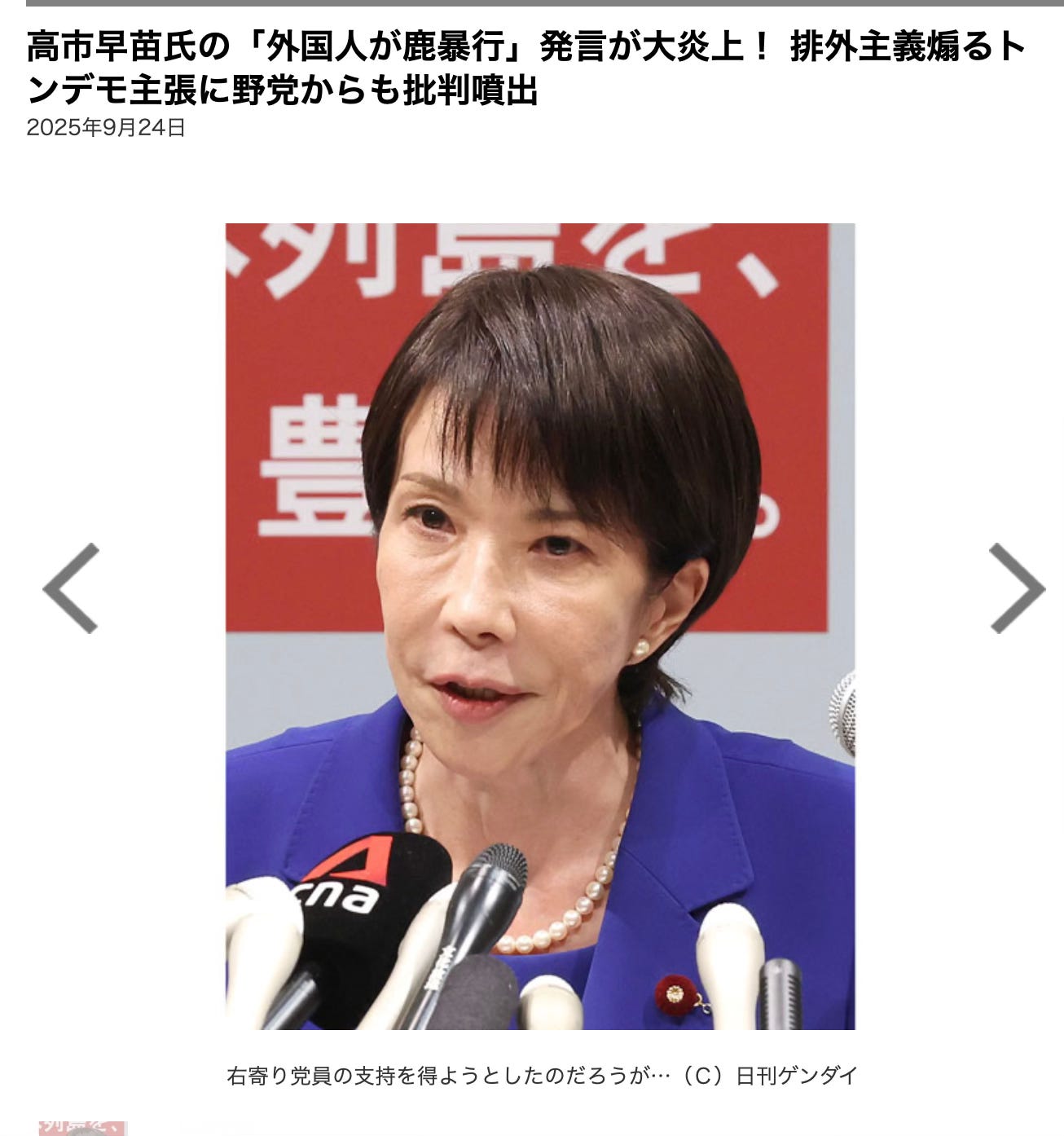
Sanae Takaichi has clawed her way to the top of the Liberal Democratic Party, which means she is almost sure to become Prime Minister. And if history’s any guide, Japan’s democracy is about to get the kind of cosmetic surgery that leaves the patient unrecognizable and the doctor whistling all the way to the bank.
The Spirit of “Dishonest Abe” Master Liar Lives On
Let’s not pretend this is some bold new dawn. Takaichi’s no pioneer in authoritarian populism; she’s just running the old con with a fresh coat of lipstick
Ghosts in the Newsroom: How Abe’s Japan Became Trump’s Blueprint

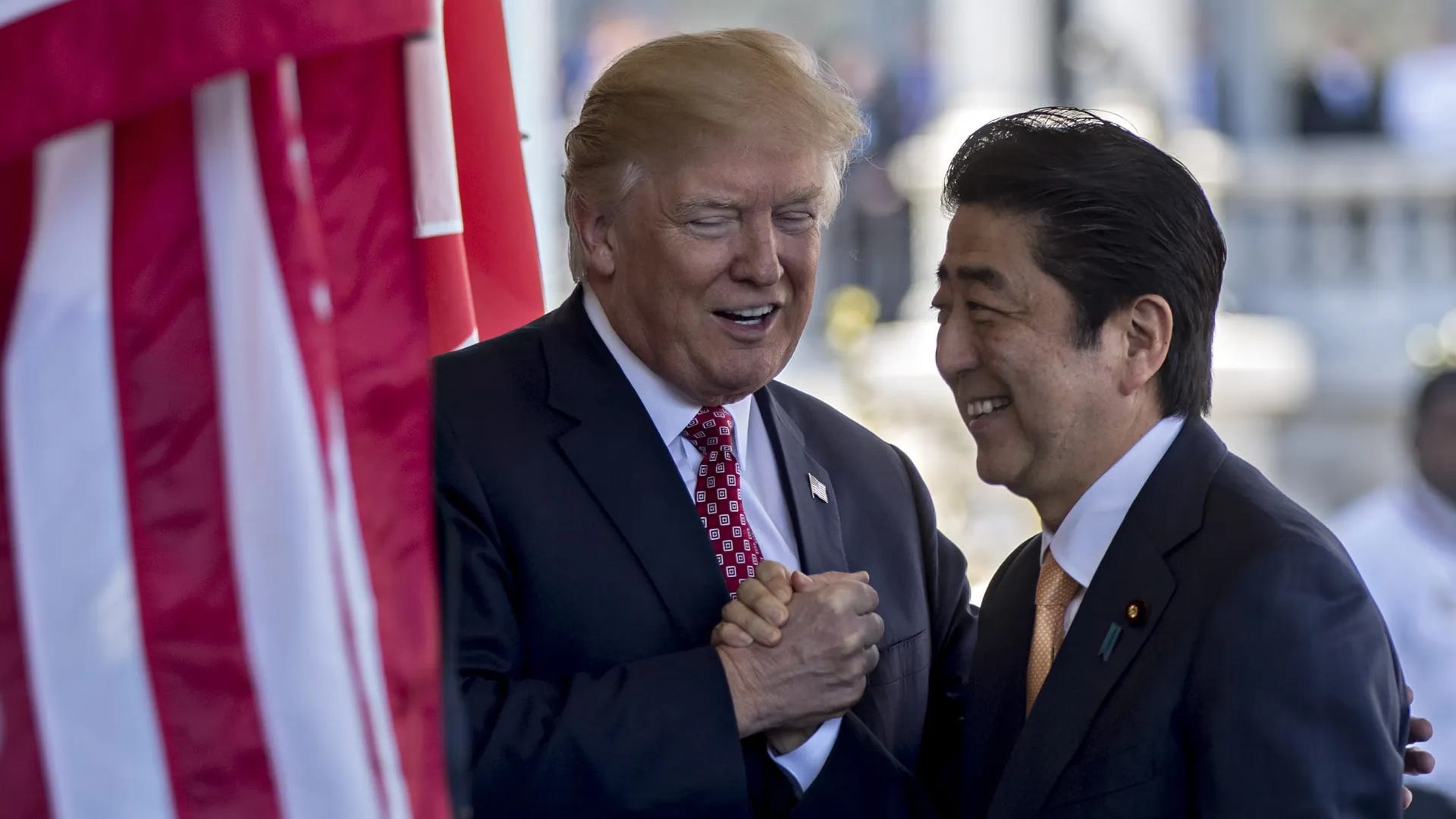
Japan had its Trump long before America did, and his name was Shinzo Abe. Back in 2014 and 2015, Shinzo Abe, grandson of a war criminal, and his backers successfully brought Japan's largest media organizations to heel. They punished critical coverage with a ruthlessness that’s now being echoed stateside. Disney (ABC) recently suspended talk-show host Ji…
She channels Shinzo Abe like a medium running a séance for a ghost that never left the room. This is the same woman who, back in the 1990s, posed for a magazine ad touting “ヒトラー選挙戦略” (Hitler’s Election Strategy), a book that treated the Führer as a case study in strong leadership. It praised his knack for “wiping out enemies with emergency measures.” Takaichi didn’t just read the book—she seems to have underlined it.
When reporters asked about her brush with Nazi marketing, her staff did the usual two-step: “No recollection.” It’s the political version of saying you don’t remember getting that swastika tattoo. Technically possible, sure. Believable? Not on this planet.
Brendan Carr in a Blue Dress
Her track record on press freedom makes Donald Trump look like a crusader for the First Amendment. In 2016, when she was Abe’s communications minister, Takaichi threatened Japan’s TV networks with license revocation if they didn’t toe the government line. Same script, different subtitles. Trump’s FCC chair Brendan Carr may have thought he wrote the playbook, but she was already running the show.
She helped turned NHK—Japan’s PBS— into what insiders called “Abe TV,” a state-friendly echo chamber with the warmth of a tax audit. Under her watch, Japan’s press freedom ranking plummeted from 11th to 72nd. Veteran anchors—people like Hiroko Kuniya and Ichirō Furutachi—were quietly shown the door for the crime of asking inconvenient questions. In the new Abe Japan, truth became a fire hazard, and Takaichi was the one holding the extinguisher.
What we’re watching isn’t a rise to power; it’s a final act. Takaichi inherits Abe’s broken machinery: a media trained to flinch, a bureaucracy that cooks its own books, and a public too weary to protest. Her brand of nationalism is less leadership than necromancy—raising old ghosts to terrify the living.
Xenophobia: The New Campaign Strategy
Where she really shines—if you can call it that—is in weaponizing xenophobia. Her recent campaign rally was a symphony of dog whistles, complete with a solo about foreign tourists “kicking Nara’s sacred deer.” She claimed, “奈良の鹿を足で蹴り上げるとんでもない人がいます”—outrageous people kicking the deer with their feet.
Pressed for evidence, she swore she’d “personally confirmed” it. That’s politician-speak for I read it on Facebook. Nara Park officials, who actually walk the beat, said they’d seen no such daily violence. But facts aren’t the point. The deer story was bait, and the mob swallowed it whole.
日刊ゲンダイ called her remarks “排外主義を煽る”—stoking xenophobia. Opposition leaders said the same. But outrage was the goal. A society that’s afraid of foreigners won’t notice who’s robbing it blind from the inside.
Economic Illiteracy Meets Nationalist Delusion
Her economics are the same half-baked gospel Abe peddled under the name “Abenomics.” Inflate the market, deflate the wages, and hope nobody checks the price of rice. Japan’s currency is still gasping, but her prescription is more of the same. It’s like watching a magician saw the same woman in half and expecting a different ending.
And all the while she wraps it in patriotism—visiting Yasukuni Shrine, paying homage to Class A war criminals as though they were misunderstood patriots. Each visit is a liturgy of denial, a polite middle finger to history.
Divine Delusions and Historical Revisionism
There’s also the matter of her private line to the gods. Takaichi’s a Shinto nationalist of the old school, the kind that confuses divine will with campaign strategy. Her Yasukuni pilgrimages aren’t about remembrance; they’re about rewriting the past with holy ink.
The thing about politicians and their convenient amnesia is that it’s never really about forgetting—it’s about choosing what to remember. Take Takaichi, standing there in her tailored suit, mouth moving with all the practiced precision of a seasoned pol, denying what happened in Nanking, what went down in the comfort stations, Unit 731’s experiments on human beings—including dissecting prisoners while they were alive—she has no time to remember what her country’s soldiers did when nobody was looking. Or when everybody was looking, for that matter. She’s got that look they all get when they’re rewriting history, that slight tilt of the chin that says she believes her own bullshit, or at least wants you to think she does. Maybe she figures if she says it loud enough, long enough, the dead will stay buried and the past will behave itself. But the past has a way of showing up uninvited, like a drunk ex at a wedding, and all the smooth talk in the world won’t make those ghosts go back to sleep.
She moves in circles that want to scrap the pacifist constitution, restore the Emperor’s divinity, and bring back the obedient Japan that marched off to war. Some of her colleagues, and the man who fixed the election for her, Taro Aso, even said Japan should “learn from the Nazis” in how to rewrite a constitution without the public noticing. You can’t make that up—and you don’t have to. They already did. If you understand that original meaning of “insane” her nickname should be “Insane Sanae”.
The Sanseito Alliance: When Birds of a Feather Flock Together
Her new playmates in the far-right Sanseito party make her intentions clearer than any manifesto. They’re Japan’s answer to the Proud Boys: paranoid, performative, and allergic to reality. Their platform reads like an obituary for democracy. By cozying up to them, Takaichi isn’t courting votes—she’s recruiting zealots.
These groups spread hoaxes about immigrant “invasions” so wildly that ministries had to cancel international programs. Her alliance with them isn’t strategy; it’s kinship. The same fever dreams, the same hunger for purity, the same contempt for outsiders.
Following Trump’s Authoritarian Playbook
The resemblance to Trump isn’t coincidence; it’s choreography. Both wrap failure in flags, both vilify the press, both flirt with divine mandate. Takaichi even bragged about her rapport with Trump, citing their shared “First” philosophies. Birds of a populist feather.
She fabricates stats with the same smoothness that Trump lies about crowd sizes. Her claim that police can’t prosecute foreign criminals due to interpreter shortages was debunked before lunch. But accuracy was never the point—it’s narrative warfare, and fear is the only currency that never devalues.
The Divine Comedy of Japan’s Political Priestess
If the divinity talk sounds like purple smoke, well, somebody should tell Takaichi Sanae to quit hotboxing the shrine. But look at the record: she wraps policy in liturgy like a bad sushi chef wraps fish in last week’s newspaper. Her shrine visits tick by with the regularity of a broken cuckoo clock. Whenever a national memorial day comes around, she kneels before Yasukuni’s war dead as if she’s auditioning for a kabuki role in some nationalist drama. Yasukuni is where Japan’s war criminals were enshrined by a rogue nationalist Shinto priest and ever since that happened, the Emperor of Japan and the Imperial Family refuse to visit the place.
But Takaichi, while claiming like Abe, that Japan should return to an Imperial Constitution, doesn’t really care for the wisdom of the Emperor.
She doesn’t just visit these sacred spaces; she performs them. Each pilgrimage becomes a political photo op wrapped in the theatrical gravitas of someone who believes the kami are taking notes. Her Yasukuni genuflections aren’t quiet moments of reflection—they’re public displays of spiritual authority, complete with reporters documenting her every bow and prayer.
The woman frames contemporary politics as if she’s delivering divine revelation rather than campaign promises. When she speaks of Japan’s “great ancestors” who secured today’s gifts through sacrifice, she’s not making historical observations—she’s conducting a séance with electoral implications. Her rhetoric flows with the cadence of Shinto norito, those liturgical chants where gods speak through mortals. Except in her version, the gods are apparently telling her to run for office.
On social media, she doesn’t just announce policy positions; she proclaims political destiny. Her messaging suggests politics isn’t a career choice but a divine calling, complete with ancestral blessing and spiritual mandate. She doesn’t have to explicitly claim she communes with deities—the performance tells you she thinks they’re not just listening, but taking detailed notes for her next campaign strategy session.
It’s political theater elevated to religious ceremony, where every policy proposal becomes a sacred text and every campaign appearance transforms into a pilgrimage. The scary part isn’t that she thinks the gods are listening—it’s that she might actually believe they’re giving her advice on economic policy
https://www.nikkan-gendai.com/articles/view/news/377942
Handmaiden of the Unification Church
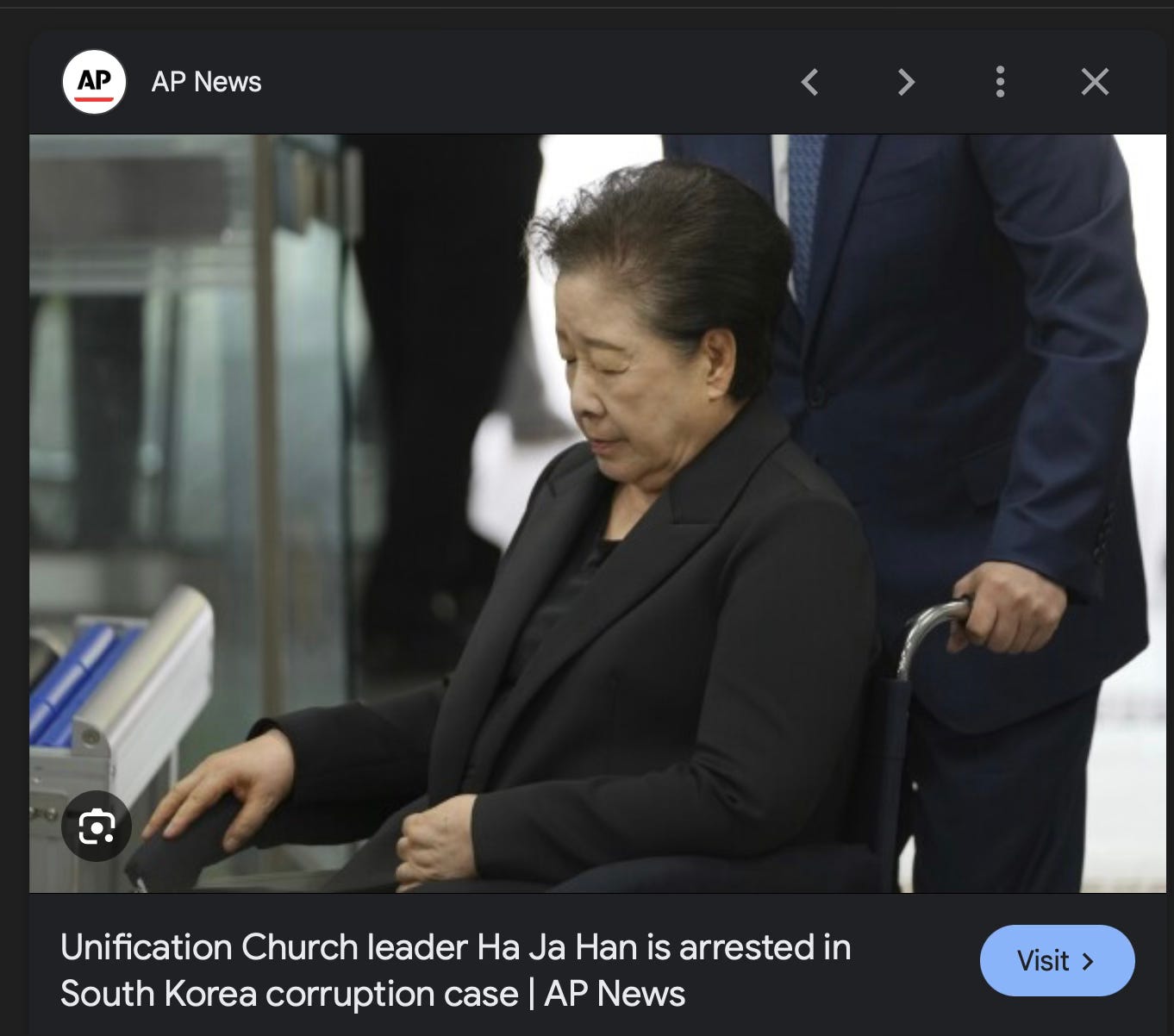
The Unification Church is a quasi-Christian religious cult based in Korea that has become infamous in Japan for fraudulent activties—and politictal influence.
Takaichi is one of many Japanese politicians in the Liberal Democratic Party that benefitted from this weird and unholy alliance.
Before Takaichi Sanae started cozying up to the Unification Church, her spiritual and political father, Shinzo Abe, had already cleared the path—and maybe rolled out the red carpet. Abe’s ties to the Church went back generations, to his grandfather Nobusuke Kishi, a wartime cabinet minister turned Class-A war criminal who somehow walked out of Sugamo Prison and into the prime minister’s office. Kishi saw the fiercely anti-communist Church as a convenient Cold War ally—a spiritual bulldog in the fight against leftists and labor unions. In return, the Church got political cover, legitimacy, and a direct line to Japan’s ruling elite. It was a tidy marriage of ideology and influence, sealed with prayer and campaign donations.
Abe kept that legacy alive, attending events, sending congratulatory messages, and treating the Unification Church like just another faction in Japan’s permanent ruling class. It paid off—for him, anyway. Until July 2022, when Tetsuya Yamagami, whose mother had been financially destroyed by the Church’s ruinous “spiritual sales,” decided to settle accounts. He aimed for the Church but hit its most famous friend instead. Abe’s assassination turned the spotlight on a truth Japan had politely ignored for decades: the LDP and the Unification Church had been dancing together since the 1950s, and nobody ever bothered to turn off the music.
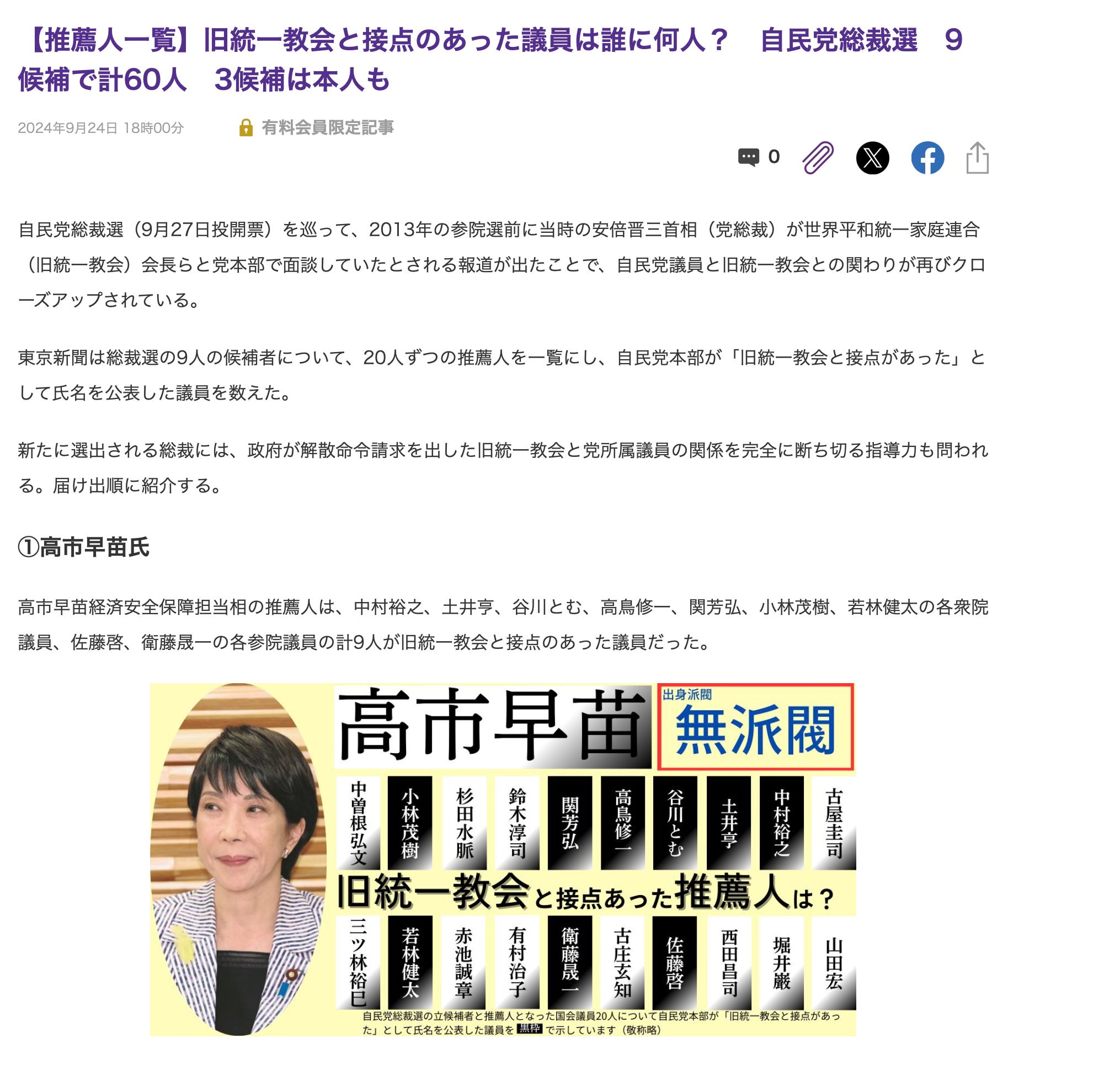
Takaichi, for her part, never once criticized Abe’s deep entanglements with the Church. That kind of loyalty is either admirable or alarming, depending on how you feel about cults that bankrupt families and convince followers their misfortune is a lack of faith—and money. She’s attended Church-related meetings three years running—2019, 2020, and 2021—her office admitting as much only after reporters unearthed the receipts. The spin was predictable: she didn’t know who organized them, she was just “supporting family values.” Convenient, since “family values” happens to be one of the Church’s favorite euphemisms for patriarchal control, political obedience, and anti-LGBTQ crusades. Her opposition to laws that would have banned discrimination against Lesbian, Gay, Bisexual, Transexual and Queer people in Japan seems to stem from those ties as well.
If you want to know more start with Editorial: Murky Unification Church ties, dusty Abe policies cloud Japan’s new Cabinet (August 11, 2022 (Mainichi Japan) and then keep going.
Her political philosophy fits right in with that worldview. She opposes separate surnames for married couples, wants to revise Japan’s pacifist constitution, and dreams of restoring “traditional morals”—all buzzwords that could’ve been lifted straight from a Unification Church pamphlet circa 1970. When she talks about Japan’s “spiritual revival,” it’s hard to tell whether she’s campaigning for higher office or auditioning for a sermon.
Meanwhile, the media has been trying to follow the money and the handshakes. Mainichi and Japan Times have reported that several of Kishida’s cabinet members—including Takaichi—maintained contact with the Church, from attending events to receiving election help. Victims’ groups, made up of families bankrupted by the Church’s demands for “atonement donations,” have demanded investigations. The stories are grim: elderly believers convinced to sell their homes, children left destitute, and decades of silence bought with fear and shame.
But Takaichi doesn’t seem bothered. She’s too busy resurrecting Abe’s old guard—many of whom share her Church-friendly sympathies—and talking about restoring Japan’s “moral backbone.” It’s the same script the Church has been writing for seventy years, just performed with better hair and a red suit jacket.
In the end, her relationship with the Unification Church is less an anomaly than a continuation—a perfectly logical sequel to Abe’s unholy alliance. Takaichi didn’t inherit his charm or his tact, but she certainly inherited his playbook. She knows where the power lies, even if it wears a cross and smiles through tax exemptions. And if she becomes Japan’s first female prime minister, it won’t be a glass ceiling she breaks—it’ll be the stained glass window of a Church that’s been running its own ministry of influence all along.
Japan’s Democracy on Life Support
What we’re watching isn’t a rise to power; it’s a final act. Takaichi inherits Abe’s broken machinery: a media trained to flinch, a bureaucracy that cooks its own books, and a public too weary to protest. Her brand of nationalism is less leadership than necromancy—raising old ghosts to terrify the living.
The woman who once promoted Hitler’s Election Strategy now has the podium and the gavel. She’s Brendan Carr in a dress, Abe’s spirit guide, Trump’s pen pal, and as economically literate as a fortune cookie. Her alliance with Sanseito and her God-on-speed-dial worldview make her a danger not just to Japan, but to whatever’s left of democracy in East Asia.
Japan’s first female prime minister should have been a sign of progress. Instead, it feels like a eulogy—with Takaichi delivering the sermon, smiling the way Mussolini used to before he looked up and saw the rope.
The deer of Nara may be fine, but Japanese democracy is limping, and the person holding the stick just got promoted.
As Abe discovered too late, you can’t dance with extremists without picking up their rhythm. His assassin wasn’t a political rival; he was a believer betrayed by the faith Abe shilled for. Takaichi might want to take note. History’s patient, but it keeps receipts.
Then again, when you think you’re speaking for the gods, you tend not to listen for the sound of footsteps behind you.


When I saw one of the expats in my feed refer to this election as "time to find out if the LDP hates women or foreigners more", I didn't really have context for why, and now I do. Thanks for that.
Japan is following all of our own steps, but because it's all happening in comparative slow motion, it doesn't have the same kind of snap back being seen in the US with active constant (and under-reported) protest. I figure the reason the old boys club chose her is the same as Liz Truss - picked a woman to handle what they know is going to be a catastrophe, so may as well distract the feminist cadre by jangling keys in front of their face. I have low expectations, but I can only hope that the slow motion decay becoming fully evident can make even a tenth of the spark that the Anpo movement had all those years ago. History doesn't often repeat exactly, but it does have the same tune...
I knew she wasn't the best choice. I didn't know she was closer to the worst. My (Japanese) wife fills me in on most things, and when I asked her about Takaichi, she said, "I don't hate her. But I don't like her, either." That's Japanese for problematic. Just learned a lot more. Thanks, Jake.