
[This is one of the finalists in the 2025 review contest, written by an ACX reader who will remain anonymous until after voting is done. I’ll be posting about one of these a week for several months. When you’ve read them all, I’ll ask you to vote for a favorite, so remember which ones you liked]
You Can Just Do Things
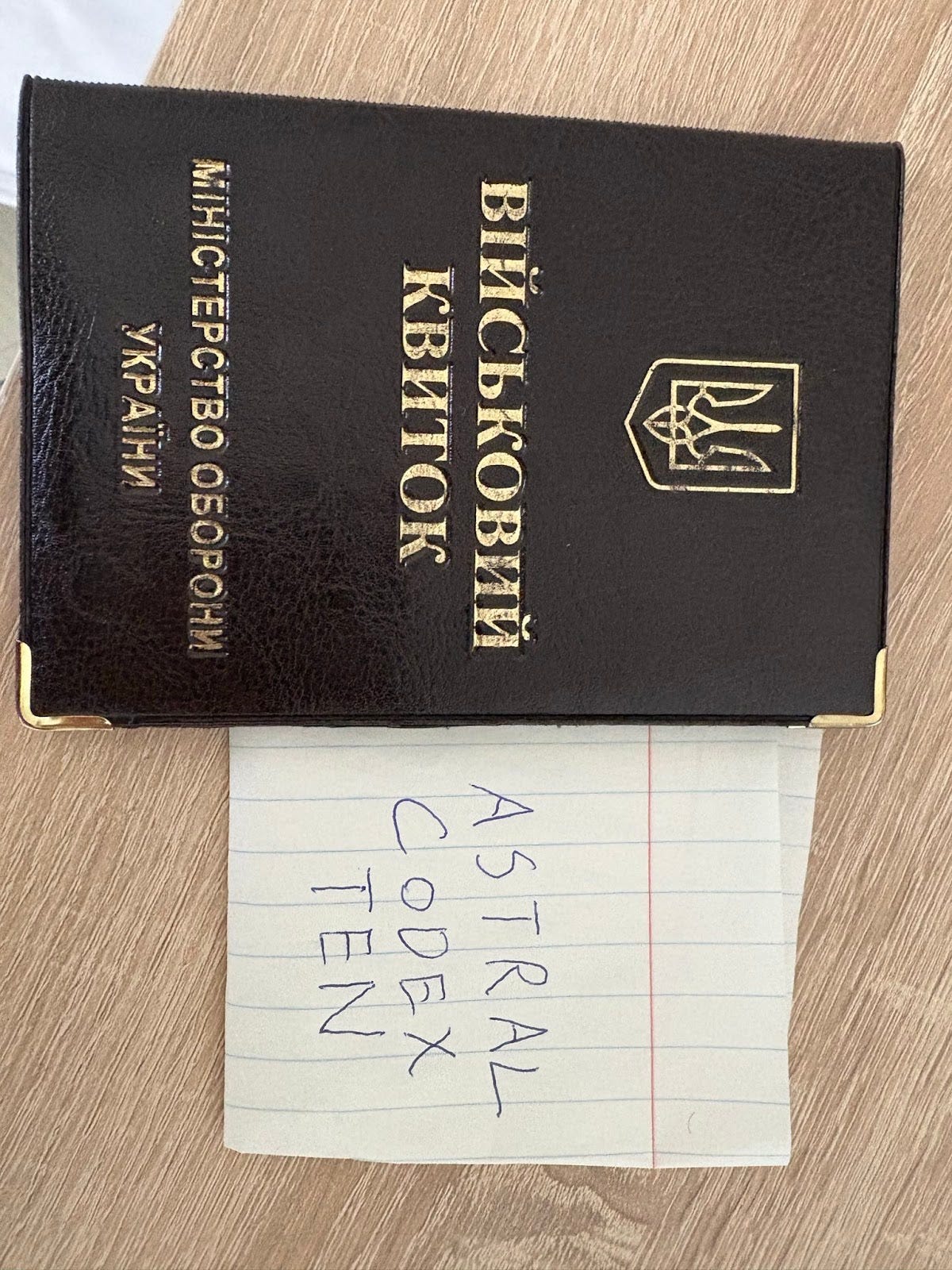
In the winter of 2022 I was unhappily working at a dull but decently compensated IT job, which I had come upon at last after four years of phoning it in at college and abandoning my brief stint as an MMA Fighter/Porn Store Security Guard due to feeling like I was getting too old to be broke. If pressure to fit in with my yuppie, family-and-career-having peers pushed me into corporate life, the depressing mundanity of Covid-era day-to-day pushed me out just as quickly.
On February 24th, 2022, Russia began its full scale invasion, and America learned what a “Ukraine” was. Having long used politics as a surrogate activity to distract myself from my life of chronic underachievement, I was already a little more familiar than most with the country’s woes, and had followed the conflict from the time of the Euromaidan protests.
Years before I had read of the likes of Azov and its many foreign volunteers, and had
even periodically fantasized about dropping everything and going to the Donetsk Airport. But no, that Wasn’t The Type Of Thing Normal People Like Me Did, so instead I joined my own country’s armed forces, sat around pushing papers, earned the dubious honor of washing out “ahead of schedule”, and finally graduated college with a not very useful degree and a mediocre GPA.
With the invasion however, things changed. Before I had always vaguely felt that I would eventually end up doing something “cool”, and had soothed myself with reassurances that I was still in the “early life” section of my future Wikipedia article and would bide my time before I made my play at greatness.
Now however, the unrealisticness of this conceit was thrown into uncomfortably sharp relief by a certain contrast I could not not ignore. Only three days after the start of the full scale invasion, Ukrainian foreign minister Dymytro Kuleba announced the creation of the “International Legion For The Territorial Defense Of Ukraine”. Unlike in 2014, Ukraine was now specifically and officially soliciting foreigners with military experience to fight for them! I was at least technically in that category! I thought about my own time in the military. My ideas of going to war in Afghanistan had been quashed by the US withdrawal not long after I joined, and I had quickly found that military life involved more editing forms in Adobe Acrobat and less explosions than I had naively supposed.
But this was a real war, a deadly serious war, and a major, world defining event at that. In the early months of the invasion the international media talked about almost nothing else. I spent all day at my desk pretending to work while frantically refreshing OSINT live maps and breathlessly following news from the front. I remember the circulation of harrowing video clips. Kalashnikovs being distributed to civilians in Kyiv, the mayor of a small village publicly asking its inhabitants whether they should personally accede to Russian ultimatums, or risk having their property destroyed and lives forfeit- to resounding cries of “Glory to Ukraine”. The Ukrainians’ courage blew my mind. There were people who really had something to die for, and by extension something to live for.
Meanwhile, there I was, sipping coffee and getting fat. The creation of the legion felt like destiny was reaching its hand out to me. Was I really going to ignore it so I could handle support tickets for the rest of my life?
Over the next few days I began to entertain, half joking at first, the notion that I would join the war. As I began catching myself thinking about it more and more, and with increasing seriousness, I realized with a sinking feeling that this idea had germinated whether I liked it or not, and that I might really do this. I allowed myself to elaborate upon the fantasy with research. I started looking at helmets, body armor, and mag pouches. Finally I took the plunge. Following the Ukrainian government’s officially published instructions, I called the embassy in DC, and… no one picked up.
I called a few more times throughout that day to no avail, also trying the Ukrainian Consulates General of New York, Chicago and San Francisco. None of them picked up the phone. Understandably, in the first few days of the invasion I imagine they were very busy. At length I resorted to calling the Consulate General of Toronto. To my surprise, a very tired sounding man with a thick accent picked up the phone. When I informed him of my intention to join the legion he replied with an almost disinterested “Okay, send an email to this address”, and the conversation was shortly over.
When I did as I was told, I received a quick reply with a request for a scan of my passport and forms that I should fill out. I did this the same day with a deep breath and butterflies in my stomach and... nothing. Days turned into weeks. I followed up with another email. I called the consulate in Toronto again. This time there was no answer. I started to get frustrated, and wondered whether this was a sign that I shouldn’t go. Maybe they didn’t like my resume and decided to ghost me. Afterall, they were probably looking for Elite Special Operations Ranger Seal Marines™, or at least combat veterans.
Browsing the several newly created “Ukraine Volunteers” subreddits at least showed me that I wasn’t alone. There were countless posts by people who had been similarly ghosted, and many more stern replies sensibly urging people not to go unless they were Elite Special Operations Ranger Seal Marines™. A couple months had now elapsed, and although I had already bought a lot of kit for myself online, I was starting to come to my senses and give up on the idea.
Then came the straw that broke the camel’s back. A few months had passed since the start of the invasion, and the media’s intense focus on Ukraine had already started to be diluted. At risk of being read as a vulgar culture war partisan, I suspect it was no coincidence that around this time my corporate workplace reintroduced the enforcement of Covid restrictions, to include masks worn at desk. This policy had previously been abandoned shortly after the invasion. Reintroducing it after the winter season was already over seemed less than rational, but I think Covid defaulting back to “the current thing” after being temporarily replaced by the excitement of a European War played a role.
One day as I was being lectured by a female HR representative for leaving my (cloth, non-medical) mask off for too long during lunch, I could barely hear what she was saying. All I could think of were the uncounted men across untold generations who had lived and died as warriors, with all the honor and pain that entailed. I thought of how men in Ukraine right now lived a modern version of that, while I allowed myself to be subject to the feminized safteyist ideology of everyday civilization.
The spiritual offensiveness of this contrast hit me like a ton of bricks, more vividly than ever. At that moment I silently made my final decision. I wasn’t going to wait around to hear back from the Ukrainian Government. It was time, in the immortal words of an ISIS recruiter on Twitter to “put down the chicken wings n come to jihad, bro”.
That night I booked a one way flight to Warsaw, as all air travel to Ukraine was suspended. I told very few of my friends what I was doing. I told a girl I was seeing that I was moving to Europe with no further explanation. I told my parents the truth and felt a pit open up in my stomach as my mom cried like I told her I had terminal cancer. As the day of departure approached I called in sick from work a few times to prepare, before finally telling my boss I had to resign because of “long Covid” in a deadpan parody of their neuroticism.
Some Notes On Wartime Ukraine
When I landed in Warsaw the Polish border guards saw my body armor and asked where I was going and if I was a soldier. I instinctively denied this for no good reason and claimed I was just visiting. They asked for proof of a return ticket and while I aimlessly scrolled my phone for a non-existent ticket they eventually rolled their eyes and let me through. When I crossed the Ukrainian border on a hot and overcrowded bus I expected a similar line of questioning from the Ukrainian border guards, but they did not speak English and did not seem to care who I was or what I was doing in their country. They just stamped my passport and waved me on.
The passengers were overwhelmingly women, as Ukrainian martial law forbids men aged 18-60 from leaving the country in order to prevent them fleeing conscription. Therefore, any Ukrainian man in this age range who enters the country will not be leaving again anytime soon, with very few exceptions. The most common way people get around this is by having dual citizenship. Ukrainian law does not technically allow dual citizenship, but the government has no way of checking if a citizen has a passport from another country, and they can just show that at the border, pretending to be a foreigner. The second most common way around this is paying a bribe, which can be quite costly, especially by the standards of one of the poorest states in Europe by GDP per capita.
When I arrived in Ukraine, the first city I came to was Lviv, which holds a special place in my heart to this day. It’s the largest city in western Ukraine and a big tourist hub. Its ornate, often Polish and Austro-Hungarian architecture and charming cobblestone streets give it the classic “Old Europe” aesthetic, especially in the old town, which unlike many other Ukrainian cities survived WWII nearly unscathed.
It may be jarring for the reader to see me jump from preparing for war to writing a tourist guide, but it was also a surprise to me. I don’t know what I was expecting, but it wasn’t this relative tranquility. Foreign media naturally mostly focuses on the destruction of the war, but just like in WW2, some areas are nearly unscathed. When I got off the bus in late spring of 2022 I quickly felt silly for bringing my MREs when I realized I could just eat at a fancy restaurant.
This is not to say that even Lviv was or is untouched by the war. First of all, it does occasionally get bombed. I promise, this sounds scarier than it is if you’ve never spent time in a city that occasionally gets bombed. Air raid sirens will regularly blare, but no one pays them much heed. Kids keep playing, hipsters keep sipping their lattes. Once in a while the sirens will be accompanied by a faint boom in the distance. It sounds a bit like thunder. Everyone keeps walking. Later you might see a damaged building, or hear the whine of an ambulance, but Ukraine’s modern air defense means that there are no Russian planes flattening grid squares, only missiles and suicide drones that slip through. In a city of hundreds of thousands, a few might die from bombing, but life goes on.
More relevant to daily life however are the curfew and checkpoints. Curfew, or as the Ukrainians call it “Commandant’s hours” lasts from midnight until 5AM in the safe cities, and begins earlier closer to the front. The last businesses close an hour or so before curfew, which generally means no checking into hotels late at night. Ukrainian “nightlife” too is confined mostly to secret places, although it is legal and sometimes possible to pay the owner of a small bar to stay in it all night serving a private party.
Checkpoints or “Blockposts” are not so common as to be a traffic nuisance, but are definitely a noticeable feature of even western and central Ukrainian roads. They are manned by a combination of police and soldiers, who will usually just wave all cars through one by one, or even stand on the side of the road smoking while cars go through unabated. Sometimes, they will stop the cars one by one and ask to see the driver’s documents, which for Ukrainian citizens refers primarily to a digital version of your passport accessed through an app on your phone.
In the beginning of the war and in certain areas closer to the front even today, these checkpoints were somewhat more serious amid the heightened concern of sabotage. Now however, they are primarily used to randomly check eligible Ukrainian men against the database of those wanted as draft dodgers. Curfew is also used as a tool of conscription, and eligible male violators are often drafted as a punishment for its violation.
Conscription has certainly intensified since 2022. At the outbreak of the full scale invasion, the army was overwhelmed with volunteers. Recruitment offices were in fact turning men away because they lacked the capacity to train and equip them all. When Ukraine achieved its greatest battlefield successes in Kharkiv and Kherson in the fall of 2022, they actually outnumbered the Russians in many places.
The upwelling of war enthusiasm that created this surge of volunteers was on full display when I arrived. Europeans sometimes make fun of Americans for the ubiquity of our national flag on city streets, but since the war Ukrainian flags are even more omnipresent. It seemed every third billboard was either a recruitment advertisement or a general statement of praise for the military and faith in victory. If that sounds almost Orwellian, remember, Ukrainians in general are not cynical about this, but sincerely believe and support it in a way that may be hard for Americans of my generation or younger to imagine. The billboards are accompanied by printed posters, often produced by private organizations or groups supporting the war effort, and a load of street art and graffiti with the same basic message.
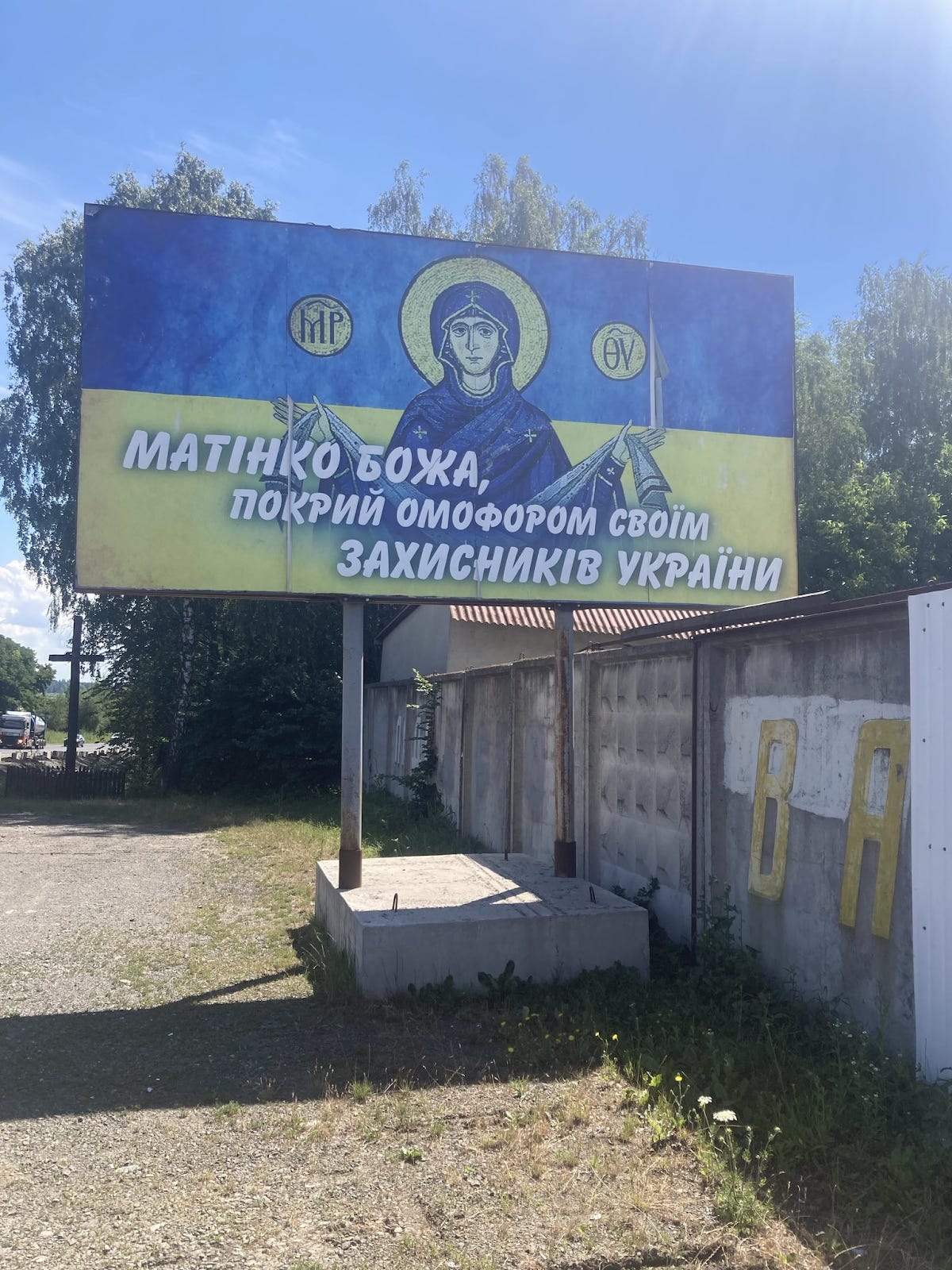
In the summer of 2022 you could find shrewd businessmen in market squares charging passersby for the chance to shoot pictures of Putin with a pellet gun shaped like an AK-74. College aged volunteers and grandmas alike gathered at volunteer centers to knit camouflage nets used to cover Ukrainian vehicles and positions. Uniformed soldiers were often treated to free coffee and snacks by local cafes. When passing civilians on the street they would often be greeted with the now famous salute “Glory to Ukraine”. This phrase “Slava Ukraini” is in fact the first line of a longer call and response salute:
A: “Glory to Ukraine!”
B: (often multiple people): “Glory to [her] heroes!”
A: “Glory to the nation!”
B: “Death to the enemies!”
A: “Ukraine!”
B: “Above all!”
This salute dates back to the Ukrainian Insurgent Army, which during WWII and several years afterward fought a very bloody guerilla campaign in western Ukraine, which pitted them in a 4-way struggle against Germany, the Soviet Union and the Polish resistance. They are closely associated with an older variant of the Ukrainian flag, which rather than blue and yellow uses the colors black and red: black for the soil of Ukraine and red for the blood of its defenders. Or, as one of their folk songs alternatively posits: “Red for true love and black for the bottom of Hell”.
The Ukrainian Insurgent Army has historically had a very controversial legacy even in Ukraine, being accused of pogroms and ethnic cleansing during its war. Consequently, before the 21st century Russo-Ukrainian War their legacy and symbolism was much marginal in Ukrainian society. Certain elements have always glorified them, but especially older generations often chafed at the harsh and militant repudiation of the Soviet past. This touches on the very core of the conflict: the question of Ukrainian national identity.
When the Soviet Union fell, some of its constituent republics essentially ran as fast as they could in the other direction screaming “We’re free!” at the top of their lungs. These famously included the Baltic republics, which had only joined the union at bayonet point in the 1930s and in fact precipitated the crisis which ultimately led to the Soviet Collapse with their “Singing Revolution” as soon as they smelled blood in the water in the late 1980s. In Russia meanwhile, people were much more reluctant to see the USSR go, and the older generations especially still generally have a positive opinion of it today.
Somewhere between these two was Ukraine. It did have a series of pro independence or quasi pro independence protests starting in 1989. Unlike Georgia or the Baltics though, it did not boycott the 1991 referendum on the “New Union” treaty, which would have created a potentially “less communist” successor to the USSR. Instead, the Ukrainian SFSR ratified it with a high turnout, though it should be noted “independence” was not an option in the referendum.
When conservative communists attempted a coup to prevent the implementation of this “New Union” treaty, Ukrainian public opinion shifted strongly towards independence, and every region of Ukraine (Including Crimea, Donetsk and Luhansk) voted for it in an independence referendum later that year. Nevertheless, there was a notable regional gradient in the prevalence of Ukrainian Nationalism as expressed in the prevalence of anti-soviet protests, votes against the “New Union” and votes in favor of independence. All of these were most prevalent in Western Ukraine for the same reason the Ukrainian Insurgent Army had its stronghold there in the 40s. Western Ukraine was never part of the Russian Empire. Like the Baltics it was only conquered in the Soviet Era, and so did not have time to undergo the Russification the rest of Ukraine was subject to.
In 2022, a furious backlash against Russia swept over the entire country, but in Lviv, where the question of whether Ukrainians are fundamentally a subset of Russians was never much of a question, its intensity was positively electric. Everywhere I went and whoever I talked to there was a palpable sense that we were all engaged in a common struggle, all on the same team. People were nicer and more helpful to strangers than they otherwise may have been. The atmosphere was almost like a much more vivid and intense version of a big team sporting event. When I read about the excitement at the beginning of WWI, I can understand it much better now.
I was overwhelmed and intoxicated with this environment, and wanted more than ever to make myself useful to the war effort. The Legion had still not gotten back to me, and since the infamous Russian strike on their recruitment center in Yavoriv they had become more secretive. Many would be legionnaires had been killed in that attack on the nascent unit, and I later learned that many more had immediately gone home. Unsure what to do next, I joined a Facebook group for foreign volunteers in the country, and quickly found myself inside of a very odd and eclectic network.
Through the Facebook group I made contact with a fellow American, the founder of an impromptu organization based in Lviv. He had dropped everything and came to Ukraine without any clear plan like me, but a few months earlier at the very start of the invasion. After a brief conversation he agreed to help me make myself useful while I figured out how to join the military. When we met in Lviv almost the first thing he said to me was “What took you so long to come here?”.
The organization he brought me to was technically an NGO in the sense that they had certain official documents with certain official stamps that conveyed certain official status. To the reader familiar with the broader international ecosystem of “NGO world” however, this is probably a highly misleading characterization. In safe cities like Lviv, it wasn’t hard to find the standard western “Official” types, who were usually getting paid to work for well established (often UN adjacent) humanitarian organizations like the Red Cross, World Central Kitchen etc. What I first fell into was not that. At the beginning of the invasion various organs of the Ukrainian government greatly streamlined the process of obtaining gradients of “official NGO status” in order to accommodate the flood of foreign support.
This was not a bad idea. Foreigners from all over the broader West flocked to Ukraine, not only to fight but to help any way they could. Many brought with them useful experience and background knowledge. Often they raised funds to donate important supplies from their personal communities and networks to great effect. But this also meant that very quickly Ukraine was overrun with small and usually well-intentioned but often very disorganized “NGOs”. These organizations often overlapped or had dealings with their more professional counterparts. They performed many useful tasks including assembling first aid kits, driving supplies close to the front and clearing away rubble in liberated areas.
These groups were often staffed by volunteers who did not have backgrounds in related fields. Couch surfing world travelers, waiters, misfits and nomads. One guy I met had spent years working in a traveling circus. Even though areas of Ukraine far from the front really weren’t very objectively dangerous, the world’s perception of Ukraine as one giant Bakhmut meant that there was quite a selection effect for the type of person who would end up there. A lot of people were running from something. A lot of people had problems back home. Messy divorce, death of a child, terminal disease, previous suicide attempts, mental illness, PTSD, legal issues, substance abuse issues. I saw all of these things that I listed in multiple people.
There were also a lot of retired cops and soldiers trying to put a sense of purpose and danger back in their lives. Local Ukrainian military administration would give them pieces of paper that said they were special and could stay out past curfew. Grateful civilians treated them like the Beatles. Naturally this would often go to people's heads. Everyone wants to feel important, and I noticed a negative correlation between how much people were actually doing for the war effort and how much politicking and rent seeking they engaged in with “official status”.
One funny flavor this came in was delusions about their own value as targets. More than one western volunteer believed they were being surveilled by Russian intelligence assets, as though such assets didn’t have much bigger fish to fry. In one particular case a group of volunteers on a mission to deliver supplies to a rear area in Donbas abandoned their vehicle in the middle of the road when an (almost certainly Ukrainian) fighter jet flew overhead. They believed not only that it was a Russian plane on a bombing run but that the Russians knew of their 4 man strong “NGO” and were specifically targeting their van full of canned vegetables and disposable diapers.
More often though, it just took the form of internal power struggles and intrigue over control of groups themselves. Conspiracy minded pro-Russian interlocutors often like to insinuate that there is deep corruption in these kinds of groups involving substantial monetary value, but the sad reality is that this kind of intrigue was primarily about pedestrian personality clashes between people who were somewhat worse adjusted than average.
Another interesting angle to these “Amateur NGOs” is that they were often adjacent to military or paramilitary activities in a way that bureaucratic professionals would shy away from. Many foreigners with military or law enforcement backgrounds are proficient in TCCC, which is the most basic level of field care for trauma, revolving around using simple tools like tourniquets and chest seals to keep someone alive until they can get to doctors or more qualified medics. The commanders of under supplied and shorthanded Ukrainian units often invited these foreign organizations to train their newly recruited or mobilized soldiers in these skills.
The particular organization that I initially worked with also functioned very effectively as a kind of halfway house for foreign fighters entering the country and looking for a unit to join, while simultaneously putting up refugees who were fleeing the eastern part of Ukraine.
The foreign fighters who passed through came in all shapes and sizes like the civilian volunteers, but their overall vibe was a bit different. Naturally there was less “save the whales” and more “I want to shoot people”. All of the negative tendencies I mentioned were if anything a bit worse than among the civilian volunteers, but at least they didn’t have to exaggerate to tell a good war story. There was less overlap with the bureaucratic professional NGO types among them.
The post invasion foreign community in Ukraine is pretty small, and everyone knows someone who knows someone. I fell in with the others of the military crowd, and soon I found my way to the Legion.
War Stories
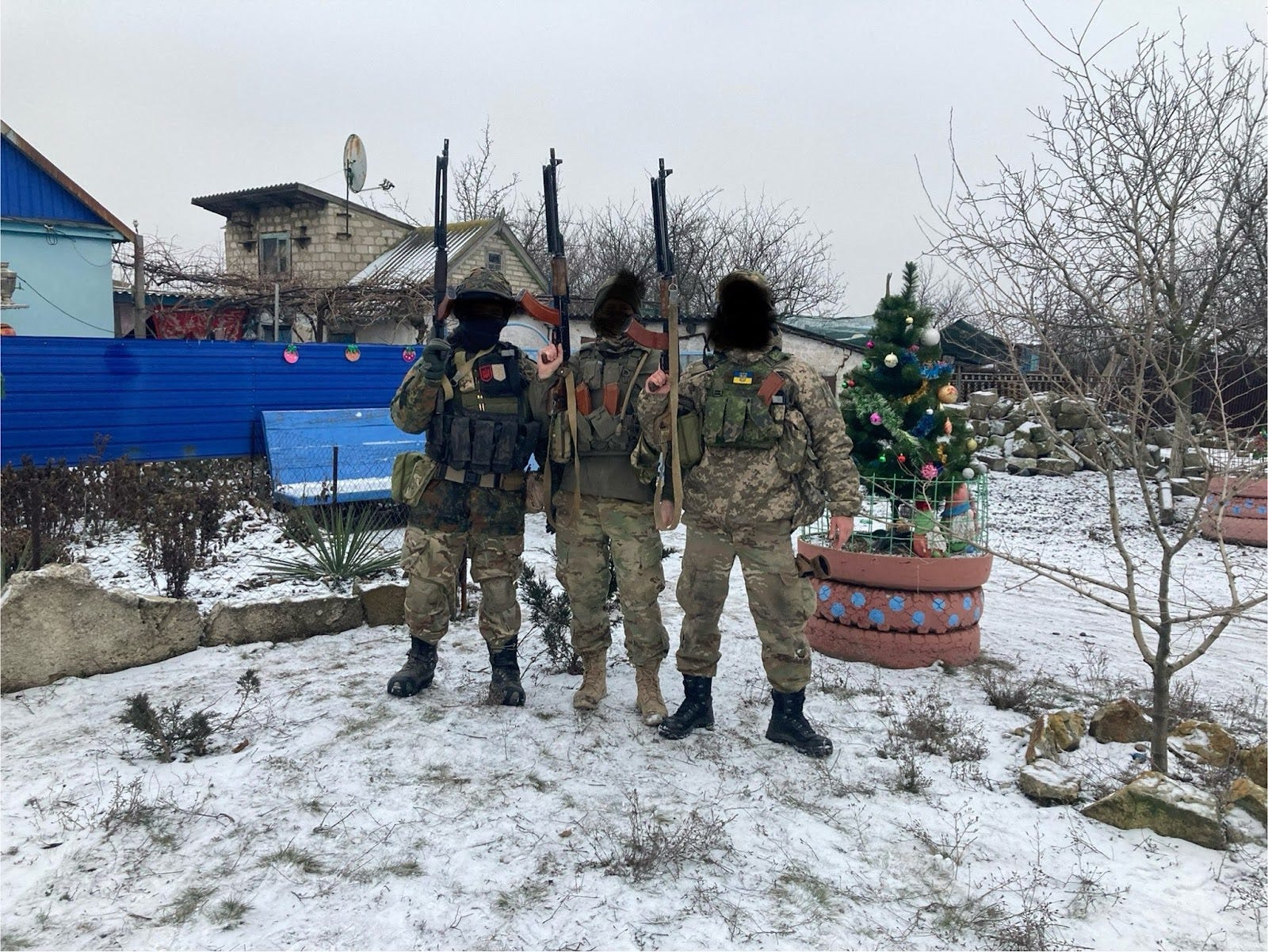
“This is not like Iraq” the Ukrainian recruiting officer soberly told me with a thick accent. “You have 50% chance of dying.” That wasn’t actually true, but it was a lot closer to being true than almost anything you can voluntarily sign up for in an organized way. I decided it was worth it.
It wasn’t long before I was shivering in a trench, ducking slightly at the occasional whistle of artillery. Intermittently I scanned the pitch blackness in front of our position with my team’s shared thermal optic. Still nothing. That was good. This was the zero line, meaning there were no friendly positions in front of us. The Russians were about 400 meters away, dug into the treeline on the other side of a field. Ukraine is very flat, especially in the South and East. A lot of the battlefields consist of a farmers field as the no man’s land, with the trench lines being dug into the wooded borders that separate the fields. Trees make it harder for recon drones to see what you are doing.
If you stand up out of the trench during the daytime, the enemy may be able to see you and take a shot, if they are paying attention. It's not easy to see someone, let alone hit them with a rifle at that distance unless you have a good optic. With a machine gun it's easier to hit, but no easier to see.
That didn’t stop both our side and the Russians from occasionally opening up with both rifle and machine gun fire. Did they see something? Was there an attack we couldn’t see? Maybe, but quickly we learned that more often than not people were just shooting out of boredom. One side would start firing over the top of the trench, then the other side would respond, and it would go on like that for a few minutes back and forth until everyone stopped, usually without hitting anything.
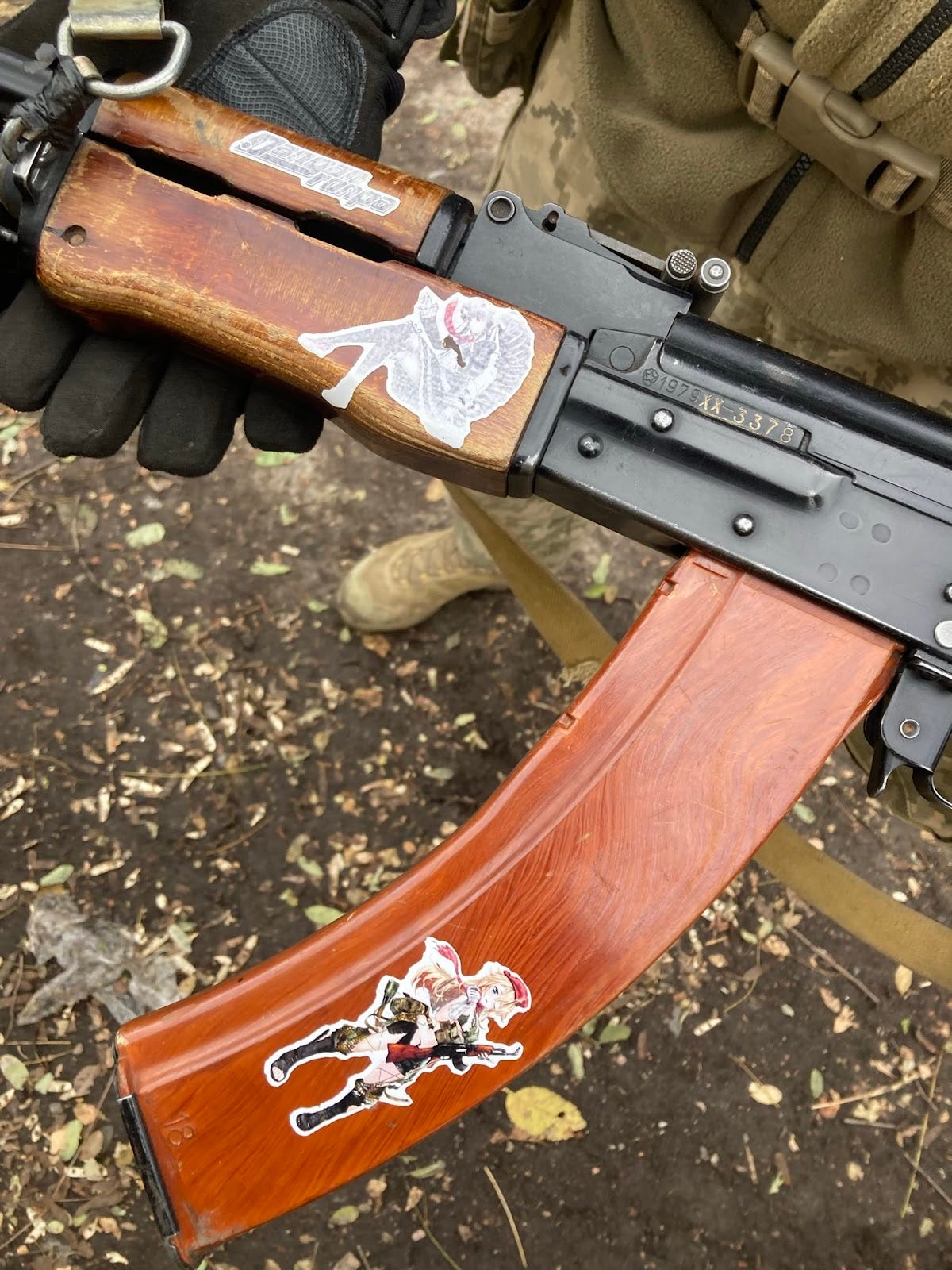
Our team leader was a salty infantryman, an American like me. He told us to be smart and not shoot unless there was a real reason to shoot. This was especially important with the machine gun, which we kept in a fixed position with a camouflage tarp over the top of it to keep it dry in the rain. Every time we fired it, we risked giving away its position. Once however, with my team leader’s permission, I fired an old soviet grenade launcher randomly in the enemy’s direction for funsies.
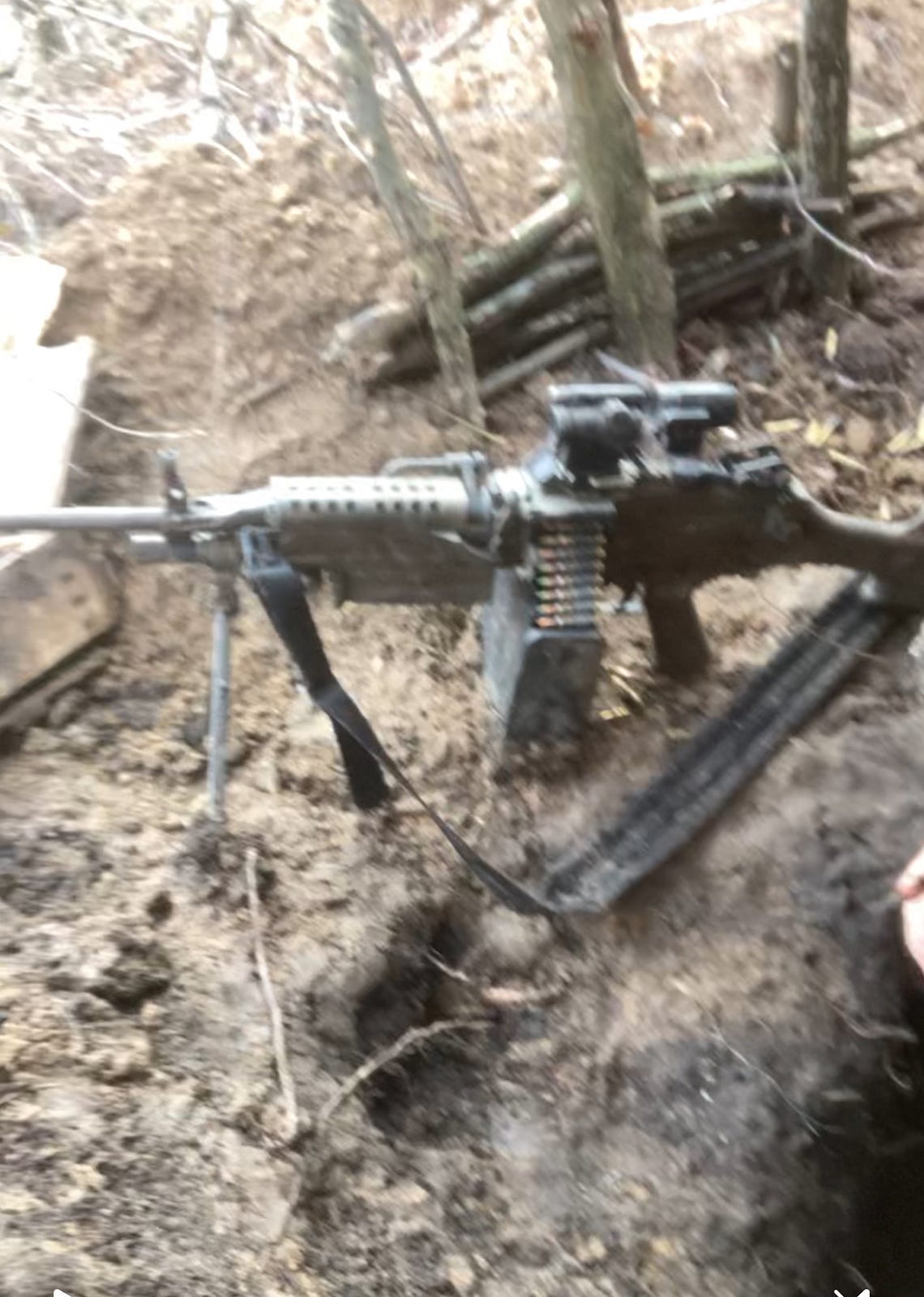
During the day we mostly just stood there, leaning against the walls of the trench. Periodically we would improve certain areas of the trench by digging with our collapsible shovels. The joke was that we were playing Minecraft IRL. “Watch out for the creeper!”.
The Ukrainian units we encountered were pretty curious about us. Many initially had the idea that we were the American, British, or some other western army, and were vaguely disappointed to learn that we were Ukrainian soldiers of foreign extraction. Once a soldier who spoke English insisted on playing his favorite American rock song “enter sandman” for us on his phone during an uneventful fire fight. “The Pidors [Russians; literally homosexuals] are scared of Kraken [A Ukrainian unit known for nationalist politics], but they are REALLY scared of you!” I’m not sure how he would know that, but it made our day.
It's hard to blame the Ukrainians for being confused about us, because it is pretty confusing. First of all there are actually two completely separate military units called the International Legion, each under completely separate commands. This is for reasons I will not discuss. The basic structure of the legion that I served in was the team, which was more or less an equivalent of the infantry squad in US army doctrine. Teams generally had about 5-10 men and were led by a team leader, who would himself be a foreigner. Compared to a US Army infantry squad, teams had a huge degree of autonomy, especially in the early days of the Legion. They could pretty much attach themselves to any Ukrainian unit that would have them and do whatever they wanted, which is very common in action movies but is basically unheard of in modern militaries, and for good reason.
By the time I joined, this system was already on its way out the door. The Legion was reorganized into a system of Squadrons, each composed of several teams. Each Squadron had a commander and deputy commander who were both commissioned officers of Ukrainian citizenship. Although this has since legally changed, at the time foreigners could not serve as officers in the Ukrainian military. He was assisted by the senior enlisted man in the unit, traditionally a foreigner.
Despite this reform, teams maintained a very unusual structure with a high degree of autonomy throughout my time in service. First of all, rather than being appointed from above, team leaders were chosen by their own teams through democratic consensus. Although this had its problems, at a small scale it wasn’t as problematic as you might think. Soldiers know their lives are on the line; they want to be led capably, and they generally know who among them is going to be the best choice. Often it's the man with the most experience.
Secondly, teams could hire and fire people at their own discretion. Rather than being assigned to a team, newly recruited legionnaires would have to find a team that wanted them, lest they be left to rot in the barracks in Kyiv. Individual teams often had their own sources of funding, their own social media, and their own shared equipment, to include night vision and vehicles used on the front line. Teams normally lived together in the same houses and apartments, both when deployed and on leave. Normally they split the rent among themselves. Rather than being called Alpha, Bravo Charlie, or One Two and Three, teams could even name themselves, and that is what everyone, including the Ukrainian officers, would call them.
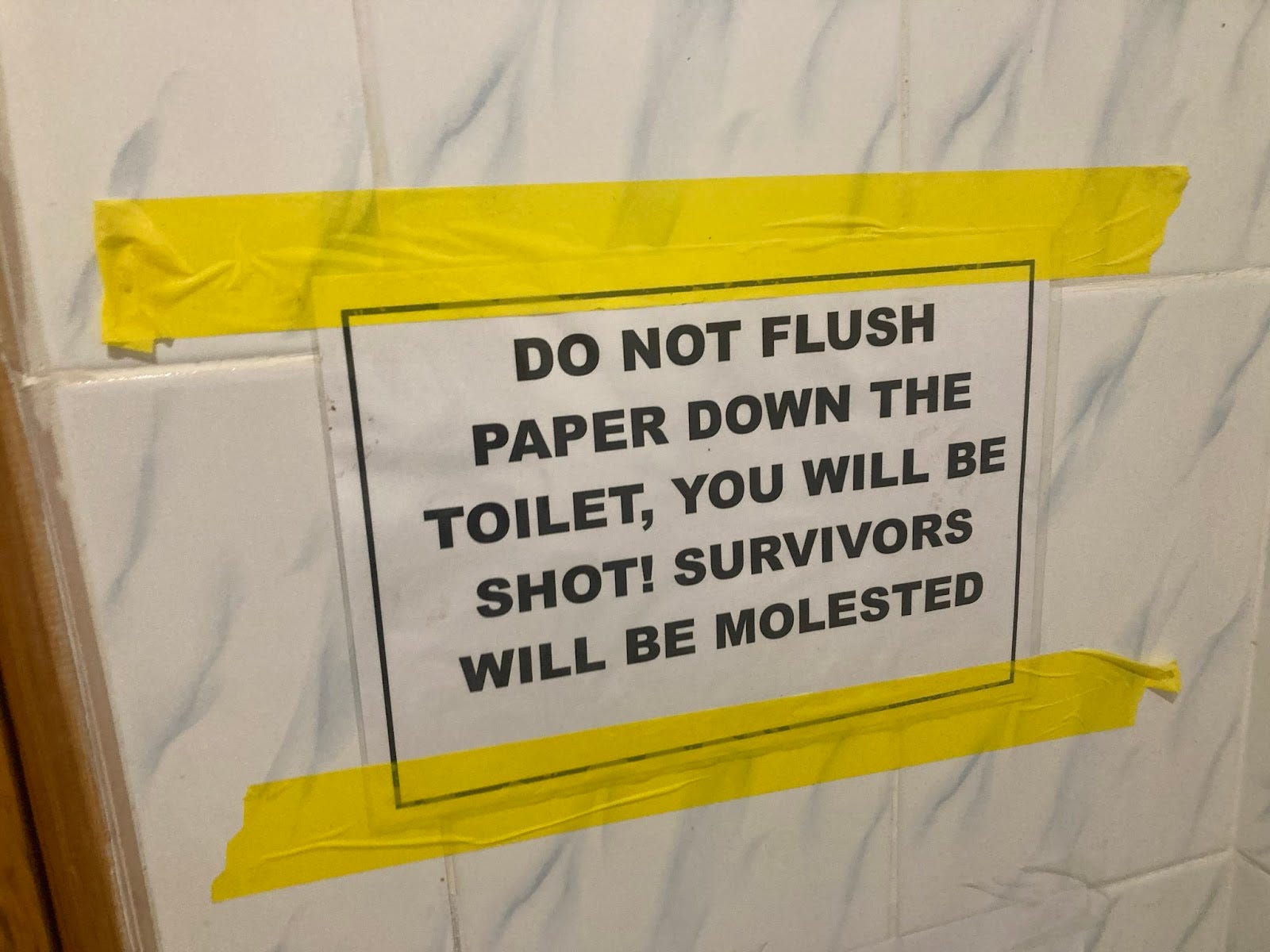
In stark contrast to the French Foreign Legion, teams in the Ukrainian International Legion would often form around ethnolinguistic lines. Ukraine was not trying to assimilate us and teach us all Ukrainian, she just needed more soldiers, and fast. Latin Americans, Chechens, Belarusians and even Quebecois all often formed teams where they spoke their own languages internally.
There were sometimes cases of violence both between and within teams. One inter-team incident coming from a dispute during a squadron wide training exercise resulted in a huge brawl, with order only being restored by a Ukrainian officer firing his pistol into the air. Smaller scale rivalries and incidents were not uncommon. This whole experience made me think about the concept of the “gang” as a natural grouping of men, and the extent to which further military development has been based on adjustments to this naturally occurring phenomenon.
When the weather was nice, life in a trench wasn’t too bad. You could sit on the ground in some places without getting too wet. We had a few loose tree stumps in certain parts of the trench, one side of which we were careful to keep clean, so as to have somewhere nice to sit when it got muddy. Mud is unpleasant. In the fall it's very cold, and it sticks to everything.
There were a few little holes in the sides of the trench with blankets to cover the entrances where we slept two to a hole. Making sure mud didn’t get in there was one of the impossible tasks which preoccupied our minds the most while on position. My “hole mate”, a Canadian former construction worker, devised a system where we would use a corner of the hole to store our muddy boots when we had the luxury of taking them off, and wrap our clean feet in trash bags. It sort of worked.
We listened to audio books. We had our cellphones, but they had to be on airplane mode, and even if they weren’t they probably wouldn’t have worked because most nearby towers were damaged or destroyed. I liked to play minesweeper on my phone.
The first night we were in that position I had to poop, so under cover of darkness I crawled out of the trench into the field behind us on the side facing away from the enemy, did the deed, wiped with baby wipes and crawled back. Later we talked to some Ukrainian soldiers in the position next to us and they showed us a not-quite-deep-enough hole which served as a toilet.
Even when it wasn’t raining there was a certain puddle between the machine gun and my hole which became a permanent fixture of the trench because the water had nowhere to drain. It was a wonder there were no fish in it. It was very important not to step in this puddle, so I memorized where it started even in the pitch black, light pollution free nights. When it was coming up, I would brace myself against the walls of the trench and shuffle forward with my feet as far apart as I could. It sort of worked.
Once it was raining during the day, our tarp had fallen down and morale was low as we were getting wet and would have to be on position for another 2 days. One of my friends, a Greek who once told me he had considered joining ISIS “for the aesthetic” had enough and asked me to hold the other end of the tarp steady while he fixed it. This was dangerous as it required climbing out of the trench. No sooner had he triumphantly tied the knot than a shot rang out and we heard a little “woosh”. This is the sound bullets make when they pass close to the hearer. My friend sprawled quickly back into the trench, and there were no further shots.
Bullets were one thing. As long as we stayed in the trench, we learned we were comparatively safe. Once, after minutes of a protracted back and forth shooting at nothing session, a friend spontaneously cried “CONTACT! CONTACT” in a shriek of mock panic. This was a hilarious parody, and everyone laughed appropriately. Artillery and mortars were bigger threats. Few of my squadron were ever killed or wounded by bullets, but many by shrapnel. When the rounds would start landing close it was best to crouch down in the trench.
More serious still were FPVs, or suicide drones. I remember crouching down in the trench to the whine of propellers while I contemplated what the instant of death would feel like if I were hit. Would it really feel like nothing? Would it be hot?
When I was serving on the front, anti drone guns were quite rare, as I believe they still are today. But many positions would have a shotgun loaded with birdshot on hand. Today I understand FPVs are even more prolific, and fiber FPVs, which are immune to all jamming, are especially pernicious. I believe they represent a turning point in conventional warfare. I know many foreign fighters who came to the war as riflemen, and today serve as FPV pilots. If the US military industrial complex fails to adapt such absurdly cost effective weapons I believe it does so at its own great peril. Destroying a tank for a few hundred dollars is a great deal.
Pictures of trench warfare from WWI often show trench systems which are in many ways considerably more elaborate than what you will find in a typical Ukrainian battlefield. You also will notice they seem to accommodate dozens and hundreds of men at a time, all in fairly compact spaces. This is very much not the case in the Russo-Ukrainian war. A single position, perhaps 20-50 meters of trenchline, might be defended by 4 or 5 or infantrymen. This is mostly because of drones. Recon drones will see you coming many kilometers before you arrive. It is almost impossible to mass forces in secret, which is part of why forward progress in this war is so difficult. Russia and Ukraine are playing with the fog of war turned off, so to speak. Any time too many people gather in too dense of an area, they become a very tempting target for artillery, mortars, glide bombs, and FPV drones.
My unit was lucky in that we were afforded the luxury of frequent rotations off of positions. Usually it was a cycle of something like 2-3 days followed by 2-3 days off, depending on the circumstances. However, because of this “No fog of war” thing, infiltration and exfiltration of zero line positions were the most consistently dangerous part of the job. First of all, you can only even think of doing it at night. Even when soldiers were wounded, they generally had to stay where they were until at least nightfall. Night meant only higher end drones with thermal cameras could fly.
A typical rotation would go something like this: the team is hanging out in their shared house, rented for cheap from a Ukrainian landlord a few towns away from the frontline. Their team leader gets a message from the squadron commander that at night they will be taking up positions, probably to relieve another team. They choose who will go on this rotation, because often teams have more people than you’d want going in at once. Sometimes they take turns, sometimes the team leader picks who he wants to go. We even rolled dice once to decide while laughing and screaming “oh baby” like it was Vegas.
They spend the rest of the day getting ready: loading magazines, cleaning weapons, packing food etc. In the evening they drive to the Tactical Operations Center (TOC), which would generally be a basement in the last Ukrainian held city before the front in a particular area. The TOC is where the squadron commander, the deputy commander, and the senior enlisted foreigner would hang out and oversee operations. Sometimes if we had time we would stop at a gas station to get hot dogs to eat in the trench.
The soldiers would hang out in the TOC for a bit drinking energy drinks and getting hyped up while the team leader talks to the squadron commander and gets the details of exactly where they are going and what they are doing. By this point it should be getting dark. The team leader then briefs his team, they make any final preparations, and climb into an armored vehicle which will take them to within a few kilometers of the position. It can’t get any closer because armored vehicles are tempting targets. After a very bumpy ride, the driver abruptly stops, yells in Russian for everyone to get out and immediately turns around and speeds away without headlights.
The team spreads out and walks the rest of the way to the position, following the person in front. Hopefully they don’t fall down too much in the dark or get spotted by any drones. They make contact with whoever they are relieving, get some situational awareness from them and settle in for a few days of getting bombed in a hole.
Takeaways
Every time I prepared to do this I was scared and every time I came back from doing this I felt very glad to be alive. I don’t do this anymore and I probably never will again, but I am very glad that I did. I don’t personally hate the Russians the way most Ukrainians do, but I also genuinely do not feel bad about the people that I’ve killed. That was mostly through correcting mortars, which is another story too long for this post. Maybe I would feel differently if I had stabbed them or something, but I honestly doubt it.
I think our modern culture has built a very strong taboo around certain parts of the human experience, and I understand there are valid reasons for that taboo, but I can’t help but roll my eyes a little bit at the idea that there is nothing cool or ennobling about war. Really, nothing? Have you ever felt the rush of seeing an enemy tank destroyed? There is and I won’t pretend there isn’t.
Does that mean war is good per se? I can’t go that far, because I’ve also seen some really horrible stuff in Ukraine which happened to regular people going about their daily lives, who unlike me did not choose it and would do anything to not be living in a war right now.
But I also think we should be hesitant to dismiss the much more mixed view of violence which has traditionally been held by almost every society before WWI. The concept of honor, of which suffering and the risk of bodily harm and even death are active ingredients, is a powerful human instinct which cannot be hand waved away.
Before my experiences in Ukraine I used to desperately feel like I had to do something, without even necessarily knowing what it was. I think a lot of young men feel this way, and have felt this way since prehistory. For most of human history war has been a powerful answer to that longing. From ancient indo-european tradition we have the concept of the Koryos, a group of young unmarried men who would spend some time living outside of normal society, raiding rival tribes and living by violence. After this period, those who survived would return to their people and be fully integrated into society.
I’ve already briefly discussed how drones are changing war right now, and I think AI has the chance to make an even bigger impact. I have no idea what that will entail, but If we do end up being outright wiped out, or end up as the equivalent of zoo animals with no agency for the rest of time, I will feel slightly better knowing I was part of something real and dangerous before that happened.
Once, a few days before we were to return to the front, I snorted ecstasy with a comrade in a Kyiv strip club. “If we die” I told him, “we’re going to come back as flowers.”. “Yep.” he nodded in solemn agreement.
None of my comrades were mercenaries in the sense that they did it for the money. The pay was pretty bad by western standards. Some of them had very high minded ideas about defending western civilization, fighting imperialism, etc. Others really did not care, and just wanted a chance to be part of a modern day Koryos. Some are still in the Koryos, fighting to this day. Others have left and integrated or reintegrated into society. Still others have now come back as flowers. I will remember them for the rest of my life.
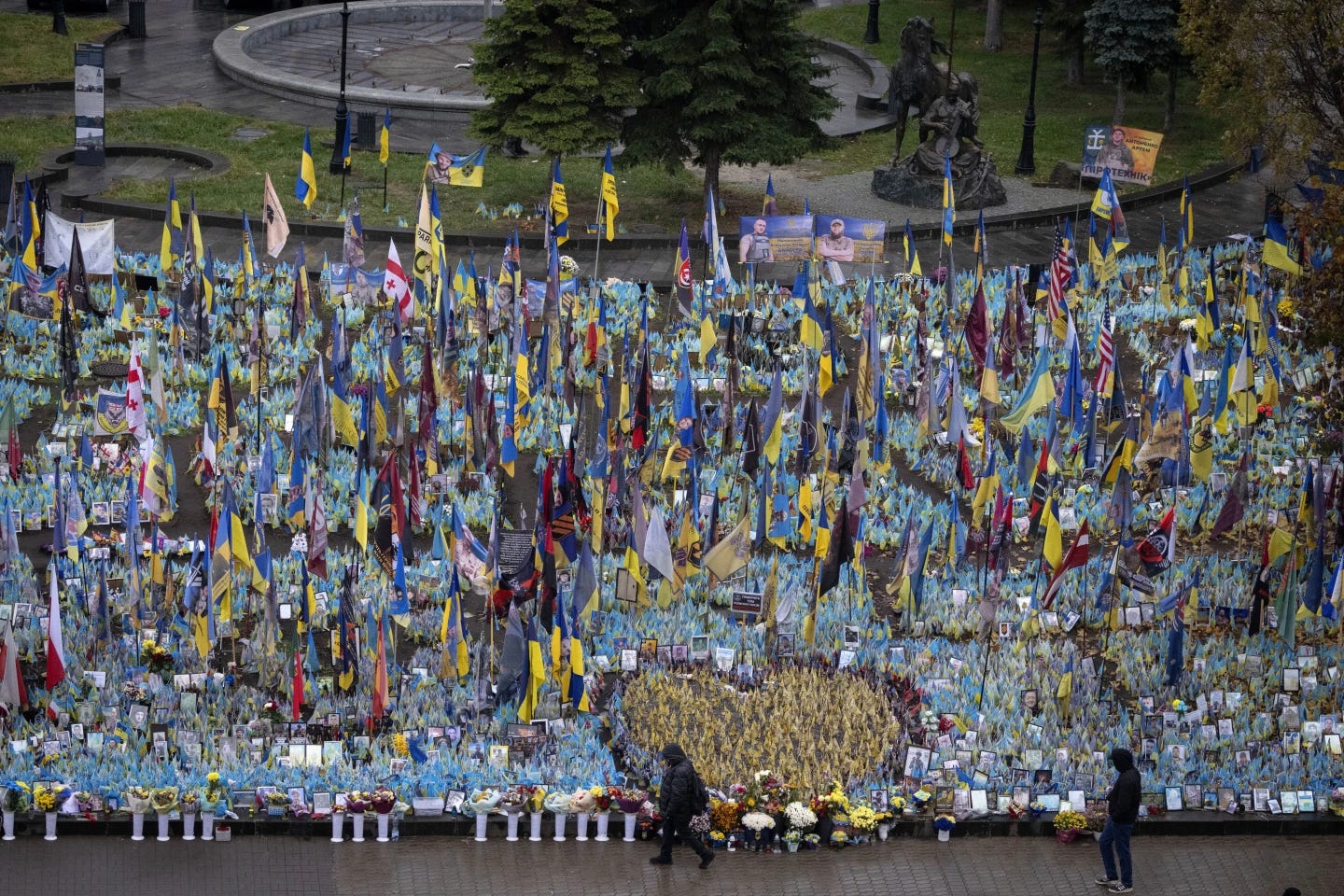
10/10, would recommend.


"telling my boss I had to resign because of “long Covid” in a deadpan parody of their neuroticism."
*Sigh*. I pushed through the earlier bait, thinking 'it's good for me to read things by people very different to me' but having spent months with crippling fatigue and years with merely very bad fatigue, I really can't be arsed with this attitude. I hope the rest of the review was good
Very sad
Writing this on shrooms so coherence might be low: this saddens me. I share your policy of "it's good [...] to read things by people very different to me", and what I observe is mostly people escaping echochambers they've grown tired of — but not by doing something constructive you might hope for — but rather by swinging wildly into whatever echochamber is opposite. So from "my corpo is obsessed with Covid-adjecent bullshit" to "long Covid is not a thing and also let's mock people for funsies". I expect the comment section underneath this to be another manifestation. And it's a shame that people like you, who are presumably pretty close to the target demographic, are turned away. If even you can't pierce the echochamber, then what chances does the rest of society have?
(I am also saddened by the LLM induced persecution of em dashes, but that's a separate issue)
As someone with about three years of chronic fatigue that may or may not be Long COVID, I still smiled wryly at that point in the post. The OP had to tell his boss something, and I don't think the Long COVID virus will be annoyed to get the blame for one it didn't do like this.
For what it's worth Covid is never mentioned for the rest of the review after that exact point that you quite the piece.
How dare anyone make a joke that offends you.
I don't think they're communicating outrage — I don't see a "how dare you!" in there. But there is a lesson for writers (or anyone trying to communicate) in this: don't offend people if you wish them to be in your audience. It seems obvious, but all the time I see people be smug and mocking and alienating people who could benefit from a piece of writing or whatever, but the author prioritises getting a cheap shot at the outgroup instead (like here). It's wasteful if nothing else, and there's quite a bit of something else I think.
(to be clear I don't think the author of this post is the worst offender by any means, it just came up here)
People need to have a sense of humor about themselves. Even if I'd had a genuinely horrible long-Covid experience, that wouldn't prevent me from acknowledging that long Covid correlates with trait neuroticism; at the very least that's the conventional wisdom. As someone who grew up Christian, for example, I was never offended by the Church Lady skit on SNL. That's because I recognized that there was a valid perception of Christianity as smugly moralistic. It's important to understand other people's perspectives even if they differ from yours. Humorlessness only does harm to the people it infests.
It'd be one thing if the entire essay was an exercise in dunking on long Covid, but it wasn't. It was a single throwaway joke and OP is doing nothing but letting their own fragile perspective needlessly limit their experience of the world, which ironically does nothing but reinforce the rhetorical point that they were attempting to undermine. Writing with the goal of avoiding all offense is the quickest way I know to destroy creativity.
I don't think the insult mattered personally. It was more like a sign of poor epistemics/judgment. Like if somebody's epistemics are such that they won't entertain long covid as a thing, why should I believe they understand international relations or war?
There is no indication that they don't think long covid isn't "a thing" or not real. There is seemingly an indication that they think that the prevalence and danger of it was exaggerated at his workplace, which may or may not be true, I have no idea since I have next to no idea what his workplace was like.
Thanks, yeah I think I probably exaggerated this! I did see other signs of poor judgment in the review as well but it's probably not worth going into/too mean.
Sure! Have a good day!
You as well! Enjoy your weekend!
Idk I think it's mostly a joke about the absurdity of some of the things that were done during covid, perhaps it's also a joke "against the outgroup" but even if it is it's a very light one, and perhaps was not intended to be one at all. But I agree with your broader point that if you want to be sure that people will be your audience you shouldn't write something that will alienate them.
If anything I think in the context of ACX, the place he submitted this essay to be read by ACX commentators, its more a joke against the ingroup than against the outgroup. I could be wrong but it seems like there's more covid "hawks" on average here compared to outside and less doves, but tbf probably more people with very specific/ detailed or extreme opinions on all sides of Covid. But anyway if I'm right about the overall general average/composition than it's a joke against the ingroup.
> don't offend people if you wish them to be in your audience
That goes both ways. Don't act offended if you wish to be taken seriously.
Put this man in charge of the Democratic Party
Incredible summary. Thanks so much for this.
Very interesting account. Thanks!
Tremendous essay. I'd love the coda. "I was part of something real and dangerous." Yes; now what?
Wow! This is gripping. Write a book, man. I would gladly buy it. And stay safe. Slava Ukraini!
If you like this type of in depth look, I strongly recommend the similar accounts from the Civ Div YouTube channel of an American soldier in Ukraine the last few years: https://youtube.com/@CivDiv
This was great. Thanks for writing it.
Shit! I want to know more! It sounds like the author is no longer on the front lines. Did he get through his entire 3-year enlistment period serving on the front? Or did he move into some other role?
Incredible. Thanks for writing!
"This whole experience made me think about the concept of the 'gang' as a natural grouping of men, and the extent to which further military development has been based on adjustments to this naturally occurring phenomenon."
This is an interesting point. I don't know how we went from feuds between foragers clans to organised states staging pitched battles, but this seems to evidence that military hierarchies naturally emerge as you add more men to a stressful situation. I'm reminded of the Nika riots in medieval Constantinople, where crowds went from being angry about cart racing to full-on-January-6th mode and a spontaneous revolution (that was quickly crushed).
Once you push otherwise civil men over some criticality threshold, they chimp out. I wonder if anyone has tried to model this quantitatively.
Amazing piece, a few questions for the author if they choose to respond:
>Before my experiences in Ukraine I used to desperately feel like I had to do something, without even necessarily knowing what it was.
So you stopped feeling that way presumably? Was there a specific turning point, or did it dwindle? A bit more elaboration on this part would be fascinating, I felt like the ending could have used more detail!
>First of all there are actually two completely separate military units called the International Legion, each under completely separate commands. This is for reasons I will not discuss
For OpSec reasons presumably?
I asked GPT, apparently there's just boring historical separation (one was originally a Georgian legion that expanded, the other one is a new one from 2022 directly under Ukrainian intelligence). Assuming GPT isn't hallucinating it sounds like this is less opsec and "boring org chart legacy reasons".
No I think it's just because it's just not very relevant to the essay or particularly interesting.
Not the most polished writing. My favorite by far. While my bet would still be the massively liked "men" of the bay-area. Dakuju & PTN PNX
This poem, published the same day by another, might act as a foil:
https://delicioustacos.com/2025/09/26/dont-be-the-guy/
"Don’t be the guy. A lot of people out there saying someone’s gotta DO SOMETHING. About the left the right Zionists Hamas blacks whites troons Nazis etc. etc. etc. Don’t let it be you. You are gonna live a long life. A nice house. A nice dog. Not end up cold and alone in the woods on the run from big men putting knees on your neck. With everyone who said someone’s gotta do something saying you’re a piece of shit cuz you did something. Someone’s gotta do something. Never them. So not you. Live a long life."
I am a friend of the author and he has been living a very fulfilled life in every way you can imagine during and after the events of the post, in different ways. Everything indicates that he will live a long life as well.
Yes don't do this just because but there are plenty of people whose lives have meaningfully improved by volunteering to help people in dangerous situations, whether it be purely civilian or military as well, or doing both at different points as this author has.
But yes don't do something just to do something, I also think doing what the author did is in many circumstances a good and noble thing to do.
Yeah, I was wondering what the author does now. If he was feeling ennui before going to Ukraine, I feel like it's gotta be 1000 times worse after being there and going back to boring society
Then you move out to the woods.
Did he mention what the dating situation was like there for American men?
Ernst Junger lived to a hundred and two, as a renowned scientist, author, and occasional anti-Nazi activist as well as a husband and a father. I think that counts as a good life for a good man, and I don't think it would have turned out that way if he'd been hanging out in Switzerland from 1914-1918.
Great risks, properly calculated, can lead to great rewards. Let us hope that our anonymous author enjoys such a life.
This was very interesting to read, but I think it failed somewhat at being a good review. The takeaways portion felt too short and disconnected from the rest; it's difficult to see the connection between the story focusing on calmer times and the opinions centered around violence.
Honestly I think it's more of a review than a solid majority of the finalists, many of which or even most don't even seem to review their subjects or attempt to review them at all. It's even the only review that actually gives its subject a rating.
There was a review of the world as a whole which did as well, I was surprised it didn't make it to the finalists.
It's very clearly just an autobiographical story rather than a "review". But it was very interesting as an autobiographical story. I generally don't find those interesting to read at all but I made it an the way through this one.
Thanks for sharing so honestly. I would read more of your stuff, fwiw
Sincerely, thanks for the service to our ally, and for the review.
If anyone is interested in more of these kinds of Ukraine International Legion stories, Lindybeige has some fascinating multi-part interviews with British volunteers starting at https://www.youtube.com/watch?v=TCbD4WBqPg4&t=3225s and https://www.youtube.com/watch?v=4LcUj47_7S4&t=182s . If I'm remembering correctly, the first guy started out digging trenches after surviving that Yavoriv recruitment center bombing, moved on to evacuating civilians from the front full-time, and then eventually worked his way up to being an FPV drone pilot.
I wonder if ISIS would have managed to take over so much territory and enlist so many westerners if the Ukraine war happened earlier. Perhaps an active conflict somewhere in the world is needed to satiate the latent demand of people like this to be part of "something real".
I think the amount of territory would've been about the same, Westerner volunteers were not significant numerically or even that significant in the limited low tier leadership roles they mostly had to the degree they even rised to leadership at all.
Also it's worth noting that lot of the Western volunteers were disaffected Radical Islamist second generation kids of immigrants who were Muslim or from a Muslim background, and those kids clearly would never have volunteered to fight in a non-Islamic war like Russia vs Ukraine. Most of the others converted significantly before they decided to volunteer in Syria or Iraq.
I find it odious to take part in a war that you have no stake in and to kill people, all because you have a fairly banal and commonplace need to seek "meaning" and camaraderie.
I'm sure all the widows and grieving mothers you've left behind aren't any more thrilled that their son was killed by some affluent American looking to dispel their bourgeois ennui, rather than a native Ukrainian.
Personally I find your statement absurd. Do you support Ukraine's right as a state to exist and not be invaded and forcibly conquered against its will and for its culture to continue to exist? Then it is hypocritical of you to criticize those who are willing to do more for it. Frankly it's odious hypocritical if you think that your own country should be allowed to exist and to kill people who invade it. I have never fought in a war but I am grateful to those who have defended freedom from autocracy and their native or adopted lands against invaders.
Foreign volunteers and heroes have existed for thousands of years. Many are considered heroes, Lord Byron of England still has statues in Greece of him, he was an affluent Englishmen involved in a war very far from home.
Your last paragraph is particularly absurd, you refute yourself in that obviously the Russians aren't thrilled to be killed in their invasion whether it's a Ukrainian or an American or a Italian or a British man or whoever.
I'm not sure this is the problem the previous commenter has or if he is actually pro Russian, but the problem I had with the reviewer is that it does not seem to me like he has done the necessary epistemic work to be confident he is on the right side of history. A-priori the chance that you are fighting for the side that deserves to win is around 50%. There are many westerners that joined to fight for the Russian side, some of whom probably thought about it a bit and came to the conclusion that Russia is on side worth fighting for. I think you can only ethically kill people if you have done the requisite philosophy. And the review makes it sound like the author didn't do that.
To me it seems like he decided to kill a Nazi if a coin he flipped would come up heads, and a allied soldier if it comes up tails. Now it happened to come up on the right side, but this doesn't mean the process that lead to this result should be endorsed.
But this is just my first impression, I may underestimate just how much the reviewer has thought about pacifism and when it can be moral to kill someone, in which case (I think) I want to thank him for fighting the good fight.
I'm pretty confident that in another world where it was possible for him to volunteer for Russia but impossible for him to volunteer for Ukraine in this same war that he would not join the Russian army.
The Russo-Ukraine war isn't so complicated that you need to do some complex epistemic work to figure out what the right side is. Unless you're being a contrarian edgelord, Russia is obviously in the wrong and Putin is blatantly evil. There have been few world conflicts that have been this cut and dry.
Whether fighting in a war is an act of heroism or savagery has nothing whatsoever to do with a person's individual stake in that conflict. A Nazi volunteer had a much greater personal stake in the Second World War than, for example, an American who chose to join the British Army before the US entered the war- but I would venture to call that American a hero and the Nazi a savage. In fact, I would say that the American's lack of personal stake in the conflict only increases their heroism.
What determines heroism is the degree to which a cause is just, and the defense of Ukraine is one of the most unambiguously just wars we've seen in a century. Here we have a despot attempting to rebuild a historically evil empire by invading the historic victim of that empire, a nascent European democracy. A man with Putin's stated ambitions will not settle into peace if appeased; war or tyranny are the only realistic options Ukraine has.
Few heroes are motivated entirely by ideology; most will also have personal motivations like a desire for meaning. But the OP chose to risk his life in a just war, and for that, he deserves to be lauded for his heroism.
I am a personal friend of the author, so let me get that bias out of the way. However I will say that the author has long had a personal stake in the war, he reads writes and speaks Ukrainian at an amazing level for somebody who learned it mostly as an adult, and has a deep love for Ukrainians, Ukrainian culture, their language, etc. And he knew much much more than the average person before he ever stood a foot in Ukraine. I assure you there's far more to it than your ill assumptions of his motivations.
He is also a deeply loving and generous person to his friends, family and strangers. He has personally hosted many people in Ukraine at no cost to them and been a great friend and host to Ukrainians and non-Ukrainians of all kinds alike.
Part of me wishes I could say more details but I will not now out of respect for my friend and will only say more about this particular issue if I talk to him first.
It's a fair point that it's probably not great to join a war just because you're bored. That got emphasized a lot more in this essay than Ukraine being a just cause. So I appreciate the additional information.
Yeah, I agree that he could definitely emphasize the personal aspect/ motivations/ ideological/ national determinations a bit more, but I think it's also kind of admirable in a way even if he probably significantly overdoes it here that he focuses a lot on the less "noble" motivations for wanting to join. It does open him up to easy assumptions and attacks though.
The more noble reasons etc. tend to be talked about a lot more elsewhere in mainstream publications and accounts so it certainly adds a uniqueness to the essay though. FWIW I think he'd be fine with me saying this, I think that he probably spent a lot less time on this essay polishing it then most other submitters if I had to guess based on what he told me about how he wrote it, though of course I couldn't know that for sure unless I talked to all of them.
”I'm sure all the widows and grieving mothers you've left behind aren't any more thrilled that their son was killed by some affluent American looking to dispel their bourgeois ennui, rather than a native Ukrainian.”
Their loss is a tragedy to be laid at the feet of the Russian oligarchs who started this war, as much as the lives of any Ukrainians killed.
It’s also a loss to be laid somewhat at the feet of the Russian populace in general who traded their agency for temporary comfort and are now paying the price for their acquiescence.
Once they were committed to this invasion these sons and fathers needed to die for justice to prevail, killing them was a just and worthy act. To pretend otherwise is to act as a willing tool of despotism.
I'm sure the grieving widows don't give two shits about the nationality of the person who killed their husbands. What about the families of the marginal Ukrainian who was spared because some American volunteer took the bullet that otherwise would've been meant for them? It's a bad look to criticize men who have more courage and character than you ever will. More often than not it comes across as a justification for cowardice.
> Years before I had read of the likes of Azov and its many foreign volunteers, and had even periodically fantasized about dropping everything and going to the Donetsk Airport.
In the end, did you get to “lead the white races of the world in a final crusade … against Semite-led Untermenschen”?
The vast vast majority of Azov fighters aren't like this. And you will find in every military on earth some amount of antisemites and racists. Ukraine is actually one of the least antisemitic countries in the world based on opinion polls on citizens of different countries, not to mention how many countries that have less than 1% of its population being Jewish still have a Jewish leader? I'm guessing from your comment there's a decent chance you hate Zelensky though.
In fact you can find plenty of neonazis and racists in the Russian army, probably more. After all they have ethnically cleansed many parts of the Caucuses and are now attempting to effectively genocide Ukraine.
The quote I provided was from Azov’s founder, and the current commander of the Third Army Corps which was formed from former Azov units. So, not some fringe rando.
The vast majority Ukrainian fighters and people aren’t like him, I agree. But it’s not an insignificant portion. And the Nazis punch far above their weight in numbers, because they tend to be the most committed and effective fighters against the Russians, and they don’t hesitate to use violence against their domestic political enemies either. Their willingness to die for the cause makes them too valuable for the powerful to sideline—similar to how the US has covertly supported Islamic extremists at various times, hoping to direct them against our enemies.
> you hate Zelensky
I don’t. I think he is wildly out of his depth, not nearly sufficient to the impossible challenges before him. I reserve my hate for the architects of the Maidan coup who led Ukraine down its present path of suicide-by-Russian
I did say "there's a decent chance you hate Zelensky", not that you hate him.
There are military units in Russia like the Rusich Group that have kolovorat Swastikas as their unit badges, they also punch far above their weight in numbers in the Russian Army.
A. The Azov Battalion members from 2014 (i.e. the ones that were fascists) were very quickly replaced by your typical NCO and officer corps when they were incorporated into the National Guard and official military command structure. It is deeply disingenuous to claim that the Ukrainians are somehow dependent on neo-Nazis for their military manpower when one of their first actions was to eliminate those same people from any leadership positions. And that is not even getting into the Russian ideology. B. Euromaidan was not a “coup”. The protesters themselves were entirely baffled when Yanukovych left because it was in the middle of the night and without any warning at all.
Andriy Biletsky (the “final crusade against Semite-led Untermenschen” guy) currently leads the Third Army Corps, commanding 20,000 men: https://www.thetimes.com/world/russia-ukraine-war/article/andriy-biletsky-azov-troops-tzfbj2v9p
If a woman's abusive ex-husband shows up at their door demanding that she come back, she drives him off by throwing cookery, and then he comes back and brutalizes her, we don't hate and blame the woman for having been attacked, even if the cookery was a tactical error.
In the case of Maidan, maybe that was an error, maybe it wasn't. I tend to think that an invasion by Putin was uncertain enough, and the difference in freedom and standard of living between becoming another Belarus and another Poland was great enough that it probably was not an error (though perhaps they should have gone through the full constitutional impeachment process rather than shortening it out of panic over the protests). Even if it was an error, however, the people of Ukraine have a moral right to separate from Russian influence; an error there should be met with sympathy, not hatred.
The moral violation in this conflict is on the part of Putin, and our hatred should therefore be reserved entirely for him.
Maidan wasn’t an organic upswelling of the true sentiments of the Ukrainian people for freedom, or whatever. Some Ukrainians wanted closer relations with the EU & USA, others wanted closer relations with Russia, yet others wanted to maintain a balance. Maidan was a violent, USA-instigated coup by one faction in the country against the others
Even if we accepted all of your very dubious claims as true that doesn't mean it wasn't an organic upswelling of the true sentiments of 55% or (insert your own personal percent or number here or anyone else's) of the Ukrainian people who wanted closer relations with the US and EU
Russia obviously attempts to use its influence all the time to start coups or control countries, both now and historically. If they had been able to start a hypothetical coup that 70% or pick your number, doesn't matter, would disapprove of but make Russia a far more controlling and influential country than the US and EU have ever been in Ukraine they would do it.
If you're going to condemn the EU's and US's actions and examine them at every turn you also have to examine Russia's actions past and present and condemn them when appropriate. Russia is not above having coups and if it were more powerful it would be doing more and more of them, it's inability to coup Ukraine has little to nothing to do with morality and almost everything in its lack of power and ability to do it despite no lack of trying up to even mounting a gigantic war and invasion attempt.
By the way even if the US/EU put little to no pressure on Ukraine at all there would still be many millions/ tens of millions who would prefer the EU/US as a partner over Russia.
I have no love for Putin, but I speak more about the crimes of my own leaders, because they are supposed to represent me.
Legitimate point enough but it's important to remember the other side too.
By the way if there was a button that would "magicly" make all sides accept an "Ending the war tomorrow with the present lines agreed to" including Russia occupying what they do now I would personally press that button, probably almost instantly.
While I do think Russia's actions are criminal and evil one still must be realistic, and while not impossible I think it is more probable than not that Ukraine will not recover Crimea or the Donbass anytime soon. Not impossible, but pretty unlikely.
> By the way if there was a button that would "magicly" make all sides accept an "Ending the war tomorrow with the present lines agreed to" including Russia occupying what they do now I would personally press that button, probably almost instantly.
Yeah. Unfortunately that is not likely, Putin knows he is winning and sees no reason to stop now. If only we hadn’t sent Boris Johnson to order Zelensky not to make a deal back in April 2022…
It absolutely was an organic upswelling of the true desire of a majority of the Ukrainian people for freedom. Just prior to the Euromaidan protests, Yanukovych was polling at 7.8% "trusted" and 65% "untrusted" (see https://archive.kyivpost.com/article/content/ukraine-politics/poll-klitschko-has-highest-trust-rating-among-ukrainian-voters-331837.html). During the protests, 73% of the Ukrainian parliament voted to remove him from office. Afterward, 56% of Ukrainians characterized the ousting of Yanukovych as a "popular revolution" and 34% as a coup.
It's true that both the US and Russia gave funding to activist groups calling for more European or Russian integration. Those groups also received most of their funding from domestic sources. As much as people like to attribute magical powers to the State Department's ability to influence foreign politics, obviously that kind of funding isn't going to produce strong majority support for a political movement out of thin air.
The whole "USA-instigated coup" line is pure Russian propaganda- I sincerely don't know how anyone could look at the data and come away with that impression in good faith.
Yanukovych was a corrupt gangster, yes. So was the rest of the Ukrainian political elite. Doesn’t imply that Ukrainian people were all on board with antagonizing Russia. (FWIW I agree with Boinu here: https://open.substack.com/pub/astralcodexten/p/your-review-the-russo-ukrainian-war?comments=true&commentId=160353873)
"All on board", no. "Majority on board", however- I think the polling supports that.
You're correct, though I'd dissent on Maidan being strictly engineered; as usual with these things, the core of the movement was genuine. It was merely cynically amplified and steered.
I hope the review contest has an understatement category award, because the following paragraph would be worthy of a nomination:
"The Ukrainian Insurgent Army has historically had a very controversial legacy even in Ukraine, being accused of pogroms and ethnic cleansing during its war. Consequently, before the 21st century Russo-Ukrainian War their legacy and symbolism was much marginal in Ukrainian society. Certain elements have always glorified them, but especially older generations often chafed at the harsh and militant repudiation of the Soviet past. This touches on the very core of the conflict: the question of Ukrainian national identity."
There were a number of directions in which post-dissolution Ukrainian national identity could have evolved. Not all Ukrainians active in WWII were members of UPA. Many fought bravely and well as part of the Red Army and helped build and govern the post-war Soviet Union, and many in the east even as late as 2014 spoke in surzhyk and saw themselves as vaguely supranational. Unfortunately, beginning under Yushchenko and especially under Poroshenko/Yatsenyuk, a deliberate effort was made to rehabilitate the Nazi-aligned leaders (Bandera and Melnyk most prominently, but also e.g. Petliura and Shukhevych).
The sad part is that Zelensky's election in 2019 represented something of a pushback against this version of Ukrainisation and against the harsh approach to the east. The only problem was that the Azov and aligned fighters had no interest in obeying his instructions, as in the famous clash in Zoloty, and he quickly reeled back the national reconciliation agenda.
It's always felt very weird to me that so many recent generations were never drafted to fight in a major war. Our ancestors seemed to always be attacking or defending something, and all us Millennials could do was volunteer to fight in some middle east country we couldn't care less about? I'm sure it's for the best, every history class I ever took discussed how terrible war is, but it's also like we're missing an important part of human development. Like maybe people would stop caring about pronouns if they actually had an existential threat to strategize against? Or jobs would feel more meaningful if there's some big victory at stake?
It's also surprising in hindsight that technological advancement couldn't fill this void. Whole generations adapting to new tech as fast as it releases could have been a great substitute, and maybe it was for awhile, but everything plateaued hard after the iPhone released 18 years ago. No one on the planet needs to adapt and become an expert to use Twitch or 4K TVs or the latest phone app.
The United States went without mass conscription up until the Civil War, then we dropped it until WW1. Rather than being constant, Peter Turchin has the idea that there are generational cycles in which a generation will become averse to war as a result of experience with it, but later a different generation without that experience will be more eager for it.
“It may be jarring for the reader to see me jump from preparing for war to writing a tourist guide, but it was also a surprise to me”
This was basically the first few hundred pages of Sherman’s memoirs to be fair
I certainly can’t verify anything in the story but it sure has the “no shit there we were” quality of a real army story.
Obviously almost no one can confirm what I'm saying is true but all I can say as someone who personally knows the author for many many years long before the events of this essay is that it's all true and that in a lot of ways you could even argue that he underplayed many aspects of what he talks about/experienced.
But there are obvious reasons to be careful about revealing too much information about something like this so I can not provide more substantial proof other than my words above. But it is entirely possible that the author will reveal more in the future, and perhaps a lot more the further into the future we go.
well written, yes; insightful, yes, in its own way--but a review should be about truth-telling, and truth-telling about war has a kind of moral urgency that seems strangely lacking in this review. (And indeed, lacking in the reviewers' brothers-in-arms, judging from what he writes.) There seems to be a fundamental difference in worldview evinced here such that I certainly don't think I can vote for this!
Tell the truth in what way exactly? Your truth?
If anything this review strikes me as extremely truth-telling in the sense that it tells many truths of the authors experience(and others seemingly) who have been directly involved in war that people in the West are almost always told the opposite. Namely that for many decades the overwhelming tendency in the West has been to everywhere and always for the most part emphasize that war is a necessary evil full of evils at every turn at best and almost always the worst kind of evil in almost every way at worst.
I'm sure if the author wrote a longer essay he could get deeper into the nuances on both sides about all the evils and goods that he has experienced in the war and in more general both the evils and the positive aspects of the war. But clearly in this short essay he's decided to emphasize the parts that go against the most commonly heard things about war in the West.
If you personally fought in a war and found the things that he said in this essay accurate or at least the vast majority of it accurate would it also be a strangely lacking of truth-telling by you to write an essay like it.
Truth spectacularly ugly, offensive, and unpopular sometimes. While I can't know with 100% certainty it seems that possibly you have encountered a truth that is painful, offensive, or ugly to you and that actually your comment has the reality reversed. It's just a possibility.
By the way caveat that even if it's truthful in many senses (all senses?) obviously we don't have to agree with it 100%, I certainly don't agree with it 100%. Otherwise there'd be a higher chance I'd be in some military defending an invaded country.
What would it mean for it to be truthful in all senses, but for you not to agree with it 100%?! I feel we are using the word "truth" in different ways.
I had a question mark still in the "all senses", it was being a bit playful.
So ignore the "all senses?" part then, if you otherwise have a desire still to respond to the rest of my comment.
eh, kind of feels like he softpedals the experience of war a lot. Little bad seems to happen to him, to the point where I wonder about it.
i mean reading this i wouldn't be saying "war gives meaning" as opposed to "thank god, i fucking got lucky." No long period of getting sick, no telling us about the guy making the funny sign wound up getting shot one night while trying to take a shit, no nearly getting killed by your own side, etc.
People who hate war do also say "War Is A Force That Gives Us Meaning" (describing the psychological experience, not saying the meaning is realer and more valid in a way that's lacking in the absence of war) (the title of a Chris Hedges book)
but yeah, I am noticing the lack of mention of arms blown off
More on koryos: https://www.razibkhan.com/p/casting-out-the-wolf-in-our-midst https://en.wikipedia.org/wiki/*K%C3%B3ryos
Why were shotguns ineffective versus drones?
> I think our modern culture has built a very strong taboo around certain parts of the human experience, and I understand there are valid reasons for that taboo, but I can’t help but roll my eyes a little bit at the idea that there is nothing cool or ennobling about war. Really, nothing? Have you ever felt the rush of seeing an enemy tank destroyed? There is and I won’t pretend there isn’t.
This whole section reminded me a lot of Marltenez's What It's Like To Go To War, which balances both this side and the tragic side. I remember him talking about taking a ride in a chopper dropping napalm in Vietnam and going "hell yeah burn those assholes", and then reflecting how as an older men with children of his own that age, he'd still fight the same way, but he'd feel terrible grief about it instead. Maybe it's just something you naturally change about with age.
I've taught senior non coms at West Point and, also College courses in the literature of war. I'm long since retired, but I were still active I would absolutely teach this piece. From the aimless youth pre Ukraine, you've become an Adult and a fine writer.
Слава Україні!!!!
This was an incredibly fun read and I hope the guy lives forever.
I think it's funny that there are so few major wars in the US that you have to go volunteer to fight somewhere random now if you want the honor and to sate your undying thirst for blood. Still, even normal war looks super boring by these standards. Like the only danger is that modern weapons vaporize you before you know what happened. You never actually fight anyone. It's pitiable that modern weapons reduce war to who has the better targeting system.
To his point about AI, humans will eventually need not apply at all. Suicide drones, as something like the saying goes, are the worst they'll ever be and seemed like a constant threat alongside mortars.
I bet this guy could have gotten a lot out of getting really into lifting or a sport, probably more than shitting in a hole that wasn't quite deep enough. At the end of his experience, he has to go home. He's still broke, still needs a job, still can't quite escape HR people, and based on the way he talked about meeting people from foreign countries, probably didn't come back to close friends at home.
Anyway, war is only 2/10, I wouldn't recommend it because you actually die in real life.
"He's still broke, still needs a job, still can't quite escape HR people, and based on the way he talked about meeting people from foreign countries, probably didn't come back to close friends at home"
Literally everything in this statement is wrong, especially the last point. Not only does he have close friends in the United States but many of them have personally gone through all the hurdles to visit him for months at a time in Ukraine, and at least one of them for well over a year (possibly 2+ years total in Ukraine going back and forth?). I know because I personally know all of them, and also visited him in Ukraine for over a month.
"I bet this guy could have gotten a lot out of getting really into lifting or a sport, " This parts only quasi right or half right, he already got a lot out of both before ever going to Ukraine and always has ever since including up to now.
"...roll my eyes a little bit at the idea that there is nothing cool or ennobling about war. ... Have you ever felt the rush of seeing an enemy tank destroyed? There is and I won’t pretend there isn’t."
"Feeling the rush" is supposed to be cool and ennobling? Obviously, the author wants to imply that the "rush" in this case is tied to one's sense of meaning. But if addressing that sense of meaning is sufficiently "superior" in some way to addressing other forms of "feeling the rush", say with meaner or baser indulgences, the author hasn't made the remotest attempt to justify it. Almost certainly, almost all sides of almost all wars have people tying it to their sense of meaning, and the externalities are too significant for it to suffice to address them with just words like "nobility" and "honor" or a historical reference to koryos.
It seems that the author is content to set up a narrative about honor, and let resonance with his intended audience do the rest of the hard work, while making no more than a formal nod to the existence of the "modern perspective" in lieu of actually accounting for any of it.
> But if addressing that sense of meaning is sufficiently "superior" in some way to addressing other forms of "feeling the rush", say with meaner or baser indulgences, the author hasn't made the remotest attempt to justify it.
Perhaps we should consider whether these other "indulgences" are so horrible, rather than just a natural part of being a man. I would hope the recent political shifts have been teaching people the costs of getting in the way of human nature...
This is very 4chan-esque, in a good way, as if a frog went to war and then instead of greentexting about this he wrote this dry contemplation.
Please host more things which are so clearly outside of the bubble.