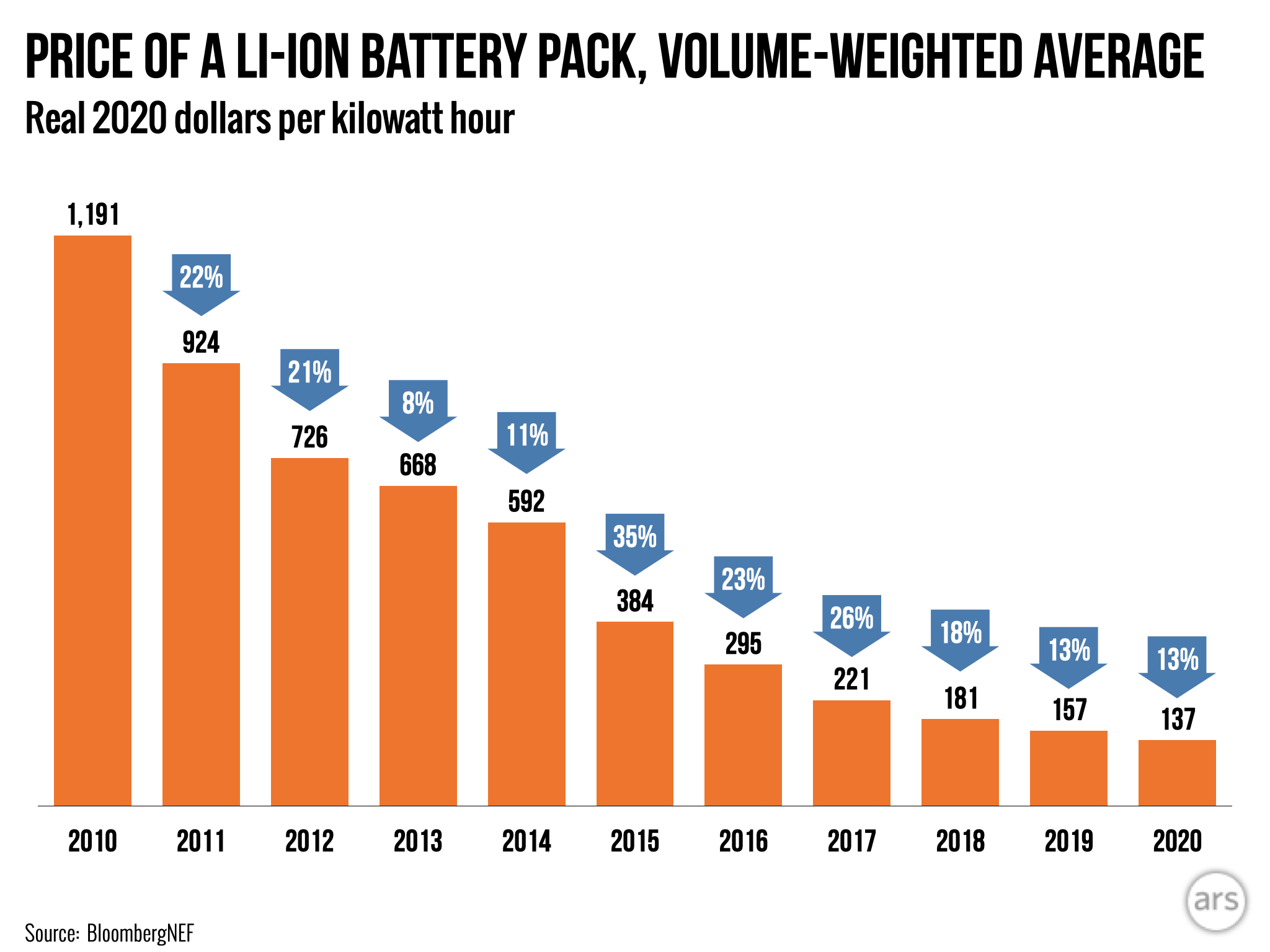
The average cost of a lithium-ion battery pack fell to $137 per kWh in 2020, according to a new industry survey from BloombergNEF. That's an inflation-adjusted decline of 13 percent since 2019. The latest figures continue the astonishing progress in battery technology over the last decade, with pack prices declining 88 percent since 2010.
Large, affordable batteries will be essential to weaning the global economy off fossil fuels. Lithium-ion batteries are the key enabling technology for electric vehicles. They're also needed to smooth out the intermittent power generated by windmills and solar panels.
But until recently, batteries were simply too expensive for these applications to make financial sense without mandates and subsidies. Now, that is becoming less and less true. BloombergNEF estimates that battery-pack prices will fall to $100 per kWh by 2024. That's roughly the level necessary for BEVs to be price-competitive with conventional cars without subsidies. Given that electric vehicles are cheap to charge and will likely require less maintenance than a conventional car, they will be an increasingly compelling option over the next decade.
A virtuous circle
Like most high-tech goods, batteries tend to get cheaper as they are manufactured at higher volumes. As the world builds more and more electric cars, grid storage installations, and other battery-based systems, higher volumes will drive prices lower and lower.
Economists define the "learning rate" as the percentage decrease in price for every doubling of output. BloombergNEF estimates that the learning rate for batteries is about 18 percent: every time global battery output doubles, prices fall by 18 percent.
Battery prices declined 13 percent between 2018 and 2019 and another 13 percent by 2020. These are certainly significant improvements, but the rate of progress seems to be slowing. Battery prices declined at an average annual rate of 19 percent between 2010 and 2018.


 Loading comments...

