


Arkansas Raids Uncover PRC-Linked Human Trafficking Ring Spanning Turkey, Mexico, and U.S. Coasts
Visa Fraud, PRC Crime Bosses, Latin American Smuggling Routes Align With The Bureau’s Findings

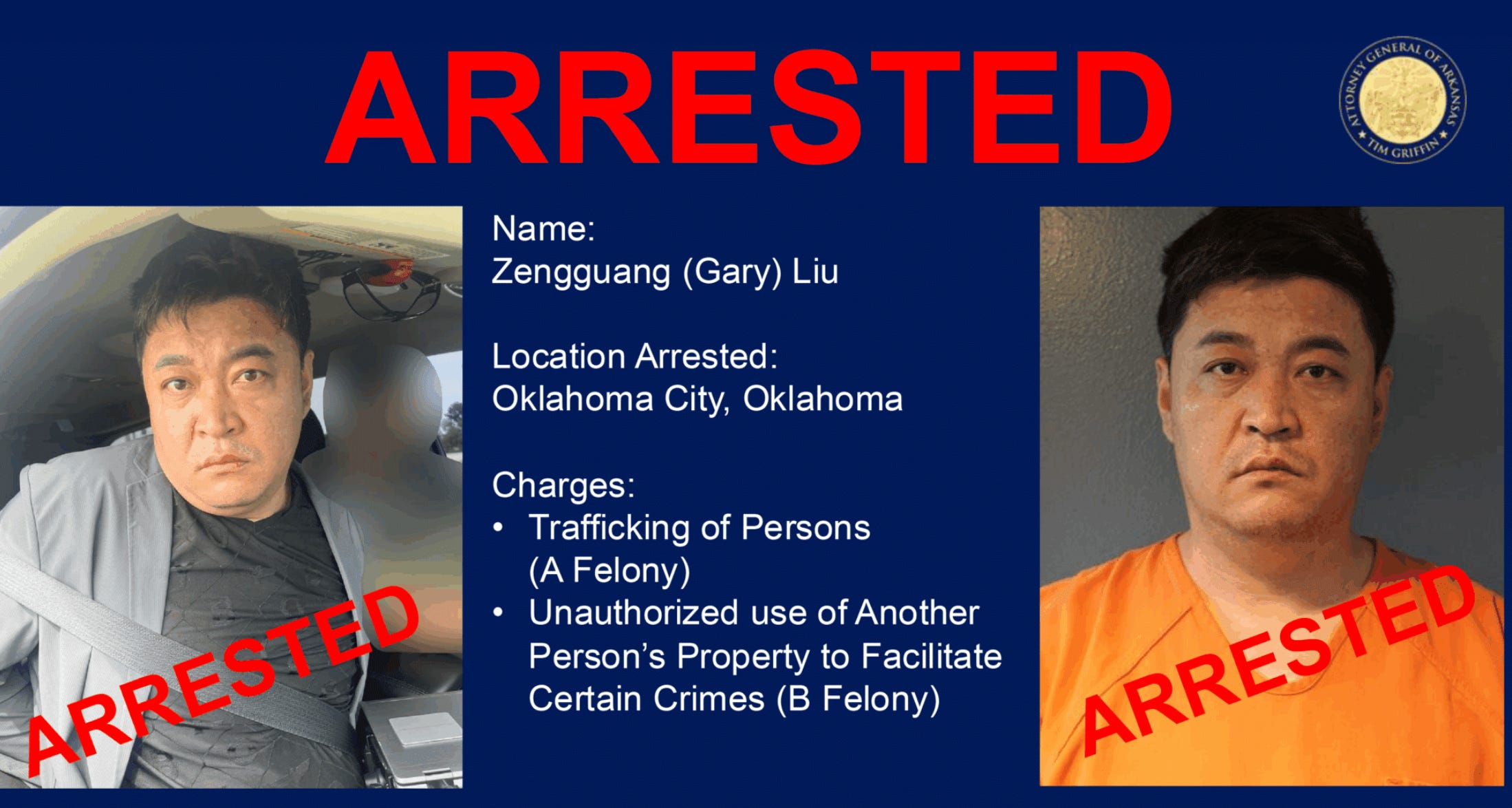
LITTLE ROCK, Ark. — The stories began the same way. A video on Chinese social media promised good work in America. One woman drained her savings for a ticket to Turkey, obtained a visa, boarded a cruise ship to Mexico, then walked across the southern border in a migrant caravan and claimed asylum. A second victim described nearly the same route. A third answered a web ad from China, made her way to Los Angeles and Seattle, and was ultimately sent to Arkansas. All three — Chinese nationals — ended up in Hot Springs, a city of roughly 38,000 residents, coerced into sexual labor inside “illicit massage” storefronts.
In the heartland of America, Arkansas investigators say they have arrested a “mid-level” operative working for bosses in China, exposing a Chinese transnational human trafficking network that mirrors the visa-fraud schemes and Latin American smuggling pipelines first identified decades ago in intelligence files reported last year by The Bureau.
Earlier this week, Zengguang “Gary” Liu, a naturalized U.S. citizen from China, was arrested in Oklahoma City by U.S. Marshals and Oklahoma City police. Liu is accused of owning and operating at least three illicit massage businesses in Hot Springs — AI Massage, Magic Massage, and Diamond Massage — where Chinese women were forced into sexual slavery. According to Attorney General Tim Griffin, all three victims found in the July 28 raids were Chinese nationals recruited through online job ads and social media in China, funneled through Turkey and Mexico, and brought into the United States via asylum claims after crossing the southern border.
State investigators say Liu’s businesses were part of a sprawling network of at least 13 illicit parlors across Arkansas, tied to several Chinese nationals believed to have fled back to China. Authorities suspect the network also operates additional prostitution and human trafficking nodes in other parts of the United States.
“In Mexico, she told our investigators, she walked across the border into the United States as part of a caravan of migrants and then claimed asylum after being detained by U.S. Border Patrol,” Griffin said of one woman, who has been provided victim services. “She was recruited for illicit massage work by a friend in southern California.”
The July raids were part of “Operation Obscured Vision,” launched January 23, 2025, with coordinated strikes in Harrison, Hot Springs, Jonesboro, Little Rock, Rogers, and Russellville. Across three phases, authorities served search warrants at 13 illicit massage businesses, identified 23 victims — all Chinese nationals — made seven arrests, and issued two warrants for Chinese nationals believed to have fled the country. More than $107,000 in cash has been seized, most in U.S. dollars but also in Chinese yuan, Turkish lira, Thai baht, Mexican pesos, UAE dirham, and Serbian dinar, indicating sophisticated cross-border laundering.
“The pattern here is clear, and it matches the intelligence and reports we have heard from federal partners and law enforcement agencies across the country. Criminals based in China have gained a firm business foothold in the United States with illicit massage businesses,” Griffin said. “Law enforcement agencies across the country are dealing with this issue to varying degrees.”
Liu’s capture in Oklahoma City shows the network’s operational range, while the multi-currency profile echoes money flows tied to human trafficking, sexual massage-parlor fronts, casino money laundering, fentanyl trafficking, and underground Chinese banking systems documented in Vancouver’s “refining” model of drug-cash laundering. Those criminal fact patterns, revealed in Canada’s E-Pirate investigation, also pointed to Chinese Triad links between Vancouver and underground banking routes through Las Vegas and California, according to documents reviewed by The Bureau.
Based on a March 15, 2024, bankruptcy petition filed in the Central District of California under the name “Zengguang Liu,” which lists a Mercedes-Benz, massage business interests in California, and related commercial lease obligations, the ownership pattern and asset profile match those of a multi-business operator of the type described by Arkansas officials. In the filing, obtained by The Bureau, Liu reported owing creditors more than $700,000. While these details suggest the filer is likely the same Liu at the center of the Hot Springs case, law enforcement has not confirmed that the bankruptcy debtor and the Arkansas defendant are the same individual.
In Arkansas, Griffin described Liu as a mid-level operator in a larger enterprise, a characterization that tracks with established trafficking patterns: online recruitment in China; staging through Turkey and Mexico; entry via U.S. coastal gateways such as Los Angeles or Seattle; and quiet redeployment into inland markets where itinerant massage circuits rotate women to avoid detection.
ProPublica has detailed in multiple investigative reports the reach of transnational Fujian crime networks across the United States, particularly through human trafficking, forced labor, and illegal marijuana operations in Oklahoma — the state where Liu was arrested. There are no public Arkansas documents naming a specific Chinese province of origin for the victims or operators, but prior intelligence and U.S. reporting have long identified Fujian as a principal hub for Chinese human smuggling, with official corruption shielding Triad-linked syndicates. That context is central to The Bureau’s exclusive reporting on historic intelligence files.
The trafficking routes in Liu’s case closely mirror the global pipelines described in those records. In 1993, Canadian consular officer Brian McAdam warned in a classified study, Passports of Convenience, Corrupt Officials and Triad Involvement in Illegal Immigration, that an unprecedented surge of illegal immigration from China was being driven by collaboration between drug-smuggling Triads, corrupt officials worldwide who sold or facilitated visas for human trafficking, and senior Chinese Communist Party leaders.
McAdam cited U.S. Immigration and Naturalization Service intelligence that the Governor of Fujian had ties to the Sun Yee On Triad and that the governor’s wife was suspected of investing in Triad-owned companies. Two years later, a U.S. Department of Justice report, Chinese Organized Crime and Illegal Alien Trafficking: Humans as a Commodity, supported McAdam’s conclusions, warning that “negotiations between the Sun Yee On Triad and the Mainland Chinese Government have taken place” to expand Triad activity into legitimate business and alien smuggling, and describing “an acute security threat posed by government links to organized crime societies” that pushed hundreds of thousands of Chinese each year into illegal migration.
McAdam’s work portrayed a sophisticated, state-protected criminal enterprise with strategic leadership in Beijing and operational hubs in Fujian, tied directly to global human smuggling. The Arkansas case, in which Liu is described as a mid-level owner of multiple illicit massage businesses, may fit that model: a local storefront operator embedded in a transnational chain that moves victims across continents, launders profits through multi-currency underground networks, and exploits legal and geographic gaps between jurisdictions. The Bureau’s historic findings suggest such operators are only the visible end of a pipeline whose highest-level controllers — rooted in Chinese organized crime and Party structures — remain insulated from prosecution while their networks adapt and persist across decades, continents, and shifting migration routes.


Forget any trial, he should be marched to the gallows. Its high time for some societal cleansing.
How the US allows China to operate business’s or purchase land here boggles the mind. If they were really serious about clamping down on this stuff they would go to these extremes to stop it.