


Iran’s Hand in Russia’s War on Ukraine Demands a Clear Response
Zelensky’s warning on Iran’s drones should be matched by Ukraine’s designation of the IRGC as a terrorist group
By M. Mehdi Moradi
OTTAWA — Israel’s Foreign Minister Gideon Sa’ar’s recent call for Ukraine to designate Iran’s Islamic Revolutionary Guard Corps (IRGC) as a terrorist organization has underscored what many have long acknowledged in whispers—though few have dared to name with precision. The time for political restraint is one Ukraine can no longer afford, as the regime in Tehran works with calculated intent inside Russia’s war against Ukraine.
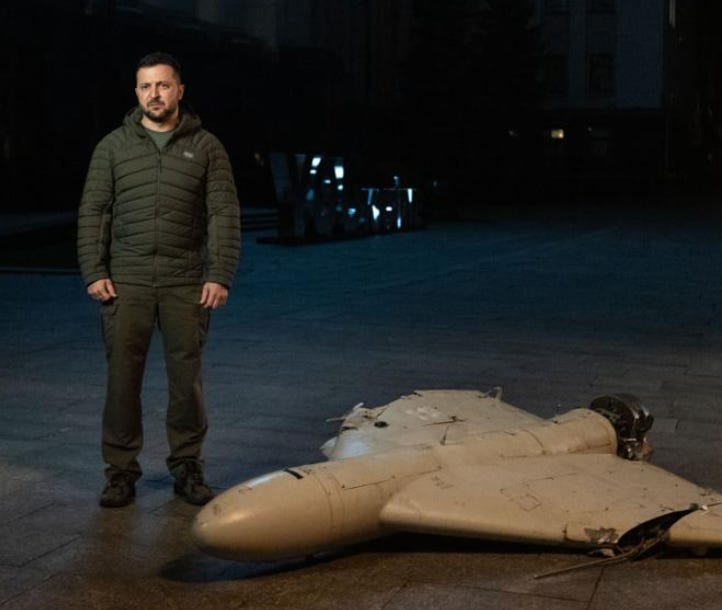
There is hardly a day when Ukrainian cities are not struck by Iranian-made Shahed drones. They arrive in broad daylight or deep night, killing civilians in apartments, hospitals, and streets, and leave a familiar pattern of destruction whose author is no mystery. Manufactured by the IRGC's Aerospace Force and, through a massive Tehran-Moscow arms deal, now adapted for production on Russian soil, these improvised weapons are products of deathcraft engineering. The Islamic regime of Iran is never a distant observer in this war; it is a material actor on the battlefield.
A little more than a year ago, President Zelensky addressed this reality directly.
“The sound of Shahed drones, a tool of terror, is the same in the skies over the Middle East and Europe,” he said. “This sound must serve as a wake-up call to the free world.” But the sound he spoke of had echoed long before. From the outset of Russia’s invasion in 2022, reports revealed that Iran had sent IRGC personnel to Russian-occupied Crimea to help operate the drones. That early warning passed without meaningful consequence, and Zelensky’s words arrived only deeper into the storm.
Here is some Canadian context: I also have seen Tehran’s hand in civilian deaths.
As an Iranian-Canadian justice advocate, I began dedicating much of my work in Canada to the campaign for listing the IRGC in the wake of the downing of Flight PS752, which claimed the lives of 176 innocent people, many from my own community. That the aircraft belonged to Ukraine made the tragedy all the more bitter in its irony. In 2023, I helped organize Montreal’s first rally exclusively focused on this demand, addressing the crowd as part of a growing chorus of determination. Beyond joining sustained protests, I engaged with MPs and senators in Ottawa alongside the PS752 victims’ families to press the urgency of the cause. In May 2024, Parliament passed a historic motion in support of the designation, and the Canadian government made it official a month later.
It is from that landscape that I now speak to Ukraine. I have met Ukrainians in Canada who, understandably, hold Iranians collectively responsible for the partnership between Tehran and Moscow. It is a painful encounter, and one I do not deflect, but engage directly. Last year, at Ukraine’s Independence Day rally in Montreal, I was invited by the Ukrainian Canadian Congress to speak—offering testimony and solidarity from those who fled the same regime now arming Russia and who, in understanding Ukraine’s grief, have long sought to expose and counter its reach.
Now recall President Zelensky’s warning: “The sound of Shahed drones, a tool of terror, is the same in the skies over the Middle East and Europe.”
What followed was not a reckoning, but persistent ambivalence. The Islamic regime’s embassy remains open in Kyiv. Despite downgraded diplomatic status, there has been no break in ties, no legislative move, and no recognition that the regime killing Ukrainians by night is still received by day. Though Canada, itself marked by victims of the IRGC’s reach, has listed the group alongside the United States, Ukraine has stalled. Even the 2023 bill introduced in Ukraine’s Parliament was quietly abandoned, never to resurface. This ambiguity conceals the true nature of a regime whose “tool of terror” still flies beyond reproach.
Urgent questions remain: how can officials, diplomats, or IRGC operatives of the Islamic regime move freely in Kyiv while their drones incinerate Ukrainian civilians? How is it acceptable that one set of agents arrives in the morning, while another, operating within the same regime apparatus, hails the slaughter by night—while the machinery behind it remains untouched? This contradiction, often reduced to diplomatic warnings, lingers within Ukraine’s reality and clouds the integrity of purpose it has shown throughout the war.
The IRGC, operating under the facade of a military force, has long functioned as the extraterritorial machinery of repression for the Islamic regime. From building Islamist proxies and dropping cluster bombs on civilians, to massacring Iranians during nationwide protests and orchestrating assassination plots in Europe, its history is marked by systematic bloodshed. Its presence in Ukraine, forged through an alliance with another ideological dictatorship—that of Putin’s Russia—and sustained through military support, is no longer speculative. To treat this entity as anything but a terrorist organization is to trivialize the very language of terrorism itself.
Ukraine cannot afford to maintain this paradox. If Canada and the United States listed the IRGC for killing their citizens abroad, Ukraine’s case is even stronger, as its civilians are targeted daily at home. It defies principle to designate the IRGC in North America while excusing it in Kyiv. The urgency is immediate.
When a state hosts the machinery of terror while condemning its effects elsewhere, the illusion of moral coherence collapses. The failure to confront the IRGC cannot be justified in the name of diplomacy, and certainly not in the hope that, one day, those agents of terror will change. Enough to note that years after the PS752 tragedy, the regime has refused responsibility and obstructed any meaningful investigation, forcing Canada, Sweden, the United Kingdom, and—of course—Ukraine to bring the case to the International Court of Justice, while the IRGC continues to harass and silence grieving families. This entity is neither fatigued nor restrained; menace is written into its very foundation.
Born of a struggle against the regime and speaking as one who paid the price in exile, I write from within a reality Ukrainians now recognize. For millions subjected to decades of the regime’s brutality, the tragedy of Ukraine follows a pattern that remains painfully present. If Zelensky’s words about resisting the normalization of terror are to carry weight, then I join Sa’ar’s call for listing the IRGC as the step, where Zelensky’s conviction must begin.
The writer is an Iranian-Canadian journalist and justice advocate focused on national security risks, including Iranian regime militant organizations and their global affiliations.


Early in Trudeau's first term, he was about to open an embassy in Tehran. This was sidelined by the PS752 tragedy. The current PM has continued Liberal Party support of Islamists by continued funding of UNWRA, and recently his vocal support for a two state solution. Canada provides safe harbour and a back door into the USA for Hezbollah, Hamas, IRCG and their drug and money laundering operations to continue funding global terrorism. These groups now also work in league with Chinese global drug operations who have made BC and its ports the gateway to North America and international distribution of drugs. I can only assume this is due to the deep corruption of current federal and certain provincial governments, courts and police. Canada has become a rogue nation and an international pariah.
Ukraine is the actual terrorist regime.