Donald Trump’s next target could be deal that shields most Canadian imports from tariffs, experts warn
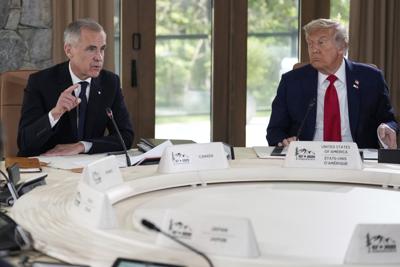
Canada’s biggest shield against U.S. tariffs is still intact after Donald Trump’s latest trade deadline, but that could change by next year, experts warn, as Prime Minister Mark Carney prepares for a new round of talks with the mercurial American president.
Conversations are opinions of our readers and are subject to the Community Guidelines. Toronto Star does not endorse these opinions.
Sign in or register for free to join the Conversation
Conversation
|
Top Comments
Comment by BobV.
Carney needs to be bolder, by literally playing Drumpf's game in the simple language and communication which he understands. Any partial acceptance or compromise will be a losing proposition for Canada. Carney is in a very unique position of having the whole country, united, behind him. He simply states to America, zero tariffs, that's it. Simple, easy to understand. America will not accept this, but it sends the most powerful message that we are standing firm. The stakes are really high, but the misconception that we need to appease America is false. As for the CUSMA pact, we state that in 2026, we will be glad to bring those tariffs to zero also. Let Drumpf and his cronies understand there is a solid fence between our 2 countries. It will also signal to other countries that we don't accept 'stuff' from anyone, period. I fully expect the moderates to downvote this opinion big time....but realize this is also a possible outcome of 'negotiations'.
Comment by Tom.
Mark Carney did not get a trade deal done. But based on what we can surmise no one who was standing up for Canada's interests could have done better. Negotiations are difficult when you are dealing with people who do not have the authority to say yes or no to a deal. Items are agreed to and the next day are back on the table because Trump rejects the agreement. It should be abundantly clear that we need to build our internal trade, secure new or expanded markets abroad and develop and manufacture our natural resources. Even if Trump is slowed by the 2026 mid terms we have to continue working toward economic independence from the US. The divorce is complete it is time to move on.
Comment by Dennis.
We tend to forget that the smart negotiators, like Carney, walk softly and carry a big stick. Fighting back is stupid. Preserve what we can in the USMCA and then quietly go about building Canada strong, develop the natural resources and energy transportation, go full steam building the infrastructure we need and swiftly diversify your markets. Right now we have an average of about a 3% tariff rate if spread across all items. Comments like Carney is moving too slow is partisan rhetoric and isn't helpful. The election is over, the NDP is now irrelevant and Carney is siding with 75% of the PC's platform. So knock it off and start thinking like a Canadian and unite.
Comment by Dale.
I think the article ignores....
That the failure to agree to open CUSMA defaults to a 2036 (not 2026) end date, with ongoing ability to extend.
That CUSMA is legislated, and ignoring it would force the constitutional issue of who has tariff and and trade authority in their constitution, outside of the very limited mechanisms he has stretched to their limits.
That attacking profitable branch plant assets of the US's largest companies also has consequences, ALCOA, Ford, GM etc....
So expect a lot of commentators demanding we open CUSMA right now, because that is the most likely, maybe only, path to Trump fully realizing his goal. A lot of the 51st state rhetoric is probably because someone showed him the very large barrier in the way of his pre-income tax tariff fantasy. So he tried the Jericho manoeuvre to see if it would fall over. Pretty standard practice for him. Expect it to ramp up as we stand pat on our best asset.edited
Comment by Robert.
Canada has tactics to limit the impact of US tariffs:
(a) gain domestic economies of scale by reducing interprovincial barriers to produce goods that we can competitively:
(i) sell to countries other than the US and
(ii) sell domestically to reduce the need to import;
(b)increase trading in goods with many stable and reliable countries that, like Canada, can gain through bypassing US trade and tariffs;
(c)impose selective tariffs on US goods that Canada can produce or acquire from trade with other countries.
The Federal and Provincial governments, along with Canadian companies, are actively working to make these tactics effective. In many countries affected by US tariffs, both governments and companies are open to adjusting their trade relationships to collaborate with each other and with Canada, in order to avoid US tariffs.
Canada and the US will continue to have a trade relationship. Increasingly we will not be dependent on that relationship.
The question of the legality of Trump's global tariff shakedown is now before the US courts. The rulings of these courts may well be to strike down the tariffs.
In short, there are grounds for optimism provided we remain resolute and act wisely.
All Comments
Comment by MARY-ANN.
Canadian business should assume the worst and start pivoting now to adapt to a world without CUSMA. That’s the only way to insulate from trump’s irrationality. If we succeed in averting the worst-case scenario, so much the better. But we cannot count on being able to sway trump with rationality, facts or reality, when none of those things have any meaning for him or the pretenders around him.
Comment by JT.
Well then, we had better get a move on…..
Comment by Glenn.
What we need to do is put an absolute moratorium on exports of any kind to the United States for two weeks. This will accomplish two things, it will let the Americans know we are serious, and it will give us the opportunity to see in real time what cutting off trade with the US will really look like, so we can prepare to put measures in place to assist workers and corporations affected. Also, it will give the people in Canadian board rooms a real incentive to diversify their exports and start shipping to destinations outside the United States. Part of the problem with the Canadian economy is the reliance of Canadian corporations on the closest customer, the US. If we are really going to stand up to Trump and future American leaders, who will be no better, no matter the Party, we have to give Canadian businesses a little shove into interprovincial and international trade with non traditional partners.
Comment by mitch.
Carney cannot continue to delegate his primary and only priority. Dump LeBlanc and Hillman and meet with Trump face to face. Britain and France and EU did. They now all have agreements
Comment by Brian.
Canada needs to trumpet on television and talk shows the real numbers behind trade with the U.S. and vice versa. Many Americans are only exposed to lies being fed to them through Fox News and the presidents talking points, both very misleading!




To join the conversation set a first and last name in your user profile.
Sign in or register for free to join the Conversation
Conversation
Top Comments
All Comments
Active Conversations
The following is a list of the most commented articles in the last 7 days.
A trending article titled "Can Marit Stiles save Ontario’s sliding New Democrats?" with 57 comments.
Can Marit Stiles save Ontario’s sliding New Democrats?
57
A trending article titled "The left needs to learn how to talk to young men — or it will keep losing them to the right" with 103 comments.
The left needs to learn how to talk to young men — or it will keep losing them to the right
103