


José Daniel Ferrer: The Personal Prisoner of Raúl Castro and Cuba’s Military Empire
“I do not fear prison, Nor inhuman treatment. The cruelty of tyrants Does not frighten my heart.” —José Daniel Ferrer
By Michael Lima
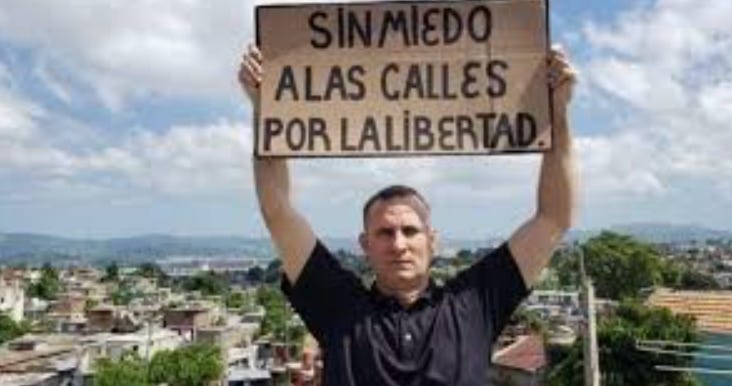
José Daniel Ferrer, Cuba’s foremost pro-democracy leader, has endured years of torture, isolation, and persecution for his unwavering commitment to freedom. He has spent nearly 13 years behind bars—not for any crime, but for demanding democratic change. In recognition of over three decades of peaceful resistance and his steadfast opposition to communism, Ferrer was awarded the Truman-Reagan Medal of Freedom by the Victims of Communism Memorial Foundation in 2020.
A four-time prisoner of conscience and founder of the Patriotic Union of Cuba (UNPACU), Ferrer embodies the island’s unbroken spirit of resistance—and the threat it poses to dictatorship. His case is not just symbolic of Cuba’s repression, but of the power of individual courage to challenge totalitarian regimes.
The regime, backed by two powerful armies—the Revolutionary Armed Forces and the Ministry of the Interior—monopolizes force. Yet it is weakened by the very ideas it tries to crush. Like autocracies in China, Russia, and Iran, Cuba’s dictatorship views dissent as an existential threat. Its repression of peaceful activists reveals not strength, but fear.
Ferrer is the personal prisoner of Raúl Castro and GAESA, the military-run conglomerate that dominates Cuba’s economy. GAESA funnels billions into offshore accounts while the nation plunges into humanitarian crisis. In 2024, as blackouts crippled daily life and food and healthcare systems collapsed, the military elite invested four times more in luxury hotels and real estate than in agriculture, education, or health—despite 89% of the population living in extreme poverty.
His imprisonment is designed to silence a man who refuses exile and continues to defy the military kleptocracy from within. His resilience threatens the very foundation of a regime built on control and fear.
As one of the island’s most effective organizers, Ferrer helped expand the opposition across Cuba and played a key role in the Varela Project, which called for constitutional reform and free elections. His allies Oswaldo Payá and Harold Cepero were assassinated in 2012 for mobilizing tens of thousands of citizens. Ferrer continues their legacy—advocating for a binding plebiscite under the Cuba Decide initiative, which demands that Cubans be allowed to choose their government freely.
Under his leadership, UNPACU provided food and medicine to thousands—until the organization was dismantled through arrests, exile, and surveillance. Between June 25 and July 5, 2025, Ferrer was brutally tortured in Mar Verde prison. He was beaten, force-fed rotten food, and threatened by guards disguised as inmates. One of them warned: “For every sanction Trump imposes, we’ll do this to you.”
Ferrer’s courage symbolizes defiance—the ultimate testament to the human spirit’s refusal to live without liberty. His case exposes the broader cruelty and desperation of the regime. The violent repression of Ferrer and other dissidents—such as Sayli Navarro, Sissi Abascal, Luis Manuel Otero Alcántara, Maykel Osorbo, and Félix Navarro—proves a deeper truth: dictatorships may appear powerful, but they are fundamentally weak. They fear ideas more than weapons.
The United States has imposed sanctions on Cuba’s military elite and their financial networks, while supporting the country’s pro-democracy movement. But no democracy can stand alone. Canada, the European Union, and Latin American nations must join in building a global coalition to expose Havana’s crimes and demand the release of all political prisoners.
Supporting leaders like Ferrer—those at the frontlines of Cuba’s peaceful democratic struggle—is both a moral duty and a strategic imperative. A free Cuba would no longer be the region’s top exporter of authoritarianism. It would help curb mass migration and weaken the influence of regimes backed by Russia, China, and Iran.
Cuba’s democratic future will depend on courageous figures like José Daniel Ferrer—leaders of integrity and principle, as Václav Havel was to Czechoslovakia. Like Navalny and Payá before him, Ferrer faces grave risks. Supporting him is not only a fight for Cuba’s freedom—it is a defense of universal human dignity against tyranny.
Michael Lima is a researcher and the director of Democratic Spaces, an NGO dedicated to fostering solidarity in Canada with human rights defenders and civil society in Cuba. He holds a Master’s degree in Latin American History from the University of Toronto.


Canada would need approval from China first before it throws any support behind Ferrer. The EU is doubtful too. They might sign some sort of declaration at the UN but any sort of monetary help is highly unlikely too. Cuba could be a gem of the Caribbean and with its location a port for shipping that would make so much money for the country its population would eradicate any poverty. With travel and business it would become a financial powerhouse.
When it comes to promoting freedom and democracy around the world and at home, we know which side the Canadian Government (I.e the Liberal Government, as exemplified by Trudeau père et fils) comes down. They idolize authoritarian regimes, whether socialist, communist or Islamist.. we should really not be surprised by recent events at home.