


Days Ahead of Critical Vote, Taiwan Accuses China of ‘Unprecedented’ Election Interference

TAIPEI — With two days remaining until a landmark recall referendum that could unseat nearly a quarter of Taiwan’s legislature, the government’s Mainland Affairs Council (MAC) has issued a stark warning: the Chinese Communist Party is engaging in “unprecedented” interference aimed at influencing the outcome.
In a rare statement released Tuesday, the MAC accused Beijing of flooding social media platforms and Taiwanese media outlets with targeted disinformation to sway the July 26 vote. According to the Council, the CCP’s Taiwan Affairs Office and state-run propaganda outlets have published and circulated “hundreds” of articles and videos across WeChat, TikTok, and Weibo — content that has then been amplified through local news outlets, often distorted to fit CCP narratives.
The scale of Beijing’s interference is “without disguise,” the MAC said.
“Through repeated pushes on Weibo, TikTok, and WeChat, and through reports by relevant Taiwanese media, [that] were processed and exaggerated, and repeatedly spread at multiple levels,” the MAC’s statement says, Beijing’s “degree of deliberate intervention was unprecedented.”
The statement comes amid growing concern in Taipei and Washington that the Chinese government is using Taiwan’s opposition Kuomintang (KMT) party — which has long favored closer ties with Beijing — as a proxy to destabilize the Lai Ching-te administration and cripple national defense efforts. The MAC, Taiwan’s top agency for dealing with the People’s Republic of China, underscored that while Taiwan’s elections and recall votes are “basic rights granted to the people,” the CCP “has no right to intervene.”
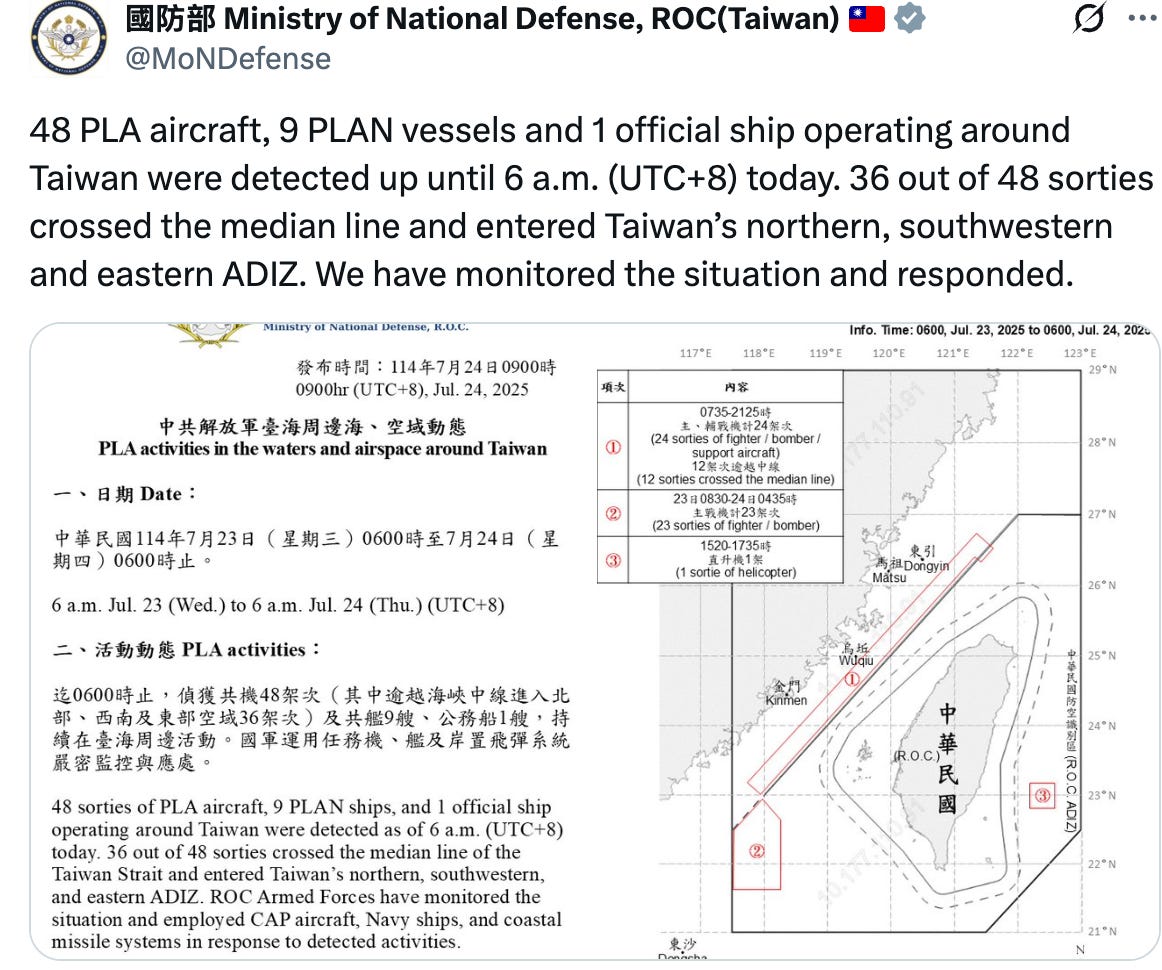
That concern was reinforced Wednesday morning by Joseph Wu, Secretary-General of Taiwan’s National Security Council and the nation’s former foreign minister. Wu posted a stark warning on social media following a Ministry of National Defense bulletin reporting the detection of 48 Chinese military aircraft and 9 PLAN warships operating around Taiwan. “Taiwan will hold recall elections this Saturday – an exercise of democracy enshrined by our constitution. Unfortunately, China won’t miss this opportunity to interfere, through military coercion and disinformation,” Wu wrote. The MND said 36 of the PLA sorties had crossed the Taiwan Strait median line or entered Taiwan’s Air Defense Identification Zones (ADIZ), describing the moves as part of a coordinated gray-zone campaign.
The Bureau previously reported that the July 26 referendum marks the largest coordinated recall effort in the island’s history. If successful, it could remove 24 KMT lawmakers who recall organizers say have consistently obstructed legislation aimed at deterring Beijing’s influence operations and bolstering military readiness.
President Lai has backed the recall effort as a national security imperative, warning that China’s goal is to “absorb Taiwan’s institutions from within.” He has accused certain KMT lawmakers of undermining sovereignty through opposition to defense budgets, support for cross-strait trade policies that benefit Beijing, and even alleged leaks of classified defense information.
Beijing, in turn, has reacted furiously. Days after Lai launched a “Unity for Taiwan” national speech tour, the CCP’s Taiwan Affairs Office accused the president of inciting a “political struggle for personal gain,” and blasted his assertion that “Taiwan is of course a country” as a “hostile provocation.”
In Washington, senior officials are watching closely. Earlier this year, senators Dan Sullivan and Angus King sharply criticized the KMT’s efforts to slash Taiwan’s proposed defense budget, calling it a dangerous signal amid rising threats from the People’s Liberation Army.
Meanwhile, civil society groups in Taiwan have framed the recall as a grassroots effort to purge Beijing’s covert United Front infiltration operations from the legislature. The campaign has been spearheaded by activists and supported by billionaire Robert Tsao, who described the moment as “Taiwan’s last chance” to stop a slow internal takeover.


At least, in Taiwan, voters know who the pro-CCP politicians are; they’re members of the KMT Party, so they know who to vote against, if they want to save their country. In Canada, we know we have pro-CCP politicians, politicians who have been bought and paid for by Beijing, but we don’t know who they are, or in which parties. CSIS knows, but can’t tell us. The Government knows, but won’t tell us. The enemy is within, but we can’t fight him.
I would really like to see you broadcast a reframing on Canada’s decision to give China the contract to build our ferries as Canada helping to fund the production of a Shipyard that could be dual used to create vessels which when needed will move personnel and equipment to Taiwan come time they decide to invade.