
Hong Kong police are rewriting the history of an infamous thug attack on civilians
Hong Kong just delivered a masterclass on how authoritarian regimes distort facts and erase history in a bid to consolidate state control.

Hong Kong just delivered a masterclass on how authoritarian regimes distort facts and erase history in a bid to consolidate state control.
One of the darkest incidents of last year’s protests took place on July 21, when dozens of thugs armed with sticks and metal rods launched an indiscriminate attack on civilians at the suburban subway station of Yuen Long. Police failed to arrive in time to stop the violent assault, and officers were later seen chatting hands-on-shoulder with some of the suspected attackers, fueling widespread suspicions of collusion. More than any other incident of police misconduct during the protests, the Yuen Long attack caused the most damage to the public’s trust (pdf, p.80) in the police force.
The police are now aggressively pushing a vastly altered narrative that runs entirely counter to what video evidence depicts of the assault. In a press conference yesterday, a senior officer said the attack was not “indiscriminate,” but rather a “clash” between two groups. That is despite overwhelming evidence from live-streams and smartphone videos showing a large group of masked, white-clad men beating commuters and protesters inside subway carriages and on the station platform, as victims tried to repel the assailants with umbrellas. The police, however, now allege that the video evidence was “one-sided.” They also argue that a notorious photo apparently depicting a police officer patting a suspected assailant on the shoulder actually shows the officer “pushing” the suspect away.

The police made those comments shortly after they arrested pro-democracy politician Lam Cheuk-ting, who was among the dozens injured in the assault, and charged him with rioting in connection with the incident. A video shot at the time of his arrest shows an incredulous Lam exclaiming, “Me, taking part in a riot? The riot of July 21? Hong Kong is utterly absurd.” According to local news outlet HK01, police allege that Lam provoked his assailants by shouting at them. Prior to Lam’s arrest, police had detained 44 suspected assailants and charged eight of them with rioting. Lam will appear in court today.
Rewriting history and peddling absolute falsehoods against the full force of established facts is a well-worn tactic of authoritarians. The political philosopher Hannah Arendt observed that “[i]f everybody always lies to you, the consequence is not that you believe the lies, but rather that nobody believes anything any longer.” Fomenting that kind of mass disbelieving is a classic state tactic of maintaining control, wrote the journalist Peter Pomerantsev in his book This is Not Propaganda, because when everyone is questioned and nothing is trusted, people look to a strong hand for guidance in the murk.
Though this is the first time the police have publicly tried to redefine the Yuen Long attack, they appear to be drawing heavily from an exhaustive report published in May by the Independent Police Complaints Council (IPCC), which in reality has limited investigative powers and no authority to subpoena evidence and summon witnesses. Billed as a “fact-finding” study into police conduct during the protests, the report described the Yuen Long incident as a “gang fight involving…both sides” (pdf). While critics of the report dismissed it as a whitewash, it appears the police are now using it to back up their distortionary claims.
In response to a request for comment, a police spokesperson directed Quartz to comments made by police commissioner Chris Tang on Aug. 27, in which he denied that the police force is rewriting history.
The police are evidently trying to write “their own history of 2019 in a manner that is in line with their ideological position of portraying the protest crowds as irrational mobs” in order to “mask the role of [the] state in the construction of crowd violence and to legitimize reactionary forms of policing,” said Clifford Stott, a professor of social psychology at the UK’s Keele University. Stott resigned from his advisory role on the IPCC because he felt he was being “manipulated” by authorities.
Gwyneth Ho, a former journalist who was live-streaming the Yuen Long attack and who was assaulted while doing so, also pushed back against the police’s version of events.
“It is not possible for the authority to distort the facts of the [July 21] incident unless the government of Hong Kong shut down Facebook and YouTube in Hong Kong,” she wrote on Twitter. “As long as all the video clips of that day are still accessible to the public, their attempts will always be futile.” She added that she now fears arrest for her role in live-streaming the assault. Ho was recently among a dozen opposition candidates disqualified from running in legislative elections, now postponed in the name of pandemic concerns.
This post was updated to include a response from the police force.
📬 Sign up for the Daily Brief

Trump eyes up to 20% tariff on all E.U. imports for trade deal
The White House is pushing at least 15% to 20% tariff on all European Union imports, according to a new report
President Donald Trump is pushing for a minimum 15% to 20% tariff on all European Union imports, according to a Friday report in the Financial Times.
The Trump administration is currently negotiating with the E.U. ahead of an Aug. 1 deadline to clinch a comprehensive deal. Otherwise, Trump threatened to put in place a 30% tariff on its imports. A 50% universal tariff is already enacted on all steel and aluminum, which includes the E.U.
EU trade commissioner Maroš Šefčovič offered a glum assessment on the talks to E.U. diplomats in Washington D.C., the FT report said.
U.S. stocks fell during Friday's trading session. The Dow Jones Industrial Average had shaved nearly 200 points by the afternoon. The S&P 500 index proved sturdier and dipped only five points.
Spokespeople for the White House and the European Commission didn't immediately respond to a request for comment.
The 27 nations of the European Union make it the biggest U.S. trading bloc with $605 billion in imports, much of it consisting of pharmaceuticals, autos, and aircraft. E.U. Commission President Ursula von Der Leyen has previously said the E.U. is ready to retaliate with tariffs of its own on certain U.S. sectors if necessary.
So far, the Trump administration has negotiated two skinnier trade agreements with the U.K. and Indonesia. The latest agreement with Indonesia left in place a 19% tariff on its exports to the U.S. while clearing the way for U.S. products to enter the country duty-free.
Elon Musk's Neuralink called itself a 'small disadvantaged business.' Then it was worth $9 billion
Musk’s brain-chip startup used a label that could help it unlock federal perks, raising questions about optics and ownership
In late April, Elon Musk’s brain-implant company, Neuralink, filed government paperwork claiming it was a “small disadvantaged business.” Weeks later, the company closed a $650 million funding round at a $9 billion valuation.
By Small Business Administration (SBA) standards, “economically disadvantaged” status is intended to help companies that are at least 51% owned by socially and economically disadvantaged individuals with a net worth under $850,000 (excluding a primary residence). The designation was designed to help level the playing field for founders who have historically faced barriers to capital.
Yet Neuralink — whose public face and majority owner is Musk, the world’s richest person — checked the box anyway.
But the company listed Jared Birchall, a company executive who is also the head of Musk’s family office and a longtime lieutenant, as the official contact. In theory, if someone other than Musk is the actual majority owner of Neuralink, the SDB designation might hold up to scrutiny. But filings and investor decks consistently identify Musk as the company’s driving force and controlling figure. There’s also no evidence that Birchall meets the financial or social thresholds for the designation, either.
An SDB designation could give Neuralink a leg up in bidding for federal contracts, perks that could come in handy as the company builds out brain-computer interfaces with national security implications. To this point, there’s no public record of Neuralink winning any contracts.
Neuralink’s technology — an implantable device that translates brain activity into computer commands — is already in early human trials and is currently working to help patients with paralysis. But Musk has hinted at more ambitious applications, including military use cases, cognitive enhancement, and eventually, full brain-machine symbiosis. If any of those projects intersect with federal research or defense priorities, the SDB status could offer Neuralink a head start.
In recent months, the company has implanted brain chips in five human patients, with participants using the device to control computers, play video games, and edit videos. In May, Neuralink’s speech-restoration implant received FDA “Breakthrough Device” status, fast-tracking its path to approval. A separate vision-restoration device earned the same designation late last year.
Meanwhile, Neuralink’s filing, first flagged by watchdog site MuskWatch, seems to underscore a common theme in Musk’s career: disdain for government intervention — until there’s something to gain from it. Whether it’s EV credits for Tesla, rocket contracts for SpaceX, or tax breaks for Boring Company tunnels, Musk has repeatedly positioned himself as an anti-regulation entrepreneur while benefiting from public-sector support.
The SBA allows companies to self-certify their status, meaning there’s minimal scrutiny unless someone files a formal challenge. It’s a system built on good faith. And right now, Neuralink’s filing remains active in the government’s public database, uncorrected and unchallenged. Misrepresentation in SBA filings can carry steep penalties, including civil fines and criminal liability, but enforcement is rare. And the company is now worth $9 billion.
Neuralink’s filing landed on the SBA’s desk while Musk was still leading the Trump administration’s Department of Government Efficiency (DOGE) — an agency Musk helped create and run, with a mission to cut spending and jobs. During his time at DOGE, Musk helped eliminate funding for DEI-related grants at the Department of Education and has disparaged government equity programs. Meanwhile, his own company was quietly applying to benefit from one. Not long after Neuralink checked the SDB designation, the brain-interface startup locked in a fresh round of funding from some of the most elite names in venture capital, such as Founders Fund, Sequoia, and ARK Invest.
Consumers feel slightly better about the economy. But inflation fears persist
Consumer sentiment is getting better as tariff concerns begin to cool off — for now, but fear of higher inflation remains elevated above 2024 levels.
Consumer sentiment on the economy reached its highest value in five months, but still fell behind December 2024 levels as consumers struggle to shake off long-term inflation concerns, a survey released Friday found.
Sentiment rose 1.8% in July to an index of 61.8 from June’s 60.7, marking its highest value since February, according to preliminary data from the University of Michigan’s Survey of Consumers for July. But, compared to the same month's data in 2024, the survey found that consumer sentiment has dropped 6.9%.
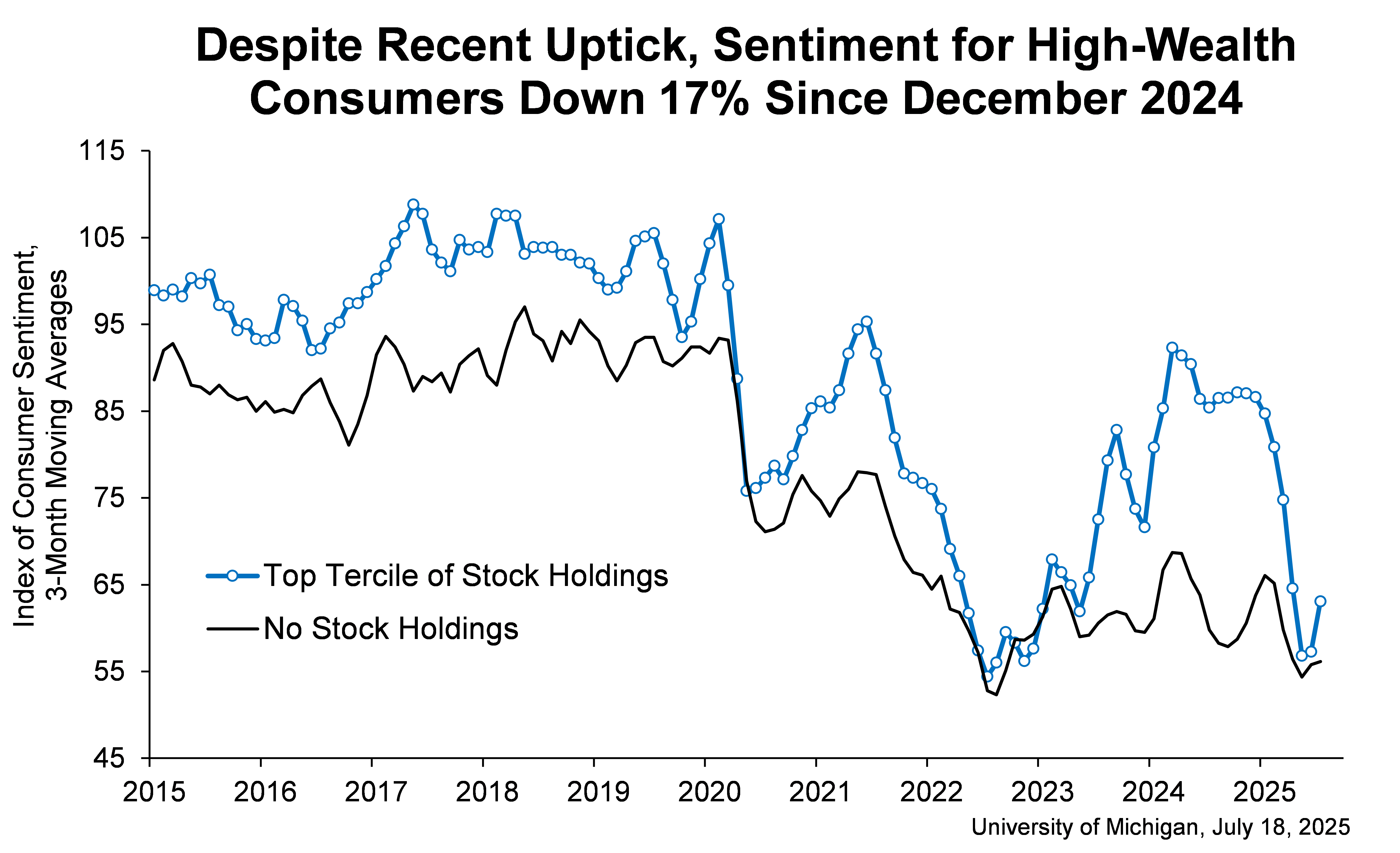
Even with a better outlook than previous months, consumer sentiment is still a "substantial" 16% below December 2024 value and is “well below its historical average.” Plus, sentiment among “high-wealth” consumers is down 17% since December 2024, the survey found.
“Consumers are unlikely to regain their confidence in the economy unless they feel assured that inflation is unlikely to worsen, for example if trade policy stabilizes for the foreseeable future,” Surveys of Consumers Director Joanne Hsu said in the release. “At this time, the interviews reveal little evidence that other policy developments, including the recent passage of the tax and spending bill, moved the needle much on consumer sentiment.”
Since taking office in January — when consumer sentiment was at an index of 71.7 — President Donald Trump has declared a trade war on countries around the world that has seemingly geneerated more fear among consumers of even higher prices, but now they seem to be reporting feeling a little less concerned about inflation.
“Year-ahead inflation expectations fell for a second straight month, plunging from 5.0% last month to 4.4% this month. Long-run inflation expectations receded for the third consecutive month, falling back from 4.0% in June to 3.6% in July,” Hsu said.
However, Hsu noted that although these numbers are the lowest they’ve been since February, they are still sitting above December 2024 levels, indicating that “consumers still perceive substantial risk that inflation will increase in the future.”
The Survey of Consumers is a national poll conducted for the last 79 years, focusing on three areas: consumers’ own financial situation, their short-term views, and long-term views on the economy’s overall prospects.
- Michael Barclay contributed to this article.
A Fed governor says it's time to cut interest rates now with the labor market 'on the edge'
Federal Reserve Governor Christopher Waller said the Fed should cut interest rates at its next meeting as the job market weakens
Federal Reserve Governor Christopher Waller said Thursday that he wants the central bank to cut interest rates at its next meeting, saying the labor market could "deteriorate" if it doesn't.
“I believe that the Federal Open Market Committee should reduce our policy rate by 25 basis points at our next meeting,” Waller said in a speech at the Money Marketeers of New York University.
Waller said that while the labor market “looks fine on the surface,” downside risks are rising. “We should not wait until the labor market deteriorates before we cut the policy rate,” he said.
Pointing to slow growth in the private sector compared to payroll gains in state and local government, Waller said that “private payroll data are being overestimated” and will change after the benchmark revision in early 2026. Taking in account for expected changes to this data, Waller said private sector gains in June were “much closer to zero.”
“This is why I say private-sector payroll gains are near stall speed and flashing red,” he said. “Looking across the soft and hard data, I get a picture of a labor market on the edge.”
Citing other reasons for his recommended rate cut, Waller said that tariffs don’t pose a lasting impact to inflation, only a “one-off increase” causing a “temporary surge.”
He added that the policy should be “close to neutral” and “not restrictive.”
Considering an expected “soft” GDP growth number combined with an unemployment rate at 4.1% coupled with inflation close to the Fed’s target, he said the data implies that “the policy rate should be around neutral, which the median of FOMC participants estimates is 3 percent, and not where we are—1.25 to 1.50 percentage points above 3 percent.”
Waller isn’t typically “a politically motivated character,” making his “strong view” on the Fed rate important “in that context.,” said W. Brad Bechtel, Global Head of Jeffries FX, on Friday. “Pretty strong view from Waller as the Fed gets close to entering their blackout period before the next meeting.”
“We continue to expect three consecutive 25bp cuts this year at the September, October, and December FOMC meetings. We expect two additional 25bp cuts in 2026 for a terminal funds rate range of 3-3.25%,” economic researchers at Goldman Sachs said Thursday.
“The economy is still growing, but its momentum has slowed significantly, and the risks to the FOMC's employment mandate have increased,” Waller said.
President Donald Trump this week again floated the idea of firing Federal Reserve Chair Jerome Powell. The reaction was immediate: bond yields jumped, trading volume spiked to levels not seen since April’s “Liberation Day” tariff announcement.
—Catherine Baab contributed to this article.
Eric Schmidt says AI’s real limit isn’t chips — it’s electricity
Targeting superintelligence, tech giants are scrambling for nuclear deals and water rights to power AI advances
Artificial intelligence is already reshaping industries like finance and customer service, but Silicon Valley is setting its sights on something even bigger: superintelligence. This next evolution of AI, where companies aim to surpass the cognitive abilities of all humans combined, has not been realized. But it's still attracting billions of dollars in investments — and stoking a growing concern: energy scarcity.
In a new episode of the Moonshots podcast, former Google CEO Eric Schmidt said the real bottleneck to achieving artificial superintelligence isn’t computing power or funding. It’s electricity.
“AI’s natural limit is electricity, not chips,” Schmidt said. “The U.S. is currently expected to need another 92 gigawatts of power to support the AI revolution.” That’s the equivalent of building roughly 92 new nuclear power stations, a tall order in a country that’s only built two in the last three decades.
The warning comes as tech giants like OpenAI, Meta, and Microsoft race to build AI experts in fields such as law, medicine, engineering, and research. Schmidt predicts this could happen within five years.
The stakes are massive. As Wall Street piles into AI, drawn by its promise to automate tasks, boost productivity, and unlock new discoveries, superintelligence is seen as the ultimate prize. And the competition to reach it is fierce. Companies are now battling over top AI talent and securing massive energy contracts to stay ahead.
Microsoft, for example, has already signed a 20-year power purchase agreement with Constellation Energy to restart Three Mile Island, a nuclear plant shuttered in 2019, with a target relaunch in 2028. And its latest environmental report shows another cost of current AI use: a 34% jump in water consumption to cool servers and keep data centers running, totaling 1.7 billion gallons in a single year.
By 2027, researchers estimate AI workloads could consume up to 6.6 billion cubic meters of water, enough to supply all of Canada for over a year.
Even Sam Altman, CEO of OpenAI, has acknowledged the energy challenge. “An energy breakthrough is essential for AI’s future,” he said last year. Altman has personally invested in Helion, a nuclear fusion startup aiming to build a pilot plant by 2028.
Lawmakers are taking notice. In May, Microsoft and AMD urged Congress to fast-track permits for new energy projects to avoid overwhelming the U.S. power grid.
Still, the environmental toll is raising alarms among climate groups. Greenpeace has warned that, without serious planning, AI’s growth could derail national and global climate goals — which most nations are already failing to meet.
“We don’t know what AI will deliver, and we certainly don’t know what superintelligence will bring,” Schmidt said in a LinkedIn post promoting the podcast, “but we know that it is coming fast. We need to plan ahead to ensure we have the energy needed to meet the many opportunities and challenges that AI puts before us.”
In other words: It’s not enough to build the brains. We’ll need to power them, too.
Netflix had a strong quarter. That’s the problem
As the company posted strong second quarter earnings, some analysts warn that Netflix's growth is increasingly dependent on higher prices and ad revenue
For a company that is built on plot twists, Netflix’s latest earnings were pretty on-script — maybe too on-script, if you ask Wall Street. The streaming giant posted a huge second quarter: Revenue jumped 16% to $11.08 billion, net income soared 46% to $3.13 billion, and EPS crushed expectations at $7.19 a share. The company even nudged its full-year outlook higher, thanks to booming global subs, surging ad sales, and a weak U.S. dollar that makes international earnings sparkle.
But Netflix stock slipped around 5.4% in early trading on Friday, after falling around 2% in after-hours trading. The message from investors? That was a great quarter. Now what?
Despite the upside beat and raised guidance, there’s a mismatch between what Netflix delivered and what its valuation assumes. The company’s market cap is north of $540 billion, and it trades at a hefty forward earnings. That’s elite territory, meaning Netflix has to keep outperforming just to hold its ground. And this quarter, the tone was a little too cautious for comfort.
The earnings themselves were solid across the board. Ad revenue is on track to double this year, subscriber retention seems to have stayed strong despite price hikes, and revenue per user in North America accelerated to 15% growth from 9% the prior quarter. Even free cash flow nearly doubled from a year ago. “Netflix continues to produce phenomenal results with ever more growth in its sights,” Wedbush analyst Alicia Reese wrote in a Friday note. She said the streamer’s next episode is “more growth” and reiterated an “Outperform” rating.
Wedbush wasn’t the only firm to still see plenty of runway ahead. Jeffries called the quarter “solid.” William Blair said it was a “good quarter.” Piper Sandler, Morgan Stanley, Wells Fargo, and Jefferies all raised their targets to the $1,500–1,560 range, pointing to Netflix’s expanding ad business, pricing power, and the effects of reinvesting profits into premium content and tech. UBS lifted its price target by $45 to $1,495, writing that the company sees Netflix “as a secular winner.” The average price target is hovering around $1,400 — shares reached a high on June 30 at $1,339.
Netflix’s ad-supported tier is expected to generate around $2 billion in revenue next year and is a critical growth driver. The company completed the rollout of its proprietary ad tech this quarter — a key milestone to unlocking growth and one of William Blair’s three big takeaways from the second-quarter earnings. Analyst Ralph Schackart wrote in the company’s note that “this is important, in our view, because advertisers we speak to still suggest that Netflix’s ad technology needs improvement.” Still, Morgan Stanley analyst Benjamin Swinburne said the expanding ad business is a “multiple upside lever” alongside Netflix’s traditional subscription model.
JPMorgan, however, struck a more cautious tone. It reiterated a neutral rating — setting a $1,300 price target — and said Netflix’s results and improved outlook were “solid against high expectations.” But amid the company’s valuation premium, the shares, analysts also said, “need a breather.”
Execution is strong — but so are demands
“There’s no question that Netflix remains the clear leader in the streaming space, perfectly positioned to keep thriving amid the numerous tailwinds expected to benefit the industry in the second half of the year — both from its content slate and live events,” said Thomas Monteiro, a senior analyst at Investing.com. But he added that the full-year outlook still felt “conservative,” particularly given the favorable foreign exchange backdrop and the strength of the quarter — “which is problematic for a stock priced for perfection.”
Netflix is feeling the heat from YouTube, which has upped its share of U.S. screen time to 12% so far this year — Netflix sits at 8%, steady from last year’s 8%, while YouTube climbed from 10%. With Netflix betting big on ads, investors want to see if it can speed up viewing hours and start closing that gap. Jeffries said the company’s second-half lineup is a big part of that plan, but so are moves into sports and live events, shorter-form stuff like 15-20 minute videos (think YouTube-style), and even video podcasting.
Netflix struck a high-profile licensing deal with Ms. Rachel, the preschool educator whose YouTube sing-along videos have become appointment viewing for millions of families. Under the agreement, Ms. Rachel’s existing videos will be licensed nonexclusively to Netflix (initially four “curated compilation” episodes, with additional releases planned), giving the platform a powerful offering in the under‑6 market.
“Not everything on YouTube will fit on Netflix,” co-CEO Ted Sarandos said on the post-release earnings call. “But there are some creators on YouTube like Ms. Rachel that are a great fit.” Sarandos added that Netflix is “really excited about … a wide variety of creators and video podcasters that might be a good fit for us, and particularly if they're doing great work and looking for different ways to connect with audiences.”
On the live and sports front, Netflix isn’t rushing to chase every shiny event — even as the company attempts to plant a flag in linear TV’s last stronghold. Netflix remains “focused on ownable big breakthrough events that… our audiences really love,” Sarandos said, while stressing that anything in the event or sports space “has got to make economic sense.” For now, live content accounts for a small slice of both Netflix’s content budget and its massive 200 billion total view hours.
Still, Sarandos said live programming punches above its weight — “not all view hours are equal,” he said, “and what we've seen with live is it has its outsized positive impacts around conversation, around acquisition, and we suspect around retention.” The company’s coming calendar includes the Canelo vs. Crawford fight in September, the SAG Awards, weekly WWE matches, and an NFL Christmas Day doubleheader. So far, Netflix’s live events have been mostly U.S.-centric, but the company plans to “continue to invest and grow our live capabilities for events around the world in the years ahead,” Sarandos said. For now, the strategy remains steady, focused, and measured. Live is a tool, not the whole playbook.
What’s gnawing at investors is what comes next.
On top of its coming live events, Netflix is betting big on a stacked content slate for the next couple of quarters, with season two of “Wednesday,” the final season of “Stranger Things,” “Happy Gilmore 2,” the latest “Knives Out” movie, and Guillermo Del Toro’s “Frankenstein” all landing. Jeffries said that this slate was “exceptional” and that it “expect[s] this to support healthy member growth” through the second half of the year.
But all of that content is expensive, and Netflix warned that operating margins in the back half of the year will come down slightly as content amortization and marketing costs ramp up. But the payoff, investors hope, will come in both viewer engagement and subscriber growth — particularly in the ad tier, where Netflix sees its next leg of monetization.
“[Netflix] is evolving into a larger revenue platform as it recoups monies from paid sharers and leans into advertising tiers as a share gainer,” Wells Fargo analyst Steven Cahall said, pointing to the flywheel effect of reinvesting in content and tech to drive more subs, more pricing power, and more margin.
Netflix's bet on AI
One of Netflix’s more interesting moves last quarter didn’t show up in the financials — it showed up in the credits. “El Eternauta,” the platform’s Argentine sci-fi series that had more than 29 million viewers, featured a building collapse that was created with AI-assisted VFX that, according to Sarandos, was completed “10 times faster” than with traditional VFX tools and “wouldn’t have been feasible” on the show’s budget otherwise.
Sarandos framed the move not as a cost-cutting stunt but as a creative unlock, saying the company remains “convinced that AI represents an incredible opportunity to help creators make films and series better, not just cheaper.” He added, “These are AI-powered creator tools — real people doing real work with better tools. Our creators are already seeing the benefits in production through previsualization and shot planning work and, certainly, visual effects.”
The result, Sarandos, marked “the very first GenAI final footage to appear on screen in a Netflix original series or film.” And while he emphasized that creators — and audiences — were happy with the outcome, the message was clear: AI is starting to shift not just how Netflix markets or recommends content, but how it makes it. Those tools are already expanding into other areas of the business, including AI-assisted ad targeting, voice-based content discovery, and a more adaptive recommendation engine. Sarandos framed it as a way to “expand the possibilities of storytelling,” but the financial implications are hard to miss, particularly for a company pledging to double its ad revenue this year and spend $18 billion on content (according to chief financial officer Spencer Neumann).
Still, the Street seems to want Netflix’s next act to be louder.
As Monteiro put it, Netflix’s current trajectory feels “overly dependent on further price increases — at least through 2026 — to drive revenue.” With inflation pressuring consumer spending, a volatile macroeconomic environment, and shifting consumer behavior, Netflix might have only so much pricing leverage left. If the second half of the year can deliver on its content promise — and push engagement beyond the modest 1% year-over-year growth in viewing hours that Netflix reported — it could reset the narrative. Shorter-form content, live events, and new ad formats may help shift the platform from being just TV 2.0 to a broader digital ecosystem.
For now, Netflix is executing well. But to justify its premium, its story needs to enter the next chapter.