




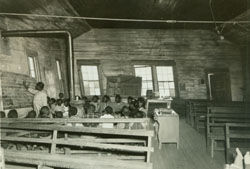
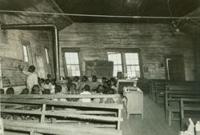



PHOTO: Black schools like this one in Sunflower County in 1949 were typical. (University of Mississippi Archives)
By JOE RUTHERFORD
Daily Journal
The U.S. Supreme Court's 1954 ruling in Brown vs. Board of Education declared that segregated schools were "inherently unequal."
One year earlier, a special Mississippi legislative committee's report unwittingly supported and illuminated that position, even though its goal was to "psychologically" persuade the court to maintain separate but equal schools.
Mountains of information gathered by the committee revealed Mississippi as a state behind every other in educating all children - and appallingly further behind in educating "Negro" or "colored" students, as the report described African-Americans.
The disparity between whites and blacks happened within a system poorly educating almost everyone, but especially African-Americans:
- One black child in 40 (2.5 percent) graduated from high school; 25 percent of white children earned a diploma.
- Mississippi provided $67 per year per child in school support, compared to $180 for the U.S. and $118 in the South.
- Per pupil expenditures for African-Americans varied by district, but it didn't equal per-pupil support for whites in any county. In Tupelo, white per capita spending was $143.69; it was $63.08 for blacks. In Monroe County's Prairie school, white per capita was $194.50; per capita for black students was $16.02.
- Statewide enrollment was almost 50-50, with slightly more African-American children.
- Mississippi had 2,079 administrative school districts; 1,239 were for blacks. The report noted, "In actual practice the number of Negro districts is much higher ... because many of the counties have set up countywide Negro districts which never have functioned as such."
- Statewide, counties averaged 15 African-American districts compared to 10 white districts
- One in four black teachers was a college graduate.
- Mississippi had 4,031 school buildings; half had one or two teachers.
- School conditions for African-Ameican children in rural areas, it reported, were "... pathetic and in some cases inexcusable." The schools were largely unheated, unlighted and unpainted, and few had sanitary drinking water or toilets.
- Tax levies for black schools were a "rarity," and previous laws equalizing pay for white and African-American teachers had been ignored and the appropriated state money unaccounted for in many counties.
Law based on the separate but equal doctrine rose from the famous Plessy vs. Ferguson decision in 1896, which upheld segregation. In that case, a black man named Homer Plessy was fined for sitting in the whites-only seats on a train.
He appealed from Missouri to the Supreme Court and lost. Legal segregation was maintained and almost universally practiced until 1954.
The report from the Recess Education Committee to the Legislature, presented in March 1953, sought to lay out a rationale and supporting evidence for upgrading and "equalizing" public education for all.
Its ultimate goal, known from the outset by participants, was stated in language buried on page 51 of the 121-page document:
"The fact that Mississippi has made an honest attempt to remedy an inequitable situation may have a psychological influence upon the United States Supreme Court in its decision in the segregation cases."
Former Gov. William Winter represented Grenada County in the House when the report was compiled. Winter said he and other self-styled moderates of the time hoped the report would lead to real improvement for all schools, but he said the "driving force" was maintaining segregation.
Winter said the report provides an accurate statewide window in pre-1954 Mississippi education history, which he described as "in disarray" for all.
Moderates gained a measure of satisfaction in 1953 when the structure of the bellwether Minimum Foundation Program for all schools passed in a special session.
The program guaranteed a "minimum level" of support for schools statewide, and it stood as the core of public education finance until 1999, when the Mississippi Adequate Education Program was established.
"In May 1954, the court decision came down and threw everything into chaos," Winter said.
The structure remained temporarily without money, and its funding would come at the price of a desperate gasp by the hard-line segregationists.
Winter said House Speaker Walter Sillers of Rosedale orchestrated a tacit swap - authority to abolish public schools in the event of integration for funding the Minimum Foundation.
But history had exacted a steep toll: African-American Mississippians had virtually no reliable public education from the time of statehood until 1954 - and later.
History's liability
Winter remembers African-American schools largely as "one-room shacks" with one teacher for all grades.
The unspoken, longtime public policy of the era was to ensure that blacks were maintained as an "unskilled labor" force for agriculture.
The flow of 20th century events already had exposed the folly of the "unskilled" policy. Between 1919 and 1950, as agriculture became mechanized and labor-intensive farming declined, about 6 million African-Americans moved from the South to the North.
Those who moved wanted a better life, and some found it. Blacks who remained in Mississippi and other Southern states fared differently from place to place by only a few degrees.
Mississippi - always a state of the greatest disparities - remained the poorest, the least educated and the most segregated. It would be more than 10 years before the first "freedom of choice" students entered formerly all-white K-12 public schools under court order or consent decrees.
It was between 1969 and 1971 before full consolidation of formerly all-black and all-white schools happened under sweeping federal court decrees.


