Wednesday, June 18, 2025 | Daily Newspaper published by GPPC Doha, Qatar.
×
Subscribe now for Gulf Times
Personalise your news and receive Newsletters!
By signing up with an email address, I acknowledge that I have read and agree to the Terms of Service and Privacy Policy .
Your email exists

Top Stories

A damaged residential building in Tel Aviv following a missile attack from Iran

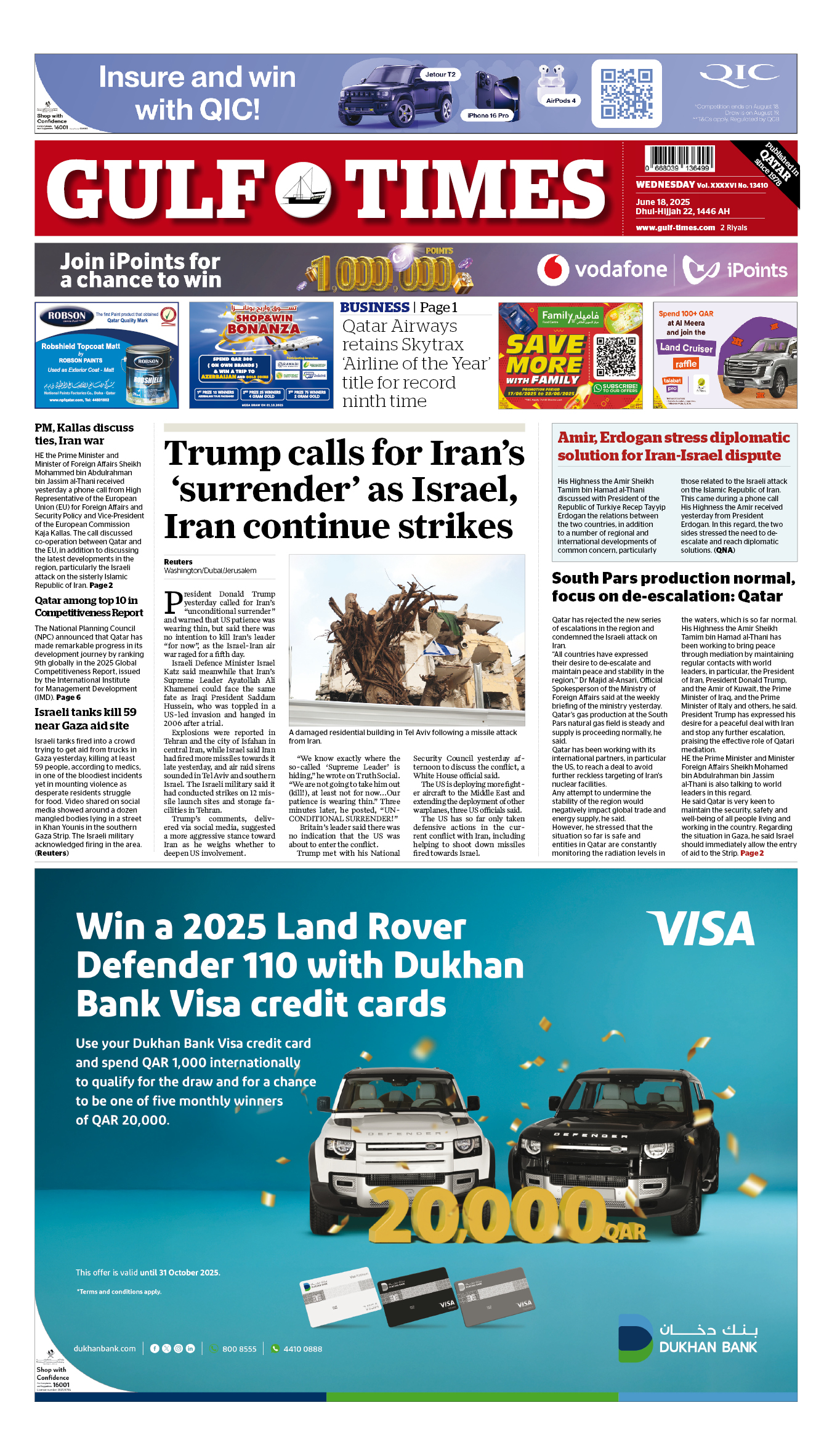
Trump calls for Iran's 'surrender' as Israel, Iran continue strikes

President Donald Trump on Tuesday called for Iran's "unconditional surrender" and warned that US patience was wearing thin, but said there was no intention to kill Iran's leader "for now", as the Israel-Iran air war raged for a fifth day.Israeli Defence Minister Israel Katz said meanwhile that Iran's Supreme Leader Ayatollah Ali Khamenei could face the same fate as Iraqi President Saddam Hussein, who was toppled in a US-led invasion and hanged in 2006 after a trial.Explosions were reported in Tehran and the city of Isfahan in central Iran, while Israel said Iran had fired more missiles towards it late Tuesday, and air raid sirens sounded in Tel Aviv and southern Israel. The Israeli military said it had conducted strikes on 12 missile launch sites and storage facilities in Tehran.Trump's comments, delivered via social media, suggested a more aggressive stance toward Iran as he weighs whether to deepen US involvement."We know exactly where the so-called 'Supreme Leader' is hiding," he wrote on Truth Social. "We are not going to take him out (kill!), at least not for now...Our patience is wearing thin." Three minutes later, he posted, "UNCONDITIONAL SURRENDER!"Britain's leader said there was no indication that the US was about to enter the conflict.Trump met with his National Security Council Tuesday afternoon to discuss the conflict, a White House official said.The US is deploying more fighter aircraft to the Middle East and extending the deployment of other warplanes, three US officials said.The US has so far only taken defensive actions in the current conflict with Iran, including helping to shoot down missiles fired towards Israel.Israeli Prime Minister Benjamin Netanyahu has stressed that he will not back down until Iran's nuclear development is disabled, while Trump says the Israeli assault could end if Iran agrees to strict curbs on enrichment.But Israel will struggle to deal a knock-out blow to deeply buried nuclear sites like Fordow, which is dug beneath a mountain, without the US joining the attack, according to analysis echoed by Germany's leader.Iran has so far fired nearly 400 ballistic missiles and hundreds of drones towards Israel, with about 35 missiles penetrating Israel's defensive shield and making impact, Israeli officials say.The Iranian news agency Tasnim reported that a new wave of drone and missile attacks was launched by the Iranian Air Force against Israeli targets.The Iranian army also announced the downing of 28 enemy drones.

Editor's Picks

Trump poses for a photo with Diana Fox Carney and Prime Minister of Canada Mark Carney, as he arrives at the G7 leaders' summit in Kananaskis, Alberta, Canada Monday.
International
G7 leaders struggle for unity at summit

Group of Seven leaders met Monday seeking a common approach on wars in Ukraine and the Middle East but before their summit formally began, US President Donald Trump said removing Russia from the former Group of Eight over a decade ago had been a mistake.Trump’s overt statement of support for Russian President Vladimir Putin was an early challenge for a once tight-knit grouping that has struggled to find unity as Washington retreats from multilateralism.G7 leaders from Britain, Canada, France, Germany, Italy, Japan, and the US, along with the European Union, are convening in the resort area of Kananaskis in the Canadian Rockies until tomorrow.Speaking alongside Canadian Prime Minister Mark Carney, Trump said the former Group of Eight had been wrong to kick out Russia in 2014 after it annexed Crimea.“This was a big mistake,” Trump said, adding he believed Russia would not have invaded Ukraine in 2022 had Putin not been ejected.“Putin speaks to me. He doesn’t speak to anybody else ... he’s not a happy person about it. I can tell you that he basically doesn’t even speak to the people that threw him out, and I agree with him,” Trump said.His comments raise doubts about how much Ukrainian President Volodymyr Zelensky can achieve when he meets the leaders Tuesday. European nations say they want to persuade Trump to back tougher sanctions on Moscow.Zelensky said he planned to discuss new weapons purchases for Ukraine with Trump.Trump spoke on Saturday with Putin and suggested the Russian leader could play a mediation role between Israel and Iran.French President Emmanuel Macron dismissed the idea, arguing that Moscow could not be a negotiator because it had started an illegal war against Ukraine.A European diplomat said Trump’s suggestion showed that Russia was very much on US minds.European officials said they hoped to use Tuesday’s meeting with Zelensky and Nato Secretary-General Mark Rutte and next week’s Nato summit to convince Trump to toughen his stance.“The G7 should have the objective for us to converge again, for Ukraine to get a ceasefire to lead to a robust and lasting peace, and in my view it’s a question of seeing whether President Trump is ready to put forward much tougher sanctions on Russia,” Macron said.With an escalating Israel-Iran conflict, the summit in Canada is seen as a vital moment to try to restore a semblance of unity among democratic powerhouses.In another early sign the group may struggle to reach agreement on key issues, a US official said Trump would not sign a draft statement calling for de-escalation of the Israel-Iran conflict.A Canadian official, though, said the conflict would come up in bilateral meetings throughout the day and it was too early to speculate on the outcome of those conversations. A senior European diplomat echoed those comments, saying Trump had yet to make a decision.Canada has abandoned any effort to adopt a comprehensive communique to avert a repeat of the 2018 summit in Quebec, when Trump instructed the US delegation to withdraw its approval of the final communique after leaving.Leaders have prepared several draft documents seen by Reuters, including on migration, artificial intelligence, and critical mineral supply chains. None of them have been approved by the United States, however, according to sources briefed on the documents.Europeans are on the same page on most issues, a European diplomat said. But without Trump, it is unclear if there will be any declarations, the diplomat said. The first five months of Trump’s second term upended foreign policy on Ukraine, raised anxiety over his closer ties to Russia, and resulted in tariffs on US allies.Talks on Monday will centre around the economy, advancing trade deals, and China. Efforts to reach an agreement to lower the G7 price cap on Russian oil, even if Trump decided to opt out, were complicated by a temporary surge in oil prices since Israel launched strikes on Iran on June 12, two diplomatic sources said. Oil prices fell Monday on reports Iran was seeking a truce.The escalation between the two regional foes is high on the agenda, with diplomatic sources saying they hope to urge restraint and a return to diplomacy and would encourage Trump to sign a declaration.“I do think there’s a consensus for de-escalation. Obviously, what we need to do today is to bring that together and to be clear about how it is to be brought about,” British Prime Minister Keir Starmer told reporters.

A man carries his son as they evacuate the area following a strike by an Iranian missile in the Israeli city of Petah Tikva, east of Tel Aviv, on Monday. AFP
Region
'Very scared': Israelis reel from escalating Iran missile fire

After an Iranian strike early Monday gouged a gaping hole in his apartment building in central Israel, Idan Bar said he feared for his family as the air war between the longtime foe escalated.A tangle of metal protruded from the charred section of a high-rise building in Petah Tivka near Tel Aviv, as rescuers wheeled elderly residents away from the damage.One woman's mouth hung open as she was taken away in a wheelchair."My building got bombed from Iran," Bar told AFP."It was very scary while I have four children, four boys. We're very scared, but everyone is ok."Inside the building, first responders in orange helmets scoured the blown-out apartments. Debris from the blast littered the ground below, where plastic patio furniture lay overturned.Iran unleashed a missile barrage on Israeli cities after Israel hit deep inside the Islamic republic, pressing a major offensive that began in the early hours of Friday.On the fourth day of the escalating air war, the death toll in Israel rose to 24 after authorities announced on Monday 11 dead. In Iran, officials said the Israeli attacks had killed at least 224 people since Friday.The scenes of devastation witnessed in Petah Tikva on Monday are relatively rare in Israel, whose advanced air defence systems usually intercept incoming threats.The country has long been used to rockets and drones fired by Iran-backed militant groups like Hamas in the Gaza Strip and Lebanon's Hezbollah, but volleys of ballistic missiles launched from the Islamic republic have left the population feeling vulnerable.Since Friday, air raid sirens have sent people across Israel running to bomb shelters on a nightly basis.The latest Iranian attack followed Israeli strikes in central Iran, which Israel's military said targeted surface-to-surface missile launchers.Israel has said that its surprise attack launched on Friday -- after decades of enmity and a prolonged shadow war -- targets Iran's nuclear programme and military facilities.The deaths in Iran have included top military commanders, nuclear scientists and civilians, according to authorities.AFP images showed fires blazing next to gutted buildings and charred cars in the coastal hub of Tel Aviv, after the military warned people to take cover from incoming Iranian missiles.Henn, a Petah Tivka resident who declined to give his last name, said he ran to take shelter after hearing sirens.The 39-year-old said he heard a loud explosion, "and after a few minutes we saw all the damage, all the houses broken".Israeli officials said four people were killed in Petah Tivka and some 35 others taken to hospital with injuries.Families with young children wandered amongst cars whose windows had been smashed by the blast impact.Despite the destruction, Henn said "we hope for good days".

Oil tankers pass through the Strait of Hormuz, on December 21, 2018. File photo/REUTERS

Oil tankers near Iran appear to be in rural Russia as signals jammed

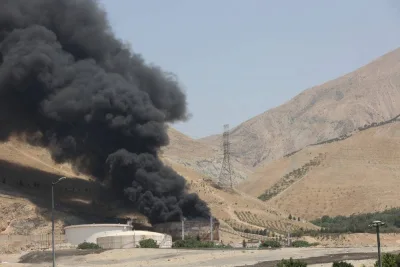
The Front Tyne oil tanker was sailing through the Gulf between Iran and the United Arab Emirates on Sunday when just past 9:40 a.m. shiptracking data appeared to show the massive vessel in Russia, in fields better known for barley and sugar beets.By 4:15 p.m., the ship's erratic signals indicated it was in southern Iran near the town of Bidkhun, before later placing it back and forth across the Gulf.Mass interference since the start of the conflict between Israel and Iran has affected nearly 1,000 ships in the Gulf, according to Windward, a shipping analysis firm.A collision involving tankers south of the Strait of Hormuz, a vital shipping lane for the world's oil, occurred on Tuesday with both vessels catching fire.One of them, the Front Eagle, a sister ship of the Front Tyne, and like it, more than three football pitches long, appeared to be onshore in Iran on June 15, data from commodity data platform Kpler showed."There is usually no jamming in the Strait of Hormuz and now there is a lot," said Ami Daniel, chief executive of Windward."The culmination of all that is higher risk. It's a hot area... if you don't geolocate, there's a bigger chance you'll have an accident."Ships are required to indicate their location and are fitted with transmitters similar to GPS called an AIS, or Automatic Identification System, that send regular signals on location, speed and other data. Jamming disrupts these signals."The problem these days is that most ships use digitised systems, so if your GPS is jammed, then you have no real form of navigating other than by the seat of your pants," said Jim Scorer, secretary general of International Federation of Shipmasters' Associations.If a ship's crew intentionally disrupts its signalling, it is called spoofing, and may indicate illegal conduct, such as an effort to conceal a cargo or destination.If a third party disrupts signals, as is happening in the Gulf, it is referred to as jamming, according to Dimitris Ampatzidis, an analyst at Kpler.The practice has become increasingly common in conflict areas, as some militaries seek to obscure the location of navy vessels or other potential targets.Jamming has been observed in the Black Sea during Russian attacks on Ukrainian ports, in the Taiwan Strait and in waters near Syria and Israel, analysts said. Several ships appeared to be on land at Port Sudan last month."If you don't know where vessels are, you're unable to target them," said Ampatzidis.International Maritime Organization, along with other United Nations agencies, issued a statement in March expressing concern over rising cases of interference in global navigation.The oil tanker Xi Wang Mu, which was placed under U.S. sanctions, appeared to be at a Hindu temple in India earlier this year when it spoofed its location, according to analysis by maritime data platform Lloyd's List Intelligence.

TODAY'S NEWSPAPER
Epaper
PDF
18 June 2025
Gulf Times
Qatar
Katara's vibrant Eid festivities draw crowds

On the second day of the Eid al-Fitr celebrations, the Cultural Village Katara continued to offer its impressive events, attracting large numbers of visitors who immensely enjoyed the festive atmosphere.Katara Corniche hosted a variety of activities and events that added a special joy to the Eid celebrations. Among the standout events was the street play "The Adventures of Adnan the Pirate – The Mind is a Blessing." This children’s play was written by Dr Hanan Sadiq, directed by artist Ali al-Khalaf, and performed by a group of Qatari actors, including Ali al-Sharshani, Shahd al-Jassem, and Faisal al-Jassem, alongside young talents and a team of performance artists. The music was composed by the Qatari group Neymar Music.Dr Hanan Sadiq explained that the play continues Katara's tradition of presenting theatrical performances during Eid, aiming to reinforce the cherished values and principles in a creative and engaging way for children, while introducing them to the expressive power of theatre.She noted that the performances have drawn large audiences of children and families, receiving enthusiastic interaction, which indicates the play’s success. The first show takes place at 6.15pm on the Katara Corniche, while the second show starts at 8.45pm.Another major attraction during Eid is Fereej Katara, which draws large crowds of visitors.Saeed al-Kuwari from the beach management team explained that Fereej Katara is a traditional heritage village that recreates the authentic atmosphere of the past, both in architecture and in the variety of activities it offers. These include children’s workshops, competitions with prizes, and the participation of family-run businesses and craftsmen specialising in traditional arts, all designed to highlight Qatari culture and heritage.The spectacular fireworks displays continue to captivate large audiences, with the final show scheduled for the third day of Eid at 8.30pm on the Katara Corniche. The sky will be lit up with vibrant colours, spreading joy and delight among attendees.Another highlight is the Qatari Ardha (traditional sword dance), which attracts spectators from various nationalities. Participants form opposing rows and chant patriotic songs expressing pride in the country's leadership and heritage. The Ardha is a fundamental part of Qatari culture, combining poetry with synchronised movements in a powerful display of tradition.Among the prominent activities in Katara’s Eid celebrations was the performance by the Police Music Band, where musicians delivered a captivating show blending rhythm and choreography, making it one of the most admired events.Further, visitors enjoyed a range of Asian and African folkloric performances, featuring traditional dances and music from various African countries, along with vibrant showcases from Egypt and Syria. These performances provided audiences with a rich cultural experience, forming a colourful and diverse artistic spectacle that was met with great enthusiasm. Visitors expressed their appreciation for the cultural diversity presented by Katara.Katara’s Eid celebrations will continue until the fourth day of Eid, offering a rich and diverse programme that appeals to all age groups and social backgrounds.

Gulf Times
Qatar
13th edition of Halal Qatar Festival kicks off at Katara

Katara Cultural Village on Wednesday inaugurated the 13th edition of the Halal Qatar Festival. The festival features prominent participation from livestock breeders in Qatar, Saudi Arabia, the UAE and Kuwait, attracting a large audience of heritage enthusiasts and lovers of traditional culture.Chairman of the Festival's Organising Committee Salman Mohammed al-Nuaimi told Qatar News Agency that the festival aims to attract all interested parties and livestock breeders in Qatar and the region, adding that since its inception and after 13 years, the festival has become one of the largest and most influential events in establishing the concept of genetic improvement among breeders to enhance animal production efficiency.He highlighted the committee's commitment to involving and supporting productive families in the festival, in addition to organising various activities and events for school students and festival visitors.Al-Nuaimi explained that the festival has established its prestigious position among breeders from Qatar and the GCC countries, thanks to its unique economic platform for displaying and acquiring the best types of livestock, including sheep and goats, and highlighting their features and specifications.Al-Nuaimi added that this year's edition includes several new additions and developments to enrich the experience of participants and visitors. The festival features a variety of competitions, including the "Mazayen" competition for selecting the most beautiful livestock, bidding on rare breeds, and direct sales exhibitions.The festival got underway Wednesday with the Mazayen competitions, where breeders showcased the best types of livestock in different categories in the presence of a judging panel and livestock experts.The first day also witnessed auctions for some distinguished breeds of goats and sheep, adding excitement to the event.In addition to the competitions, the festival includes a range of accompanying activities and events, such as a comprehensive market featuring veterinary pharmacies, date stores, honey and sweets shops, traditional foods, and handicrafts, along with drawing and crafts workshops for children and a traditional tent (Beit Al Shaar) to introduce children and visitors to traditional lifestyles.A dedicated area for children has been set up, allowing them to experience horse and camel riding in a fun and safe environment, helping to introduce new generations to the heritage of horsemanship and desert transportation.The festival also saw the opening of an art exhibition in collaboration with Gallery 38, featuring the works of nine artists from Qatar and various nationalities.The artworks are inspired by the desert heritage and its authentic elements, adding a new cultural dimension to the festival.The festival will continue until February 24, blending authenticity and heritage. It serves as an outstanding platform to promote the Gulf heritage related to livestock breeding (sheep and goats) and includes a variety of competitions and traditional shows that attract heritage and folklore enthusiasts. It also offers visitors the opportunity to learn about rare livestock breeds and their breeding methods in an environment that simulates desert life.Katara has been organising the Halal Qatar Festival annually, recognising it as one of the most prominent heritage festivals that contribute to preserving the Bedouin heritage and traditional customs, fostering a deep-rooted legacy in the hearts of the younger generation, and providing them with a realistic portrayal of various aspects of desert and wilderness life. (QNA)

Gulf Times
Qatar
Katara International Arabian Horse Festival kicks off Wednesday

The fifth Katara International Arabian Horse Festival (KIAHF) will kick off on Wednesday at the Cultural Village Foundation (Katara).Organised by the institution and in cooperation with the Qatar Racing and Equestrian Club (QREC) and the Qatar Equestrian Federation (QEF), the festival aims to enhance the legacy of the State of Qatar in equestrian sports, that has been loved by Qataris since ancient times and their interest in the ancient breeds of Arabian horses.The festival will run from January 29 to February 8. The first edition of the festival was launched in February 2021.This year's edition includes three main events, namely the Al Jazira Horse Championship, which starts on January 29 and concludes on February 1, followed by the horse auction on February 3, then the Arabian Peninsula Horse Show during the period from February 5 to 8.KIAHF is one of the largest sporting events in the field of equestrianism and is held as part of a series of events hosted by Katara annually and is witnessing great development in various organizational and artistic aspects in addition to its accompanying events.The idea of the festival is inspired by the large cultural and historical stock of the Qatari society, as Katara has taken the responsibility of caring for this heritage and love for Arabian horses and highlighting it globally, which falls within its continuous and persistent efforts to balance between the duality of heritage and authenticity on the one hand, and promoting the culture of modernization on the other hand, in line with Qatar Vision 2030.The festival's message is based on supporting the rich Qatari heritage in the field of equestrianism to spread it globally, as the festival aims to enhance the position of purebred and unique Arabian horses at various local, regional and international levels.The festival has a vision and objectives that features making the State of Qatar a global center for horse and equestrian sports, taking the lead in caring for purebred Arabian horses and enhancing its position in this sport, in addition to contributing to the pride of purebred Arabian horse owners by holding an international championship with a high level of organization and coordination by giving them the opportunity to participate with their best productions, in addition to spreading the culture of "modernity and authenticity", which is in line with Qatar National Vision 2030.

SIGN UP FOR THE GULF TIMES NEWSLETTER
Our biggest stories, delivered to your inbox every day.
See all newsletters.

By signing up you agree to our User Agreement (including the class action waiver and arbitration provisions), our Privacy Policy & Cookie Statement and to receive marketing and account-related emails from GULF TIMES. You can unsubscribe at any time.