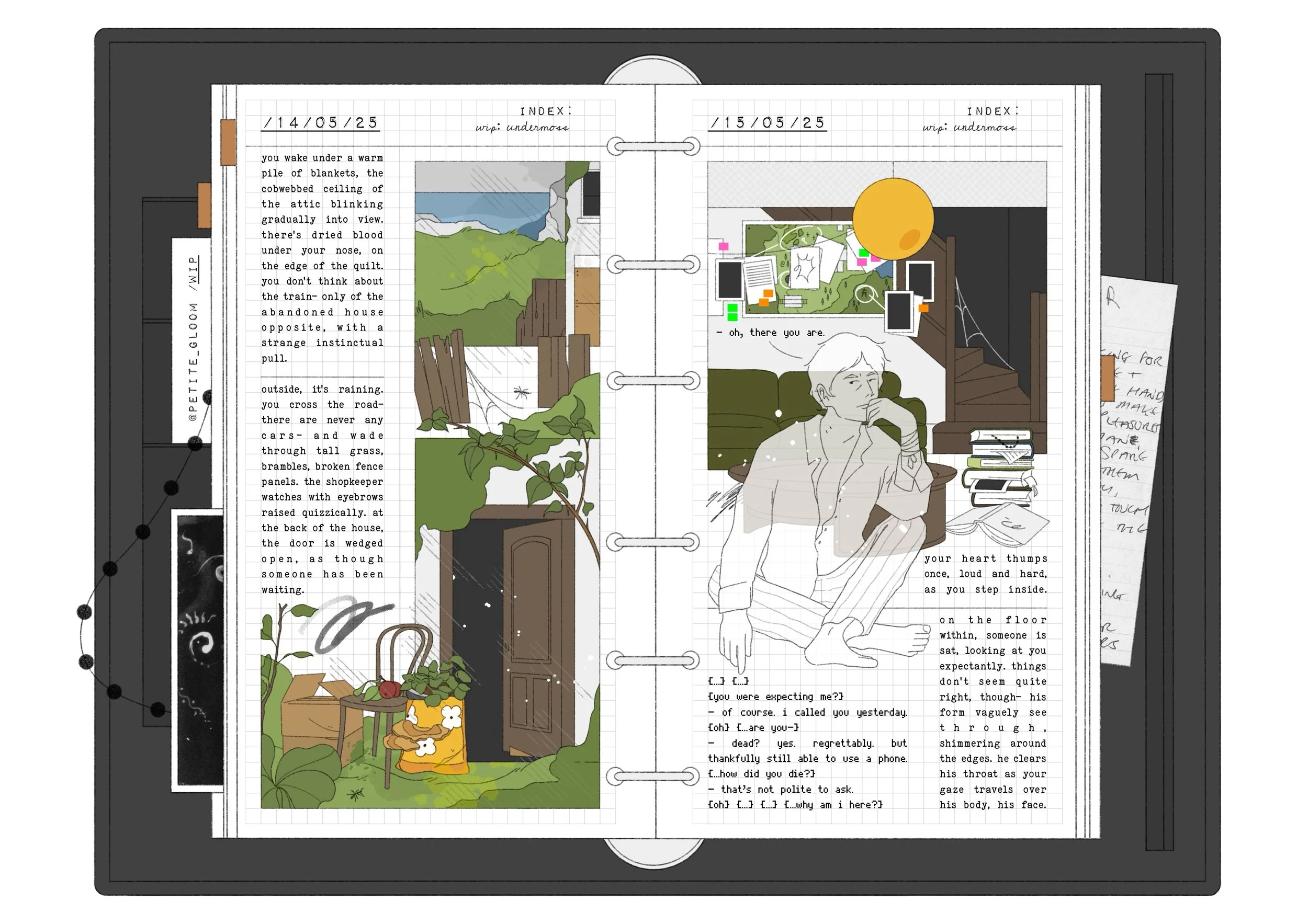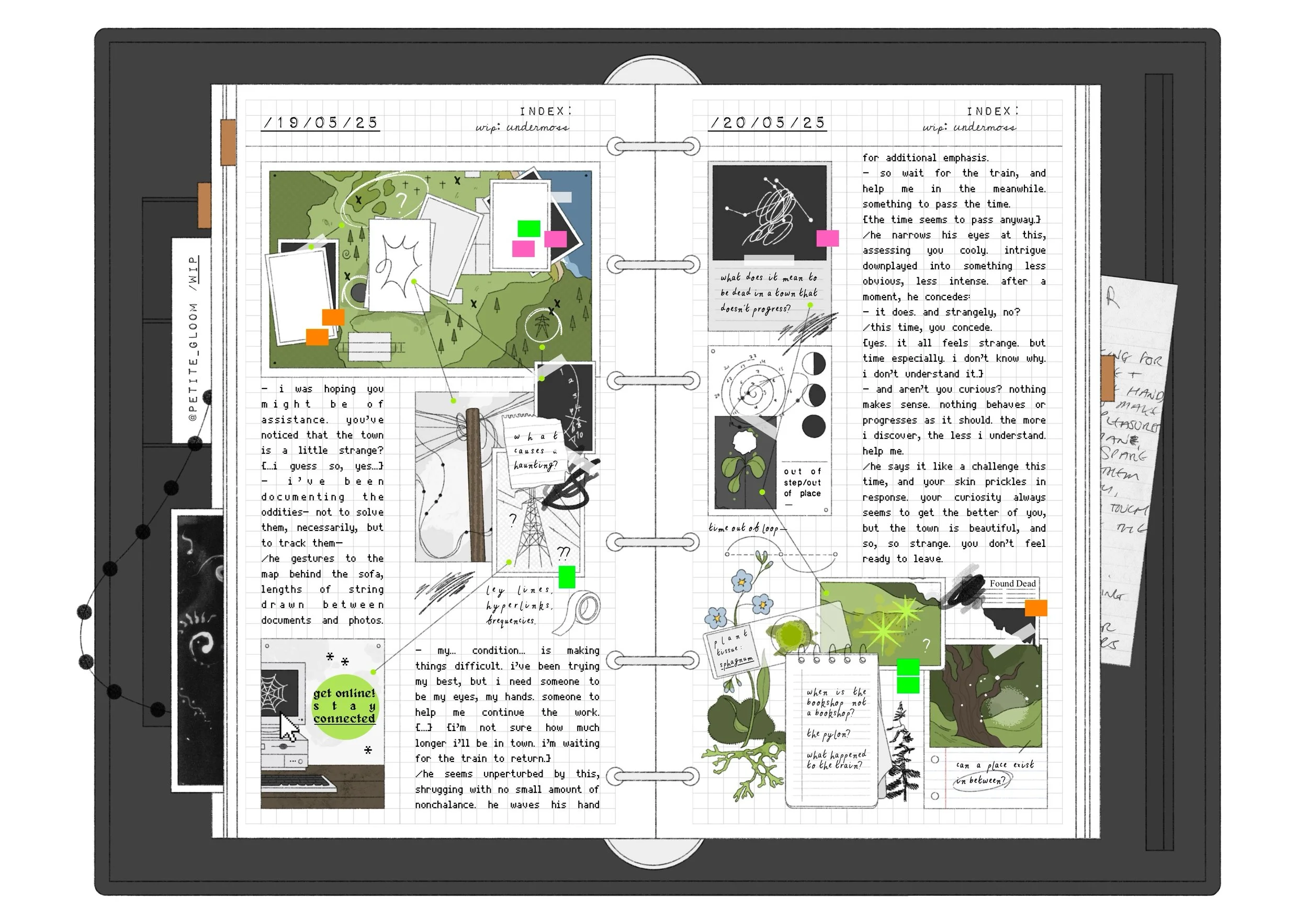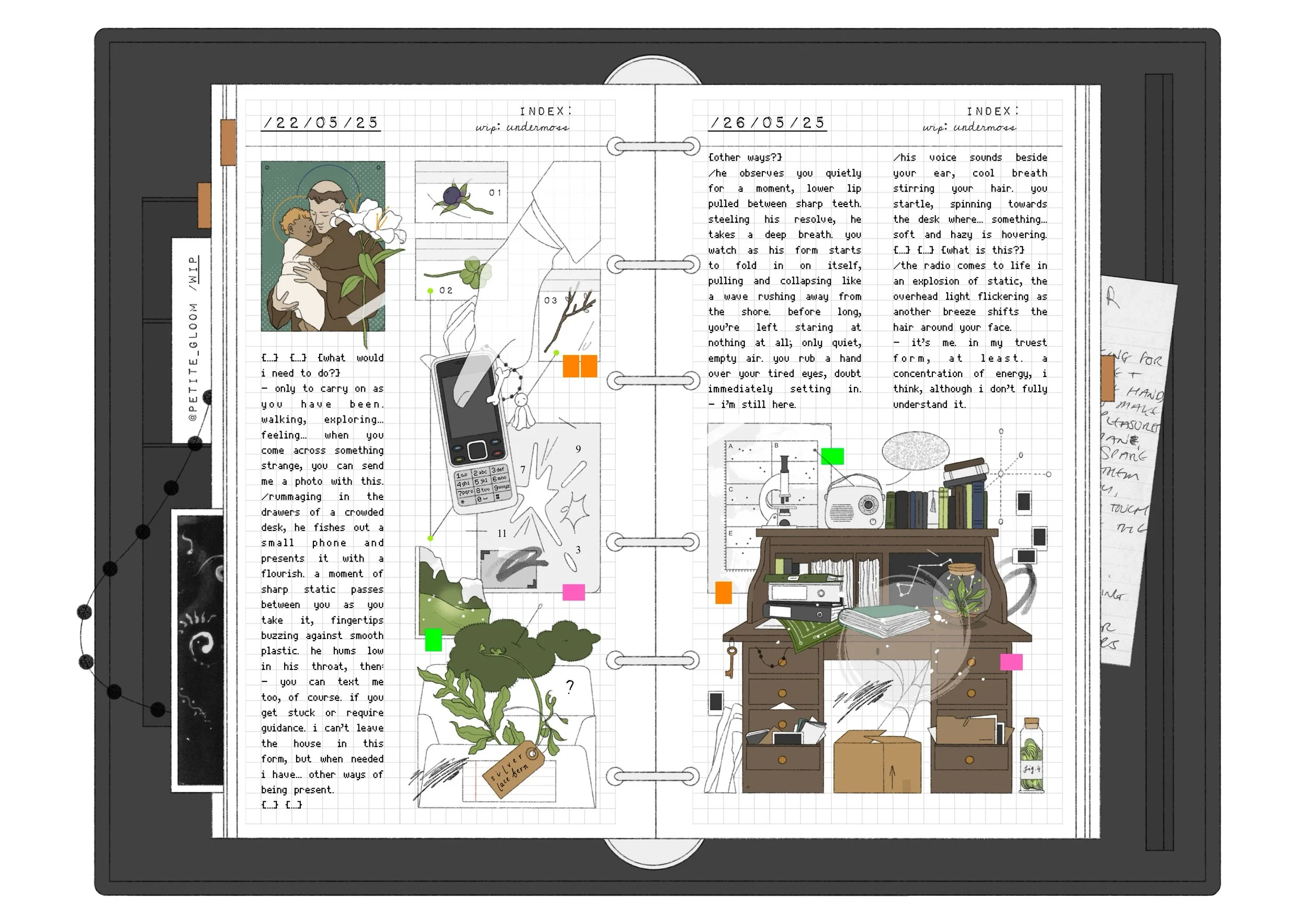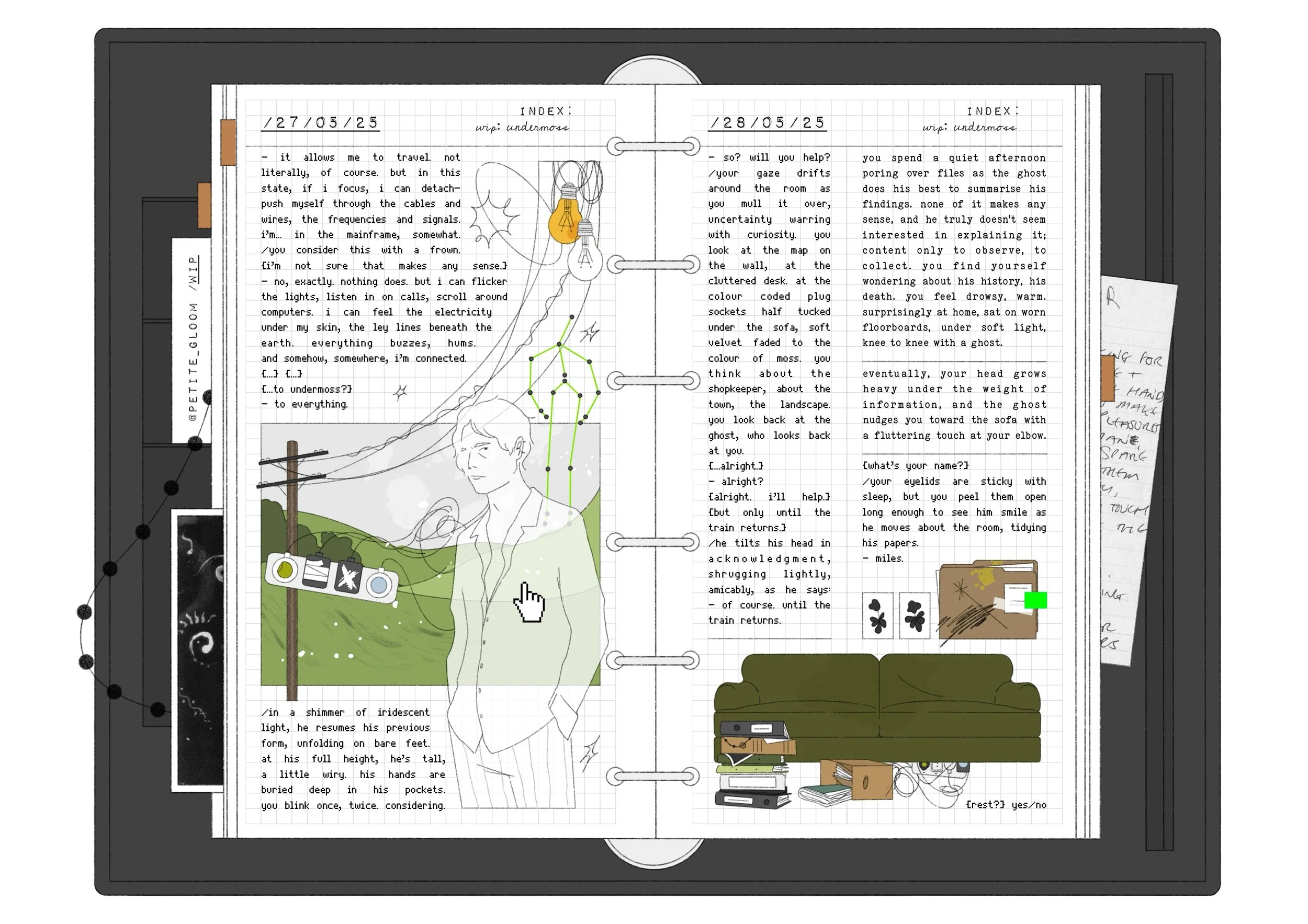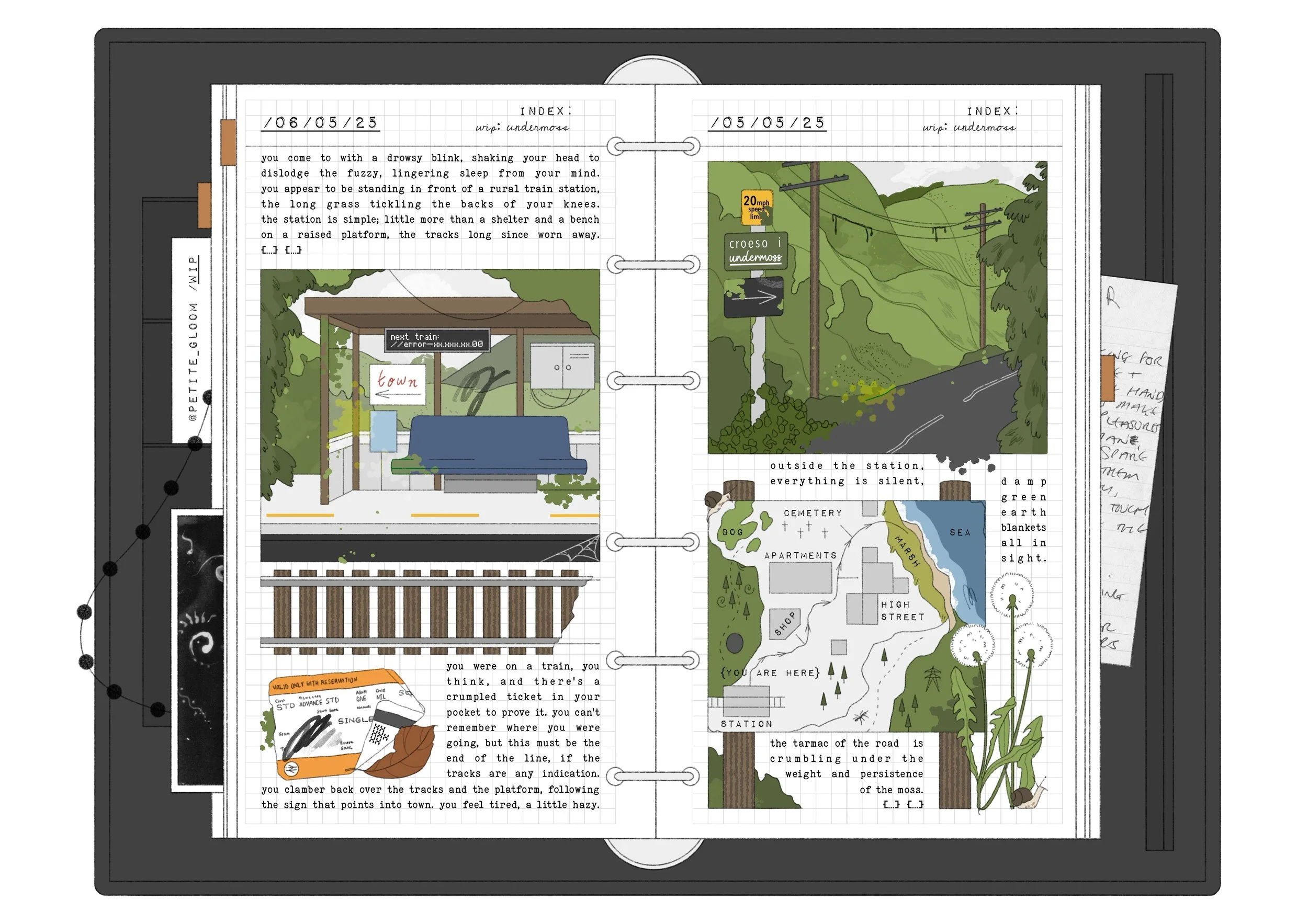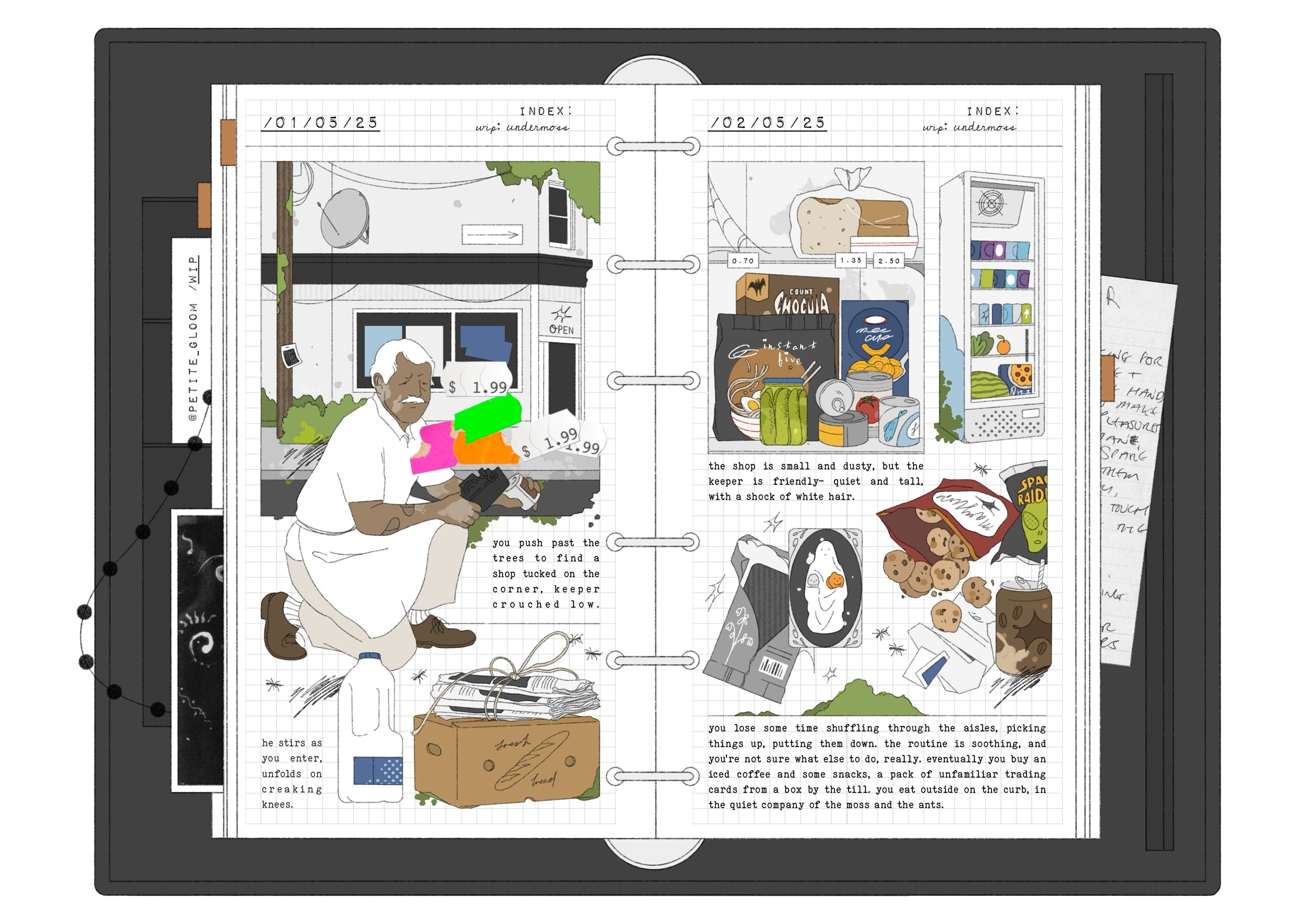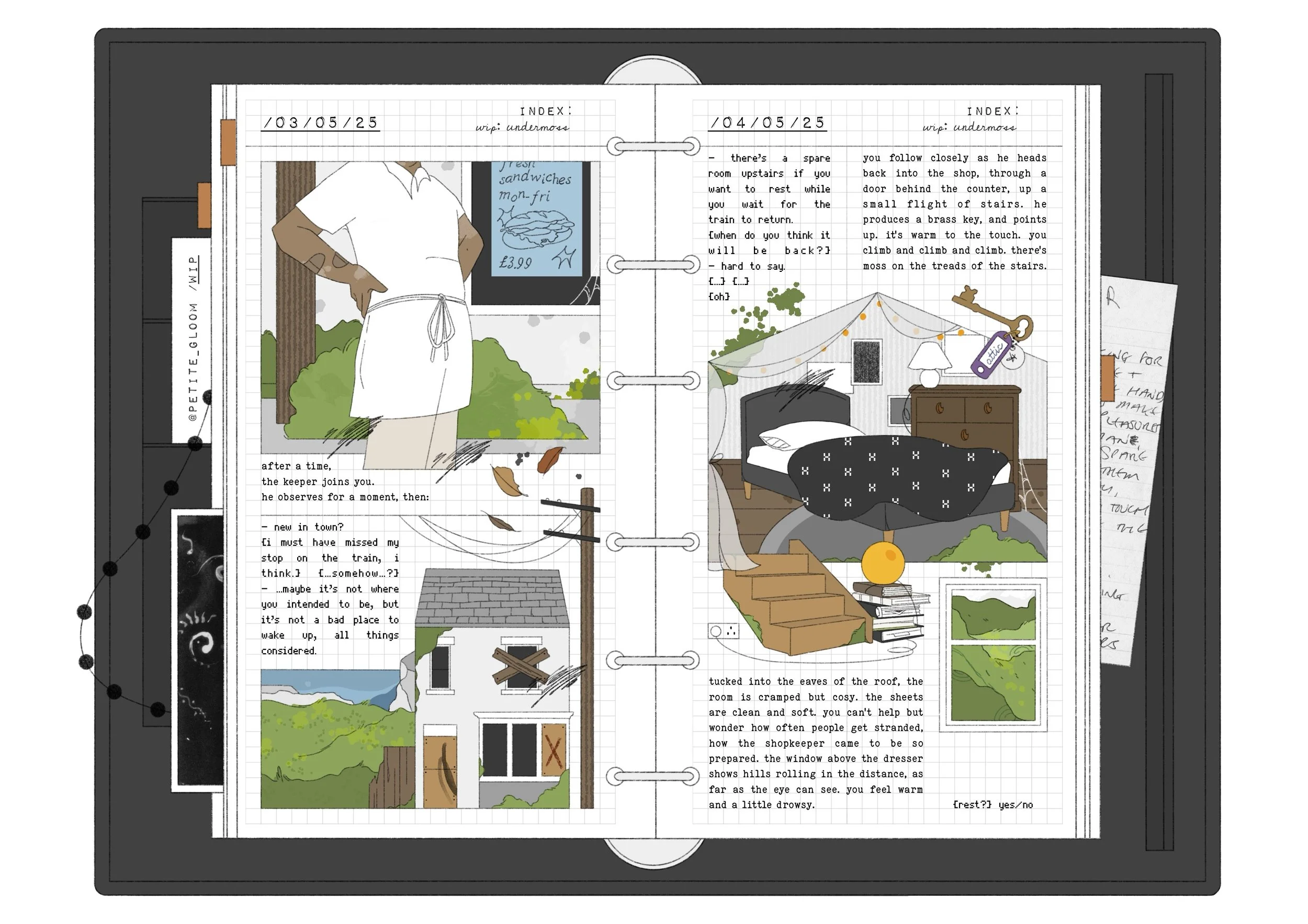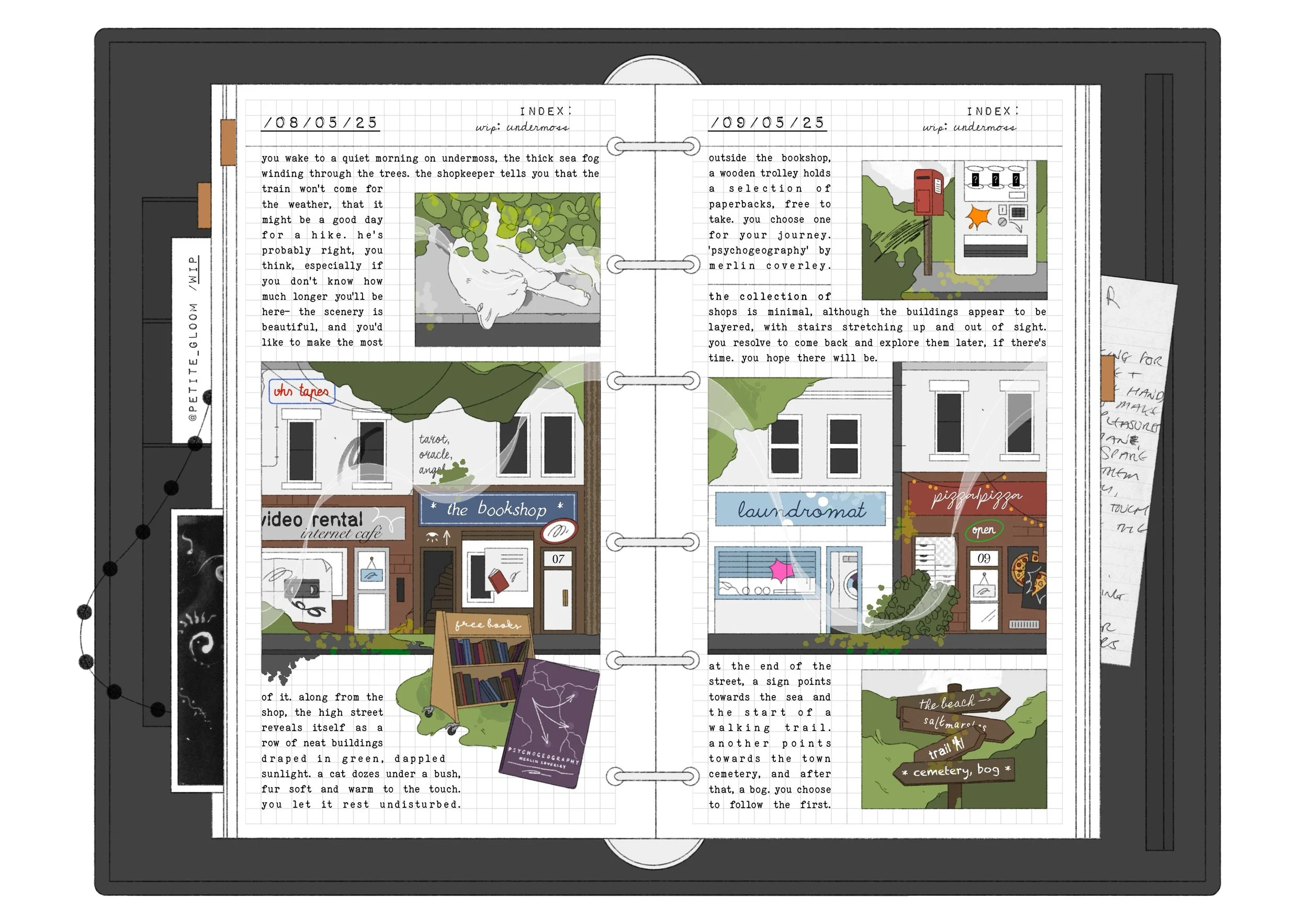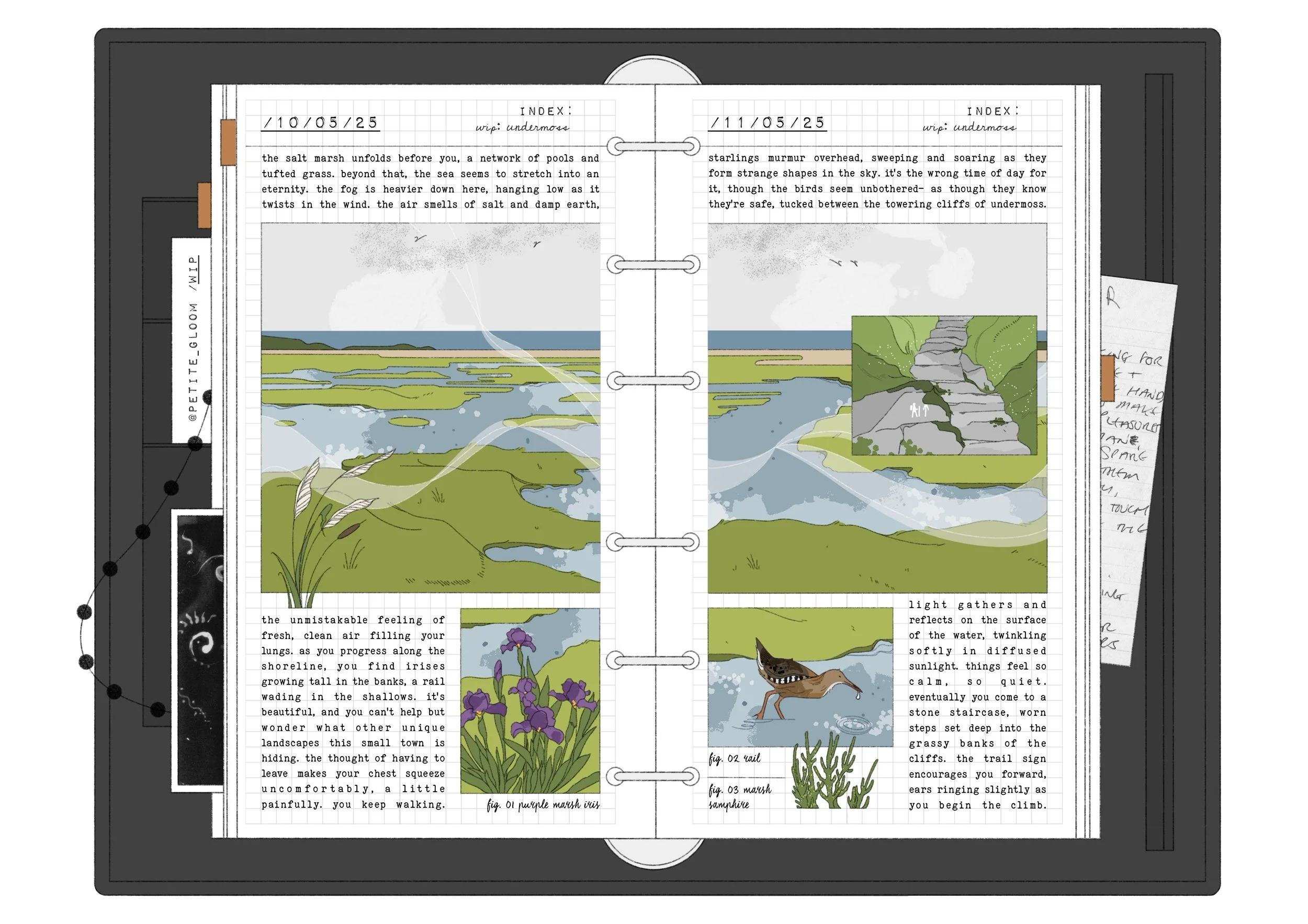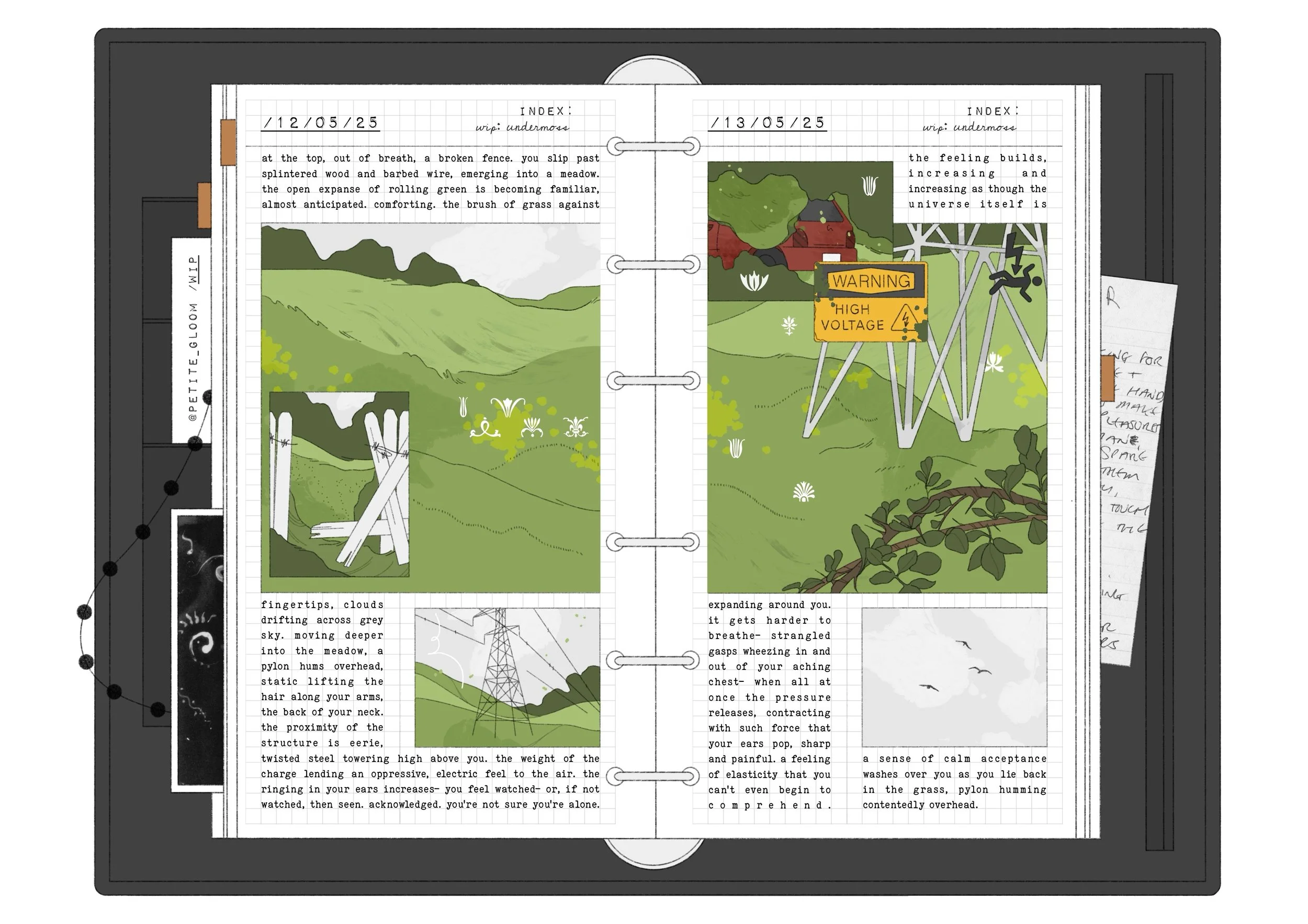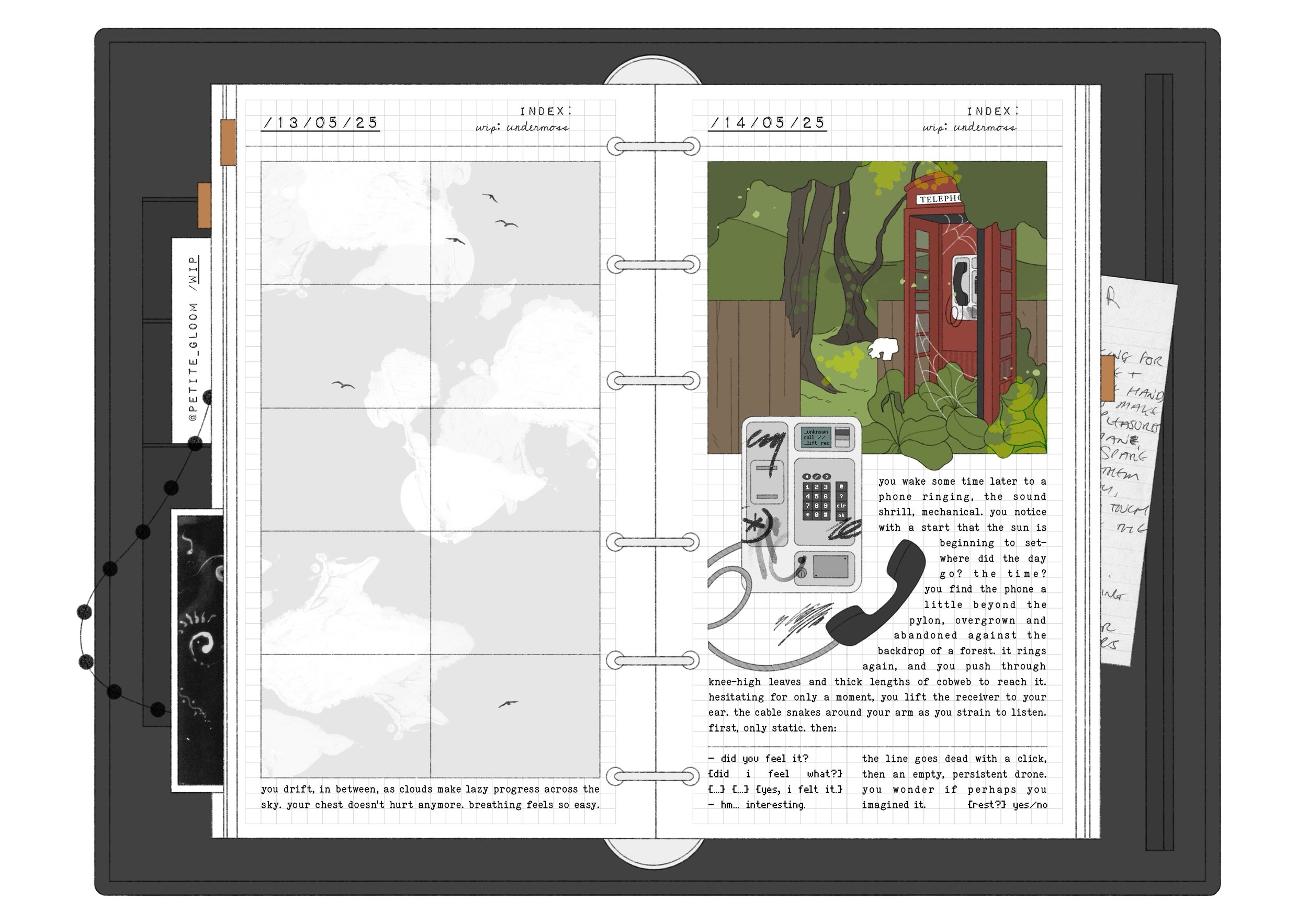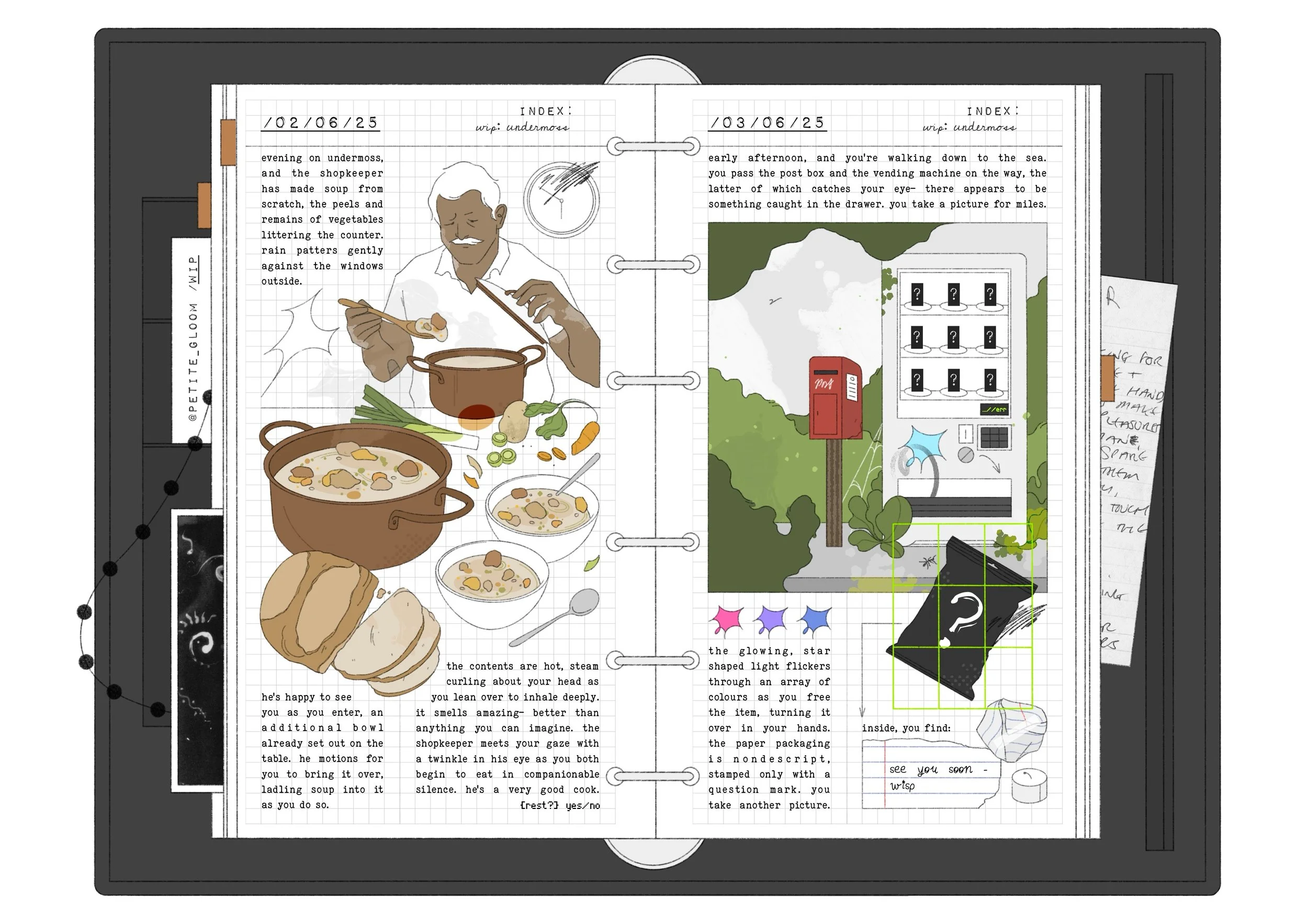
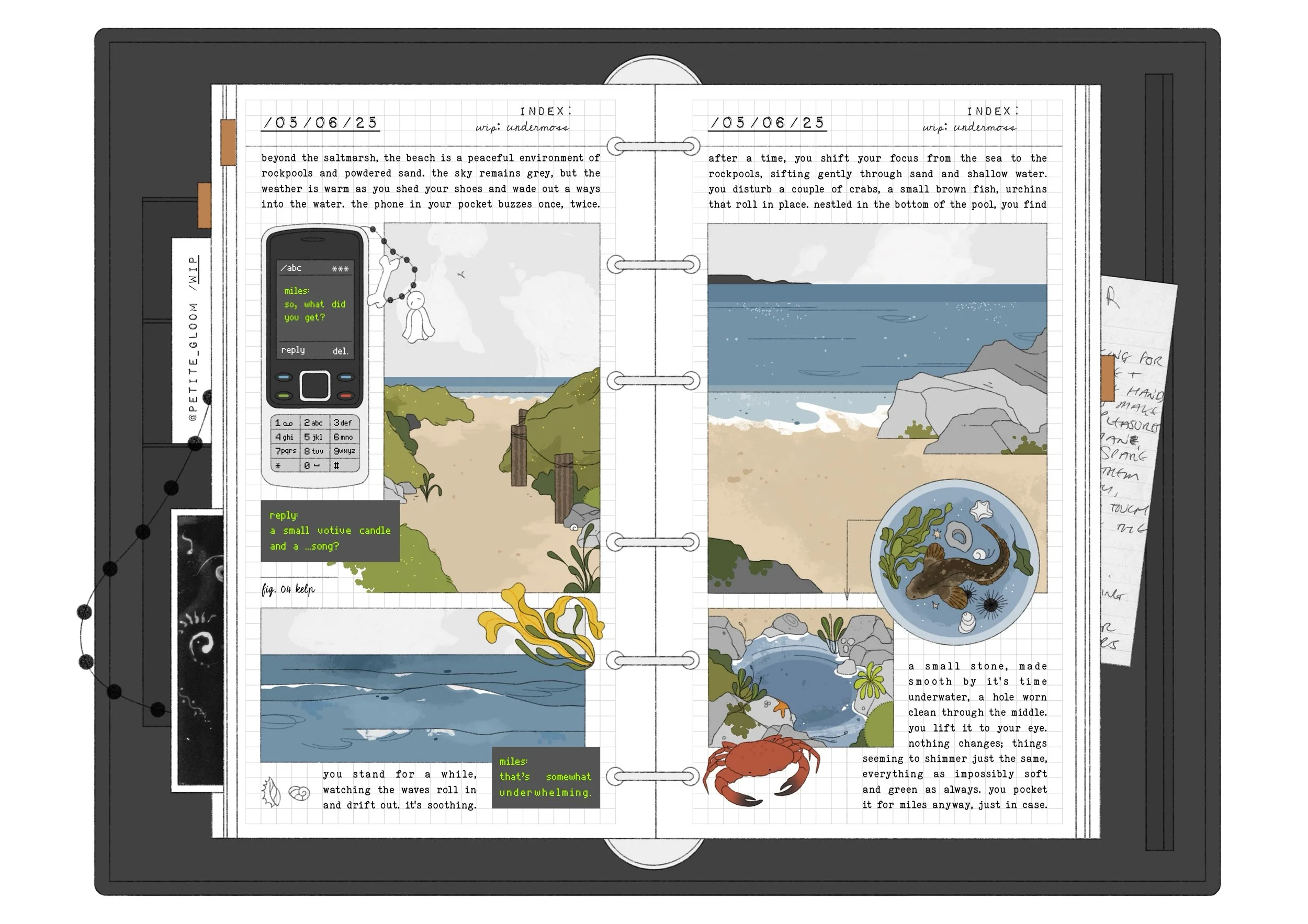
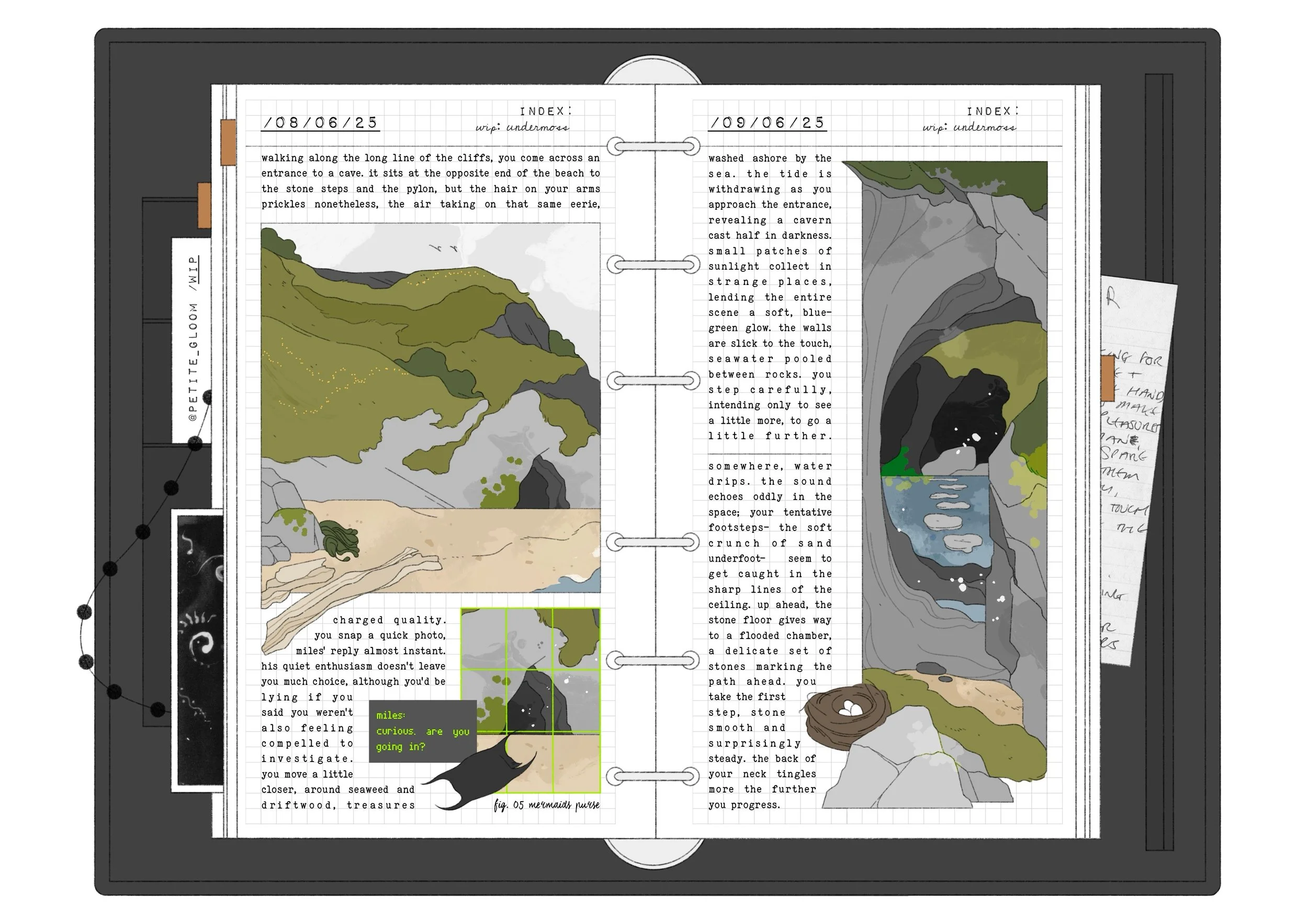

Chapter three! Please zoom into the page if you need to- i’m not sure how best to go about uploading pages for reading. You don’t need an account to leave a comment, so if you have any questions, please leave them below.
Enjoy :-)
please note that i’m currently only shipping physical products within the uk. post office day is a wednesday :-)
A narrative project inspired by nostalgia and homesickness- point and click video games, choose your own adventure, welcome to nightvale, etc. You wake in a town caught between time, where nothing seems to make much sense. You’re not sure what’s going on, but you’re not in any rush to leave. Just something fun to pass the time. It’s not too serious.
Please zoom into the page if you need to- i’m not sure how best to go about uploading pages for reading. You don’t need an account to leave a comment, so if you have any questions, please leave them below.
Enjoy :-)

Recently, I’ve been feeling a little lost when it comes to notebooks. The 2025 planner preview events have been slowly unfolding, unravelling seemingly endless options and ideas, new formats, sizes, and shapes to form our thoughts in. Contrary to the way that this might make us feel though, the year is not actually at its end. We’re only *just* over the midway point, yet I find myself feeling nervous, a little trapped. Not only am I uncertain of what to choose going forward, but I have somehow ended up confused and book-less in the present, and completely (worryingly) clueless about my needs for the first time in what feels like a very long time.
At this point, I feel I have tried most things. Almost everything, maybe, and when I begin to feel restless, it’s usually with a very clear inclination towards something familiar and specific- leaping from Filofax to Hobonichi, from Hobonichi to Traveler’s Company, from Traveler’s Company back into Filofax- but not this time. In recent months, my rings haven’t been clicking in the way that I need. I’ve been feeling overwhelmed when trying to manage multiple smaller booklets, and for the life of me, I can’t seem to work out whether A5 or A6 is the better size for thinking, writing, documenting, and working.
To be book-less is a difficult thing, at least for me. My notebooks have always been a coping mechanism, a tool for accessibility, an external brain. The place where I store the things that I desperately don’t want to lose. Without one, I feel unmoored. Adrift somewhere, lost in the hazy fog of my mind, with no reference points or landmarks to help guide me. The nature of this is what makes me prone to change, to “planner hopping.” Disability and chronic ill health leave you with needs that are always adjusting, evolving, shifting. Everything is always in endless motion, and you are forced to constantly adapt to manage, to maintain some semblance of a life and working mind for yourself (…although I am susceptible to a little FOMO every now and then, too).
To have a working notebook is to feel grounded, secure, supported. To not have one is slightly inconceivable. What will happen to the hours? To the days and the weeks spent in between? I’ve been keeping notes on my phone as a form of crisis management, but it feels a little wrong, somehow. A little nauseating, a little poisonous. This might all be down to the way I frame things internally- nothing about keeping notes digitally needs to be “gross.” But when I’m comfortable in a notebook system, I can feel it. A connection forms, something tangible and present that I’m aware of throughout my days. When I flip through the pages, the photographs, the work progress and the scraps, I feel confident that I am here, that I have been here. With only notes on a screen I am less certain, less convinced. I cannot feel it in the same way. There is no home to return to, and it eats away at me.
Perfection, or “planner peace” as much of the community refers to it, is something I have been seeking for a long time. I don’t think I need 100% perfection- around 75-80% would (probably) do, depending- I can usually cope with some amount of compromises. But how do you find perfection, when the definition is always changing? When the book and the system stay the same, but the symptoms and maladies do not? And how do you come to terms with this, as an individual so reliant on the support and comfort that a well-fitted book provides? I don’t think I have a good answer.
The approach that I usually take, perhaps the only approach that I know how to take, is to adjust the book. When everything shifts, shift with it. Tweak the system, bend its shape into something else, something better. Adjusting a layout, a way of working. A way of recording data, of where to store things- of how much to store. Trying desperately to cut down on the maintenance, of the time needed to collect everything, to collate everything, to archive it.
For me at least, when in perpetual motion, there’s only so many times you can shift before you reach something of a breaking point. When the tool that you have come to rely so heavily on is always changing shape before your eyes, under your hands, the day you wake up unable to recognise (unable to feel) it as the thing you started with is almost inevitable. I don’t like it. The trouble, it seems, is that no book feels “perfect” enough to withstand so many changes, to support so many forms- so much hurt, so much development, so much progress. The relapses in symptom management, in wellbeing, in routine.
Eventually then, the next step is changing the entirety of the book itself. Starting fresh in a different size, a different shape. The spine is new, intact, unbroken. The mess of the last few weeks is not bursting from the pages, a haunting and unwelcome reminder. Things are clean here, hopeful. Undamaged, unchanged. This is how I’ve ended up trapped in the revolving doors of perpetual book and system set-up, content only for a time before everything changes, everything evolves, devolves, disintegrates. I feel as though I am fighting for my life. I do not enjoy it. I keep looking for “perfection”- the one that will withstand. Work with me, grow with me, change with me in a way that doesn’t hurt quite so much. I have a graveyard of incomplete books- maybe a hundred pages in each, at most. A couple with two or three hundred- months when I thought I had found it. Each one a reminder of a darkened time, something that started good and ended bad. The inevitability, the grief.
All of this has led me here then, in the midst of the 2025 preview parties, spiralling slightly, entirely. There’s still time to decided how I want to approach things next year. But for now I am book-less, and the time is losing and lost. The small memories of how I spend my days are not anywhere, and in turn I am not anywhere. It’s a very strange thing. I remain hopeful nonetheless. I see other people find their peace, and I want that for myself- for the others who are still lost with me. I am equal parts split, at all times, between believing that there is a book out there for everyone, and that a book is what we choose to make of it. A balance, I suppose, needs to be found between the two. I’ll keep looking.
When I restarted my YouTube channel back in 2022, I never really expected it to gain the small but significant following that it has (significant to me, at least). Because of this, and partly because of the nature of my issues with cognition and the struggle of putting my thoughts into clear and concise words, I feel I have contributed slightly to a growing misunderstanding around the concept of the commonplace book. In this newfound blogging space, where i’m able to take my time and think things through, speak a little more carefully, i’d really like to try and undo some of that damage.
Traditionally, a commonplace book was a tool and personal compilation of knowledge- quotes, ideas, theories, observations, and notes- gathered by an individual for future reference and reflection. It wasn’t a diary or a journal, but a reference book, a database of information to be accessed and reflected upon again and again.
Due to the personal nature of such books, the contents depended greatly on the collector and their interests, with entries usually organised under systematic subject headings. They could be hyper-specific collections focused on a particular area of interest or research, or instead be a more casual, broader collection of curious knowledge gathered over a period of time. Frequently, they have been used by writers to collect interesting or inspiring sentences, phrases, and quotes (with the intention of revisiting and reworking them later for their own use), but also found popularity among scientists and scholars, as a place to keep and organise information and theories.
According to wikipedia, commonplacing is a practice that has been observed since antiquity, being particulary common during the Renaissance and in the nineteenth century- the linked page contains a fairly extensive (and interesting) breakdown of their history, from their early use in philosophical and religious contexts, to their rise in popularity among famous writers of the nineteenth century.
It seems that for as long as there have been thinkers, there have been commonplace books. Different to journals and diaries, which are usually chronological and introspective in nature, commonplace books have perhaps been the secondary, quieter companion to the thinkers, writers, and collectors of times past. Certainly as a child in school, I heard plenty about the famous dairy keepers (Samuel Pepys and Florence Nightingale, for instance) but not of those who kept commonplace books (Virginia Woolf! Leonardo Da Vinci!), which is a bit of a shame. Although I did take the lessons of keeping a diary to heart, I think there’s potentially something very special about encouraging children to keep record of their interests as they grow, learn, and discover, especially as an instinct that can often wane or leave us entirely as we enter adulthood.
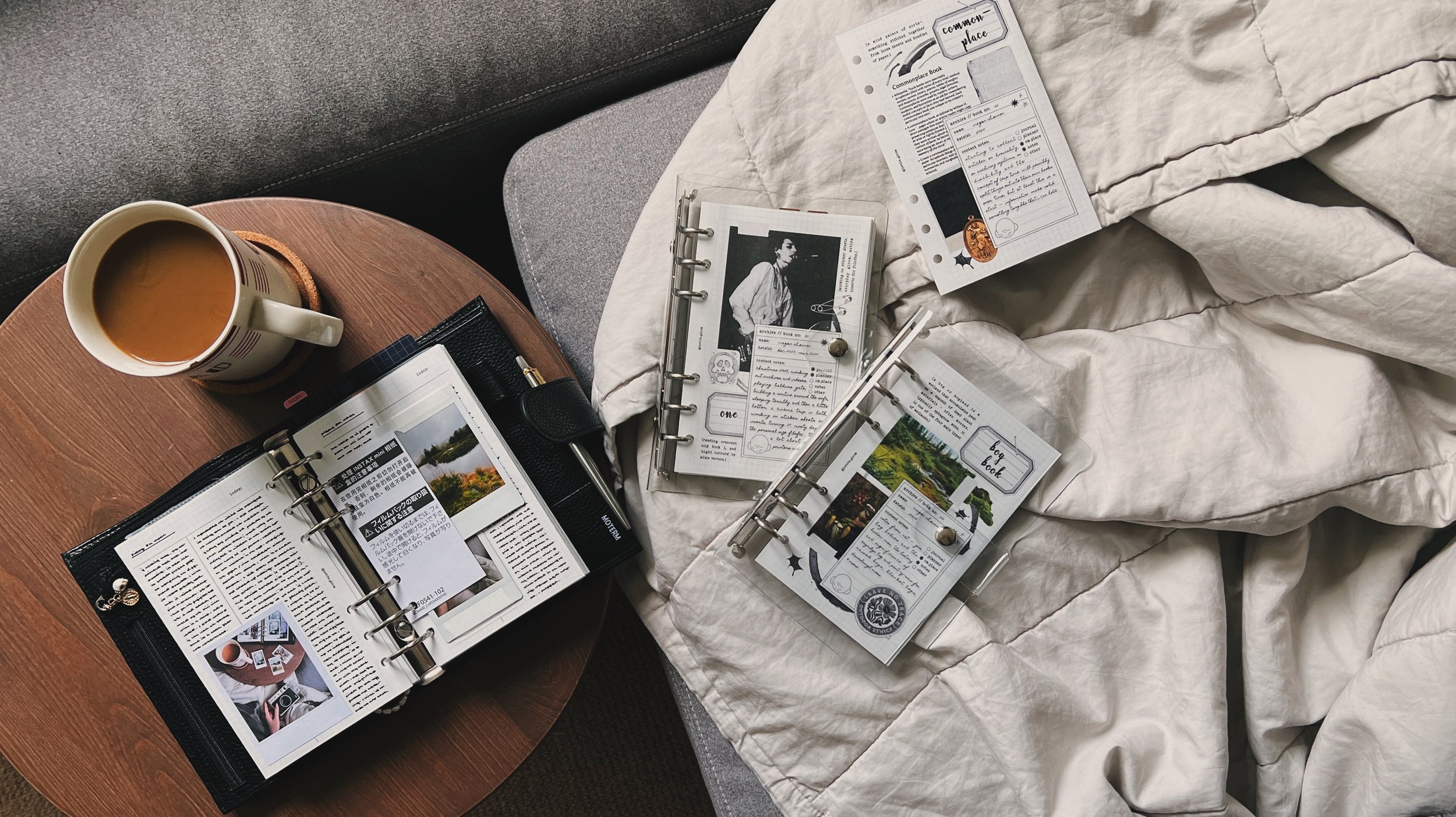
By nature of growing up autistic (although undiagnosed at the time), I was keeping something of a commonplace book- or a series of them. For a short time, I dedicated my school lunch breaks and evenings at home to meticulously crafting special interest pamphlets out of printer paper, pva glue, and whatever else I could find- often sand, little playground pebbles, photos cut from magazines. The words I took from textbooks, history books, and wikipedia articles- admittedly not much has changed there. Unfortunately none of them survived to current day, which i’ll chalk up to their poor construction, but it’s a practice I (thankfully) rediscovered in my late teens, as a student.
Regrettably I don’t remember exactly where I came across it all again- it might have been in this blog post, by Ashley Watson of Notebook of Ghosts (who I have been following on instagram for very many years) or it might have been the result of an interest spiral fuelled by Gansey’s journal in The Raven Boys by Maggie Stiefvater. Regardless, it happened sometime around 2015-2018, when I was reading and interacting with both spaces for the first time. By this point, I had already been a pretty prolific journal keeper for a number of years, ending up with some combination of a commonplace book and the trendier bullet-journal of the time- articles, quotes, and recipes collected amongst crayola felt-tip calendars, future logs, and minimal task lists. Eventually, some years later, I ended up with a little stack of nine A6 Leuchtturm1917 notebooks, all filled with thoughts, to-do lists, observations, notes, and pasted in articles from magazines and online essays. Admittedly, I wasn't really sure what I was doing- all I knew was that I had accidentally awoken something in myself, accidentally stumbled upon a practice that suddenly felt very important, in the way that makes it feel as though gravity has shifted slightly.
Eventually, as time went on, I found myself dealing with some increasingly difficult health issues. They’re still mostly unexplained now, but i’m working on it- and commonplacing is a practice that has become really quite significant to the maintenance of my wellbeing. The difficulties I experience are related to sleep, pain and exhaustion- a persisting haziness, a general and noticeable cognitive decline, and truly debilitating levels of sleepiness and fatigue. The TL;DR: if you’ll allow it, is that I can’t remember anything, and I haven’t been able to for a long time. I have difficulty perceiving time as it passes, in understanding when things happened, and in what order. I can tell you the names of my special interests, I can feel that I feel incredibly strongly about them, but I cannot often “infodump” in the way that is customary and expected of most autistic individuals. I know the information is in there somewhere, I know that I have read countless books, articles and essays, have participated in many hours of research, lost days and weeks to hyper-fixations, but I cannot access any of it. It’s a very disconcerting, and often upsetting, thing. Mostly it leaves me feeling very confused, profoundly lost, sometimes a little scared. Every year it seems to get a little worse, and I feel I lose a little more of myself in the process.
But here’s where commonplacing comes in- as a practice and a coping mechanism, as a way of making things tangible and concrete. As we now know, commonplacing is not the act of keeping a journal or a diary, but the routine of collecting information and resources for future reference. I do also keep a journal, as a way of storing memories and thoughts, but that’s not a part of my commonplace book. This is where i’ve messed up a little in the past- because I prefer a system that allows me to carry all of my books or pages together at once, i’ve frequently referred to this entire volume (which contains both journal and commonplace sections) as my “commonplace book.” When i’ve done this, it’s been meant in a sincere and very literal way; it’s my common place. The place where everything goes. But it does do a slight disservice to the concept, practice, and history of the commonplace book, and that wasn’t really my intention. As my following and subscriber count grows, as people begin to start their own commonplace journeys, I want to clear that up- to fix my mistake. Now, when holding my filofax, with all of it’s sections and pages, I refer to it as my “gloomy archive”- which also inspired the name for this blog. The gloomy archive, in its wider concept, is all of my knowledge and memories. Everything I put down into words, everything I pull from the hazy depths of my brain and make readable, tangible, real.
My true commonplace book, the sections of my archive that fit that definition, help me to interact with my special interests in a way that is manageable and sustainable. I collect articles and essays, type them up, highlight key passages, add notes and annotations, and print them for my filofax. I take the time spent reading, and instead of letting it instantly dissolve in the malfunctioning grey matter of my brain, I turn it into something real, something I can hold in my hands, something I can read again later. When I flip through my special interest binders, I can see the time I invested, see the information I consumed and processed, even if I can no longer (mentally) access it. I can sit and read it again, though- see which paragraphs stood out to me, read the notes and annotations I left in the margin, and process it once more. Each time I do this I think it sticks a little better, but I never really get to a point when I can access it “normally”- effortlessly.
As a result, my commonplace binders bring me a lot of joy. I value the practice and their presence deeply, which is why I spend so much time talking about them. It’s why I carry them around the house with me, and it’s how we ended up six episodes deep in the “filofax infodump”- at the time of writing, at least. It’s how I accidentally built a small following online talking and sharing about notebooks. And more importantly, it’s why I wanted to clear up the definitions, to acknowledge my mistake, and to compile my thoughts on it all here. The practice of commonplacing and of keeping a commonplace book is one that has probably saved my life. I try not to look at these things too closely, but if i’m being honest for a moment, i’m not sure where I would be without it.
Anyway, your commonplace book doesn’t have to be a coping mechanism- doesn’t have to be built from some profound loss or sadness. It doesn’t have to have a reason as deep as that, or work quite so hard. My commonplace books carry a lot of weight, but yours don’t have to. You don’t really need a reason to keep one, you just have to want to, truly want to. It can be a pretty time consuming hobby otherwise.
At this point, you might be thinking: “Ok. That sounds kind of neat. I too, would like to have a small stack of notebooks, filled with whimsy and knowledge beyond the retaining powers of my modern brain. But i’m a little overwhelmed, how do I get started?” which is a question I receive often in various inboxes, emails and direct messages, although maybe not worded quite in the same way. It’s ok. Let’s work it out.
Why do you want to keep a commonplace book? Before we start, i’d really like to take a moment to preface by saying: if you feel like you really don’t get it, don’t see the point, don’t understand why it’s so “popular” at the moment, it’s ok. It might not be for you. Some people don’t enjoy journalling, diary keeping, note taking, and that’s absolutely fine. It might not be for you, and you don’t need to force yourself to feel interested or participate to keep up with whatever is happening online. Maybe you’re better suited to knitting, or crochet. Maybe you just really need to be outdoors, talking to people, instead of talking to yourself, in a notebook. It’s 100% ok. I’m very much the opposite, and that’s ok too. If, however, you do want to keep a commonplace book, think about your why. It’ll help you get started, help keep you on track, and help stop things from getting overwhelming (hopefully). Is it to document your special interest(s)? To aid you in research or academic pursuits? To get to know yourself better? To document a particular time in your life? Any reason is a good reason.
Pick a book. This is probably the step that most resembles “easier said than done”- it’s the first hurdle that a lot of people stumble at. Picking the right book can feel like an impossible task, and in some ways I think it is. The grass will always look greener. To get started with commonplacing, let’s try and pick any book. Information can be moved later, but the practice won’t form itself. To get results, to have something to look at, you have to pick a book, get started, and persevere. It took me many years of experimentation and book hopping to find an overall “system” that I was happy with, but I commonplaced throughout, and by the time I found the one, my personal practice was formed, and well on it’s way to being refined. Nowadays I love filofax- the ability to print my own pages and move them around, recategorise them at will, move them into an archive, is invaluable. But ring planners are an acquired taste, and they don’t work for everyone. Try to worry about it later.
Work out your topics and sections. Or rather, think about how you want to organise things. Page numbers are a big help for this, as they allow you to keep a traditional style contents or index page, which is organisation enough for some people. If you want more refined sections, you should try to work these out. I break mine down into topics like liminality, ghosts and hauntings, disability, sleep and the in-between, bogs, and knowledge management. This is also where ring-bound or similar style books are helpful- things can be moved around or slotted in as needed. If bound books are a must for you, consider smaller notebooks that can be carried together- field notes, or a traveler’s style system, for example. Additionally, you can tag topics or themes with index dots, which can help make it faster to identify pages when flipping back through in search of something specific. I like these ones by stalogy.
Write yourself a little introduction. I find this helps break the tension, helps alleviate some of the new book, new system stress. Take a moment to think about your intentions for the book, and for your wider commonplacing practice. It’s a good opportunity to jot down your thoughts and answers to question one- why? Don’t worry too much about making it look nice, just get it down on the page. A commonplace book isn’t meant to be perfect, isn’t meant to be a work of art. It just needs to function. It has a very specific job to do.
Find an article, essay, quote or poem and copy it down. Make sure to include the title and the author- we’re not stealing, and credit is important. It’s not quite Harvard style referencing, but it’s important to acknowledge the author and be able to find them again later if needed. Spend some time with the text. Try not to just copy it down and leave it, especially if you feel a little spaced out in the process. Read it again, highlight the bits that stand out to you, leave yourself some thoughts and notes about what you’ve read. What did you like about it? Would you read it again? What kind of themes can you recognise in the text? Do you want to do further reading on the author/topic?
Find some pictures (optional). I usually like to finish a commonplace entry off by adding some photos- I have big margins for this. It isn’t necessary, but it can help break up the appearance of the text, especially if you’re visually or aesthetically driven. It’s nice to have something to look at, and it can help you locate entries faster when flipping back through after some time has passed. My commonplace books look a little like a scrapbook because of this, which I find nice. Try to remember to add credit for the photos. Keep things neat and respectful.
Repeat! Find another piece of text, some more information, and transfer it into the book. Anything that interests you is good, and new topics and themes can be introduced over time. Try not to overthink too much, as hard as it may be. Focus on the routine of the practice, of developing some consistency. You don’t need to write every day, but at least once a week might be a good start, just until things feel established. As with any hobby, commonplacing takes time before it feels natural, before you feel “good” at it. It doesn’t happen immediately, or overnight. You have to give it space, patience, and a little dedication. You have to put in a little work.
Reflect. In my opinion, one of the most important parts of commonplacing is the reflection. Without it, you might find yourself thinking “why am I doing this?” or “what’s the point?” and growing a little disillusioned. Traditionally, the information is collected to be referenced and revisited later. It’s a big book (eventually) of things that you like, of things that stood out to you, stuck with you. Take a little time each week, or each day, to flip back through entries. Read the ones that jump out, add some new notes in the margins or via post-its, and let the sweet, sweet knowledge percolate in your brain. After some time, you’ll have a satisfying tome, a book with some weight, some heft, full of the things that you’ve read, the interests that you’ve enjoyed, the words and themes that you’ve loved. And that’s truly one of the most satisfying and (for me, at least) fulfilling things in the world. (˵¯͒〰¯͒˵)
This might all sound very easy, or it might sound hard- either is ok. Take as much time as you need to work it out. I’ve always been someone who kept notebooks, and the act of filling them and problem-solving my various systems is a little compulsive. It’s taken me many years to get to where I am today, and I hope the things i’ve learned can be of a little use.
Finally, after all of this, you might be thinking: “Ok, sounds good. But where can I find interesting things to read?” and it’s a very fair question to ask. We live in an age of information over-saturation, which is maybe part of what makes commonplace books so compelling to us now- the opportunity to collect and curate our own archives of the things we feel actually matter, that we actually enjoy and are interested in, amongst so much noise- but I digress. It can be hard to find things, especially as content of all kind is starting to lean shorter, and shorter, and shorter. Luckily, i’ve compiled a list of my favourite websites for reading. From there you’ll have to jump in and do your own research. Scroll! Dive into the depths of wikipedia, type strange keywords into the search bar of Aeon to see if anything interesting comes up. Google the authors and the references they mention, click every link in the “further reading” list. It’s good to explore, to investigate, to dig and uncover.
Aeon • Wellcome • The Marginalian • Poetry Foundation • Medium • The Atlantic • New Scientist • Wikipedia • Internet Archive • Substack • Longreads • The Electric Typewriter • The Walrus • National Geographic • The New Yorker • Electric Lit • Granta • Idler • Apollo Magazine • Rolling Stone • Philosophy Now • Art & Letters Daily • Nightmare • Rookie Mag Archive • Dazed • It’s Nice That • Smithsonian Magazine • Literary Hub • Places Journal • V&A • Cambridge Digital Library
Although I believe that digital commonplace books should be a part of the conversation, and that there is room for them in the practice, a small part of me can’t help but feel that analogue is better. To copy something out by hand, or to print something but spend time reading, rereading, highlighting and annotating, is (at least in my opinion) to truly commit to the text. Processing it, understanding it. My fear with digital commonplacing is that part of this is lost- not in all instances, i’ll admit, but in some. If the inclination is to always save a link for later, or to bookmark something with the intention of coming back to it and never doing so, then not only is the text not being processed or understood, but often times it’s not even being read. It essentially just becomes a version of digital hoarding. PDF’s within folders within folders, or long lists of articles collected in journalling software. Which, to be fair, is absolutely fine if that’s what you like, but I wouldn’t then consider it to be commonplacing.
If it’s a matter of accessibility, or privacy, or some other factor that might make digital commonplacing preferable or necessary, then the key thing to remember is that commonplacing is the practice of collecting information with the intention to revisit it later. It’s to gather, organise and reflect, not to collect and abandon, or ignore.
There are many examples, for instance, of digital commonplacing done well. The resurgence of neocities is something i’ve been watching with great enthusiasm, as sites are created around an individuals interests- sometimes even around a very specific theme, like this shrine to haunted houses, which, in it’s essence, is a digital interactive commonplace book. It’s very very cool, and a lot of work and love has clearly gone into it. I think for me, this is where the difference lies- it isn’t simply copying and pasting, or bookmarking, but interacting with the text. Collecting with a purpose and a reason.
Another example could be how many people use obsidian.md- especially in academic circles, where texts are collected, themes mapped, and connections made between them all. I back my own commonplace book up through obsidian, and sometimes it allows me to make connections I hadn’t realised were otherwise there. Again, I think it comes down to the interaction with the text, or in this case, between the texts. It provides an additional layer that I consider to be important to the practice. A brief caveat to say that you might disagree with me, and that’s ok- these are just my own personal feelings on the matter. You can take it with a pinch of salt.
https://notebookofghosts.com/2018/02/25/a-brief-guide-to-keeping-a-commonplace-book/
https://www.nytimes.com/2022/03/22/magazine/commonplace-books-recommendation.html
https://www.commonplacing.net/what-is-commonplacing/
https://www.thephoenixnews.com/posts/everyone-needs-a-commonplace-book
https://www.theatlantic.com/technology/archive/2012/01/commonplace-books-the-tumblrs-of-an-earlier-era/251811/
https://www.nytimes.com/1970/05/03/archives/speaking-of-commonplace-books-commonplace-books.html
https://www.reddit.com/r/commonplacebook/