The Conversation (0)
Sort by

Inflammation: It’s the body’s natural response to injury and infection, but medical science now recognizes it as a double-edged sword. When inflammation becomes chronic, it can contribute to a host of serious health problems, including arthritis, heart disease, and certain cancers. As this understanding has grown, so too has the search for effective ways to manage harmful inflammation.
Doctors and researchers are exploring various approaches to tackle this pervasive health issue, from new medications to dietary interventions. But what if one of the most promising treatments relies on a familiar technology that’s been in hospitals for decades?
Enter focused ultrasound stimulation (FUS), a technique that uses sound waves to reduce inflammation in targeted areas of the body. It’s a surprising new application for ultrasound technology, which most people associate with prenatal checkups or diagnostic imaging. And FUS may help with many other disorders too, including diabetes and obesity. By modifying existing ultrasound technology, we might be able to offer a novel approach to some of today’s most pressing health challenges.
Our team of biomedical researchers at the Institute of Bioelectronic Medicine (part of the Feinstein Institutes for Medical Research), in Manhasset, N.Y., has made great strides in learning the electric language of the nervous system. Rather than treating disease with drugs that can have broad side effects throughout the body, we’re learning how to stimulate nerve cells, called neurons, to intervene in a more targeted way. Our goal is to activate or inhibit specific functions within organs.
The relatively new application of FUS for neuromodulation, in which we hypothesize that sound waves activate neurons, may offer a precise and safe way to provide healing treatments for a wide range of both acute and chronic maladies. The treatment doesn’t require surgery and potentially could be used at home with a wearable device. People are accustomed to being prescribing pills for these ailments, but we imagine that one day, the prescriptions could be more like this: “Strap on your ultrasound belt once per day to receive your dose of stimulation.”
Ultrasound is a time-honored medical technology. Researchers began experimenting with ultrasound imaging in the 1940s, bouncing low-energy ultrasonic waves off internal organs to construct medical images, typically using intensities of a few hundred milliwatts per square centimeter of tissue. By the late 1950s, some doctors were using the technique to show expectant parents the developing fetus inside the mother’s uterus. And high-intensity ultrasound waves, which can be millions of milliwatts per square centimeter, have a variety of therapeutic uses, including destroying tumors.
The use of low-intensity ultrasound (with intensities similar to that of imaging applications) to alter the activity of the nervous system, however, is relatively unexplored territory. To understand how it works, it’s helpful to compare FUS to the most common form of neuromodulation today, which uses electric current to alter the activity of neurons to treat conditions like Parkinson’s disease. In that technique, electric current increases the voltage inside a neuron, causing it to “fire” and release a neurotransmitter that’s received by connected neurons, which triggers those neurons to fire in turn. For example, the deep brain stimulation used to treat Parkinson’s activates certain neurons to restore healthy patterns of brain activity.

In focused ultrasound stimulation, we theorize that sound waves’ vibrations (1) cause channels (2) on the neuron’s cell membrane to open. Positive ions flow in, causing a voltage change within the neuron that triggers it to fire with an action potential (3) that travels down the axon. The axon’s tips (4) release neurotransmitters that cause connected neurons to fire in turn.
Chris Philpot
In FUS, by contrast, the sound waves’ vibrations interact with the membrane of the neuron, opening channels that allow ions to flow into the cell, thus indirectly changing the cell’s voltage and causing it to fire. One promising use is transcranial ultrasound stimulation, which is being tested extensively as a noninvasive way to stimulate the brain and treat neurological and psychiatric diseases.
We’re interested in FUS’s effect on the peripheral nerves—that is, the nerves outside the brain and spinal cord. We think that activating specific nerves in the abdomen that regulate inflammation or metabolism may help address the root causes of related diseases, rather than just treating the symptoms.
Inflammation is something that we know a lot about. Back in 2002, Kevin Tracey, currently the president and CEO of the Feinstein Institutes, upset the conventional wisdom that the nervous system and the immune system operate independently and serve distinct roles. He discovered the body’s inflammatory reflex: a two-way neural circuit that sends signals between the brain and body via the vagus nerve and the nerves of the spleen. These nerves control the release of cytokines, which are proteins released by immune cells to trigger inflammation. Tracey and colleagues found that stimulating nerves in this neural circuit suppressed the inflammatory response. The discoveries led to the first clinical trials of electrical neuromodulation devices to treat chronic inflammation and launched the field of bioelectronic medicine.

When focused ultrasound (1) is applied to the spleen (2), it activates neurons (3), causing them to release certain neurotransmitters that interact with immune cells called T-cells (4) and macrophages (5). Those interactions release another neurotransmitter that binds to receptors on the macrophages, inhibiting them from producing and releasing cytokines, thus putting the brakes on the inflammatory response.
Chris Philpot
Tracey has been a pioneer in treating inflammation with vagus nerve stimulation (VNS), in which electrical stimulation of the vagus nerve activates neurons in the spleen. In animals and humans, VNS has been shown to reduce harmful inflammation in both chronic diseases such as arthritis and acute conditions such as sepsis. But direct VNS requires surgery to place an implant in the body, which makes it risky for the patient and expensive. That’s why we’ve pursued noninvasive ultrasound stimulation of the spleen.
Working with Tracey, collaborators at GE Research, and others, we first experimented with rodents to show that ultrasound stimulation of the spleen affects an anti-inflammatory pathway, just as VNS does, and reduces cytokine production as much as a VNS implant does. We then conducted the first-in-human trial of FUS for controlling inflammation.
We initially enrolled 60 healthy people, none of whom had signs of chronic inflammation. To test the effect of a 3-minute ultrasound treatment, we were measuring the amount of a molecule called tumor necrosis factor (TNF), which is a biomarker of inflammation that’s released when white blood cells go into action against a perceived pathogen. At the beginning of the study, 40 people received focused ultrasound stimulation, while 20 others, serving as the control group, simply had their spleens imaged by ultrasound. Yet, when we looked at the early data, everyone had lower levels of TNF, even the control group. It seemed that even imaging with ultrasound for a few minutes had a moderate anti-inflammatory effect! To get a proper control group, we had to recruit 10 more people for the study and devise a different sham experiment, this time unplugging the ultrasound machine.

Shonagh Rae
After the subjects received either the real or sham stimulation, we took blood samples from all of them. We next simulated an infection by adding a bacterial toxin to the blood in the test tubes, then measured the amount of TNF released by the white blood cells to fight the toxin. The results, which we published in the journal Brain Stimulation in 2023, showed that people who had received FUS treatments had lower levels of TNF than the true control group. We saw no problematic side effects of the ultrasound: The treatment didn’t adversely affect heart rate, blood pressure, or the many other biomarkers that we checked.
The results also showed that when we repeated the blood draw and experiment 24 hours later, the treatment groups’ TNF levels had returned to baseline. This finding suggests that if FUS becomes a treatment option for inflammatory diseases, people might require regular, perhaps even daily, treatments.
One surprising result was that it didn’t seem to matter which location within the spleen we targeted—all the locations we tried produced similar results. Our hypothesis is that hitting any target within the spleen activates enough nerves to produce the beneficial effect. What’s more, it didn’t matter which energy intensity we used. We tried intensities ranging from about 10 to 200 mW per cm2, well within the range of intensities used in ultrasound imaging; remarkably, even the lowest intensity level caused subjects’ TNF levels to drop.
Our big takeaway from that first-in-human study was that targeting the spleen with FUS is not just a feasible treatment but could be a gamechanger for inflammatory diseases. Our next steps are to investigate the mechanisms by which FUS affects the inflammatory response, and to conduct more animal and human studies to see whether prolonged administration of FUS to the spleen can treat chronic inflammatory diseases.
For much of our research on FUS, we’ve partnered with GE Research, whose parent company is one of the world’s leading makers of ultrasound equipment. One of our first projects together explored the potential of FUS as a treatment for the widespread inflammation that often accompanies obesity, a condition that now affects about 890 million people around the world. In this study, we fed lab mice a high-calorie and high-fat “Western diet” for eight weeks. During the following eight weeks, half of them received ultrasound stimulation while the other half received daily sham stimulation. We found that the mice that received FUS had lower levels of cytokines—and to our surprise, those mice also ate less and lost weight.
In related work with our GE colleagues, we examined the potential of FUS as a treatment for diabetes, which now affects 830 million people around the world. In a healthy human body, the liver stores glucose as a reserve and releases it only when it registers that glucose levels in the bloodstream have dropped. But in people with diabetes, this sensing system is dysfunctional, and the liver releases glucose even when blood levels are already high, causing a host of health problems.
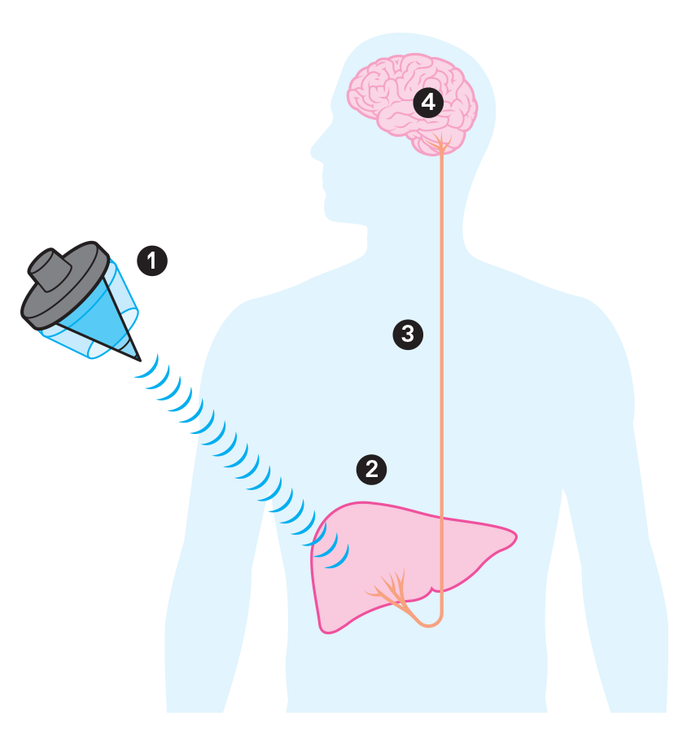
When focused ultrasound (1) is applied to an area in the liver (2) called the porta hepatis, it activates glucose-sensing neurons. Those neurons send signals up the vagus nerve (3) to the brain, where a region called the hypothalamus (4) commands the body to reduce glucose production and increase glucose uptake.
Chris Philpot
For diabetes, our ultrasound target was the network of nerves that transmit signals between the liver and the brain: specifically, glucose-sensing neurons in the porta hepatis, which is essentially the gateway to the liver. We gave diabetic rats 3-minute daily ultrasound stimulation over a period of 40 days. Within just a few days, the treatment brought down the rats’ glucose levels from dangerously high to normal range. We got similar results in mice and pigs, and published these exciting results in 2022 in Nature Biomedical Engineering.
Those diabetes experiments shed some light on why ultrasound had this effect. We decided to zero in on a brain region called the hypothalamus, which controls many crucial automatic body functions, including metabolism, circadian rhythms, and body temperature. Our colleagues at GE Research started investigating by blocking the nerve signals that travel from the liver to the hypothalamus in two different ways—both cutting the nerves physically and using a local anesthetic. When we then applied FUS, we didn’t see the beneficial decrease in glucose levels. This result suggests that the ultrasound treatment works by changing glucose-sensing signals that travel from the liver to the brain—which in turn changes the commands the hypothalamus issues to the metabolic systems of the body, essentially telling them to lower glucose levels.
The next steps in this research involve both technical development and clinical testing. Currently, administering FUS requires technical expertise, with a sonographer looking at ultrasound images, locating the target, and triggering the stimulation. But if FUS is to become a practical treatment for a chronic disease, we’ll need to make it usable by anyone and available as an at-home system. That could be a wearable device that uses ultrasound imaging to automatically locate the anatomical target and then delivers the FUS dose: All the patient would have to do is put on the device and turn it on. But before we get to that point, FUS treatment will have to be tested clinically in randomized controlled trials for people with obesity and diabetes. GE HealthCare recently partnered with Novo Nordisk to work on the clinical and product development of FUS in these areas.
FUS may also help with chronic cardiovascular diseases, many of which are associated with immune dysfunction and inflammation. We began with a disorder called pulmonary arterial hypertension, a rare but incurable disease in which blood pressure increases in the arteries within the lungs. At the start of our research, it wasn’t clear whether inflammation around the pulmonary arteries was a cause or a by-product of the disease, and whether targeting inflammation was a viable treatment. Our group was the first to try FUS of the spleen in order to reduce the inflammation associated with pulmonary hypertension in rats.
The results, published last year, were very encouraging. We found that 12-minute FUS sessions reduced pulmonary pressure, improved heart function, and reduced lung inflammation in the animals in the experimental group (as compared to animals that received sham stimulation). What’s more, in the animals that received FUS, the progression of the disease slowed significantly even after the experiment ended, suggesting that this treatment could provide a lasting effect.
One day, an AI system might be able to guide at-home users as they place a wearable device on their body and trigger the stimulation.
This study was, to our knowledge, the first to successfully demonstrate an ultrasound-based therapy for any cardiopulmonary disease. And we’re eager to build on it. We’re next interested in studying whether FUS can help with congestive heart failure, a condition in which the heart can’t pump enough blood to meet the body’s needs. In the United States alone, more than 6 million people are living with heart failure, and that number could surpass 8 million by 2030. We know that inflammation plays a significant role in heart failure by damaging the heart’s muscle cells and reducing their elasticity. We plan to test FUS of the spleen in mice with the condition. If those tests are successful, we could move toward clinical testing in humans.
We have one huge advantage as we think about how to bring these results from the lab to the clinic: The basic hardware for ultrasound already exists, it’s already FDA approved, and it has a stellar safety record through decades of use. Our collaborators at GE have already experimented with modifying the typical ultrasound devices used for imaging so that they can be used for FUS treatments.
Once we get to the point of optimizing FUS for clinical use, we’ll have to determine the best neuromodulation parameters. For instance, what are the right acoustic wavelengths and frequencies? Ultrasound imaging typically uses higher frequencies than FUS does, but human tissue absorbs more acoustic energy at higher frequencies than it does at lower frequencies. So to deliver a good dose of FUS, researchers are exploring a wide range of frequencies. We’ll also have to think about how long to transmit that ultrasound energy to make up a single pulse, what rate of pulses to use, and how long the treatment should be.
In addition, we need to determine how long the beneficial effect of the treatment lasts. For some of the ailments that researchers are exploring, like FUS of the brain to treat chronic pain, a patient might be able to go to the doctor’s office once every three months for a dose. But for diseases associated with inflammation, a regular, several-times-per-week regimen might prove most effective, which would require at-home treatments.
For home use to be possible, the wearable device would have to locate the targets automatically via ultrasound imaging. As vast databases already exist of human ultrasound images from the liver, spleen, and other organs, it seems feasible to train a machine-learning algorithm to detect targets automatically and in real time. One day, an AI system might be able to guide at-home users as they place a wearable device on their body and trigger the stimulation. A few startups are working on building such wearable devices, which could take the form of a belt or a vest. For example, the company SecondWave Systems, which has partnered with the University of Minnesota, in Minneapolis, has already conducted a small pilot study of its wearable device, trying it out on 13 people with rheumatoid arthritis and seeing positive outcomes.
While it will be many years before FUS treatments are approved for clinical use, and likely still more years for wearable devices to be proven safe enough for home use, the path forward looks very promising. We believe that FUS and other forms of bioelectronic medicine offer a new paradigm for human health, one in which we reduce our reliance on pharmaceuticals and begin to speak directly to the body electric.


Associate Professor Michael Proctor from Macquarie University’s Department of Linguistics recently spoke about his experience of working on the successful bid to host the Interspeech 2026 Conference in Sydney, on behalf of the Australasian Speech Science and Technology Association (ASSTA).
Interspeech is the world’s largest and most comprehensive conference on the science and technology of spoken language processing. The conference will feature expert speakers, tutorials, oral and poster sessions, challenges, exhibitions, and satellite events, and will draw around 1,200 participants from around the world to Sydney. Interspeech conferences emphasize interdisciplinary approaches addressing all aspects of speech science and technology.
Associate Professor Proctor is Director of Research in the Department of Linguistics at Macquarie University, where he leads the Phonetics Laboratories. Under the leadership of Professor Felicity Cox at Macquarie University, Associate Professor Proctor worked in partnership with Associate Professor Beena Ahmed and Associate Professor Vidhya Sethu at the University of NSW (UNSW) to prepare the bid on behalf of ASSTA.
Every breakthrough begins with a conversation. Become a Global Conference Leader and be the voice that starts it all. BESydney’s Global Conference Leaders share their voice and leadership vision to bid and host for a global conference that drives change and shapes the future of academic and industry sectors, with BESydney’s trusted advice, guidance and support at every step of the way. BESydney
“Organizing a major international conference is an important service to the scientific community,” says Associate Professor Proctor. A primary motivation for bringing Interspeech 2026 to Sydney was to highlight the rich multilingual landscape of Australasia and refocus the energies of speech researchers and industry on under-resourced languages and speech in all its diversity. These themes guided the bid development and resonated with the international speech science community.
“Australasia has a long tradition of excellence in speech research but has only hosted Interspeech once before in Brisbane in 2008. Since then, Australia has grown and diversified into one of the most multilingual countries in the world, with new language varieties emerging in our vibrant cities,” stated Associate Professor Proctor.
Working with BESydney, the bid committee were able to align the goals and requirements of the conference with local strengths and perspectives, positioning Sydney as the right choice for the next rotation of the international conference. Organizing a successful bid campaign can offer broader perspectives on research disciplines and academic cultures by providing access to global networks and international societies that engage in different ways of working.
“Organizing a major international conference is an important service to the scientific community. It provides a forum to highlight our work, and a unique opportunity for local students and researchers to engage with the international community.” —Associate Professor Michael Proctor, Macquarie University
“Although I have previously been involved in the organization of smaller scientific meetings, this is the first time I have been part of a team bidding for a major international conference,” says Associate Professor Proctor.
He added that “Bidding for and organizing a global meeting is a wonderful opportunity to reconsider how we work and to learn from other perspectives and cultures. Hosting an international scientific conference provides a forum to highlight our work, and a unique opportunity for local students and researchers to engage with the international community in constructive service to our disciplines. It has been a wonderful opportunity to learn about the bidding process and to make a case for Sydney as the preferred destination for Interspeech.”
One of the primary opportunities associated with hosting your global meeting in Sydney is to showcase the strengths of your local research, industries and communities. The Interspeech bid team wanted to demonstrate the strength of speech research in Australasia and provide a platform for local researchers to engage with the international community. The chosen conference theme, “Diversity and Equity – Speaking Together,” highlights groundbreaking work on inclusivity and support for under-resourced languages and atypical speech.
Interspeech 2026 in Sydney will provide significant opportunities for Australasian researchers – especially students and early career researchers – to engage with a large, international association. This engagement is expected to catalyze more local activity in important growth areas such as machine learning and language modeling.
Interspeech 2026 will be an important milestone for ASSTA. After successfully hosting the International Congress of Phonetic Sciences (ICPhS) in Melbourne in 2019, this will be an opportunity to host another major international scientific meeting with a more technological focus, attracting an even wider range of researchers and reaching across a more diverse group of speech-related disciplines.
“It will also be an important forum to showcase work done by ASSTA members on indigenous language research and sociophonetics – two areas of particular interest and expertise in the Australasian speech research community,” says Associate Professor Proctor.
Interspeech 2026 will be held at the International Convention Centre (ICC) Sydney in October, with an estimated attendance of over 1,200 international delegates.
The larger bid team included colleagues from all major universities in Australian and New Zealand with active involvement in speech science, and they received invaluable insights and support from senior colleagues at the International Speech Communication Association (ISCA). This collaborative effort ensured the development of a compelling bid which addressed all necessary aspects, from scientific content to logistical details.
As preparations for Interspeech 2026 continue, the Sydney 2026 team are focused on ensuring the conference is inclusive and representative of the diversity in speech and language research. They are planning initiatives to support work on lesser-studied languages and atypical speech and hearing, to make speech and language technologies more inclusive.
“In a time of increasing insularity and tribalism,” Associate Professor Proctor says, “we should embrace opportunities to bring people together from all over the world to focus on common interests and advancement of knowledge, and to turn our attention to global concerns and our shared humanity.”
For more information on how to become a Global Conference Leader sign up here.
Associate Professor Michael Proctor from Macquarie University’s Department of Linguistics recently spoke about his experience of working on the successful bid to host the Interspeech 2026 Conference in Sydney, on behalf of the Australasian Speech Science and Technology Association (ASSTA).
Interspeech is the world’s largest and most comprehensive conference on the science and technology of spoken language processing. The conference will feature expert speakers, tutorials, oral and poster sessions, challenges, exhibitions, and satellite events, and will draw around 1,200 participants from around the world to Sydney. Interspeech conferences emphasize interdisciplinary approaches addressing all aspects of speech science and technology.
Associate Professor Proctor is Director of Research in the Department of Linguistics at Macquarie University, where he leads the Phonetics Laboratories. Under the leadership of Professor Felicity Cox at Macquarie University, Associate Professor Proctor worked in partnership with Associate Professor Beena Ahmed and Associate Professor Vidhya Sethu at the University of NSW (UNSW) to prepare the bid on behalf of ASSTA.
Every breakthrough begins with a conversation. Become a Global Conference Leader and be the voice that starts it all. BESydney’s Global Conference Leaders share their voice and leadership vision to bid and host for a global conference that drives change and shapes the future of academic and industry sectors, with BESydney’s trusted advice, guidance and support at every step of the way. BESydney
“Organizing a major international conference is an important service to the scientific community,” says Associate Professor Proctor. A primary motivation for bringing Interspeech 2026 to Sydney was to highlight the rich multilingual landscape of Australasia and refocus the energies of speech researchers and industry on under-resourced languages and speech in all its diversity. These themes guided the bid development and resonated with the international speech science community.
“Australasia has a long tradition of excellence in speech research but has only hosted Interspeech once before in Brisbane in 2008. Since then, Australia has grown and diversified into one of the most multilingual countries in the world, with new language varieties emerging in our vibrant cities,” stated Associate Professor Proctor.
Working with BESydney, the bid committee were able to align the goals and requirements of the conference with local strengths and perspectives, positioning Sydney as the right choice for the next rotation of the international conference. Organizing a successful bid campaign can offer broader perspectives on research disciplines and academic cultures by providing access to global networks and international societies that engage in different ways of working.
“Organizing a major international conference is an important service to the scientific community. It provides a forum to highlight our work, and a unique opportunity for local students and researchers to engage with the international community.” —Associate Professor Michael Proctor, Macquarie University
“Although I have previously been involved in the organization of smaller scientific meetings, this is the first time I have been part of a team bidding for a major international conference,” says Associate Professor Proctor.
He added that “Bidding for and organizing a global meeting is a wonderful opportunity to reconsider how we work and to learn from other perspectives and cultures. Hosting an international scientific conference provides a forum to highlight our work, and a unique opportunity for local students and researchers to engage with the international community in constructive service to our disciplines. It has been a wonderful opportunity to learn about the bidding process and to make a case for Sydney as the preferred destination for Interspeech.”
One of the primary opportunities associated with hosting your global meeting in Sydney is to showcase the strengths of your local research, industries and communities. The Interspeech bid team wanted to demonstrate the strength of speech research in Australasia and provide a platform for local researchers to engage with the international community. The chosen conference theme, “Diversity and Equity – Speaking Together,” highlights groundbreaking work on inclusivity and support for under-resourced languages and atypical speech.
Interspeech 2026 in Sydney will provide significant opportunities for Australasian researchers – especially students and early career researchers – to engage with a large, international association. This engagement is expected to catalyze more local activity in important growth areas such as machine learning and language modeling.
Interspeech 2026 will be an important milestone for ASSTA. After successfully hosting the International Congress of Phonetic Sciences (ICPhS) in Melbourne in 2019, this will be an opportunity to host another major international scientific meeting with a more technological focus, attracting an even wider range of researchers and reaching across a more diverse group of speech-related disciplines.
“It will also be an important forum to showcase work done by ASSTA members on indigenous language research and sociophonetics – two areas of particular interest and expertise in the Australasian speech research community,” says Associate Professor Proctor.
Interspeech 2026 will be held at the International Convention Centre (ICC) Sydney in October, with an estimated attendance of over 1,200 international delegates.
The larger bid team included colleagues from all major universities in Australian and New Zealand with active involvement in speech science, and they received invaluable insights and support from senior colleagues at the International Speech Communication Association (ISCA). This collaborative effort ensured the development of a compelling bid which addressed all necessary aspects, from scientific content to logistical details.
As preparations for Interspeech 2026 continue, the Sydney 2026 team are focused on ensuring the conference is inclusive and representative of the diversity in speech and language research. They are planning initiatives to support work on lesser-studied languages and atypical speech and hearing, to make speech and language technologies more inclusive.
“In a time of increasing insularity and tribalism,” Associate Professor Proctor says, “we should embrace opportunities to bring people together from all over the world to focus on common interests and advancement of knowledge, and to turn our attention to global concerns and our shared humanity.”
For more information on how to become a Global Conference Leader sign up here.

Chinese EV manufacturer BYD is setting new records for charging times.
BYD, the automaker that has passed Tesla in global EV sales, demonstrated its record-setting tech in Beijing during the recent Shanghai auto show. The numbers are staggering: More than a kilometer of added driving range per second on the plug. It supplies 400 kilometers of fresh range (nearly 250 miles) in five minutes. Even by the U.S. Environmental Protection Agency’s more-realistic estimates, that equates to about 270 kilometers (168 miles) of range in five minutes.
“Despite advancements in EV technology, ‘charging anxiety’ remains the biggest pain point affecting the user experience,” BYD chairman and president Wang Chuanfu said in a statement. “To fully address this, our goal is to make the charging time of electric vehicles as short as the refueling time for gasoline cars.”
How does BYD’s lightning pace compare with other standards? In the latest Hyundai Ioniq5, I’ve added 270 kilometers in about 18 minutes. Tesla says its latest Model Y can manage that in 15 minutes. Lucid’s new Gravity SUV, the best of the bunch, can add 320 kilometers in 15 minutes, at a peak rate of 400 kW.
In the Shanghai demonstration, a new BYD Han L sedan reached a brief charging peak of 1,002 kW, before steadily tapering off to a “low” of 463 kW. In just under five minutes, the Han L boosted its battery from 13 to 60 percent and added 421 kilometers (262 miles) of range—about three times as fast as the top EV-and-charger combos in the United States.
“If I can add 250 miles in five minutes, what does this mean for oil and gas?” says Tu Le, managing director of Sino Auto Insights. “And if China is the only country that’s going to support this, are the rest of us going to live in an analog world?”
The real game changer, Le said, is that BYD—which is on pace to sell 5 million EVs and hybrids this year—has the cars, chargers, and batteries to bring these advances to the masses at affordable prices. Without all three, none of this works. And none of that would be possible without being a vertically integrated company at massive scale. That includes an entire “kilovolt manufacturing chain” to develop and build every necessary component.
“This is where BYD is uniquely positioned,” Le says. “No other company has that much engineering control over what might seem to be disparate elements, by designing their own cars, chargers, and batteries.”

In March, BYD debuted its Super e-Platform, which underpins the Han L sedan and Tang L SUV. The world’s first 1,000-volt car platform tops the Lucid’s 926 V, the 800 V of Hyundai, Porsche and other brands, or Tesla’s puny 400 V. To match the charging speeds, the platform integrates the industry’s first mass-produced, 1,500-V silicon-carbide chips. A powerful, 30,000-rpm electric motor can generate up to 580 kilowatts (778 horsepower). That’s enough to scoot the new BYDs from 0 to 100 kilometers per hour (62 miles per hour) in about 2.7 seconds. And while the Han L would surely cost more in Western countries, the sedan starts at roughly 210,000 yuan in China, or about US $29,000. The Tang L sells for the equivalent of about $40,000.
BYD’s next advance is a Flash Charging Battery, a variant of its current Blade batteries. Its lithium iron phosphate (LFP) chemistry trades some power density for safety, durability, and unbeatable charging speeds. The company claims its 1,000 ampere current and 10-C charging rate are global records for any EV battery. (A 1-C battery refers to one that can charge or discharge in one hour; a 10-C battery can do the trick in six minutes.) BYD reduced the battery’s internal resistance by 50 percent, redesigning electrolytes, separators, and electrodes for “ultrafast ion channels.” Its latest refrigerant cooling system helps deliver a 35 percent gain in high-temperature lifespan, ensuring that megawatt charging won’t degrade the battery.
Finally, there’s the BYD Megawatt charger itself, whose maximum 1,360-kW output whips the 500 kW of Lucid’s new Charging Hub in New York City. The units feature built-in energy storage to reserve juice for when the grid can’t supply it, or for use in China’s rural areas.
The company designed its plug handles, or guns, to be less bulky than the CCS units found in the United States and Europe, if not quite as svelte as Tesla’s Supercharger plugs. But BYD’s quick-draw routine can extend to a pair of pistols: When a Megawatt charger isn’t available, the Han L and Tang L can plug into two fast chargers at once to maximize refill speeds, using DC ports on either side of the car. Pull up to a 250-kW charger with two plug outlets, and these Chinese models can charge at about 500 kW, or 360 kW on a pair of 180 kW units. Several Western models offer dual charging ports, but they’re exclusively DC on one side and AC on the other. BYD is the first to let users double their charging pace; no word on how Chinese EV owners might react to seeing one car hogging a pair of public outlets.
As Le notes, that speed is a watchword for China’s entire EV ecosystem. While the United States dithers—or seeks to kill incentives that encouraged consumers to buy EVs and automakers to build factories—China continues to innovate through a ruthless blend of competition and government support. Just two months after announcing its kilovolt platform, BYD has already built 500 Megachargers, though only at its dealerships for now, with plans for 4,000 chargers.
“The system is ready and the cars are affordable, from day one,” Le says.
That country’s arms race in fast charging is already sparking one-upmanship. Since BYD’s big move, Huawei—the smartphone giant now stepping into the automotive industry—and the Geely Group’s Zeekr brand have announced their own chargers that promise speeds of up to 1,500 kW. And Le responded to industry critics who have described these systems as overkill.
“Maybe so,” Le said. “But that’s the nature of the Chinese market: You have to outdo your competitor, or you’ll be left behind.”
BYD, the automaker that has passed Tesla in global EV sales, demonstrated its record-setting tech in Beijing during the recent Shanghai auto show. The numbers are staggering: More than a kilometer of added driving range per second on the plug. It supplies 400 kilometers of fresh range (nearly 250 miles) in five minutes. Even by the U.S. Environmental Protection Agency’s more-realistic estimates, that equates to about 270 kilometers (168 miles) of range in five minutes.
“Despite advancements in EV technology, ‘charging anxiety’ remains the biggest pain point affecting the user experience,” BYD chairman and president Wang Chuanfu said in a statement. “To fully address this, our goal is to make the charging time of electric vehicles as short as the refueling time for gasoline cars.”
How does BYD’s lightning pace compare with other standards? In the latest Hyundai Ioniq5, I’ve added 270 kilometers in about 18 minutes. Tesla says its latest Model Y can manage that in 15 minutes. Lucid’s new Gravity SUV, the best of the bunch, can add 320 kilometers in 15 minutes, at a peak rate of 400 kW.
In the Shanghai demonstration, a new BYD Han L sedan reached a brief charging peak of 1,002 kW, before steadily tapering off to a “low” of 463 kW. In just under five minutes, the Han L boosted its battery from 13 to 60 percent and added 421 kilometers (262 miles) of range—about three times as fast as the top EV-and-charger combos in the United States.
“If I can add 250 miles in five minutes, what does this mean for oil and gas?” says Tu Le, managing director of Sino Auto Insights. “And if China is the only country that’s going to support this, are the rest of us going to live in an analog world?”
The real game changer, Le said, is that BYD—which is on pace to sell 5 million EVs and hybrids this year—has the cars, chargers, and batteries to bring these advances to the masses at affordable prices. Without all three, none of this works. And none of that would be possible without being a vertically integrated company at massive scale. That includes an entire “kilovolt manufacturing chain” to develop and build every necessary component.
“This is where BYD is uniquely positioned,” Le says. “No other company has that much engineering control over what might seem to be disparate elements, by designing their own cars, chargers, and batteries.”
 BYD claims its Blade battery’s 1,000-ampere current and 10-C charging rate are global records for the EV industry.BYD
In March, BYD debuted its Super e-Platform, which underpins the Han L sedan and Tang L SUV. The world’s first 1,000-volt car platform tops the Lucid’s 926 V, the 800 V of Hyundai, Porsche and other brands, or Tesla’s puny 400 V. To match the charging speeds, the platform integrates the industry’s first mass-produced, 1,500-V silicon-carbide chips. A powerful, 30,000-rpm electric motor can generate up to 580 kilowatts (778 horsepower). That’s enough to scoot the new BYDs from 0 to 100 kilometers per hour (62 miles per hour) in about 2.7 seconds. And while the Han L would surely cost more in Western countries, the sedan starts at roughly 210,000 yuan in China, or about US $29,000. The Tang L sells for the equivalent of about $40,000.
BYD’s next advance is a Flash Charging Battery, a variant of its current Blade batteries. Its lithium iron phosphate (LFP) chemistry trades some power density for safety, durability, and unbeatable charging speeds. The company claims its 1,000 ampere current and 10-C charging rate are global records for any EV battery. (A 1-C battery refers to one that can charge or discharge in one hour; a 10-C battery can do the trick in six minutes.) BYD reduced the battery’s internal resistance by 50 percent, redesigning electrolytes, separators, and electrodes for “ultrafast ion channels.” Its latest refrigerant cooling system helps deliver a 35 percent gain in high-temperature lifespan, ensuring that megawatt charging won’t degrade the battery.
Finally, there’s the BYD Megawatt charger itself, whose maximum 1,360-kW output whips the 500 kW of Lucid’s new Charging Hub in New York City. The units feature built-in energy storage to reserve juice for when the grid can’t supply it, or for use in China’s rural areas.
The company designed its plug handles, or guns, to be less bulky than the CCS units found in the United States and Europe, if not quite as svelte as Tesla’s Supercharger plugs. But BYD’s quick-draw routine can extend to a pair of pistols: When a Megawatt charger isn’t available, the Han L and Tang L can plug into two fast chargers at once to maximize refill speeds, using DC ports on either side of the car. Pull up to a 250-kW charger with two plug outlets, and these Chinese models can charge at about 500 kW, or 360 kW on a pair of 180 kW units. Several Western models offer dual charging ports, but they’re exclusively DC on one side and AC on the other. BYD is the first to let users double their charging pace; no word on how Chinese EV owners might react to seeing one car hogging a pair of public outlets.
As Le notes, that speed is a watchword for China’s entire EV ecosystem. While the United States dithers—or seeks to kill incentives that encouraged consumers to buy EVs and automakers to build factories—China continues to innovate through a ruthless blend of competition and government support. Just two months after announcing its kilovolt platform, BYD has already built 500 Megachargers, though only at its dealerships for now, with plans for 4,000 chargers.
“The system is ready and the cars are affordable, from day one,” Le says.
That country’s arms race in fast charging is already sparking one-upmanship. Since BYD’s big move, Huawei—the smartphone giant now stepping into the automotive industry—and the Geely Group’s Zeekr brand have announced their own chargers that promise speeds of up to 1,500 kW. And Le responded to industry critics who have described these systems as overkill.
“Maybe so,” Le said. “But that’s the nature of the Chinese market: You have to outdo your competitor, or you’ll be left behind.”


The Smart Tissue Autonomous Robot (STAR) autonomously performed laparoscopic surgery in a live animal for the first time in 2020.
During surgery, this robot will perform tasks that require the utmost accuracy. The surgeon will first control its motions by hand to remove the cancerous tissue, then supervise the robot’s motion as it independently sews the remaining healthy colon back together. Using several forms of imaging and real-time surgical planning, the robot will place each stitch with submillimeter precision, a feat not possible with human hands. As a result, the resulting suture line will be stronger and more uniform, making it less likely to leak, a dangerous complication that can occur when the connection doesn’t heal properly.
While autonomous robots aren’t yet being used to operate on people in the way we’ve just described, we now have the tools capable of this futuristic style of surgery, with more autonomy on the way. Our team, centered around coauthor Axel Krieger’s robotics lab at Johns Hopkins University, in Baltimore, is dedicated to developing robots that can perform complex, repetitive tasks more consistently and accurately than the best surgeons. Before too long, a patient may expect to hear a new version of the familiar greeting: “The robot will see you now.”
Robot-assisted surgery dates back to 1985, when a team of surgeons at Long Beach Memorial Medical Center, Calif., used an adapted industrial robot arm to guide a needle into a brain for a biopsy. Although the procedure went well, Westinghouse, the robot’s manufacturer, halted further surgeries. The company argued that because the robot was designed for industrial applications, it lacked necessary safety features. Despite this hitch, surgical robots continued to evolve. In 1994, U.S. regulators approved the first surgical robot: the Automated Endoscopic System for Optimal Positioning (AESOP), a voice-controlled robotic arm for laparoscopic camera positioning. The year 2000 saw the introduction of the da Vinci robot, a teleoperated system that enables surgeons to have fine control over tiny instruments.
 The first version of STAR sutured a piece of small intestine pulled up through an incision.Ryan Decker
Surgeons are a cautious bunch, and so were initially slow to adopt the technology. In 2012, less than 2 percent of surgeries in the United States involved robots, but by 2018, that number rose to about 15 percent. Surgeons found that robots offered clear advantages for certain procedures, such as the removal of the prostate gland—today, more than 90 percent of such procedures in the United States are robot-assisted. But the benefits for many other surgeries remain uncertain. The robots are expensive, and the human surgeons who use them require specialized training, leading some experts to question the overall utility of robotic assistance in surgeries.
However, autonomous robotic systems, which can handle discrete tasks on their own, could potentially demonstrate better performance with less human training required. Surgery requires spectacular precision, steady hands, and a high degree of medical expertise. Learning how to safely perform specialized procedures takes years of rigorous training, and there is very little room for human error. With autonomous robotic systems, the high demand for safety and consistency during surgery could more easily be met. These robots could manage routine tasks, prevent mistakes, and potentially perform full operations with little human input.
The need for innovation is clear: The number of surgeons around the world is quickly decreasing, while the number of people who need surgery continues to increase. A 2024 report by the Association of American Medical Colleges predicted a U.S. shortage of up to 19,900 surgeons by the year 2036. These robots present a way for millions of people to gain access to high-quality surgery. So why aren’t autonomous surgeries being performed yet?
Typically, when we think of robots in the workplace, we imagine them carrying out factory tasks, like sorting packages or assembling cars. Robots have excelled in such environments, with their controlled conditions and the relatively small amount of variation in tasks. For example, in an auto factory, robots in the assembly line install the exact same parts in the exact same place for every car. But the complexity of surgical procedures—characterized by dynamic interactions with soft tissues, blood vessels, and organs—does not easily translate to robotic automation. Unlike controlled factory settings, each surgical scenario presents unexpected situations that require making decisions in real time. This is also why we don’t yet see robots in our day-to-day lives; the world around us is full of surprises that require adapting on the fly.
Developing robots capable of navigating the intricacies of the human body is a formidable challenge that requires sophisticated mechanical design, innovative imaging techniques, and most recently, advanced artificial-intelligence algorithms. These algorithms must be capable of processing real-time data in order to adapt to the unpredictable environment of the human body.
2016 marked a major milestone for our field: One of our team’s robotic systems performed the first autonomous soft-tissue surgery in a live animal. Called the Smart Tissue Autonomous Robot, or STAR, it sewed together tissue in the small intestine of a pig using a commercially available robot arm while supervised by a human surgeon. The robot moved independently between suturing locations along the tissue edge and waited for the surgeon’s approval before autonomously placing the stitches. This control strategy, called supervised autonomy, is commonly used to make sure surgeons stay engaged when automating a critical task.
STAR’s suturing was the first time a robot had demonstrated autonomous surgical performance that was objectively better than the standard of care: Compared with the performance of human surgeons, STAR achieved more consistent suture spacing, which creates a stronger and more durable suture line. And a stronger stitch line can withstand higher pressures from within the intestine without leaking, compared with sutures done by the manual laparoscopic technique. We consider this a groundbreaking achievement, as such leaks are the most dreaded complication for patients receiving any kind of gastrointestinal surgery. Up to 20 percent of patients receiving surgery to reconnect the colon develop a leak, which can cause life-threatening infections and may require additional surgery.
 The 2016 STAR system sutures the small intestine with a single robotic arm. Behind the robot, a screen shows near-infrared and 3D imaging side by side. Ryan Decker
Before this 2016 surgery, autonomous soft-tissue surgery was considered a fantasy of science fiction. Because soft tissue constantly shifts and contorts, the surgical field changes each time the tissue is touched, and it’s impossible to use presurgical imaging to guide a robot’s motion. We had also been stymied by the state of surgical imaging. The best cameras that were compatible with surgical scopes—the long, thin tubes used to view internal surgeries—lacked the quantifiable depth information that autonomous robots need for navigation.
Critical innovations in surgical tools and imaging made the STAR robot a success. For instance, the system sutured with a curved needle, simplifying the motion needed to pass a needle through tissue. Additionally, a new design allowed a single robotic arm to both guide the needle and control the suture tension, so there was no risk of tools colliding in the surgical field.
But the most important innovation that made STAR possible was the use of a novel dual-camera system that enabled real-time tracking of the intestine during surgery. The first camera provided color images and quantifiable three-dimensional information about the surgical field. Using this information, the system created surgical plans by imaging the intestinal tissue and identifying the optimal locations for the stitches to yield the desired suture spacing. But at the time, the imaging rate of the system was limited to five frames per second—not fast enough for real-time application.
To solve this limitation, we introduced a second, near-infrared camera that took about 20 images per second to track the positions of near-infrared markers placed on the target tissue. When the position of a given marker moved too much from one frame to the next, the system would pause and update the surgical plan based on data from the slower camera, which produced three-dimensional images. This strategy enabled STAR to track the soft-tissue deformations in two-dimensional space in real time, updating the three-dimensional surgical plan only when tissue movement jeopardized its success.
This version of STAR could place a suture at the correct location on the first try a little more than half the time. In practice, this meant that the STAR system needed a human to move the suture needle—after it had already pierced the skin—once every 2.37 stitches. That rate was nearly on par with how frequently human surgeons have to correct the needle position when manually controlling a robot: once every 2.27 stitches. The number of stitches applied per needle adjustment is a critical metric for quantifying how much collateral tissue is damaged during a surgery. In general, the fewer times tissue is pierced during surgery (which corresponds to a higher number of sutures per adjustment), the better the surgical outcomes for the patient.
For its time, the STAR system was a revolutionary achievement. However, its size and limited dexterity hindered doctors’ enthusiasm, and it was never used on a human patient. STAR’s imaging system was much bigger than the cameras and endoscopes used in laparoscopic surgeries, so it could perform intestinal suturing only through an open surgical technique in which the intestine is pulled up through a skin incision. To modify STAR for laparoscopic surgeries, we needed another round of innovation in surgical imaging and planning.
In 2020 (results published in 2022), the next generation of STAR set another record in the world of soft-tissue surgery: the first autonomous laparoscopic surgery in a live animal (again, intestinal surgery in a pig). The system featured a new endoscope that generates three-dimensional images of the surgical scene in real time by illuminating tissue with patterns of light and measuring how the patterns are distorted. What’s more, the endoscope’s dimensions were small enough to allow the camera to fit within the opening used for the laparoscopic procedure.

 The autonomy afforded by the 2020 STAR system allows surgeons to take a step back from the surgical field [top]. Axel Krieger [bottom] takes a close look at STAR’s suturing. Max Aguilera Hellweg
Adapting STAR for a laparoscopic approach affected every part of the system. For instance, these procedures take place within limited workspace in the patient’s abdomen, so we had to add a second robotic arm to maintain the proper tension in the suturing thread—all while avoiding collisions with the suturing arm. To help STAR autonomously manipulate thread and to keep the suture from tangling with completed stitches, we added a second joint to the robot’s surgical tools, which enabled wristlike motions.
Now that the intestine was to be sutured laparoscopically, the tissue had to be held in place with temporary sutures so that STAR’s endoscope could visualize it—a step commonly done in the nonrobotic equivalent of this procedure. But by anchoring the intestine to the abdominal wall, the tissue would move with each breath of the animal. To compensate for this movement, we used machine learning to detect and measure the motions caused by each breath, then direct the robot to the right suture location. In these procedures, STAR generated options for the surgical plan before the first stitch, detected and compensated for motion within the abdomen, and completed most suturing motions in the surgical plan without surgeon input. This control strategy, called task autonomy, is a fundamental step toward the full surgical autonomy we envision for future systems.
While the original STAR’s method of tissue detection still relied on the use of near-infrared markers, recent advancements in deep learning have enabled autonomous tissue tracking without these markers. Machine learning techniques in image processing also shrank the endoscope to 10 millimeters in diameter and enabled simultaneous three-dimensional imaging and tissue tracking in real time, while maintaining the same accuracy of STAR’s earlier cameras.
All these advances enabled STAR to make fine adjustments during an operation, which have reduced the number of corrective actions by the surgeon. In practice, this new STAR system can autonomously complete 5.88 stitches before a surgeon needs to adjust the needle position—a much better outcome than what a surgeon can achieve when operating a robot manually for the entire procedure, guiding the needle through every stitch. By comparison, when human surgeons perform laparoscopic surgery without any robotic assistance, they adjust their needle position after almost every stitch.
AI and machine learning methods will likely continue to play a prominent role as researchers push the boundaries of what surgical jobs can be completed using task automation. Eventually, these methods could lead to a more complete type of automation that has eluded surgical robots—so far.
With each technical advance, autonomous surgical robots inch closer to the operating room. But to make these robots more usable in clinical settings, we’ll need to equip the machines with the tools to see, hear, and maneuver more like a human. Robots can use computer vision to interpret visual data, natural-language processing to understand spoken instructions, and advanced motor control for precise movements. Integrating these systems will mean that a surgeon can verbally instruct the robot to “grasp the tissue on the left” or “tie a knot here,” for instance. In traditional robotic surgery systems, by contrast, each action has to be described using complex mathematical equations.
 Specialized imaging enables STAR’s laparoscopic suturing. The purple dots here show the system’s proposed suture locations. Hamed Saeidi
To build such robots, we’ll need general-purpose robotic controllers capable of learning from vast datasets of surgical procedures. These controllers will observe expert surgeons during their training and learn how to adapt to unpredictable situations, such as soft-tissue deformation during surgery. Unlike the consoles used in today’s robotic surgeries, which give human surgeons direct control, this future robot controller will use AI to autonomously manage the robot’s movements and decision-making during surgical tasks, reducing the need for constant human input—while keeping the robot under a surgeon’s supervision.
Surgical robots operating on human patients will gather a vast amount of data and, eventually, the robotic systems can train on that data to learn how to handle tasks they weren’t explicitly taught. Because these robots operate in controlled environments and perform repetitive tasks, they can continuously learn from new data, improving their algorithms. The challenge, however, is in gathering this data across various platforms, as medical data is sensitive and bound by strict privacy regulations. For robots to reach their full potential, we’ll need extensive collaboration across hospitals, universities, and industries to train these intelligent machines.
As autonomous robots make their way into the clinical world, we’ll face increasingly complex questions about accountability when something goes wrong. The surgeon is traditionally accountable for all aspects of the patient’s care, but if a robot acts independently, it’s unclear whether liability would fall on the surgeon, the manufacturer of the robotic hardware, or the developers of the software. If a robot’s misinterpretation of data causes a surgical error, for example, is the surgeon at fault for not intervening, or does the blame lie with the technology providers? Clear guidelines and regulations will be essential to navigate these scenarios and ensure that patient safety remains the top priority. As these technologies become more prevalent, it’s also important that patients be fully informed about the use of autonomous systems, including the potential benefits and the associated risks.
A scenario in which patients are routinely greeted by a surgeon and an autonomous robotic assistant is no longer a distant possibility, thanks to the imaging and control technologies being developed today. And when patients begin to benefit from these advancements, autonomous robots in the operating room won’t just be a possibility but a new standard in medicine.
One of my favorite parts about working at a multiphysics software company is getting to see up close all of the clever and innovative ways our customers use simulation to move the world forward. There was the loudspeaker engineer who talked about turning an idea in their head into a viable product that passed both the technical spec and looked good, and they credited simulation for turbocharging their design iteration process. Another time, I spoke with someone who used our software for automating their process of designing boat landings for offshore wind turbines by creating their own library of parts, combining their learned experience with structural analysis. Someone else invited me into their impressive test lab where they showed off how they run experiments to generate material data, which they later used in their true-to-life computer models.
The benefits of getting a preview of the real-world outcome before you commit to a project plan or design transcend industry and product offerings. There are countless examples of how modeling and simulation speeds up innovation and reduces overall costs. That said, using simulation in the way it has largely been done over the past 30 years has required specific expertise and training on how to use the software of choice. So while companies that use it have a lot to gain, the total gain is still limited by the number of employees who have learned the necessary skills to build computational models. But that does not need to be the case.
Take a company that develops power transformer equipment, for instance. Powering the grid involves transporting electricity over long distances, which requires dangerously high voltages. To protect people in the community, transformers are placed near neighborhoods and buildings to decrease the voltage upon arrival. Transformers are inherently noisy, but they can be designed to be as close to silent as possible. As with most things in this world, transformers involve many interconnected physics — electromagnetics, acoustics, and structural mechanics, in this case — which means that multiphysics simulation software is the tool for the job when optimizing their designs.
When organizations build and distribute their own custom simulation apps, everyone in the workforce will be able to make decisions based on forecasts that account for real-world complexities and the underlying laws of physics.
The R&D engineers responsible for coming up with one manufacturer’s new transformer designs all knew how to use finite element analysis (FEA) software, but they worked closely with other teams and departments without such expertise. For example, the designers tasked with building the final transformers had no familiarity with FEA. Instead, they preferred to use spreadsheets and other tools based on statistics and empirical models, which worked well for transformers they build frequently, but not for new designs or scenarios where different dimensions are introduced. In that case, multiphysics simulation is absolutely necessary to get accurate predictions of how noisy the final transformer will be. Additionally, if the final design is too noisy, the company has to make costly modifications after the fact. They needed something better.
What did they do? They built their own custom simulation apps based on the finite element models. That way, their design team could enter parameters into input fields in a straightforward user interface — built by the engineers in-house, customized to suit the company’s needs. Since the apps are powered by their own underlying multiphysics models, the designers could then quickly and accurately analyze how their transformers would hum as a result of different combinations of geometry, material, and other design parameters.

Now, in this case, the apps were built by and for R&D teams to improve their own work. While this benefited the company and the team, it is still “just” another example of using modeling and simulation for R&D. Apps have the potential to break far beyond the traditional simulation software user groups and we have already started seeing real examples of that.
Even with proper design optimization by equipment manufacturers, the power grid still needs to be monitored and maintained to prevent and resolve outages and other issues. When it comes to power cables, for example, regular health checks are typically performed by field technicians using special testing equipment. In the event of cable failure, the technicians are tasked with troubleshooting and pinpointing what caused the failure. There are a lot of factors at work: the environment where the cable is located, cable structure and material, impurities in the cable, voltage fluctuations, and operating conditions. The structure is particularly complex, comprising multiple layers and a wire core of mutually insulated stranded wires. Getting a detailed understanding of cable failure involves being able to analyze the inside of the cables, which you can do using simulation software.
However, it is not practical or realistic to send a simulation engineer out with the technicians nor is it realistic to teach the technicians how to use simulation software. But it is possible to have a simulation engineer build a custom app for troubleshooting personnel to use out in the field. Simulation apps would allow them to assess cable failure based on both physics and their local onsite conditions and ultimately resolve the issue in real time. This is not a fictional example, by the way: a power grid company rolled out an app for this use several years ago.
Custom simulation apps would allow field engineers to assess failures based on both physics and their local onsite conditions and ultimately resolve the issue in real time.
Next, let’s consider a company focused on manufacturing. An indoor environment can be tightly controlled, but there are still there are still many uncertainties at play that can impact production outcomes. If you can predict them in advance, the business will be better off. Let’s take an additive manufacturing factory producing parts via metal powder bed fusion as an example. Back at the office, simulation engineers can optimize the designs ahead of production, but the end result might still not match the model if the facility conditions are not ideal at the time of production. Heat and humidity inside the facility can cause the metal powder to oxidize and pick up moisture while in storage, and this will alter how it flows, melts, picks up electric charges, and solidifies. Furthermore, the powder is flammable and toxic, even more so when it dries out. In other words, measuring and managing humidity levels in the factory impacts both product quality and worker safety.
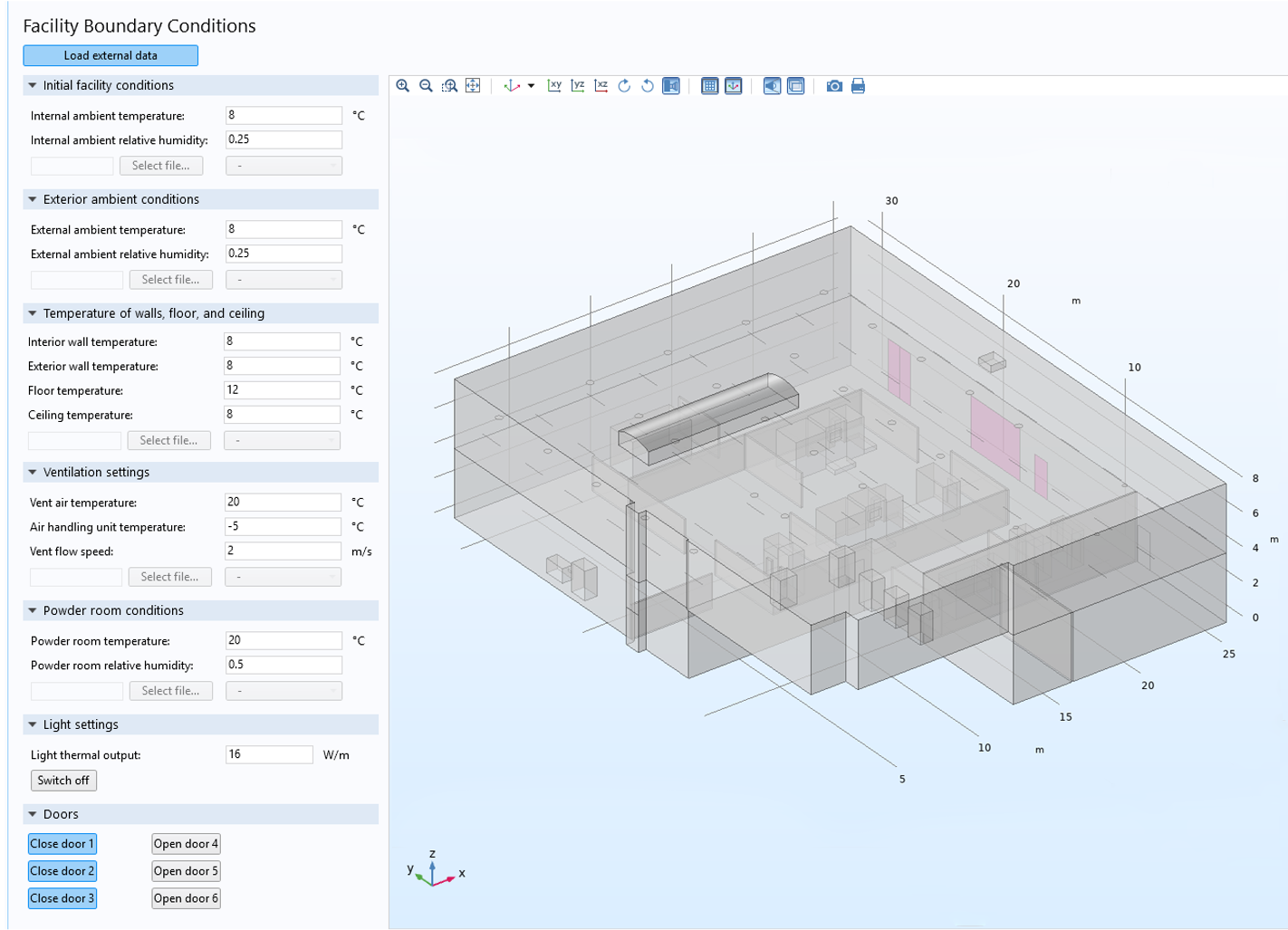
One such company modeled their own factory and built simulation apps around it to monitor and predict factory conditions based on variables such as outside climate, how many machines are running, and how machines are positioned. Their staff can then use the apps on the spot to figure out how to adjust ventilation and production schedules to create the conditions they need for the best production results.
Now, if you are running direct experiments in a lab or using test rigs, you can, of course, see exactly what the real outcome is based on carefully selected inputs and a controlled setup. By coupling experimental testing with simulation, though, you can improve understanding and make faster predictions using your lab-generated results. For example, if you’re researching thermal elastohydrodynamic lubrication of gear contacts, you might learn through observation that a diamond-like carbon coating on the gears’ surface improves their efficiency, but that only shows you what happens, not why.
In this case, having a simulation app in the lab would allow you to easily input the details of your actual setup and get a multiphysics simulation of how the heat flows inside the system. A research team that did exactly this, understood from the model that the efficiency improvement stemmed from the fact that the coating traps heat in the contact, which lowers the lubricant’s viscosity and thereby decreases friction. They would not have known this using only the naked eye.
Simulation can be used as an effective decision-making tool in the office, field, factory, and lab. When organizations build and distribute their own custom apps, everyone in the workforce will be able to make decisions based on forecasts that account for real-world complexities and the underlying laws of physics — without having to first learn how to use simulation software or take up a lot of someone else’s time. The world is ever changing and simulation apps help companies and teams of all kinds keep pace.
Learn more about simulation apps in this suggested resource: https://www.comsol.com/benefits/simulation-apps
One of my favorite parts about working at a multiphysics software company is getting to see up close all of the clever and innovative ways our customers use simulation to move the world forward. There was the loudspeaker engineer who talked about turning an idea in their head into a viable product that passed both the technical spec and looked good, and they credited simulation for turbocharging their design iteration process. Another time, I spoke with someone who used our software for automating their process of designing boat landings for offshore wind turbines by creating their own library of parts, combining their learned experience with structural analysis. Someone else invited me into their impressive test lab where they showed off how they run experiments to generate material data, which they later used in their true-to-life computer models.
The benefits of getting a preview of the real-world outcome before you commit to a project plan or design transcend industry and product offerings. There are countless examples of how modeling and simulation speeds up innovation and reduces overall costs. That said, using simulation in the way it has largely been done over the past 30 years has required specific expertise and training on how to use the software of choice. So while companies that use it have a lot to gain, the total gain is still limited by the number of employees who have learned the necessary skills to build computational models. But that does not need to be the case.
Take a company that develops power transformer equipment, for instance. Powering the grid involves transporting electricity over long distances, which requires dangerously high voltages. To protect people in the community, transformers are placed near neighborhoods and buildings to decrease the voltage upon arrival. Transformers are inherently noisy, but they can be designed to be as close to silent as possible. As with most things in this world, transformers involve many interconnected physics — electromagnetics, acoustics, and structural mechanics, in this case — which means that multiphysics simulation software is the tool for the job when optimizing their designs.
When organizations build and distribute their own custom simulation apps, everyone in the workforce will be able to make decisions based on forecasts that account for real-world complexities and the underlying laws of physics.
The R&D engineers responsible for coming up with one manufacturer’s new transformer designs all knew how to use finite element analysis (FEA) software, but they worked closely with other teams and departments without such expertise. For example, the designers tasked with building the final transformers had no familiarity with FEA. Instead, they preferred to use spreadsheets and other tools based on statistics and empirical models, which worked well for transformers they build frequently, but not for new designs or scenarios where different dimensions are introduced. In that case, multiphysics simulation is absolutely necessary to get accurate predictions of how noisy the final transformer will be. Additionally, if the final design is too noisy, the company has to make costly modifications after the fact. They needed something better.
What did they do? They built their own custom simulation apps based on the finite element models. That way, their design team could enter parameters into input fields in a straightforward user interface — built by the engineers in-house, customized to suit the company’s needs. Since the apps are powered by their own underlying multiphysics models, the designers could then quickly and accurately analyze how their transformers would hum as a result of different combinations of geometry, material, and other design parameters.
 An example of a custom app for developing high-voltage switchgears, where the user inputs the voltage and the results show the electric potential and electric field distribution based on an underlying computational model.
COMSOL
An example of a custom app for developing high-voltage switchgears, where the user inputs the voltage and the results show the electric potential and electric field distribution based on an underlying computational model.
COMSOL
Now, in this case, the apps were built by and for R&D teams to improve their own work. While this benefited the company and the team, it is still “just” another example of using modeling and simulation for R&D. Apps have the potential to break far beyond the traditional simulation software user groups and we have already started seeing real examples of that.
Even with proper design optimization by equipment manufacturers, the power grid still needs to be monitored and maintained to prevent and resolve outages and other issues. When it comes to power cables, for example, regular health checks are typically performed by field technicians using special testing equipment. In the event of cable failure, the technicians are tasked with troubleshooting and pinpointing what caused the failure. There are a lot of factors at work: the environment where the cable is located, cable structure and material, impurities in the cable, voltage fluctuations, and operating conditions. The structure is particularly complex, comprising multiple layers and a wire core of mutually insulated stranded wires. Getting a detailed understanding of cable failure involves being able to analyze the inside of the cables, which you can do using simulation software.
However, it is not practical or realistic to send a simulation engineer out with the technicians nor is it realistic to teach the technicians how to use simulation software. But it is possible to have a simulation engineer build a custom app for troubleshooting personnel to use out in the field. Simulation apps would allow them to assess cable failure based on both physics and their local onsite conditions and ultimately resolve the issue in real time. This is not a fictional example, by the way: a power grid company rolled out an app for this use several years ago.
Custom simulation apps would allow field engineers to assess failures based on both physics and their local onsite conditions and ultimately resolve the issue in real time.
Next, let’s consider a company focused on manufacturing. An indoor environment can be tightly controlled, but there are still there are still many uncertainties at play that can impact production outcomes. If you can predict them in advance, the business will be better off. Let’s take an additive manufacturing factory producing parts via metal powder bed fusion as an example. Back at the office, simulation engineers can optimize the designs ahead of production, but the end result might still not match the model if the facility conditions are not ideal at the time of production. Heat and humidity inside the facility can cause the metal powder to oxidize and pick up moisture while in storage, and this will alter how it flows, melts, picks up electric charges, and solidifies. Furthermore, the powder is flammable and toxic, even more so when it dries out. In other words, measuring and managing humidity levels in the factory impacts both product quality and worker safety.
One such company modeled their own factory and built simulation apps around it to monitor and predict factory conditions based on variables such as outside climate, how many machines are running, and how machines are positioned. Their staff can then use the apps on the spot to figure out how to adjust ventilation and production schedules to create the conditions they need for the best production results.
 A simulation app for predicting manufacturing facility conditions.
COMSOL
A simulation app for predicting manufacturing facility conditions.
COMSOL
Now, if you are running direct experiments in a lab or using test rigs, you can, of course, see exactly what the real outcome is based on carefully selected inputs and a controlled setup. By coupling experimental testing with simulation, though, you can improve understanding and make faster predictions using your lab-generated results. For example, if you’re researching thermal elastohydrodynamic lubrication of gear contacts, you might learn through observation that a diamond-like carbon coating on the gears’ surface improves their efficiency, but that only shows you what happens, not why.
In this case, having a simulation app in the lab would allow you to easily input the details of your actual setup and get a multiphysics simulation of how the heat flows inside the system. A research team that did exactly this, understood from the model that the efficiency improvement stemmed from the fact that the coating traps heat in the contact, which lowers the lubricant’s viscosity and thereby decreases friction. They would not have known this using only the naked eye.
Simulation can be used as an effective decision-making tool in the office, field, factory, and lab. When organizations build and distribute their own custom apps, everyone in the workforce will be able to make decisions based on forecasts that account for real-world complexities and the underlying laws of physics — without having to first learn how to use simulation software or take up a lot of someone else’s time. The world is ever changing and simulation apps help companies and teams of all kinds keep pace.
Learn more about simulation apps in this suggested resource: https://www.comsol.com/benefits/simulation-apps

It was not obvious that Jeremy would be able to wear an AR headset, let alone use it to communicate. The headset we use, Microsoft’s HoloLens 2, weighs 566 grams (more than a pound), and the straps that encircle the head can be uncomfortable. Interacting with virtual objects requires precise hand and finger movements. What’s more, some people doubt that people like Jeremy can even understand a question or produce a response. And yet, in study after study, we have found that most nonspeaking autistic teenage and adult participants can wear the HoloLens 2, and most can type short words on the HoloBoard.
Nonspeaking autistic people can use the HoloBoard to type independently.
The HoloBoard prototype that Jeremy first used in 2023 was three years in the making. It had its origins in an interdisciplinary feasibility study that considered whether individuals like Jeremy could tolerate a commercial AR headset. That study was led by the three of us: a developmental psychologist (Vikram Jaswal at the University of Virginia), an electrical and software engineer (Diwakar Krishnamurthy at the University of Calgary), and a computer scientist (Mea Wang, also at the University of Calgary).
Our journey to this point was not smooth. Some autism researchers told us that nonspeaking autistic people “do not have language” and so couldn’t possibly communicate by typing. They also said that nonspeaking autistic people are so sensitive to sensory experiences that they would be overwhelmed by augmented reality. But our data, from more than a half-dozen peer-reviewed studies, have shown both assumptions to be wrong. And those results have informed the tools we’re creating, like the HoloBoard, to enable nonspeaking autistic people to communicate more effectively.
Autism is a lifelong neurological condition that affects people in very different ways. It’s most commonly associated with social differences, but many autistic people also have difficulty with communication. In fact, about one-third of autistic children and adults are nonspeaking: Even after years or decades of speech therapy, they cannot communicate effectively using speech. We don’t yet know why, but it may be related to the significant motor challenges associated with producing speech. As with autism in general, nonspeaking autistic people have a range of abilities and language skills: Some are comfortable typing, while others struggle to communicate at all.
Nonspeaking autistic people may also appear inattentive, engage in impulsive behavior, and score poorly on standard intelligence tests (many of which require spoken responses within a set amount of time). Historically, these challenges have led to unfounded assumptions about these individuals’ ability to understand language and their capacity for symbolic thought. To put it bluntly, it has sometimes been assumed that someone who can’t talk is also incapable of thinking.
Most attempts to provide nonspeaking autistic people with an alternative to speech have been rudimentary. Picture-based communication systems, often implemented on an iPad or tablet, are frequently used in schools and therapy clinics. If a user wants a cookie, they can tap a picture of a cookie. But the vocabulary of these systems is limited to the concepts that can be represented by a simple picture.
 When asked what he thought of a HoloBoard session, a user typed out a positive review. Ethereal Research Group
There are other options. Some nonspeaking autistic people have learned, over the course of many years and guided by parents and professionals, to communicate by spelling words and sentences on a letterboard that’s held by a trained human assistant—a communication and regulation partner, or CRP. Part of the CRP’s role is to provide attentional and emotional support, which can help with conditions that commonly accompany severe autism and that interfere with communication, including anxiety, attention-deficit hyperactivity disorder, and obsessive-compulsive disorder. Having access to such assisted methods of communication has allowed nonspeaking autistic people to graduate from college, write poetry, and publish a best-selling memoir.
But the role of the CRP has generated considerable controversy. Critics contend that the assistants can subtly guide users to point to particular letters, which would make the CRP, rather than the user, the author of any words produced. If nonspeaking autistic people who use a letterboard really know how to spell, critics ask, why is the CRP necessary? Some professional organizations, including the American Speech-Language-Hearing Association, have even cautioned against teaching nonspeaking autistic people communication methods that involve assistance from another person.
And yet, research suggests that CRP-aided methods can teach users the skills to communicate without assistance; indeed, some individuals who previously required support now type independently. And a recent study by coauthor Jaswal showed that, contrary to critics’ assumptions, most of the nonspeaking autistic individuals in his study (which did not involve a CRP) knew how to spell. For example, in a string of text without any spaces, they knew where one word ended and the next word began. Using eye tracking, Jaswal’s team also showed that nonspeaking autistic people who use a letterboard look at and point to letters too quickly and accurately to be responding to subtle cues from a human assistant.
So how can technology help nonspeaking autistic people communicate? It’s not unusual for researchers to look at a platform technology like AR and imagine how it could be used to help a group of people. However, the ultimate success of any such project isn’t judged by technical innovation or elegance. Rather, the main criterion for success is whether or not the end result is used and useful. An amazing technology that is, say, too delicate or expensive to escape the laboratory is of limited value. And a raft of innovations that miss the mark in meeting the needs of the people it’s supposed to help is similarly limited.
Our focus then was not on improving underlying AR hardware and system software, but finding the most productive ways to adapt it for our users.
We knew we wanted to design a typing system that would allow users to convey anything they wanted. And given the ongoing controversy about assisted communication, we wanted a system that could build the skills needed to type independently. We envisioned a system that would give users more agency and potentially more privacy if the tool is used outside a research setting.
 Geoff Ondrich [left] uses the Meta Quest 3 headset to type letters independently via the HoloBoard system. The augmented-reality system can be configured to use either hand tracking or eye tracking to determine which letter the user intends to press. Madison Imber
Augmented reality has various features that, we reasoned, make it attractive for these purposes. AR’s eye- and hand-tracking capabilities could be leveraged in activities that train users in the motor skills needed to type, such as isolating and tapping targets. Some of the CRP’s tasks, like offering encouragement to a user, could be automated and rolled into an AR device. Also, AR allows users to move around freely as they engage with virtual objects, which may be more suitable for autistic people who have trouble staying still: A HoloBoard can “follow” the user around a room using head tracking. What’s more, virtual objects in AR are overlaid on a user’s actual environment, making it safer and less immersive than virtual reality (VR)—and potentially less overwhelming for our target population.
We carefully considered our choice of hardware. While lightweight AR glasses like the Ray-Ban Meta AI glasses and Snap’s AI Spectacles would have been less cumbersome for users, they don’t have the high-fidelity hand-tracking and gaze-tracking we needed. Headsets like the HoloLens 2 and Meta’s Quest 3 provide greater computing power and support a broader range of interaction modalities.
We aren’t the first researchers to consider how AR can help autistic people. Other groups have used AR to offer autistic children real-time information about the emotions people show on their faces, for example, and to gamify social- and motor-skill training. We drew inspiration from those efforts as we took on the new idea of using AR to help nonspeaking autistic people communicate.
Our efforts have been powered by our close collaboration with nonspeaking autistic people. They are, after all, the experts about their condition, and they’re the people best suited to guide the design of any tools intended for them. Everything we do is informed by their input, including the design of prototypes and the studies to test those prototypes.
When neurotypical people see someone who cannot talk, whose body moves in unusual ways, and who acts in socially unconventional ways, they may assume that the person wouldn’t be interested in collaborating or wouldn’t be able to do so. But, as noted by Anne M. Donnellan and others who conduct research with disabled people, behavioral differences don’t necessarily reflect underlying capacities or a lack of interest in social engagement. These researchers have emphasized the importance of presuming competence—in our case, that means expecting nonspeaking autistic people to be able to learn, think, and participate.
Thus, throughout our project, we have invited nonspeaking autistic people to offer suggestions and feedback in whatever manner they prefer, including by pointing to letters on a physical letterboard while supported by a CRP. Although critics of assisted forms of communication may object to this inclusive approach, we have found the contributions of nonspeakers invaluable. Through Zoom meetings, email correspondence, comments after research sessions, and shared Google docs, these participants have provided essential input about whether and how the AR technology we’re developing could be a useful communication tool. In keeping with the community’s interest in more independent communication, our tests of the technology have focused on nonspeakers’ performance without the assistance of a CRP.
 A user selects a letter on the HoloBoard by “pushing” it toward a virtual backplate. Successful activation is accompanied by a click and a recorded voice saying the letter aloud.Ethereal Research Group
In early conversations, our collaborators raised several concerns about using AR. For example, they worried that wearing a head-mounted device wouldn’t be comfortable. Our first study investigated this topic and found that, with appropriate support and sufficient time, 15 of 17 nonspeakers wore the device without difficulty. We now have 3D-printed models that replicate the shape and weight of the HoloLens 2, to allow participants to build up tolerance before they participate in actual experiments.
Some users also expressed concern about the potential for sensory overload, and their concerns made us realize that we hadn’t adequately explained the difference between AR and VR. We now provide a video before each study that explains exactly what participants will do and see and shows how AR is less immersive than VR.
Some participants told us that they like the tactile input from interacting with physical objects, including physical letterboards, and were concerned that virtual objects wouldn’t replicate that experience. We currently address this concern using sensory substitution: Letters on the HoloBoard hover slightly in front of a semitransparent virtual backplate. Activating a letter requires the user to “push” it approximately 3 centimeters toward the backplate, and successful activation is accompanied by an audible click and a recorded voice saying the letter aloud.
Our users’ needs and preferences have helped us set priorities for our research program. One person noted that an AR communication system seemed “cool,” but worried that the motor skills required to interact in AR might not be possible without practice. So from the very first app we developed, we built in activities to let users practice the motor skills they needed to succeed.
Participants also told us they wanted to be able to customize the holograms—not just to suit their aesthetic preferences but also to better fit their unique sensory, motor, and attentional profiles. As a result, users of the HoloBoard can choose its color scheme and the size of the virtual letterboard, and whether the letters are said aloud as they’re pressed. We’ve also provided several ways to activate letters: by pressing them, looking at them, or looking at them while using a physical clicker.
We had initially assumed that users would be interested in predictive text capabilities for the HoloBoard—having it autofill likely words based on the first letters typed. However, several people explained that although such a system could theoretically speed up communication, they would find it distracting. We’ve put this idea on the back burner for now; it may eventually become an option that users can toggle on if they wish.
To make things easier for users, we’ve investigated whether the HoloBoard could be positioned automatically in space, dynamically adjusting to the user’s motor skills and movement patterns throughout a session. To this end, we used a behavioral cloning approach: During real-world interactions between nonspeakers and their CRPs, we observed the position of the user’s fingers, palms, head, and physical letterboard. We then used that data to train a machine learning model to automatically adapt the placement of a virtual letterboard for a specific user.
So many assumptions are made about people who cannot speak, including that they don’t have anything to say.
Many nonspeaking participants who currently communicate with human assistance see the HoloBoard as providing a way to communicate with more autonomy. Indeed, we’ve found that after a 10-minute training procedure, most users of the HoloBoard can, like Jeremy, use it to type short words independently. We recently began a six-month study with five participants who have regular sessions in building their typing skills on the HoloBoard.
One of the most common questions from our nonspeaking participants, as well as from parents and professionals, is whether AR could teach the skills needed to type on a standard keyboard. It seems possible, in theory. As a first step, we’re creating other types of AR teaching tools, including an educational AR app that teaches typing in the context of engaging and age-appropriate lessons.
We’ve also begun developing a virtual CRP that can offer support and feedback as a user interacts with the virtual letterboard. This virtual assistant, named ViC, can demonstrate motor movements as a user is learning to spell with the HoloBoard, and also offers verbal prompts and encouragement during a training session. There aren’t many professionals who know how to teach nonspeakers typing skills, so a virtual CRP could be a game changer for this population.
Although nonspeakers have responded enthusiastically to our AR communication tools, our conversations and studies have revealed a number of practical challenges with the current technology.
For starters, most people can’t afford Microsoft’s HoloLens 2, which costs US $3,500. (It’s also recently been discontinued!) So we’ve begun testing our software on less expensive mixed-reality products such as Meta’s $500 Quest 3, and preliminary results have been promising. But regardless of which device is used, most headsets are bulky and heavy. It’s unlikely that someone would wear one throughout a school day, for example. One idea we’re pursuing is to design a pair of AR glasses that’s just for virtual typing; a device customized for a single function would weigh much less than a general-purpose headset.
 Shonagh Rae
We’ve also encountered technical challenges. For example, the HoloLens 2’s field of view is only 52 degrees. This restricts the size and placement of holograms, as larger holograms or those positioned incorrectly may be partially or entirely invisible to the user. So when participants use their fingers to point at virtual letters on the HoloBoard, some letters near the edges of the board may fall outside the visible area, which is frustrating to users. To address these issues, we used a vertical layout in our educational app so that the multiple-choice buttons always remain within a user’s field of view. Our systems also allow a researcher or caregiver to monitor an AR session and, if necessary, adjust the size of virtual objects so they’re always in view.
We have a few other ideas for dealing with the field-of-view issue, including deploying devices that have a larger field of view. Another strategy is to use eye tracking to select letters, which would eliminate the reliance on hand movements and the problem of the user’s pointing fingers obscuring the letters. And some users might prefer using a joystick or other handheld controller to navigate and select letters. Together, these techniques should make the system more accessible while working within hardware constraints.
We have also been developing cross-reality apps, which allow two or more people wearing AR headsets to interact within the same virtual space. That’s the setup we use to enable researchers to monitor study sessions in real time. Based on our development experience, we created an open-source tool called SimpleShare for the development of multiuser extended-reality apps in a device-agnostic way. A related issue is that many of our users make sudden movements; a sudden shake of a head can interfere with the sensors on the AR headset and upset the spatial alignment between multiple headsets. So our apps and SimpleShare instruct the headset to routinely scan the environment and use that data to automatically realign multiple devices, if necessary.
We’ve had to find solutions to cope with the limited computing power available on AR headsets. Running the AI model that automates the custom placement of the HoloBoard for each user can cause a lag in letterboard interactions and can cause the headset to heat up. We solved this problem by simplifying the AI model and decreasing the frequency of the model’s interventions. Rendering a realistic virtual CRP via a headset is also computationally intensive. In our virtual CRP work, we’re now rendering the avatar on an edge device, such as a laptop with a state-of-the-art GPU, and streaming it to the display.
As we continue to tackle these technology challenges, we’re well aware that we don’t have all the answers. That’s why we discuss the problems that we’re working on with the nonspeaking autistic people who will use the technology. Their perspectives are helping us make progress toward a truly usable and useful device.
So many assumptions are made about people who cannot speak, including that they don’t have anything to say. We went into this project presuming competence in nonspeaking people, and yet we still weren’t sure if our participants would be able to adapt to our technology. In our initial work, we were unsure whether nonspeakers could wear the AR device or interact with virtual buttons. They easily did both. In our evaluation of the HoloBoard prototype, we didn’t know if users could type on a virtual letterboard hovering in front of them. They did so while we watched. In a recent study investigating whether nonspeakers could select letters using eye-gaze tracking, we wondered if they could complete the built-in gaze-calibration procedure. They did.
The ability to communicate—to share information, memories, opinions—is essential to well-being. Unfortunately, most autistic people who can’t communicate using speech are never provided an effective alternative. Without a way to convey their thoughts, they are deprived of educational, social, community, and employment opportunities.
We aren’t so naïve as to think that AR is a silver bullet. But we’re hopeful that there will be more community collaborations like ours, which take seriously the lived experiences of nonspeaking autistic people and lead to new technologies to support them. Their voices may be stuck inside, but they deserve to be heard.
This article appears in the June 2025 print issue as “Breaking Silence.”
The breakthrough, known as Sequential NanoPrecipitation (SNaP), builds on existing nano-precipitation techniques to offer improved control and scalability, essential factors in ensuring that drug delivery technologies reach patients efficiently and effectively. This technique enables scientists to manufacture drug-carrying particles that maintain their structural and chemical integrity from lab settings to mass production—an essential step toward bringing novel therapies to market.
Nanoparticles and microparticles hold tremendous promise for targeted drug delivery, allowing precise transport of medicines directly to disease sites while minimizing side effects. However, producing these particles consistently at scale has been a major barrier in translating promising research into viable treatments. As Pinkerton explains, “One of the biggest barriers to translating many of these precise medicines is the manufacturing. With SNaP, we’re addressing that challenge head-on.”
 Pinkerton is an Assistant Professor of Chemical and Biomolecular Engineering at NYU Tandon.NYU Tandon School of Engineering
Traditional methods like Flash Nano-Precipitation (FNP) have been successful in creating some types of nanoparticles, but they often struggle to produce larger particles, which are essential for certain delivery routes such as inhalable delivery. FNP creates polymeric core–shell nanoparticles (NPs) between 50 to 400 nanometers in size. The process involves mixing drug molecules and block-copolymers (special molecules that help form the particles) in a solvent, which is then rapidly blended with water using special mixers. These mixers create tiny, controlled environments where the particles can form quickly and evenly.
Despite its success, FNP has some limitations: it can’t create stable particles larger than 400 nm, the maximum drug content is about 70 percent, the output is low, and it can only work with very hydrophobic (water-repelling) molecules. These issues arise because the particle core formation and particle stabilization happen simultaneously in FNP. The new SNaP process overcomes these limitations by separating the core formation and stabilization steps.
In the SNaP process, there are two mixing steps. First, the core components are mixed with water to start forming the particle core. Then, a stabilizing agent is added to stop the core growth and stabilize the particles. This second step must happen quickly, less than a few milliseconds after the first step, to control the particle size and prevent aggregation. Current SNaP setups connect two specialized mixers in series, controlling the delay time between steps. However, these setups face challenges, including high costs and difficulties in achieving short delay times needed for small particle formation.
A new approach using 3D printing has solved many of these challenges. Advances in 3D printing technology now allow the creation of precise, narrow channels needed for these mixers. The new design eliminates the need for external tubing between steps, allowing for shorter delay times and preventing leaks. The innovative stacked mixer design combines two mixers into a single setup, making the process more efficient and user-friendly.
“One of the biggest barriers to translating many of these precise medicines is the manufacturing. With SNaP, we’re addressing that challenge head-on.”
—Nathalie M. Pinkerton, NYU Tandon
Using this new SNaP mixer design, researchers have successfully created a wide range of nanoparticles and microparticles loaded with rubrene (a fluorescent dye) and cinnarizine (a weakly hydrophobic drug used to treat nausea and vomiting). This is the first time small nanoparticles under 200 nm and microparticles have been made using SNaP. The new setup also demonstrated the critical importance of the delay time between the two mixing steps in particle size control. This control over the delay time enables researchers to access a larger range of particle sizes. Additionally, the successful encapsulation of both hydrophobic and weakly hydrophobic drugs in nanoparticles and microparticles with SNaP was achieved for the first time by Pinkerton’s team.
The SNaP process is not only innovative but also offers a unique practicality that democratizes access to this technology. “We share the design of our mixers, and we demonstrate that they can be manufactured using 3D printing,” Pinkerton says. “This approach allows academic labs and even small-scale industry players to experiment with these techniques without investing in costly equipment.”
 A stacked mixer schematic, with an input stage for syringe connections (top), which connects immediately to the first mixing stage (middle). The first mixing stage is interchangeable, with either a 2-inlet or a 4-inlet mixer option depending on the desired particle size regime (dotted antisolvent streams only present in the 4-inlet mixer). This stage also contains pass-through for streams used in the second mixing step. All the streams mix in the second mixing stage (bottom) and exit the device.
The accessibility of SNaP technology could accelerate advances across the drug delivery field, empowering more researchers and companies to utilize nanoparticles and microparticles in developing new therapies.
The SNaP project exemplifies a successful cross-disciplinary effort. Pinkerton highlighted the team’s diversity, which included experts in mechanical and process engineering as well as chemical engineering. “It was truly an interdisciplinary project,” she noted, pointing out that contributions from all team members—from undergraduate students to postdoctoral researchers—were instrumental in bringing the technology to life.
Beyond this breakthrough, Pinkerton envisions SNaP as part of her broader mission to develop universal drug delivery systems, which could ultimately transform healthcare by allowing for versatile, scalable, and customizable drug delivery solutions.
Before arriving at NYU Tandon, Pinkerton spent three years in Pfizer’s Oncology Research Unit, where she developed novel nano-medicines for the treatment of solid tumors. The experience, she says, was invaluable. “Working in industry gives you a real-world perspective on what is feasible,” she points out. “The goal is to conduct translational research, meaning that it ‘translates’ from the lab bench to the patient’s bedside.”
Pinkerton — who earned a B.S. in Chemical Engineering from the Massachusetts Institute of Technology (2008) and a doctoral degree in Chemical and Biological Engineering from Princeton University — was attracted to NYU Tandon, in part, because of the opportunity to collaborate with researchers across the NYU ecosystem, with whom she hopes to develop new nanomaterials that can be used for controlled drug delivery and other bio-applications.
She also came to academia because of a love of teaching. At Pfizer, she realized her desire to mentor students and pursue innovative, interdisciplinary research. “The students here want to be engineers; they want to make a change in the world,” she reflected.
Her team at the Pinkerton Research Group focuses on developing responsive soft materials for bio-applications ranging from controlled drug delivery, to vaccines to medical imaging. Taking an interdisciplinary approach, they use tools from chemical and materials engineering, nanotechnology, chemistry and biology to create soft materials via scalable synthetic processes. They focus on understanding how process parameters control the final material properties, and in turn, how the material behaves in biological systems — the ultimate goal being a universal drug delivery platform that improves health outcomes across diseases and disorders.
Her SNaP technology represents a promising new direction in the quest to scale drug delivery solutions effectively. By controlling assembly processes with millisecond precision, this method opens the door to creating increasingly complex particle architectures, providing a scalable approach for future medical advances.
For the field of drug delivery, the future is bright as SNaP paves the way toward an era of more accessible, adaptable, and scalable solutions.


This nearly invisible graphene tattoo can be used to detect various substances in sweat that serve as biomarkers of health or disease.
Technologies that allow early-stage screening and health tracking long before serious problems show up will lead to better outcomes. We’ll be able to look at factors involved in disease, such as diet, physical activity, environmental exposure, and psychological circumstances. And we’ll be able to conduct long-term studies that track the vital signs of apparently healthy individuals as well as the parameters of their environments. That data could be transformative, leading to better treatments and preventative care. But monitoring individuals over not just weeks or months but years can be achieved only with an engineering breakthrough: affordable sensors that ordinary people will use routinely as they go about their lives.
Building this technology is what’s motivating the work at my 2D bioelectronics lab, where we study atomically thin materials such as graphene. I believe these materials’ properties make them uniquely suited for advanced and unobtrusive biological monitors. My team is developing graphene electronic tattoos that anyone can place on their skin for chemical or physiological biosensing.
The idea of a peel-and-stick sensor comes from the groundbreaking work of John Rogers and his team at Northwestern University. Their “epidermal electronics” embed state-of-the-art silicon chips, sensors, light-emitting diodes, antennas, and transducers into thin epidermal patches, which are designed to monitor a variety of health factors. One of Rogers’s best-known inventions is a set of wireless stick-on sensors for newborns in the intensive care unit that make it easier for nurses to care for the fragile babies—and for parents to cuddle them. Rogers’s wearables are typically less than a millimeter thick, which is thin enough for many medical applications. But to make a patch that people would be willing to wear all the time for years, we’ll need something much less obtrusive.
In search of thinner wearable sensors, Deji Akinwande and Nanshu Lu, professors at the University of Texas at Austin, created graphene electronic tattoos (GETs) in 2017. Their first GETs, about 500 nanometers thick, were applied just like the playful temporary tattoos that kids wear: The user simply wets a piece of paper to transfer the graphene, supported by a polymer, onto the skin.
Graphene is a wondrous material composed of a single layer of carbon atoms. It’s exceptionally conductive, transparent, lightweight, strong, and flexible. When used within an electronic tattoo, it’s imperceptible: The user can’t even feel its presence on the skin. Tattoos using 1-atom-thick graphene (combined with layers of other materials) are roughly one-hundredth the thickness of a human hair. They’re soft and pliable, and conform perfectly to the human anatomy, following every groove and ridge.
 The ultrathin graphene tattoos are soft and pliable, conforming to the skin’s grooves and ridges. Dmitry Kireev/The University of Texas at Austin
Some people mistakenly think that graphene isn’t biocompatible and can’t be used in bioelectronic applications. More than a decade ago, during the early stages of graphene development, some preliminary reports found that graphene flakes are toxic to live cells, mainly because of their size and the chemical doping used in the fabrication of certain types of graphene. Since then, however, the research community has realized that there are at least a dozen functionally different forms of graphene, many of which are not toxic, including oxidized sheets, graphene grown via chemical vapor deposition, and laser-induced graphene. For example, a 2024 paper in Nature Nanotechnology reported no toxicity or adverse effects when graphene oxide nanosheets were inhaled.
We know that the 1-atom-thick sheets of graphene being used to make e-tattoos are completely biocompatible. This type of graphene has already been used for neural implants without any sign of toxicity, and can even encourage the proliferation of nerve cells. We’ve tested graphene-based tattoos on dozens of subjects, who have experienced no side effects, not even minor skin irritation.
When Akinwande and Lu created the first GETs in 2017, I had just finished my Ph.D. in bioelectronics at the German research institute Forschungszentrum Jülich. I joined Akinwande’s lab, and more recently have continued the work at my own lab in Amherst. My collaborators and I have made substantial progress in improving the GETs’ performance; in 2022 we published a report on version 2.0, and we’ve continued to push the technology forward.
According to the World Health Organization, cardiovascular diseases are the leading cause of death worldwide, with causal factors including diet, lifestyle, and environmental pollution. The long-term tracking of people’s cardiac activity—specifically their heart rate and blood pressure—would be a straightforward way to keep tabs on people who show signs of trouble. Our e-tattoos would be ideal for this purpose.
Measuring heart rate is the easier task, as the cardiac tissue produces obvious electrical signals when the muscles depolarize and repolarize to produce each heartbeat. To detect such electrocardiogram signals, we place a pair of GETs on a person’s skin, either on the chest near the heart or on the two arms. A third tattoo is placed elsewhere and used as a reference point. In what’s known as a differential amplification process, an amplifier takes in signals from all three electrodes but ignores signals that appear in both the reference and the measuring electrodes, and only amplifies the signal that represents the difference between the two measuring electrodes. This way, we isolate the relevant cardiac electrical activity from the surrounding electrophysiological noise of the human body. We’ve been using off-the-shelf amplifiers from companies like OpenBCI that are packaged into wireless devices.
Continuously measuring blood pressure via tattoo is much more difficult. We started that work with Akinwande of UT Austin in collaboration with Roozbeh Jafari of Texas A&M University (now at MIT’s Lincoln Laboratory). Surprisingly, the blood pressure monitors that doctors use today aren’t significantly different from the ones that doctors were using 100 years ago. You almost certainly have encountered such a device yourself. The machine uses a cuff, usually placed around the upper arm, that inflates to apply pressure on an artery until it briefly stops the flow of blood, then the cuff slowly deflates. While deflating, the machine records the beats as the heart pushes blood through the artery and measures the highest (systolic) and lowest (diastolic) pressure. While the cuff works well in a doctor’s office, it can’t provide a continuous reading or take measurements when a person is on the move. In hospital settings, nurses wake up patients at night to take blood pressure readings, and at-home devices require users to be proactive about monitoring their levels.
 Graphene electronic tattoos (GETs) can be used for continuous blood pressure monitoring. Two GETs placed on the skin act as injecting electrodes [red] and send a tiny current through the arm. Because blood conducts electricity better than tissue, the current moves through the underlying artery. Four GETs acting as sensing electrodes [blue] measure the bioimpedance—the body’s resistance to electric current—which changes according to the volume of blood moving through the artery with every heartbeat. We’ve trained a machine learning model to understand the correlation between bioimpedance readings and blood pressure.Chris Philpot
We developed a new system that uses only stick-on GETs to measure blood pressure continuously and unobtrusively. As we described in a 2022 paper, the GET doesn’t measure pressure directly. Instead, it measures electrical bioimpedance—the body’s resistance to an electric current. We use several GETs to inject a small-amplitude current (50 microamperes at present), which goes through the skin to the underlying artery; GETs on the other side of the artery then measure the impedance of the tissue. The rich ionic solution of the blood within the artery acts as a better conductor than the surrounding fat and muscle, so the artery is the lowest-resistance path for the injected current. As blood flows through the artery, its volume changes slightly with each heartbeat. These changes in blood volume alter the impedance levels, which we then correlate to blood pressure.
While there is a clear correlation between bioimpedance and blood pressure, it’s not a linear relationship—so this is where machine learning comes in. To train a model to understand the correlation, we ran a set of experiments while carefully monitoring our subjects’ bioimpedance with GETs and their blood pressure with a finger-cuff device. We recorded data as the subjects performed hand grip exercises, dipped their hands into ice-cold water, and did other tasks that altered their blood pressure.
Our graphene tattoos were indispensable for these model-training experiments. Bioimpedance can be recorded with any kind of electrode—a wristband with an array of aluminum electrodes could do the job. However, the correlation between the measured bioimpedance and blood pressure is so precise and delicate that moving the electrodes by just a few millimeters (like slightly shifting a wristband) would render the data useless. Our graphene tattoos kept the electrodes at exactly the same location during the entire recording.
Once we had the trained model, we used GETs to again record those same subjects’ bioimpedance data and then derive from that data their systolic, diastolic, and mean blood pressure. We tested our system by continuously measuring their blood pressure for more than 5 hours, a tenfold longer period than in previous studies. The measurements were very encouraging. The tattoos produced more accurate readings than blood-pressure-monitoring wristbands did, and their performance met the criteria for the highest accuracy ranking under the IEEE standard for wearable cuffless blood-pressure monitors.
While we’re pleased with our progress, there’s still more to do. Each person’s biometric patterns are unique—the relationship between a person’s bioimpedance and blood pressure is uniquely their own. So at present we must calibrate the system anew for each subject. We need to develop better mathematical analyses that would enable a machine learning model to describe the general relationship between these signals.
With the support of the American Heart Association, my lab is now working on another promising GET application: measuring arterial stiffness and plaque accumulation within arteries, which are both risk factors for cardiovascular disease. Today, doctors typically check for arterial stiffness and plaque using diagnostic tools such as ultrasound and MRI, which require patients to visit a medical facility, utilize expensive equipment, and rely on highly trained professionals to perform the procedures and interpret the results.
 Graphene tattoos can be used to continuously measure a person’s bioimpedance, or the body’s resistance to an electric current, which is correlated to the person’s blood pressure.
Dmitry Kireev/The University of Texas at Austin and Kaan Sel/Texas A&M University
Graphene tattoos can be used to continuously measure a person’s bioimpedance, or the body’s resistance to an electric current, which is correlated to the person’s blood pressure.
Dmitry Kireev/The University of Texas at Austin and Kaan Sel/Texas A&M University
With GETs, doctors could easily and quickly take measurements at multiple locations on the body, getting both local and global perspectives. Since we can stick the tattoos anywhere, we can get measurements from major arteries that are otherwise difficult to reach with today’s tools, such as the carotid artery in the neck. The GETs also provide an extremely fast readout of electrical measurements. And we believe we can use machine learning to correlate bioimpedance measurements with both arterial stiffness and plaque—it’s just a matter of conducting the tailored set of experiments and gathering the necessary data.
Using GETs for these measurements would allow researchers to look deeper into how stiffening arteries and the buildup of plaque are related to the development of high blood pressure. Tracking this information for a long time in a large population would help clinicians understand the problems that eventually lead to major heart diseases—and perhaps help them find ways to prevent those diseases.
In a different area of work, my lab has just begun developing graphene tattoos for sweat biosensing. When people sweat, the liquid carries salts and other compounds onto the skin, and sensors can detect markers of good health or disease. We’re initially focusing on cortisol, a hormone associated with stress, stroke, and several disorders of the endocrine system. Down the line, we hope to use our tattoos to sense other compounds in sweat, such as glucose, lactate, estrogen, and inflammation markers.
Several labs have already introduced passive or active electronic patches for sweat biosensing. The passive systems use a chemical indicator that changes color when it reacts with specific components in sweat. The active electrochemical devices, which typically use three electrodes, can detect substances across a wide range of concentrations and yield accurate data, but they require bulky electronics, batteries, and signal processing units. And both types of patches use cumbersome microfluidic chambers for sweat collection.
In our GETs for sweat, we use the graphene as a transistor. We modify the graphene’s surface by adding certain molecules, such as antibodies, that are designed to bind to specific targets. When a target substance interacts with the antibody, it produces a measurable electrical signal that then changes the resistance of the graphene transistor. That resistance change is converted into a readout that indicates the presence and concentration of the target molecule.
We’ve already successfully developed standalone graphene biosensors that can detect food toxins, measure ferritin (a protein that stores iron), and distinguish between the COVID-19 and flu viruses. Those standalone sensors look like chips, and we place them on a tabletop and drip liquid onto them for the experiments. With support from the U.S. National Science Foundation, we’re now integrating this transistor-based sensing approach into GET wearable biosensors that can be stuck on the skin for direct contact with the sweat.
We’ve also improved our GETs by adding microholes to allow for water transport, so that sweat doesn’t accumulate under the GET and interfere with its function. Now we’re working to ensure that enough sweat is coming from the sweat ducts and into the tattoo, so that the target substances can react with the graphene.
To turn our technology into user-friendly products, there are a few engineering challenges. Most importantly, we need to figure out how to integrate these smart e-tattoos into an existing electronic network. At the moment, we have to connect our GETs to standard electronic circuits to deliver the current, record the signal, and transmit and process the information. That means the person wearing the tattoo must be wired to a tiny computing chip that then wirelessly transmits the data. Over the next five to ten years, we hope to integrate the e-tattoos with smartwatches. This integration will require a hybrid interconnect to join the flexible graphene tattoo to the smartwatch’s rigid electronics.
In the long term, I envision 2D graphene materials being used for fully integrated electronic circuits, power sources, and communication modules. Microelectronic giants such as Imec and Intel are already pursuing electronic circuits and nodes made from 2D materials instead of silicon.
Perhaps in 20 years, we’ll have 2D electronic circuits that can be integrated with soft human tissue. Imagine electronics embedded in the skin that continuously monitor health-related biomarkers and provide real-time feedback through subtle, user-friendly displays. This advancement would offer everyone a convenient and noninvasive way to stay informed and proactively manage their own health, beginning a new era of human self-knowledge.
This article appears in the March 2025 print issue as “A Graphene Biosensor Tattoo.”
The Internet of Things, with technologies such as sensors, microcontrollers, actuators, and connectivity modules together with security solutions and software, has great potential to prevent diseases and improve health.
Technology, and with it the Internet of Things (IoT) has the potential to support the healthcare sector across all levels, for example with predictive prevention and monitoring, in diagnosis and treatment as well as in follow-up care and support in daily life.
There are numerous health and fitness devices able to track key health markers, such as a user’s heart rate or breathing patterns, that may afford users greater awareness of their health and allow them to make pro-active decisions regarding their health and well-being.
The global IoT market trend in medical devices is clearly moving towards “healthcare is self-care” with a focus on active patient engagement and patient-centric care. The vital signs monitoring segment is expected to grow at the highest rate.
Let’s take smart health devices like fitness wearables as an example: A medical band tracks health and fitness data and enables an efficient monitoring for individuals, doctors, and medical staff. Particularly valuable in critical situations: In the event of conspicuous irregularities, the medical band can advise users to take a certain action first, for example, taking a medication. If serious irregularities develop, the doctor can be contacted or an emergency call can be triggered.

Infineon’s semiconductor products and software solutions are the perfect match for smart health devices as they meet the needs of digital healthcare applications. We support a health-conscious lifestyle by enabling smart devices that can help improve well-being and stay healthy longer by making them reliable, convenient, personalized — and secure. That’s our contribution to a functioning healthcare system facing a rising global population and aging.
But there are also smart health devices that do not have to be worn on the body, as the example of smart health monitoring solutions for the home shows. The increase in chronic diseases and health problems in our society often entails the need for home care or self-treatment at home. The desire for a self-determined life is just as decisive for this as the lack of suitable facilities in some regions.
This is where the smart home can help with home automation and health monitoring solutions like sleep monitors based on radar technology that are so small and easy to use that they can replace examinations in the artificial environment of a sleep laboratory. Patients can record their sleeping behavior with high precision at home, without external stress factors, in a familiar environment – even when covered by bedding.
The use of digital technologies in health and lifestyle has advanced exponentially. This increase in digitalization makes the safeguarding of health and patient data urgent and is a basic requirement for the functioning of the digital health system. With topics such as Artificial Intelligence (AI), Machine Learning (ML) and Big Data also playing an increasingly important role, it is becoming essential to secure data to prevent the misuse of private and sensitive information.
Equipping smart health devices with the right security solutions from the get-go is key to helping prevent attacks – whether theft, fraud or manipulation. Companies that are looking for a security solution need one that is equally easy to use – in terms of fast integration and time to market – and trustworthy. Unlike software-only solutions a hardware-based solution is strong, tamperproof and provides a solid foundation.
Semiconductors from companies like Infineon are essential components in all solutions as they support the design of innovative technologies and devices for health-monitoring, preventive healthcare like sleep monitoring and, in the event of illness, self-treatment and assisted living at home. Sensors record vital data, microcontrollers process and forward it, actuators trigger actions, networking technologies integrate cloud services with medical expertise, and security solutions ensure the protection of extremely sensitive personal data.
1) United Nations Department of Economic and Social Affairs, Population Division (2022): World Population Prospects 2022: Summary of Results. UN DESA/POP/2022/TR/NO. 3.
Technology, and with it the Internet of Things (IoT) has the potential to support the healthcare sector across all levels, for example with predictive prevention and monitoring, in diagnosis and treatment as well as in follow-up care and support in daily life.
There are numerous health and fitness devices able to track key health markers, such as a user’s heart rate or breathing patterns, that may afford users greater awareness of their health and allow them to make pro-active decisions regarding their health and well-being.
The global IoT market trend in medical devices is clearly moving towards “healthcare is self-care” with a focus on active patient engagement and patient-centric care. The vital signs monitoring segment is expected to grow at the highest rate.
Let’s take smart health devices like fitness wearables as an example: A medical band tracks health and fitness data and enables an efficient monitoring for individuals, doctors, and medical staff. Particularly valuable in critical situations: In the event of conspicuous irregularities, the medical band can advise users to take a certain action first, for example, taking a medication. If serious irregularities develop, the doctor can be contacted or an emergency call can be triggered.

Infineon’s semiconductor products and software solutions are the perfect match for smart health devices as they meet the needs of digital healthcare applications. We support a health-conscious lifestyle by enabling smart devices that can help improve well-being and stay healthy longer by making them reliable, convenient, personalized — and secure. That’s our contribution to a functioning healthcare system facing a rising global population and aging.
But there are also smart health devices that do not have to be worn on the body, as the example of smart health monitoring solutions for the home shows. The increase in chronic diseases and health problems in our society often entails the need for home care or self-treatment at home. The desire for a self-determined life is just as decisive for this as the lack of suitable facilities in some regions.
This is where the smart home can help with home automation and health monitoring solutions like sleep monitors based on radar technology that are so small and easy to use that they can replace examinations in the artificial environment of a sleep laboratory. Patients can record their sleeping behavior with high precision at home, without external stress factors, in a familiar environment – even when covered by bedding.
The use of digital technologies in health and lifestyle has advanced exponentially. This increase in digitalization makes the safeguarding of health and patient data urgent and is a basic requirement for the functioning of the digital health system. With topics such as Artificial Intelligence (AI), Machine Learning (ML) and Big Data also playing an increasingly important role, it is becoming essential to secure data to prevent the misuse of private and sensitive information.
Equipping smart health devices with the right security solutions from the get-go is key to helping prevent attacks – whether theft, fraud or manipulation. Companies that are looking for a security solution need one that is equally easy to use – in terms of fast integration and time to market – and trustworthy. Unlike software-only solutions a hardware-based solution is strong, tamperproof and provides a solid foundation.
Semiconductors from companies like Infineon are essential components in all solutions as they support the design of innovative technologies and devices for health-monitoring, preventive healthcare like sleep monitoring and, in the event of illness, self-treatment and assisted living at home. Sensors record vital data, microcontrollers process and forward it, actuators trigger actions, networking technologies integrate cloud services with medical expertise, and security solutions ensure the protection of extremely sensitive personal data.
1) United Nations Department of Economic and Social Affairs, Population Division (2022): World Population Prospects 2022: Summary of Results. UN DESA/POP/2022/TR/NO. 3.
After conducting a pilot study, in 2018 Leow launched BiAffect, a research app that aims to understand mood-related symptoms of bipolar disorder through keyboard dynamics and sensor data from users’ smartphones. Now in use by more than 2,700 people who have volunteered their data to the project, the app tracks typing speed and accuracy by swapping the phone’s onscreen keyboard with its own nearly identical one.
The software then generates feedback for users, such as a graph displaying hourly keyboard activity. Researchers get access to the donated data from users’ phones, which they use to develop and test machine learning algorithms that interpret data for clinical use. One of the things Leow’s team has observed: When people are manic—a state of being overly excited that accompanies bipolar disorder—they type “ferociously fast,” says Leow.
 Compared to a healthy user [top], a person experiencing symptoms of bipolar disorder [middle] or depression [bottom] may use their phone more than usual and late at night. BiAffect measures phone usage and orientation to help track those symptoms. BiAffect
BiAffect is one of the few mental-health apps that take a passive approach to collecting data from a phone to make inferences about users’ mental states. (Leow suspects that fewer than a dozen are currently available to consumers.) These apps run in the background on smartphones, collecting different sets of data not only on typing but also on the user’s movements, screen time, call and text frequency, and GPS location to monitor social activity and sleep patterns. If an app detects an abrupt change in behavior, indicating a potentially hazardous shift in mental state, it could be set up to alert the user, a caretaker, or a physician.
Such apps can’t legally claim to treat or diagnose disease, at least in the United States. Nevertheless, many researchers and people with mental illness have been using them as tools to track signs of depression, schizophrenia, anxiety, and bipolar disorder. “There’s tremendous, immediate clinical value in helping people feel better today by integrating these signals into mental-health care,” says John Torous, director of digital psychiatry at Beth Israel Deaconess Medical Center, in Boston. Globally, one in 8 people live with a mental illness, including 40 million with bipolar disorder.
These apps differ from most of the more than 10,000 mental-health and mood apps available, which typically ask users to actively log how they’re feeling, help users connect to providers, or encourage mindfulness. The popular apps Daylio and Moodnotes, for example, require journaling or rating symptoms. This approach requires more of the user’s time and may make these apps less appealing for long-term use. A 2019 study found that among 22 mood-tracking apps, the median user-retention rate was just 6.1 percent at 30 days of use.
App developers are trying to avoid the pitfalls of previous smartphone-psychiatry startups, some of which oversold their capabilities before validating their technologies.
But despite years of research on passive mental-health apps, their success is far from guaranteed. App developers are trying to avoid the pitfalls of previous smartphone psychiatry startups, some of which oversold their capabilities before validating their technologies. For example, Mindstrong was an early startup with an app that tracked taps, swipes, and keystrokes to identify digital biomarkers of cognitive function. The company raised US $160 million in funding from investors, including $100 million in 2020 alone, and went bankrupt in February 2023.
Mindstrong may have folded because the company was operating on a different timeline from the research, according to an analysis by the health-care news website Stat. The slow, methodical pace of science did not match the startup’s need to return profits to its investors quickly, the report found. Mindstrong also struggled to figure out the marketplace and find enough customers willing to pay for the service. “We were first out of the blocks trying to figure this out,” says Thomas Insel, a psychiatrist who cofounded Mindstrong.
Now that the field has completed a “hype cycle,” Torous says, app developers are focused on conducting the research needed to prove their apps can actually help people. “We’re beginning to put the burden of proof more on those developers and startups, as well as academic teams,” he says. Passive mental-health apps need to prove they can reliably parse the data they’re collecting, while also addressing serious privacy concerns.
Seven metrics apps use to make inferences about your mood
 All icons: Greg Mably
Keyboard dynamics: Typing speed and accuracy can indicate a lot about a person’s mood. For example, people who are manic often type extremely fast.

Accelerometer: This sensor tracks how the user is oriented and moving. Lying in bed would suggest a different mood than going for a run.

Calls and texts: The frequency of text messages and phone conversations signifies a person’s social isolation or activity, which indicates a certain mood.

GPS location: Travel habits signal a person’s activity level and routine, which offer clues about mood. For example, a person experiencing depression may spend more time at home.

Mic and voice: Mood can affect how a person speaks. Microphone-based sensing tracks the rhythm and inflection of a person’s voice.

Sleep: Changes in sleep patterns signify a change in mood. Insomnia is a common symptom of bipolar disorder and can trigger or worsen mood disturbances.

Screen time: An increase in the amount of time a person spends on a phone can be a sign of depressive symptoms and can interfere with sleep.
A crucial component of managing psychiatric illness is tracking changes in mental states that can lead to more severe episodes of the disease. Bipolar disorder, for example, causes intense swings in mood, from extreme highs during periods of mania to extreme lows during periods of depression. Between 30 and 50 percent of people with bipolar disorder will attempt suicide at least once in their lives. Catching early signs of a mood swing can enable people to take countermeasures or seek help before things get bad.
But detecting those changes early is hard, especially for people with mental illness. Observations by other people, such as family members, can be subjective, and doctor and counselor sessions are too infrequent.
That’s where apps come in. Algorithms can be trained to spot subtle deviations from a person’s normal routine that might indicate a change in mood—an objective measure based on data, like a diabetic tracking blood sugar. “The ability to think objectively about my own thinking is really key,” says retired U.S. major general Gregg Martin, who has bipolar disorder and is an advisor for BiAffect.
The data from passive sensing apps could also be useful to doctors who want to see objective data on their patients in between office visits, or for people transitioning from inpatient to outpatient settings. These apps are “providing a service that doesn’t exist,” says Colin Depp, a clinical psychologist and professor at the University of California, San Diego. Providers can’t observe their patients around the clock, he says, but smartphone data can help close the gap.
Depp and his team have developed an app that uses GPS data and microphone-based sensing to determine the frequency of conversations and make inferences about a person’s social interactions and isolation. The app also tracks “location entropy,” a metric of how much a user moves around outside of routine locations. When someone is depressed and mostly stays home, location entropy decreases.
Depp’s team initially developed the app, called CBT2go, as a way to test the effectiveness of cognitive behavioral therapy in between therapy sessions. The app can now intervene in real time with people experiencing depressive or psychotic symptoms. This feature helps people identify when they feel lonely or agitated so they can apply coping skills they’ve learned in therapy. “When people walk out of the therapist’s office or log off, then they kind of forget all that,” Depp says.
Another passive mental-health-app developer, Ellipsis Health in San Francisco, uses software that takes voice samples collected during telehealth calls to gauge a person’s level of depression, anxiety, and stress symptoms. For each set of symptoms, deep-learning models analyze the person’s words, rhythms, and inflections to generate a score. The scores indicate the severity of the person’s mental distress, and are based on the same scales used in standard clinical evaluations, says Michael Aratow, cofounder and chief medical officer at Ellipsis.
Aratow says the software works for people of all demographics, without needing to first capture baseline measures of an individual’s voice and speech patterns. “We’ve trained the models in the most difficult use cases,” he says. The company offers its platform, including an app for collecting the voice data, through health-care providers, health systems, and employers; it’s not directly available to consumers.
In the case of BiAffect, the app can be downloaded for free by the public. Leow and her team are using the app as a research tool in clinical trials sponsored by the U.S. National Institutes of Health. These studies aim to validate whether the app can reliably monitor mood disorders, and determine whether it could also track suicide risk in menstruating women and cognition in people with multiple sclerosis.
BiAffect’s software tracks behaviors like hitting the backspace key frequently, which suggests more errors, and an increase in typing “@” symbols and hashtags, which suggest more social media use. The app combines this typing data with information from the phone’s accelerometer to determine how the user is oriented and moving—for example, whether the user is likely lying down in bed—which yields more clues about mood.
 Ellipsis Health analyzes audio captured during telehealth visits to assign scores for depression, anxiety, and stress.Ellipsis Health
The makers of BiAffect and Ellipsis Health don’t claim their apps can treat or diagnose disease. If app developers want to make those claims and sell their product in the United States, they would first have to get regulatory approval from the U.S. Food and Drug Administration. Getting that approval requires rigorous and large-scale clinical trials that most app makers don’t have the resources to conduct.
The sensing techniques upon which passive apps rely—measuring typing dynamics, movement, voice acoustics, and the like—are well established. But the algorithms used to analyze the data collected by the sensors are still being honed and validated. That process will require considerably more high-quality research among real patient populations.
 Greg Mably
For example, clinical studies that include control or placebo groups are crucial and have been lacking in the past. Without control groups, companies can say their technology is effective “compared to nothing,” says Torous at Beth Israel.
Torous and his team aim to build software that is backed by this kind of quality evidence. With participants’ consent, their app, called mindLAMP, passively collects data from their screen time and their phone’s GPS and accelerometer for research use. It’s also customizable for different diseases, including schizophrenia and bipolar disorder. “It’s a great starting point. But to bring it into the medical context, there’s a lot of important steps that we’re now in the middle of,” says Torous. Those steps include conducting clinical trials with control groups and testing the technology in different patient populations, he says.
How the data is collected can make a big difference in the quality of the research. For example, the rate of sampling—how often a data point is collected—matters and must be calibrated for the behavior being studied. What’s more, data pulled from real-world environments tends to be “dirty,” with inaccuracies collected by faulty sensors or inconsistencies in how phone sensors initially process data. It takes more work to make sense of this data, says Casey Bennett, an assistant professor and chair of health informatics at DePaul University, in Chicago, who uses BiAffect data in his research.
One approach to addressing errors is to integrate multiple sources of data to fill in the gaps—like combining accelerometer and typing data. In another approach, the BiAffect team is working to correlate real-world information with cleaner lab data collected in a controlled environment where researchers can more easily tell when errors are introduced.
Who participates in the studies matters too. If participants are limited to a particular geographic area or demographic, it’s unclear whether the results can be applied to the broader population. For example, a night-shift worker will have different activity patterns from those with nine-to-five jobs, and a city dweller may have a different lifestyle from residents of rural areas.
After the research is done, app developers must figure out a way to integrate their products into real-world medical contexts. One looming question is when and how to intervene when a change in mood is detected. These apps should always be used in concert with a professional and not as a replacement for one, says Torous. Otherwise, the app’s assessments could be dangerous and distressing to users, he says.
No matter how well these passive mood-tracking apps work, gaining trust from potential users may be the biggest stumbling block. Mood tracking could easily feel like surveillance. That’s particularly true for people with bipolar or psychotic disorders, where paranoia is part of the illness.
Keris Myrick, a mental-health advocate, says she finds passive mental-health apps “both cool and creepy.” Myrick, who is vice president of partnerships and innovation at the mental-health-advocacy organization Inseparable, has used a range of apps to support her mental health as a person with schizophrenia. But when she tested one passive sensing app, she opted to use a dummy phone. “I didn’t feel safe with an app company having access to all of that information on my personal phone,” Myrick says. While she was curious to see if her subjective experience matched the app’s objective measurements, the creepiness factor prevented her from using the app enough to find out.
Keris Myrick, a mental-health advocate, says she finds passive mental-health apps “both cool and creepy.”
Beyond users’ perception, maintaining true digital privacy is crucial. “Digital footprints are pretty sticky these days,” says Katie Shilton, an associate professor at the University of Maryland focused on social-data science. It’s important to be transparent about who has access to personal information and what they can do with it, she says.
“Once a diagnosis is established, once you are labeled as something, that can affect algorithms in other places in your life,” Shilton says. She cites the misuse of personal data in the Cambridge Analytica scandal, in which the consulting firm collected information from Facebook to target political advertising. Without strong privacy policies, companies producing mental-health apps could similarly sell user data—and they may be particularly motivated to do so if an app is free to use.
Conversations about regulating mental-health apps have been ongoing for over a decade, but a Wild West–style lack of regulation persists in the United States, says Bennett of DePaul University. For example, there aren’t yet protections in place to keep insurance companies or employers from penalizing users based on data collected. “If there aren’t legal protections, somebody is going to take this technology and use it for nefarious purposes,” he says.
Some of these concerns may be mediated by confining all the analysis to a user’s phone, rather than collecting data in a central repository. But decisions about privacy policies and data structures are still up to individual app developers.
Leow and the BiAffect team are currently working on a new internal version of their app that incorporates natural-language processing and generative AI extensions to analyze users’ speech. The team is considering commercializing this new version in the future, but only following extensive work with industry partners to ensure strict privacy safeguards are in place. “I really see this as something that people could eventually use,” Leow says. But she acknowledges that researchers’ goals don’t always align with the desires of the people who might use these tools. “It is so important to think about what the users actually want.”
This article appears in the July 2024 print issue as “The Shrink in Your Pocket.”
Thornhill Medical's mobile life-support device, called MOVES SLC, has been used by military medical teams for five years. The unit can be slung across the shoulder and includes a circle-circuit ventilator and oxygen concentrator that eliminate the need to carry heavy, dangerous high pressure O2 cylinders.
Meanwhile, the studies conducted by Dr. Fisher started drawing attention from the U.S. Marines. They had been looking for solutions to reduce the use of large, heavy, and potentially explosive oxygen tanks transported by their medical teams to military operation sites.
“At first, they asked us if we could prove that it was possible to ventilate patients using much less oxygen,” says Veso Tijanic, COO of Thornhill Medical. “We proved it. Then, they asked us whether we could develop a device for this. Finally, whether we could integrate other functionalities into this device.”
The device is currently saving lives in Ukraine, Thornhill Medical having donated a number of them as well as its mobile anesthesia delivery module MADM.
These back-and-forths lasted about five years, gradually combining science and technology. It resulted in a very first product, launched in 2011: MOVES, an innovative portable life support unit.
This cooperation has also deeply transformed Thornhill Medical.
“We used to see ourselves as an R&D laboratory, we have now also become a medical device manufacturer!” says Tijanic.
Whilst the U.S. Marines started using MOVES, Thornhill Medical continued to innovate. In 2017, it launched an enhanced version, MOVES SLC.
Today, the Canadian company employs a staff of about 70. It continues to do research and development with its own team and partners around the world, publishing regularly in scientific journals. It has sold MOVES SLC around the world and launched two other solutions, MADM and ClearMate.
MADM is a portable device (capable of functioning on extreme terrain) which connects to any ventilator to deliver gas anaesthesia. ClearMate is an instrument — also portable and without electricity — which allows to take quick action in case of carbon monoxide poisoning. This is the most common respiratory poisoning, where every second without treatment worsens consequences on the brain and other organs.
Just like these two products, the heart of MOVES SLC is a technology stemming directly from Dr. Fisher’s research in breathing sciences. It includes a ventilator operating in circle-circuit: It recovers the oxygen expired by the patient, carefully controls its concentration (high FiO2) and redistributes only the strict minimum to the patient.
MOVES SLC operates with significantly less oxygen than required by traditional open-circuit ventilators. This is so little that a small oxygen-concentrator — integrated into MOVES SLC, that extracts oxygen from ambient air — is sufficient. No need for supplies from large oxygen tanks.
Yet, MOVES SLC is more than an innovative ultra-efficient ventilator, says Tijanic: “It is a complete life support device.” In addition to its integrated oxygen concentrator, it also includes suction and several sensors that monitor vital signs and brings it all together via a unique interface that can be operated on the device or by a mobile touch screen.

The MOVES SLC unit includes a ventilator operating in circle-circuit: It recovers the oxygen expired by the patient, carefully controls its concentration and redistributes only the strict minimum to the patient. The device also includes a small oxygen concentrator, suction, and several sensors that monitor vital signs.
Thornhill Medical
The user can intubate a patient and monitor its ventilation (FiO2, ETCO2, SpO2, ABP and other indicators) in addition to the patient’s temperature (two sensors), blood pressure (internal and external) and 12-lead ECG. The evolution of these measurements can be followed over the last 24 hours.
All of this, in a device measuring only 84 cm x 14 cm x 25 cm, weighing about 21 kilograms (including interchangeable batteries) which can be slung across the shoulder.
“MOVES must function in the middle of military operations, and be resistant to vibrations, crashes and shock, continue operating smoothly in sandstorms or in the rain.”
—Veso Tijanic, COO of Thornhill Medical
“MOVES SLC represents no more than 30 percent of the volume and weight of traditional equipment — ventilator, concentrator, suction, monitoring device,” adds the COO. Integrating various technologies in such a lightweight, compact package was, without surprise, a major challenge for the engineers. Still, not the most difficult one.
Making medical device components capable of withstanding extreme conditions will have been even more complex. “Traditional technologies were designed to function in hospitals,” explains Tijanic. “MOVES must function in the middle of military operations, and be resistant to vibrations, crashes and shock, continue operating smoothly in sandstorms or in the rain, in temperatures between -26°C and +54°C.”
Sometimes, the engineers could take existing components and develop protective features for them. Occasionally, they would recast them from different markets (oxygen sensors, for instance) to integrate them into their device. And in other cases, they had to start from scratch, creating their own robust components.
The challenge was successfully overcome: “MOVES is designed under the highest industry standards and has been tested and fully certified by various regulatory bodies.” It has been certified MIL-STD-810G, a ruggedness U.S. military standard, verified by over twenty different tests (acoustic vibration, explosive atmosphere, etc.).
The device is hence approved for use — not only transported, but actually used on a patient — in various helicopters, aircraft and land vehicles. And this makes a world of difference for Tijanic. “Critical care, such as we provide, normally requires specially equipped facilities or vehicles. With MOVES SLC, any place or vehicle — even civilian — of sufficient size, is an opportunity for treatment.”
Thornhill’s fully integrated mobile life support has been used by military medical teams for five years already. The device is currently saving lives in Ukraine, Thornhill Medical having donated a number of them as well as its mobile anesthesia delivery module MADM.
In July 2022, the U.S. Army published a report summarizing its medical modernization strategy. The 22-page report confirms the need for ever more lightweight, compact, and cost-effective technology. It also mentions the use of artificial intelligence for more autonomous monitoring of the patients’ medical condition. Thornhill is exploring the AI angle.
“There isn’t always a qualified expert available everywhere,” explains Tijanic. “AI could ensure the optimum settings of the device, and then modify these depending on how the patient’s condition evolves.”
Thornhill is also exploring another solution for cases where no experts are available on spot. Last April, a MOVES SLC was used in a demonstration of “remote control of ventilators and infusion pumps to support disaster care.” Operators based in Seattle successfully controlled remotely a device based in Toronto. Science-fiction thus becomes science, and turns into reality.
The Canadian company continues innovating to heal and save lives on rough chaotic terrain and in the most extreme and unpredictable circumstances. It is driven by medical and technological progress. It is also driven by a many-thousand-year-old trend: Humans will likely never stop waging war.
Meanwhile, the studies conducted by Dr. Fisher started drawing attention from the U.S. Marines. They had been looking for solutions to reduce the use of large, heavy, and potentially explosive oxygen tanks transported by their medical teams to military operation sites.
“At first, they asked us if we could prove that it was possible to ventilate patients using much less oxygen,” says Veso Tijanic, COO of Thornhill Medical. “We proved it. Then, they asked us whether we could develop a device for this. Finally, whether we could integrate other functionalities into this device.”
The device is currently saving lives in Ukraine, Thornhill Medical having donated a number of them as well as its mobile anesthesia delivery module MADM.
These back-and-forths lasted about five years, gradually combining science and technology. It resulted in a very first product, launched in 2011: MOVES, an innovative portable life support unit.
This cooperation has also deeply transformed Thornhill Medical.
“We used to see ourselves as an R&D laboratory, we have now also become a medical device manufacturer!” says Tijanic.
Whilst the U.S. Marines started using MOVES, Thornhill Medical continued to innovate. In 2017, it launched an enhanced version, MOVES SLC.
Today, the Canadian company employs a staff of about 70. It continues to do research and development with its own team and partners around the world, publishing regularly in scientific journals. It has sold MOVES SLC around the world and launched two other solutions, MADM and ClearMate.
MADM is a portable device (capable of functioning on extreme terrain) which connects to any ventilator to deliver gas anaesthesia. ClearMate is an instrument — also portable and without electricity — which allows to take quick action in case of carbon monoxide poisoning. This is the most common respiratory poisoning, where every second without treatment worsens consequences on the brain and other organs.
Just like these two products, the heart of MOVES SLC is a technology stemming directly from Dr. Fisher’s research in breathing sciences. It includes a ventilator operating in circle-circuit: It recovers the oxygen expired by the patient, carefully controls its concentration (high FiO2) and redistributes only the strict minimum to the patient.
MOVES SLC operates with significantly less oxygen than required by traditional open-circuit ventilators. This is so little that a small oxygen-concentrator — integrated into MOVES SLC, that extracts oxygen from ambient air — is sufficient. No need for supplies from large oxygen tanks.
Yet, MOVES SLC is more than an innovative ultra-efficient ventilator, says Tijanic: “It is a complete life support device.” In addition to its integrated oxygen concentrator, it also includes suction and several sensors that monitor vital signs and brings it all together via a unique interface that can be operated on the device or by a mobile touch screen.
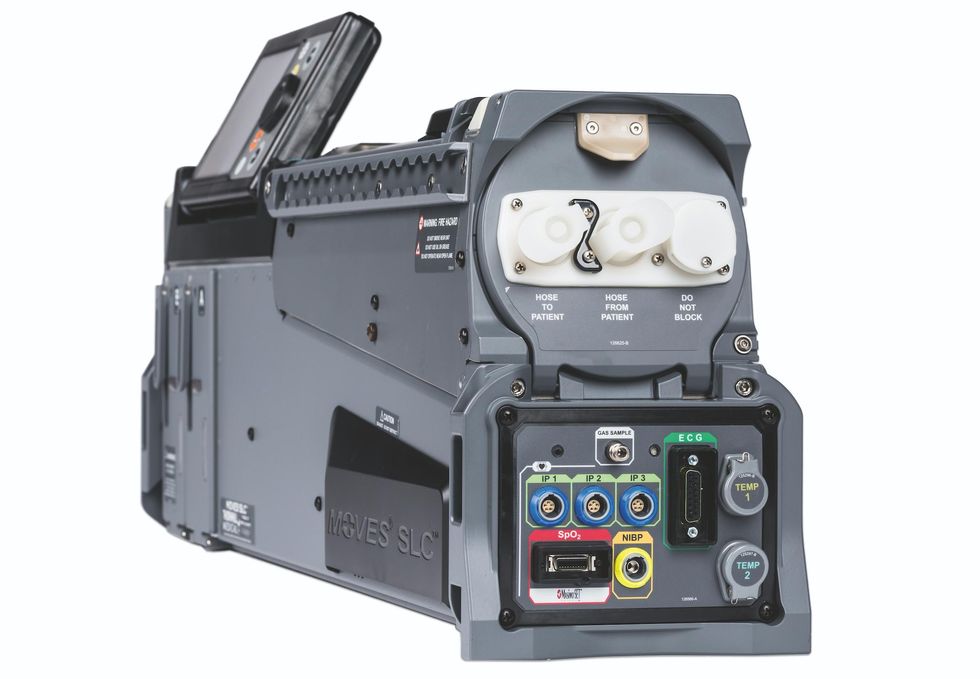
The MOVES SLC unit includes a ventilator operating in circle-circuit: It recovers the oxygen expired by the patient, carefully controls its concentration and redistributes only the strict minimum to the patient. The device also includes a small oxygen concentrator, suction, and several sensors that monitor vital signs.
Thornhill Medical
The user can intubate a patient and monitor its ventilation (FiO2, ETCO2, SpO2, ABP and other indicators) in addition to the patient’s temperature (two sensors), blood pressure (internal and external) and 12-lead ECG. The evolution of these measurements can be followed over the last 24 hours.
All of this, in a device measuring only 84 cm x 14 cm x 25 cm, weighing about 21 kilograms (including interchangeable batteries) which can be slung across the shoulder.
“MOVES must function in the middle of military operations, and be resistant to vibrations, crashes and shock, continue operating smoothly in sandstorms or in the rain.”
—Veso Tijanic, COO of Thornhill Medical
“MOVES SLC represents no more than 30 percent of the volume and weight of traditional equipment — ventilator, concentrator, suction, monitoring device,” adds the COO. Integrating various technologies in such a lightweight, compact package was, without surprise, a major challenge for the engineers. Still, not the most difficult one.
Making medical device components capable of withstanding extreme conditions will have been even more complex. “Traditional technologies were designed to function in hospitals,” explains Tijanic. “MOVES must function in the middle of military operations, and be resistant to vibrations, crashes and shock, continue operating smoothly in sandstorms or in the rain, in temperatures between -26°C and +54°C.”
Sometimes, the engineers could take existing components and develop protective features for them. Occasionally, they would recast them from different markets (oxygen sensors, for instance) to integrate them into their device. And in other cases, they had to start from scratch, creating their own robust components.
The challenge was successfully overcome: “MOVES is designed under the highest industry standards and has been tested and fully certified by various regulatory bodies.” It has been certified MIL-STD-810G, a ruggedness U.S. military standard, verified by over twenty different tests (acoustic vibration, explosive atmosphere, etc.).
The device is hence approved for use — not only transported, but actually used on a patient — in various helicopters, aircraft and land vehicles. And this makes a world of difference for Tijanic. “Critical care, such as we provide, normally requires specially equipped facilities or vehicles. With MOVES SLC, any place or vehicle — even civilian — of sufficient size, is an opportunity for treatment.”
Thornhill’s fully integrated mobile life support has been used by military medical teams for five years already. The device is currently saving lives in Ukraine, Thornhill Medical having donated a number of them as well as its mobile anesthesia delivery module MADM.
In July 2022, the U.S. Army published a report summarizing its medical modernization strategy. The 22-page report confirms the need for ever more lightweight, compact, and cost-effective technology. It also mentions the use of artificial intelligence for more autonomous monitoring of the patients’ medical condition. Thornhill is exploring the AI angle.
“There isn’t always a qualified expert available everywhere,” explains Tijanic. “AI could ensure the optimum settings of the device, and then modify these depending on how the patient’s condition evolves.”
Thornhill is also exploring another solution for cases where no experts are available on spot. Last April, a MOVES SLC was used in a demonstration of “remote control of ventilators and infusion pumps to support disaster care.” Operators based in Seattle successfully controlled remotely a device based in Toronto. Science-fiction thus becomes science, and turns into reality.
The Canadian company continues innovating to heal and save lives on rough chaotic terrain and in the most extreme and unpredictable circumstances. It is driven by medical and technological progress. It is also driven by a many-thousand-year-old trend: Humans will likely never stop waging war.

