Forbes deleted a deeply misinformed op-ed arguing Amazon should replace libraries
Where will the Echos go?
Image: Reuters/Albert Gea
By
Thu-Huong Ha
We may earn a commission from links on this page.
On Saturday morning Forbes published an opinion piece by LIU Post economist Panos Mourdoukoutas with the headline “Amazon Should Replace Local Libraries to Save Taxpayers Money.” It quickly received enthusiastic backlash from actual American libraries and their communities.
As of around 10am US eastern time this morning, the story had nearly 200,000 views, according to a counter on the page. As of 11am, though, the story’s URL has been down.
“Forbes advocates spirited dialogue on a range of topics, including those that often take a contrarian view,” a Forbes spokesperson says in a statement. “Libraries play an important role in our society. This article was outside of this contributor’s specific area of expertise, and has since been removed.”
In his article, Mourdoukoutas argued that local libraries are no longer useful. If libraries closed, he wrote, taxpayers would save money, and Amazon could open bookstores to provide those communities with physical books.
“[Libraries] don’t have the same value they used to,” the article argued. The functions of the library, Mourdoukoutas said, have been replaced: community and wifi are now provided by Starbucks; video rentals by Netflix and Amazon Prime; and books by Amazon.
“Technology has turned physical books into collector’s items, effectively eliminating the need for library borrowing services,” Mourdoukoutas wrote, despite the fact that print book sales from traditional publishing houses are steady. Mourdoukoutas also made the unsubstantiated claim that “some people have started using their loyalty card at Starbucks more than they use their library card.”
As critics have pointed out, the communities that would be hardest hit by libraries closing would be the underprivileged. Libraries provide free computers and internet access for students and people who can’t afford them at home. They also provide free ESL and reading classes; services for the elderly, college hopefuls, and entrepreneurs; and meals for kids at story time.
“The communities that would be affected the most would likely be low-income people, immigrants, and, really, the most marginalized among us,” says Paul Guequierre, director of communications for the Urban Libraries Council, a membership organization for North American public libraries. “[People] don’t have to buy a cup of coffee at the library,” he added.
Public benefit aside, would cutting public libraries save taxpayers a significant amount? The majority of a public library’s funding comes from state and local governments, not federal. According to a report (pdf) from the Ohio Library Council published last year, the state’s average library levy from 2013 to 2017 was 1.39 mills, a rate used in taxes that means $1.39 for every $1,000 in assessed property value. That’s around 2.5% (pdf) of Ohio’s average property tax rate, the eighth highest in the country last year. For the average homeowner in the state, that would have come to around $65 last year.
Across the country, if public libraries were to be cut and all funding were to be divided up among Americans, each person would get $36 back, says Richard Auxier, a researcher at the Tax Policy Center think tank.
On Twitter, Mourdoukoutas wrote, “Let me clarify something. Local libraries aren’t free. Home owners must pay a local library tax. My bill is $495/year.” Writer Kashana Cauley responded to Mourdoukoutas in a tweet with 14,000 likes at time of writing, “Let me clarify something. I don’t want poor and working class people to read books.”
Update (3:12pm ET): This story has been updated with comment from Forbes.
📬 Sign up for the Daily Brief
Our free, fast, and fun briefing on the global economy, delivered every weekday morning.
Behind the tech layoffs, Nvidia CEO's fear, Microsoft stock's new high: Tech news roundup
Plus, Meta's nuclear deal with Constellation Energy is Big Tech's latest AI power play
For the past two years, it’s been a ghost in the machine of American tech.
Between 2022 and today, a little-noticed tweak to the U.S. tax code has quietly rewired the financial logic of how American companies invest in research and development. Outside of CFO and accounting circles, almost no one knew it existed. “I work on these tax write-offs and still hadn’t heard about this,” a chief operating officer at a private-equity-backed tech company told Quartz. “It’s just been so weirdly silent.”
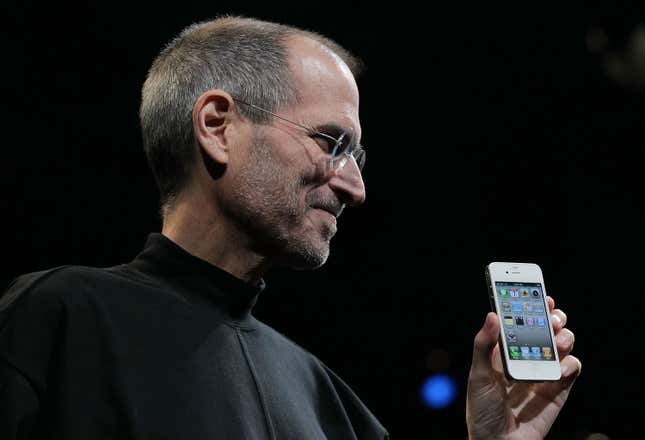
Then-Apple CEO Steve Jobs holds the new iPhone 4 in 2010.Photo: Justin Sullivan (Getty Images)
Apple’s (AAPL) first-generation iPhone entered the U.S. market in June 2007, joining other mobile devices that offered limited web browsing, email, and multimedia capabilities. As Apple’s flagship smartphone, the iPhone has seen an evolution in design, functionality, and performance, shaping the way people interact with technology.
Meta (META) believes that the source of 97% of its revenue can be fully automated by AI: its ads.
By the end of 2026, Mark Zuckerberg’s company will employ AI to work with brands to create their own advertising — imagery, video and text — and then target them to specific users on Meta platforms, according to The Wall Street Journal. The ads could even be made specific to geolocation and time, reflecting local scenery or weather conditions in the imagery.
Microsoft (MSFT) stock just clocked an intraday record on Thursday ($468.49), a milestone that caps off the company’s aggressive AI moves — and even more aggressive expectations. Wall Street isn’t just rewarding Microsoft for showing up to the AI race, it’s pricing in a future where the company leads the pack.
Clinton Clean Energy Center in Clinton, Illinois.Photo: Constellation
Meta (META) has secured a 20-year agreement with Constellation Energy (CEG) to purchase nuclear power from the Clinton Clean Energy Center in Illinois, as it works to secure more energy for its growing AI operations, the company said Tuesday.
A brain-computer interface (BCI), a fusion of man and machine, has sparked human imagination since the Industrial Revolution. This week, the small field of BCI developers — which includes Elon Musk’s Neuralink — was joined by Texan company Paradromics, who successfully installed its Connexus BCI in a patient undergoing epilepsy resection surgery at the University of Michigan.
Even Donald Trump’s sons are finding their family’s crypto business a bit cryptic.
Both Eric and Donald Trump, Jr. denied any involvement in a Trump-branded crypto walletlaunched this week by Magic Eden, an NFT marketplace that teamed up with GetTrumpMemes.com, the company behind the $TRUMP memecoin. GetTrumpMemes.com is owned by Fight Fight Fight LLC, a subdivision of CIC Digital that sells Trump-branded cologne and gold sneakers; both own 80% of the $TRUMP token supply.
As ChatGPT approaches its third anniversary this fall, OpenAI announced that the chatbot has spurred a 50% increase in paid users since February.
COO Brad Lightcap told CNBC (CMCSA) that the company now boasts three million users shelling out cash for its Enterprise, Team, and Edu platforms.
Once the revolutionary chatbot captured the public’s imagination in late 2022, OpenAI began rolling out versions specific to sectors like finance, health care, and post-secondary education.
Reddit is taking Anthropic to court, alleging that the AI startup helped itself to the platform’s vast library of user-generated content — after saying it wouldn’t.
The hidden time bomb in the tax code that's fueling mass tech layoffs
A decades-old tax rule helped build America's tech economy. A quiet change under Trump helped dismantle it
By
Catherine Baab
For the past two years, it’s been a ghost in the machine of American tech.
Between 2022 and today, a little-noticed tweak to the U.S. tax code has quietly rewired the financial logic of how American companies invest in research and development. Outside of CFO and accounting circles, almost no one knew it existed. “I work on these tax write-offs and still hadn’t heard about this,” a chief operating officer at a private-equity-backed tech company told Quartz. “It’s just been so weirdly silent.”
Still, the delayed change to a decades-old tax provision — buried deep in the 2017 tax law — has contributed to the loss of hundreds of thousands of high-paying, white-collar jobs. That’s the picture that emerges from a review of corporate filings, public financial data, analysis of timelines, and interviews with industry insiders. One accountant, working in-house at a tech company, described it as a “niche issue with broad impact,” echoing sentiments from venture capital investors also interviewed for this article. Some spoke on condition of anonymity to discuss sensitive political matters.
Since the start of 2023, more than half-a-million tech workers have been laid off, according to industry tallies. Headlines have blamed over-hiring during the pandemic and, more recently, AI. But beneath the surface was a hidden accelerant: a change to what’s known as Section 174 that helped gut in-house software and product development teams everywhere from tech giants such as Microsoft (MSFT) and Meta (META) to much smaller, private, direct-to-consumer and other internet-first companies.
Now, as a bipartisan effort to repeal the Section 174 change moves through Congress, bigger questions are surfacing: How did a single line in the tax code help trigger a tsunami of mass layoffs? And why did no one see it coming?
A tax break that built the modern tech economy
For almost 70 years, American companies could deduct 100% of qualified research and development spending in the year they incurred the costs. Salaries, software, contractor payments — if it contributed to creating or improving a product, it came off the top of a firm’s taxable income.
The deduction was guaranteed by Section 174 of the IRS Code of 1954, and under the provision, R&D flourished in the U.S.
Microsoft was founded in 1975. Apple (AAPL) launched its first computer in 1976. Google (GOOGL) incorporated in 1998. Facebook opened to the general public in 2006. All these companies, now among the most valuable in the world, developed their earliest products — programming tools, hardware, search engines — under a tax system that rewarded building now, not later.
The subsequent rise of smartphones, cloud computing, and mobile apps also happened in an America where companies could immediately write off their investments in engineering, infrastructure, and experimentation. It was a baseline assumption — innovation and risk-taking subsidized by the tax code — that shaped how founders operated and how investors made decisions.
In turn, tech companies largely built their products in the U.S.
Microsoft’s operating systems were coded in Washington state. Apple’s early hardware and software teams were in California. Google’s search engine was born at Stanford and scaled from Mountain View. Facebook’s entire social architecture was developed in Menlo Park. The deduction directly incentivized keeping R&D close to home, rewarding companies for investing in American workers, engineers, and infrastructure.
That’s what makes the politics of Section 174 so revealing. For all the rhetoric about bringing jobs back and making things in America, the first Trump administration’s major tax bill arguably helped accomplish the opposite.
Undercutting the incentive structure
When Congress passed the Tax Cuts and Jobs Act (TCJA), the signature legislative achievement of President Donald Trump’s first term, it slashed the corporate tax rate from 35% to 21% — a massive revenue loss on paper for the federal government.
To make the 2017 bill comply with Senate budget rules, lawmakers needed to offset the cost. So they added future tax hikes that wouldn’t kick in right away, wouldn’t provoke immediate backlash from businesses, and could, in theory, be quietly repealed later.
The delayed change to Section 174 — from immediate expensing of R&D to mandatory amortization, meaning that companies must spread the deduction out in smaller chunks over five or even 15-year periods — was that kind of provision. It didn’t start affecting the budget until 2022, but it helped the TCJA appear “deficit neutral” over the 10-year window used for legislative scoring.
The delay wasn’t a technical necessity. It was a political tactic. Such moves are common in tax legislation. Phase-ins and delayed provisions let lawmakers game how the Congressional Budget Office (CBO) — Congress’ nonpartisan analyst of how bills impact budgets and deficits — scores legislation, pushing costs or revenue losses outside official forecasting windows.
And so, on schedule in 2022, the change to Section 174 went into effect. Companies filed their 2022 tax returns under the new rules in early 2023. And suddenly, R&D wasn’t a full, immediate write-off anymore. The tax benefits of salaries for engineers, product and project managers, data scientists, and even some user experience and marketing staff — all of which had previously reduced taxable income in year one — now had to be spread out over five- or 15-year periods.
To understand the impact, imagine a personal tax code change that allowed you to deduct 100% of your biggest source of expenses, and that becoming a 20% deduction. For cash-strapped companies, especially those not yet profitable, the result was a painful tax bill just as venture funding dried up and interest rates soared.
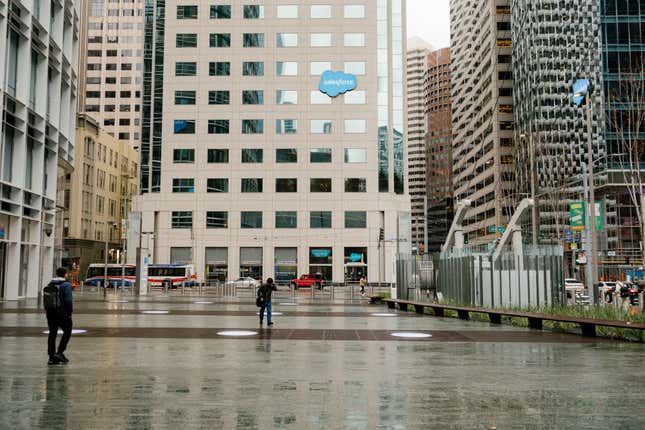
Salesforce office buildings in San Francisco.Photo: Jason Henry/Bloomberg (Getty Images)
The layoffs begin
It’s no coincidence that Meta announced its “Year of Efficiency” immediately after the Section 174 change took effect. Ditto Microsoft laying off 10,000 employees in January 2023 despite strong earnings, or Google parent Alphabet cutting 12,000 jobs around the same time.
Amazon (AMZN) also laid off almost 30,000 people, with cuts focused not just on logistics but on Alexa and internal cloud tools — precisely the kinds of projects that would have once qualified as immediately deductible R&D. Salesforce (CRM) eliminated 10% of its staff, or 8,000 people, including entire product teams.
In public, companies blamed bloat and AI. But inside boardrooms, spreadsheets were telling a quieter story. And MD&A notes — management’s notes on the numbers — buried deep in 10-K filings recorded the change, too. R&D had become more expensive to carry. Headcount, the leading R&D expense across the tech industry, was the easiest thing to cut.
In its 2023 annual report, Meta described salaries as its single biggest R&D expense. Between the first and second years that the Section 174 change began affecting tax returns, Meta cut its total workforce by almost 25%. Over the same period, Microsoft reduced its global headcount by about 7%, with cuts concentrated in product-facing, engineering-heavy roles.
Smaller companies without the fortress-like balance sheets of Big Tech have arguably been hit even harder. Twilio (TWLO) slashed 22% of its workforce in 2023 alone. Shopify (SHOP) (headquartered in Canada but with much of its R&D teams in the U.S.) cut almost 30% of staff in 2022 and 2023. Coinbase (COIN) reduced headcount by 36% across a pair of brutal restructuring waves.
Since going into effect, the provision has hit at the very heart of America’s economic growth engine: the tech sector.
By market cap, tech giants dominate the S&P 500, with the “Magnificent 7” alone accounting for more than a third of the index’s total value. Workforce numbers tell a similar story, with tech employing millions of Americans directly and supporting the employment of tens of millions more. As measured by GDP, capital-T tech contributes about 10% of national output.
It’s not just that tech layoffs were large, it’s that they were massively disproportionate. Across the broader U.S. economy, job cuts hovered around in low single digits across most sectors. But in tech, entire divisions vanished, with a whopping 60% jump in layoffs between 2022 and 2023. Some cuts reflected real inefficiencies — a response to over-hiring during the zero-interest rate boom. At the same time, many of the roles eliminated were in R&D, product, and engineering, precisely the kind of functions that had once benefitted from generous tax treatment under Section 174.
A crippling change even outside tech
Throughout the 2010s, a broad swath of startups, direct-to-consumer brands, and internet-first firms — basically every company you recognize from Instagram or Facebook ads — built their growth models around a kind of engineered break-even.
The tax code allowed them to spend aggressively on product and engineering, then write it all off as R&D, keeping their taxable income close to zero by design. It worked because taxable income and actual cash flow were often notquitethe same thing under what’s known as GAAP accounting practices. Basically, as long as spending counted as R&D, companies could report losses to investors while owing almost nothing to the IRS.
But the Section 174 change broke that model. Once those same expenses had to be spread out, or amortized, over multiple years, the tax shield vanished. Companies that were still burning cash suddenly looked profitable on paper, triggering real tax bills on imaginary gains.
The logic that once fueled a generation of digital-first growth collapsed overnight.
So it wasn’t just tech experiencing effects. From 1954 until 2022, the U.S. tax code had encouraged businesses of all stripes to behave like tech companies. From retail to logistics, healthcare to media, if firms built internal tools, customized a software stack, or invested in business intelligence and data-driven product development, they could expense those costs. The write-off incentivized in-house builds and fast growth well outside the capital-T tech sector. This lines up with OECD research showing that immediate deductions foster innovation more than spread-out ones.
And American companies ran with that logic. According to government data, U.S. businesses reported about $500 billion in R&D expenditures in 2019 alone, and almost half of that came from industries outside traditional tech. The Bureau of Economic Analysis estimates that this sector, the broader digital economy, accounts for another 10% of GDP.
Add that to core tech’s contribution, and the Section 174 shift has likely touched at least 20% of the U.S. economy.
The result? A tax policy aimed at raising short-term revenue effectively hid a time bomb inside the growth engines of thousands of companies. And when it detonated, it kneecapped the incentive for hiring American engineers or investing in American-made tech and digital products.
It made building tech companies in America look irrational on a spreadsheet.
Repeal may come too late
A bipartisan group of lawmakers is pushing to repeal the Section 174 change, with business groups, CFOs, crypto executives, and venture capitalists lobbying hard for retroactive relief. But the politics are messy. Fixing 174 would mean handing a tax break to the same companies many voters in both parties see as symbols of corporate excess. Any repeal would also come too late for the hundreds of thousands of workers already laid off.
And of course, the losses don’t stop at Meta’s or Google’s campus gates. They ripple out. When high-paid tech workers disappear, so do the lunch orders. The house tours. The contract gigs. The spending habits that sustain entire urban economies and thousands of other jobs. Sandwich artists. Rideshare drivers. Realtors. Personal trainers. House cleaners. In tech-heavy cities, the fallout runs deep — and it’s still unfolding.
Washington is now poised to pass a second Trump tax bill — one packed with more obscure provisions, more delayed impacts, more quiet redistribution. And it comes as analysts are only just beginning to understand the real-world effects of the last round.
The Section 174 change “significantly increased the tax burden on companies investing in innovation, potentially stifling economic growth and reducing the United States’ competitiveness on the global stage,” according to the tax consulting firm KBKG.
Whether the U.S. will reverse course — or simply adapt to a new normal — remains to be seen.
The 5 states with the best economies in America right now — and the 5 worst
WalletHub set out to find the states that are thriving, and the ones that are lagging behind their neighbors…
By
Ben Kesslen
The economic health of U.S. states varies widely, due to factors such as job growth, income levels, business development, and overall financial stability.
While some states have relatively strong, thriving economies, others struggle with high unemployment rates, low wages, and contracting industries.
WalletHub set out to pick the states with the best and worst economies, looking at factors across three key metrics: economic activity, economic health, and investment potential. It considered everything from unemployment rates, change in GDP, exports per capita, and the share of the population in poverty.
“A strong state economy doesn’t guarantee success for the state’s residents, but it certainly makes financial success more attainable,” said WalletHub analyst Chip Lupo. “The best state economies also encourage growth by being friendly to new businesses and investing in new technology that will help the state deal with future challenges and become more efficient.”
Continue reading to see which states have the best — and the worst — economies.
5th Worst: South Dakota
Photo: Scott Olson / Staff (Getty Images)
While South Dakota scored high marks for economic health, it suffered from poor rankings for economic activity and innovation potential.
4th Worst: North Dakota
Photo: Andrew Burton / Staff (Getty Images)
Like its neighbor to the south, North Dakota was dinged for low economic activity and meager innovation potential.
3rd Worst: Hawaii
Photo: Cliff Hawkins / Staff (Getty Images)
Hawaii may be a tourist hotspot, but it still scored low marks for economic activity and innovation potential.
2nd Worst: West Virginia
Photo: Spencer Platt / Staff (Getty Images)
West Virginia suffers from poor economic health and the lowest innovation potential, landing it the second to worst spot.
Worst: Iowa
Photo: Scott Olson / Staff (Getty Images)
Iowa came in last, with the lowest score for economic activity and a low score for economic health, too.
5th Best: New Hampshire
Photo: Darren McCollester / Stringer (Getty Images)
New Hampshire took fifth thanks to solid scores across all categories.
4th Best: California
Photo: Justin Sullivan / Staff (Getty Images)
Despite coming in 47th place for economic health, California still managed to get the 4th spot since it scored second-highest for economic activity and third-highest for innovation potential.
3rd Best: Washington
Photo: Steph Chambers / Staff (Getty Images)
Washington state came in second for innovation potential and third for economic activity, helping it secure the 3rd spot.
2nd Best: Utah
Photo: Justin Sullivan / Staff (Getty Images)
Utah ranked second thanks to its first-place ranking in economic activity, with solid scores in the other two categories.
Best: Massachusetts
Photo: Mario Tama / Staff (Getty Images)
Massachusetts claimed the top spot with the highest innovation potential and strong showings in WalletHub’s other two categories.
The economic health of U.S. states varies widely, due to factors such as job growth, income levels, business development, and overall financial stability.
Tesla stock is having a rough week. Shares have fallen more than 20% in the last five days, and were down 14% on Thursday alone.
Meanwhile, trading volumes — the number of shares trading hands — paint a distinct picture. Look beyond the headline stock moves, and the type of selling starts to come into focus.
Healthcare costs across the U.S. are out of control, with the average American spending around $1,500 out of pocket every year. But in some states, costs are significantly higher than in others.
U.S. employers announced almost 100,000 job cuts in May, up an eye-watering 47% from the same month last year, according to new data released Thursday morning by the outplacement firm Challenger, Gray & Christmas. - Catherine Baab Read More
The global economy is slowing. In a sharply downgraded forecast released Tuesday, the Organisation for Economic Co-operation and Development warned that President Donald Trump’s volatile yet sweeping tariff policies are inflicting greater damage than expected, with the effects more concentrated in the U.S. than anywhere else.
As markets whipsawed through a turbulent first quarter, American workers didn’t blink: They kept saving for retirement — even while watching their 401(k) balances get smaller.
Short sellers made a killing Thursday as Tesla (TSLA) shares plunged 14%, their steepest single-day drop in over a year, with traders raking in some $4 billion on the bearish bets, per Ortex data.
Dollar General just posted a great quarter. That’s good news for the retailer, and for investors enjoying a 9% pop in the stock price. It just might not be good news for the broader economy.
Dan Ives, a tech analyst known for his bullish calls on Nvidia (NVDA), Tesla, and the generative AI boom, is offering investors a way to buy into his thesis — literally.
President Donald Trump and Tesla (TSLA) CEO Elon Musk tore into one another on Thursday, as their close alliance collapsed in front of cameras and on social media.
Sixty-four Tesla (TSLA) Superchargers will be removed from the New Jersey Turnpike, starting on Friday. Upon hearing the news, Elon Musk tweeted, “Sounds like corruption.”
In a CBS (PARA) interview Sunday, Elon Musk tried to distance himself from the Trump administration’s controversial second-term agenda.
“It’s not like I agree with everything the administration does,” Musk said in an interview on “Sunday Morning.” “I mean, I agree with much of what the administration does. But we have differences of opinion.”
In an interview with ABC News (DIS) early Friday morning, President Donald Trump brushed off the suggestion of reconciling with Elon Musk. “You mean the man who has lost his mind?” the President asked, adding that he was “not particularly” interested in speaking to the Tesla (TSLA) and SpaceX CEO.
The magic might be wearing thin at Disney (DIS) — for employees, at least. The company is laying off several hundred workers on Monday, in CEO Bob Iger’s latest step to realign Disney’s operations in response to the declining traditional TV viewership and the rise of streaming platforms.
The fragile U.S.-China tariff truce is showing signs of unraveling.
China’s Ministry of Commerce issued sharp warnings over the weekend and into Monday, accusing the U.S. of “undermining China’s interests” and vowing to “take forceful measures to safeguard its legitimate rights.” - Catherine Baab Read More
Tesla (TSLA) CEO Elon Musk wants Republicans to take a big U-turn and start from scratch on President Donald Trump’s big domestic policy bill.
Musk hasn’t let up in his fusillade of attacks on the GOP bill that started Tuesday, only days after exiting a special advisory role spearheading a cost-cutting campaign under the U.S. DOGE Service. The billionaire exhorted his followers on X to call their lawmakers and encourage them to oppose the legislation carrying the bulk of Trump’s agenda.
Graphics cards and motherboards assembled in China are avoiding President Donald Trump’s import taxes, for now.
In a three-page notice published Saturday in the Federal Register, the Office of the Trade Representative said it was “appropriate” to extend a moratorium that won’t subject vendors of electronics equipment to tariffs on graphics cards and graphics processing units. Read More
The updated annual Fortune 500 list ranking the largest public companies by revenue was released Monday.
Fortune said the 500 businesses make up two-thirds of U.S. GDP, with a whopping $19.9 trillion in combined revenue. The companies also employ a collective 31 million people worldwide and also earned a record amount of profit, $1.87 trillion, up 10% from last year.
In a sea of health apps pinging you to meditate more and eat less, Noom is taking a different tack. Think streaks, badges, and bite-size wins — the kind of dopamine hits that made a green cartoon owl one of the most effective behavior-change tools on the planet.
Layoffs are surging as 2025 becomes the year of the pink slip
U.S. job cuts have risen almost 50% year-over-year, with some sectors hit even harder. Services, retail, tech, and…
By
Catherine Baab
U.S. employers announced almost 100,000 job cuts in May, up an eye-watering 47% from the same month last year, according to new data released Thursday morning by the outplacement firm Challenger, Gray & Christmas.
Even with a slight decline from April, the 47% year-over-year jump makes it clear: Layoffs are a rapidly accelerating trend. What was a murmur is becoming a scream.
2025 layoff totals already rival all of 2024's
“Tariffs, funding cuts, consumer spending, and overall economic pessimism are putting intense pressure on companies’ workforces,” said senior vice president Andrew Challenger. “Companies are spending less, slowing hiring, and sending layoff notices.”
In all, 2025 looks to be on track to scorch recent records.
Just six months into 2025, employers have already announced almost 700,000 job cuts. That’s a whopping 80% increase from the same period last year and just 65,000 short of all layoffs tracked in total in 2024.
Services, retail, nonprofits, and tech lead in layoffs
The services sector (which includes temporary staffing, cleaning services, and other business-to-business support providers) led the way in May with more than 22,000 layoffs, the worst month for the category since May 2020.
Retailers followed with 11,483 job cut announcements, bringing their year-to-date total to more than 75,000. That’s up 274% from the same point in 2024.
Nonprofits, likely hit by downstream effects of federal funding reductions, also saw significant pain, with layoffs in that sector up a shattering 504% year-over-year.
Government-related layoffs remain the biggest single source of reductions, with more than 284,000 job cuts attributed to direct or indirect impacts of Elon Musk’s Department of Government Efficiency, or DOGE, a Trump administration initiative driving mass federal workforce reductions.
Tech sector layoffs also surged in May, according to TrueUp.io, with 24,467 tech employees impacted and Panasonic, Microsoft (MSFT), Walmart (WMT), and OpenText (OTEX) among the largest contributors. Per the Challenger Gray data, the tech sector now trails only government and retail for total layoffs in 2025, with total layoffs for 2025 already sitting at nearly 75,000, representing a 35% year-over-year surge.
Separately, Procter & Gamble (PG) announced plans Thursday to eliminate 7,000 white-collar jobs over the next two years as it exits underperforming categories and regions. While not immediate, the cuts signal a broader shift in strategy for the consumer goods giant and add to the white-collar layoff trend.
Tesla stock plunges 14% as Trump and Elon Musk break up. Here’s what the numbers show
Huge trading volumes suggest the Tesla selloff may be institution-led, with the big money growing wary of Elon…
By
Catherine Baab
Tesla stock is having a rough week. Shares have fallen more than 20% in the last five days, and were down 14% on Thursday alone.
Meanwhile, trading volumes — the number of shares trading hands — paint a distinct picture. Look beyond the headline stock moves, and the type of selling starts to come into focus.
That pattern suggested the later move down may have been driven more by retail investors, with smaller players getting spooked or perhaps disliking Musk’s political shift, rather than big institutions rushing to exit. When both volumes and prices see declines, it’s often a sign of “mom and pop” selling.
But by the close of market on Thursday? The picture changed again, dramatically. Volume spiked, zooming past the post-NYT surge to a stunning 275 million shares, as Tesla stock sank to $284. And that kind of move, with price falling sharply and volume rising tremendously — to levels not seen for months, if not years — starts to look a lot like big-money participation. If institutional investors were on the sidelines earlier this week, they may not be anymore.
The longer history of retail love and institutional wariness
Tesla has long been a favorite among retail investors, a dynamic that gained momentum in 2020, when pandemic-era trading booms and Elon Musk’s cult-like appeal helped make it one of the most widely held and discussed stocks on the internet. Platforms like Robinhood (HOOD) and Reddit’s WallStreetBets treated Tesla less like a company and more like a movement.
At the same time, Tesla’s addition to the S&P 500 in December of 2020 forced a wave of institutional buying, including large buys from passive index funds. Later, even as Tesla’s valuation soared, traditional asset managers remained somewhat skeptical, seemingly turned off by Musk’s volatility, the stock’s eye-watering multiples, governance concerns, and its meme-driven nature.
By early 2021, institutional ownership hovered around 40% to 45%, considered somewhat below the norm for a company of Tesla’s size. Other “Magnificent 7" stocks, namely Microsoft, Nvidia, Apple, and Google parent company Alphabet, have institutional ownership as high as 60% to 70%+.
And that pattern has largely held in the years since. While institutional holdings have ticked up, and now sit just under 49%, Tesla remains somewhat under-owned by the biggest money managers compared to more staid tech names. The stock also continues to attract tremendous interest and attention from individual investors, dominating coverage across YouTube (GOOGL) finance channels, Reddit threads, and TikTok explainers.
The result is a stock that can be unusually sentiment-driven for a company of its size. It comes down to Tesla’s liquidity and prominence (some might say notoriety). Structurally speaking, it’s just a little more vulnerable to headlines than some of its big-tech peers.
Now there’s reason to think the big players are growing wary all over again
According to the most recent 13F filings, some larger firms have trimmed their Tesla stakes, while others have added. They’re months out of date, however. The danger now? If Musk’s erratic behavior keeps making headlines, big firms may decide Tesla stock is not worth what looks to be the current level of risk. And if they leave in force, this week’s drop could be only the beginning.
For the past two years, it’s been a ghost in the machine of American tech.
Between 2022 and today, a little-noticed tweak to the U.S. tax code has quietly rewired the financial logic of how American companies invest in research and development. Outside of CFO and accounting circles, almost no one knew it existed. “I work on these tax write-offs and still hadn’t heard about this,” a chief operating officer at a private-equity-backed tech company told Quartz. “It’s just been so weirdly silent.”
Then-Apple CEO Steve Jobs holds the new iPhone 4 in 2010.Photo: Justin Sullivan (Getty Images)
Apple’s (AAPL) first-generation iPhone entered the U.S. market in June 2007, joining other mobile devices that offered limited web browsing, email, and multimedia capabilities. As Apple’s flagship smartphone, the iPhone has seen an evolution in design, functionality, and performance, shaping the way people interact with technology.
Meta (META) believes that the source of 97% of its revenue can be fully automated by AI: its ads.
By the end of 2026, Mark Zuckerberg’s company will employ AI to work with brands to create their own advertising — imagery, video and text — and then target them to specific users on Meta platforms, according to The Wall Street Journal. The ads could even be made specific to geolocation and time, reflecting local scenery or weather conditions in the imagery.
Microsoft (MSFT) stock just clocked an intraday record on Thursday ($468.49), a milestone that caps off the company’s aggressive AI moves — and even more aggressive expectations. Wall Street isn’t just rewarding Microsoft for showing up to the AI race, it’s pricing in a future where the company leads the pack.
Clinton Clean Energy Center in Clinton, Illinois.Photo: Constellation
Meta (META) has secured a 20-year agreement with Constellation Energy (CEG) to purchase nuclear power from the Clinton Clean Energy Center in Illinois, as it works to secure more energy for its growing AI operations, the company said Tuesday.
A brain-computer interface (BCI), a fusion of man and machine, has sparked human imagination since the Industrial Revolution. This week, the small field of BCI developers — which includes Elon Musk’s Neuralink — was joined by Texan company Paradromics, who successfully installed its Connexus BCI in a patient undergoing epilepsy resection surgery at the University of Michigan.
Even Donald Trump’s sons are finding their family’s crypto business a bit cryptic.
Both Eric and Donald Trump, Jr. denied any involvement in a Trump-branded crypto walletlaunched this week by Magic Eden, an NFT marketplace that teamed up with GetTrumpMemes.com, the company behind the $TRUMP memecoin. GetTrumpMemes.com is owned by Fight Fight Fight LLC, a subdivision of CIC Digital that sells Trump-branded cologne and gold sneakers; both own 80% of the $TRUMP token supply.
As ChatGPT approaches its third anniversary this fall, OpenAI announced that the chatbot has spurred a 50% increase in paid users since February.
COO Brad Lightcap told CNBC (CMCSA) that the company now boasts three million users shelling out cash for its Enterprise, Team, and Edu platforms.
Once the revolutionary chatbot captured the public’s imagination in late 2022, OpenAI began rolling out versions specific to sectors like finance, health care, and post-secondary education.
Reddit is taking Anthropic to court, alleging that the AI startup helped itself to the platform’s vast library of user-generated content — after saying it wouldn’t.
How Netflix's ad business could become a $10 billion sleeper hit
The streamer's ad-supported tier was late to the party. But with 40 million users and bullish forecasts, Netflix is…
By
Shannon Carroll
Netflix (NFLX) was once allergic to ads. Now it might be growing its empire on them.
Back in 2022, the company’s decision to launch an ad-supported tier felt more like a concession than a strategy — a move that came as password crackdowns replaced product launches and was driven by slowing subscriber growth, rising competition, and economic pressure.
Fast forward to mid-2025 and that “standard with ads” plan looks less like a reluctant experiment and more like a $10 billion franchise in the making.
Netflix’s ad-supported tier now boasts greater than 94 million global monthly active users, more than doubling from 40 million just the year before, according to the company. In regions where that tier is available, over 40% of new subscribers are choosing the cheaper, ad-supported option — showing that viewers are happy to trade a few commercials for a lower monthly bill. Among these users, 44% are new to Netflix, 40% downgraded from pricier ad-free plans, and 16% are returning subscribers, per The Wrap.
Jefferies (JEF) analysts estimate that Netflix’s advertising business could hit $10 billion in annual revenue by the end of the decade, and Wall Street is finally catching up to the plot twist.
In a June note, Jefferies raised its price target on Netflix to $1,400, citing, among other things, the “infancy” of the ad business and its massive runway for growth. Oppenheimer (OPY) analysts are even more bullish in the short term, forecasting $6 billion in ad revenue by 2025 — up from a previous $4.6 billion estimate.
That’s not pocket change for a company that built its brand on being the “ad-free” TV option.
From ad-free to ad-funded
Netflix’s transformation into a hybrid media-advertising platform mirrors broader shifts in the streaming landscape. According to data from analysts at Antenna, nearly half of streaming subscriptions across major platforms are now ad-supported. Consumers, it turns out, are willing to watch a few commercials if it means saving a few bucks — and advertisers are eager to reach them in a post-cable world.
Still, Netflix wasn’t the first to adopt this model. Hulu (DIS), Peacock (CMCSA), and Paramount+ (PARA) had ad-supported offerings years earlier. But Netflix’s scale gives it an edge: a global subscriber base, premium content, and hit franchises such as “Bridgerton,” and increasingly, the infrastructure to sell those ads with surgical precision.
The company recently began building an ad-tech platform with plans to launch it globally by the end of 2025. Netflix has also inked partnerships with major programmatic players such as The Trade Desk (TTD), Google’s DV360, and Magnite (MGNI) to streamline ad sales and targeting.
The appeal to advertisers is obvious. Netflix offers premium, brand-safe content in a streaming environment that’s becoming increasingly fragmented and unpredictable. And the company’s ad business still represents a small slice of total revenue — an estimated $2 billion in 2025.
But that’s the point: There’s room to grow.
MoffettNathanson (SIVB) sees Netflix’s advertising revenue climbing past $6 billion by 2027, on track for $10 billion by 2030. For comparison, YouTube (GOOGL) generated over $40 billion in ad revenue last year. Even capturing a small fraction of that puts Netflix in a different league than most of its streaming peers.
And Wall Street is paying attention. The ad model, combined with a blockbuster second-half content slate — “Squid Game” season three, the “Stranger Things” finale, and even NFL games and other live offerings — is fueling bullish sentiment on the stock.
Analysts expect free cash flow to grow at a 20% compound annual rate over the next five years, reaching $18 billion by the end of the decade. Advertising, Wall Street seems to be arguing, is the high-margin lever that could supercharge those numbers — while the company remains a strong, recession-safe play.
It also offers Netflix pricing flexibility. Rather than hiking monthly rates across the board (a tactic that’s historically sparked churn), the company can nudge users toward the ad tier while still growing average revenue per member (ARM). So far, it seems to be working: Churn from price increases has been “limited,” per Jefferies, and ARM is rising.
In early 2025, Netflix raised the price of its ad-supported plan from $6.99 to $7.99 (the standard plan without ads from $15.49 to $17.99; and the premium tier without ads from $22.99 to $24.99). Unlike previous hikes, this one didn’t trigger a mass exodus.
That’s good news for the company’s margins — and even better news for its ambitions to grow the ad-supported tier without sacrificing user growth.
Risks? Sure. But don’t bet against binge-watching
There are, of course, still caveats. Some analysts worry that the ad tier might cannibalize higher-paying subscribers, dragging down margins. Others point to the fact that the costs of live sports and entertainment rights could weigh on profitability (just ask ESPN). And unlike tech-native platforms such as Meta (META) or Google, Netflix has only recently begun building the backend that powers programmatic ad targeting at scale.
But if Netflix can thread the needle — retaining its brand while scaling its ad business — it could pull off something rare in streaming: profitable, diversified growth. The irony? For a company that famously shunned advertising for years, Netflix’s next act could be defined by it. If the company’s original story was about killing the cable bundle, the sequel might be about inheriting cable’s ad dollars.
As the credits roll on the first chapter of the streaming wars, Netflix is already filming the next one. And this time, it comes with commercial breaks.
Aldi cuts grocery prices on more than 400 items for the summer
The supermarket chain claims it will save shoppers $100 million during its seasonal discount campaign
By
Shannon Carroll
As Americans’ wallets start to feel a little lighter and recession fears loom on the economic horizon, discount grocer Aldi is betting that lower prices might keep shoppers coming — and spending — through the summer.
“At a time when two-thirds of Americans are very concerned about the cost of groceries, Aldi is doing what others can’t: Dropping prices across its aisles,” the company said in a press release.
The Germany-based chain just announced that, starting June 5, it is cutting prices on more than 400 products (nearly 25%), from picnic staples such as hot dogs and potato chips to household goods such as paper towels and freezer bags. The markdowns, which will last through Labor Day, are aimed at softening the blow of still-sticky grocery inflation and positioning Aldi as a summer go-to for families.
This summer’s price reduction campaign isn’t Aldi first move into big discount campaigns — the company said it saved shoppers over $60 million through a similar move in 2023. Now, Aldi claims it will almost double those savings this year: to the tune of $100 million.
Aldi’s campaign underscores a shift in strategy among retailers competing for increasingly price-sensitive shoppers. While inflation has cooled from its 2022 peak, food prices are still up roughly 20% since before the pandemic, and many consumers are trading down to private labels and discount chains — making Aldi’s no-frills model suddenly very on-trend.
“Value isn’t a trend at ALDI,” said Aldi USA’s chief commercial officer, Scott Patton, in a press release. “It’s been in our DNA since we opened our first store nearly 50 years ago.”
He told USA Today: “Summer’s for grilling out, camping, concerts, and quality time with friends and family — not stressing over grocery bills.”
Aldi, which now operates more than 2,300 stores in 39 U.S. states, has steadily expanded its footprint and market share. It finalized its acquisition of Southeastern Grocers last year, adding hundreds of Winn-Dixie and Harveys Supermarket locations to its portfolio. And Aldi plans to open 225 stores this year — and 800 stores by the end of 2028.
Aldi’s cost-cutting approach is embedded in its operational DNA. It uses shipping boxes for product displays, maintains minimalist shelving, and offers predominantly private label products (which make up 90% of its inventory) to reduce overhead costs.
“Our customers count on ALDI for the lowest prices of any national grocer, every day, and we never take that trust for granted,” Aldi USA CEO Jason Hart said in the press release.
With consumer confidence dipping and grocery fatigue setting in, retailers are increasingly experimenting with ways to ease “price pain” — and foster loyalty before a potential downturn hits.
Other grocers could follow Aldi’s lead. Walmart, which leans into low pricing, has hinted at broadening its rollback strategy, and Kroger (KR) recently expanded its private-label offerings. Even Target (TGT), Walgreens (WBA), and Amazon Fresh (AMZN) have announced price reductions on thousands of items in the lead-up to summer.
Saying 'please' and 'thank you' to ChatGPT costs OpenAI millions, Sam Altman says
Being nice to your AI chatbot requires computational power that raises electricity and water costs
By
Shannon Carroll
Being polite to your AI assistant could cost millions of dollars.
OpenAI CEO Sam Altman revealed that showing good manners to a ChatGPT model — such as saying “please” and “thank you” — adds up to millions of dollars in operational expenses.
Altman responded to a user on X (formerly Twitter) who asked how much the company has lost in electricity costs from people being polite to their models.
“Tens of millions of dollars well spent — you never know,” the CEO wrote.
Sounds like someone saw what operating system Hal did in “2001: A Space Odyssey” and is going to be nice to their AI assistant just in case. Experts have also found that being polite to a chatbot makes the AI more likely to respond to you in kind.
Judging from Altman’s cheeky tone, that “tens of millions” figure likely isn’t a precise number. But any message to ChatGPT, no matter how trivial or inane, requires the AI to initiate a full response in real time, relying on high-powered computing systems and increasing the computational load — thereby using massive amounts of electricity.
AI models rely heavily on energy stored in global data centers — which already accounts for about 2% of the global electricity consumption. According to Goldman Sachs (GS), each ChatGPT-4 query uses about 10 times more electricity than a standard Google (GOOGL) search.
Data from the Washington Post suggests that if one out of every 10 working Americans uses GPT-4 once a week for a year (meaning 52 queries by 17 million people), the power needed would be comparable to the electricity consumed by every household in Washington, D.C. — for 20 days.
Rene Hass, CEO of semiconductor company ARM Holdings (ARM), recently warned that AI could account for a quarter of America’s total power consumption by 2030. That figure currently is 4%.
Polite responses also add to OpenAI’s water bill. AI uses water to cool the servers that generate the data. A study from the University of California, Riverside, said that using GPT-4 to generate 100 words consumes up to three bottles of water — and even a three-word response such as “You are welcome” uses about 1.5 ounces of water.