In 2013, a deep sea mining company named UK Seabed Resources contracted marine biologist Diva Amon and other scientists from the University of Hawaii at Manoa to survey a section of the seafloor in the Clarion-Clipperton Zone, a vast swath of international waters located in the Pacific Ocean that spans around 2 million square miles between Hawaii and Mexico.
The area is known to have an abundant supply of rocky deposits the size of potatoes called polymetallic nodules. They are rich in metals like nickel, cobalt, copper and manganese historically used to make batteries and electric vehicles.
Someday, the company envisioned it might profit from mining them. But first it wanted to know more about the largely unexplored abyssal environment where they were found, Amon said.
Using a remotely operated vehicle equipped with cameras and lights, she began documenting life 2.5 miles deep.
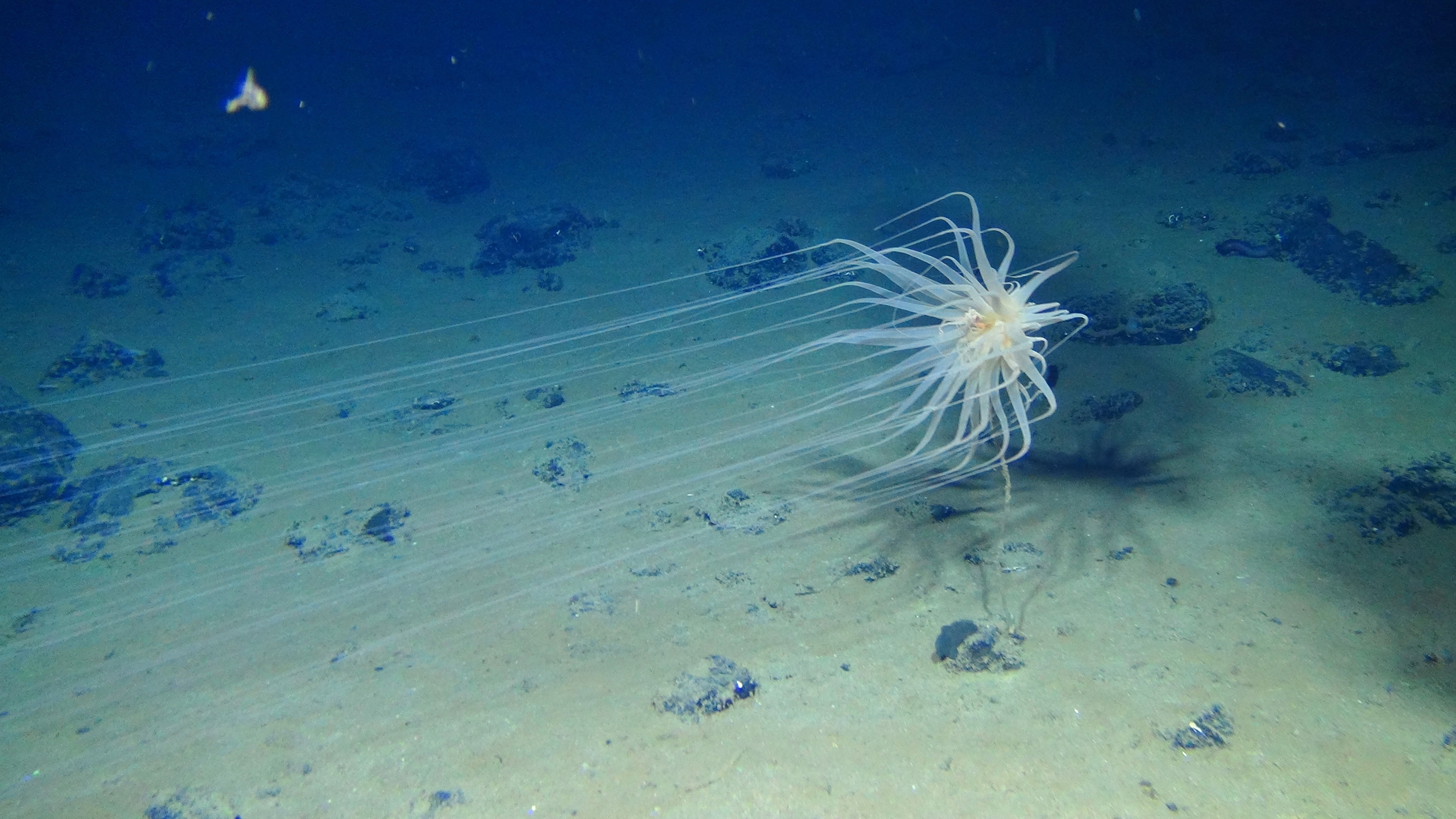
On one of the robot’s first dives, an anemone-like creature with 8-foot-long billowing tentacles appeared about two feet above the seabed. It was attached to the stem of a sea sponge anchored on one of the valuable nodules.
Amon was overwhelmed with excitement. It was likely a new species, she said. She also felt a sense of grief. “Here was this incredibly beautiful animal,” she said, “that no one has likely ever seen before.” And they might not ever again. “I feel this immense sadness at the potential that this place that we have come to survey may be mined and essentially destroyed in the future,” she remembers thinking at that moment.
Now, more than a decade later, Amon worries her fears may be coming to fruition.
“The Next Gold Rush”
On April 24, President Trump signed an executive order promoting deep sea mining in U.S. and international waters, touting the industry’s potential to boost the country’s economic growth and national security.
“These resources are key to strengthening our economy, securing our energy future, and reducing dependence on foreign suppliers for critical minerals,” the order states.
In an online post last month, the National Oceanic and Atmospheric Administration (NOAA) described the political move as a step towards paving the way for “The Next Gold Rush,” stating: “Critical minerals are used in everything from defense systems and batteries to smartphones and medical devices. Access to these minerals is a key factor in the health and resilience of U.S. supply chains.”
The order, titled “Unleashing America’s Offshore Critical Minerals and Resources,” charges NOAA and the Secretary of Commerce with expediting the process for reviewing and issuing licenses to explore and permits to mine seabed minerals in areas beyond national jurisdiction.
Less than a week after it was issued, a U.S. subsidiary of the Canadian deep-sea mining corporation called The Metals Company submitted its first applications to explore and exploit polymetallic nodules in the Clarion-Clipperton Zone.
If approved, the company could be the first to mine in international waters. It would also be the first to do so under U.S. law, sparking a rebuke from those opposed to the industry. These oceans advocates say the risks of mining far outweigh the benefits of maintaining a healthy deep sea ecosystem, which plays a vital role in managing the global climate by absorbing heat and excess carbon dioxide.
During a House Committee on Natural Resources oversight hearing on the potential impact of deep sea mining on the American economy—held in April on the same day The Metals Company made its announcement—U.S. Rep. Jared Huffman from (D-Calif.) critiqued the president’s order.
“Despite what proponents claim, it is not the great silver bullet,” he said. “The industry has very questionable market prospects because battery technology is rapidly changing. (Electrical vehicle) markets are already moving away from the nickel, cobalt, copper and manganese found in deep sea nodules towards other minerals.”
A Vast Resistance
Prior to the president’s order, more than 900 leading scientists and marine policy experts from over 70 countries including Amon from Trinidad and Tobago, had signed a statement calling for a precautionary pause on deep sea mining until more scientific data was obtained to prove related activity would not harm the marine environment.
Thirty-three countries, including Canada, France, the United Kingdom and a number of Pacific Island Countries like Fiji and Vanuatu, are also calling for a moratorium or outright ban on deep sea mining, according to the Deep Sea Conservation Coalition, an alliance of more than 100 organizations dedicated to protecting the ocean’s depths.
“You cannot authorize mining that’s going to cause biodiversity loss, that’s going to cause irreparable damage to the marine environment, that is going to potentially drive species extinct before we even discover them, until you can sort all that out, until you have enough knowledge to understand how you can prevent that kind of stuff from happening,” said Matthew Gianni, the coalition’s co-founder and political and policy advisor.
Some Indigenous peoples say deep sea mining also threatens their cultural heritage. Native Hawaiians, for example, believe the deep sea is where life began.
“The action of deep sea mining is such a destructive process, and that process now intrudes into this place, in the story of my beginning, my creation,” said Solomon Pili Kahoʻohalahala, a seventh-generation Indigenous Hawaiian elder and descendant from the island of Lānaʻi.
Legal experts also question whether Trump can authorize this activity.
— Matthew Gianni, Deep Sea Conservation Coalition
“You cannot authorize mining that’s going to cause biodiversity loss, that’s going to cause irreparable damage to the marine environment.”
The International Seabed Authority (ISA) is the only organization that can legally approve mining in international waters, sometimes referred to as high seas or the “Area,” according to Duncan Currie, an attorney who has practiced international and environmental law for more than 25 years. The organization was established under the 1982 United Nations Convention on the Law of the Sea (UNCLOS), an international treaty that provides a legal framework for governing maritime rights related to shipping, navigation, marine commerce and the peaceful and sustainable use of ocean resources.
Currie said Trump’s new order falsely purports decision-making power over international waters, citing an outdated law called the Deep Seabed Hard Mineral Resources Act (DSHMRA). The act was passed in 1980—two years before UNCLOS was established—with the intent of serving as a temporary mechanism for regulating deep sea mining until an international oversight body could be put into place. But the convention has never been ratified by the U.S. Senate.
“It has always been seen as an interim or bootstraps provision,” said Currie, who provided expert legal testimony at the House Committee on Natural Resources hearing on deep sea mining in April.
To grant companies permission to mine the deep sea under U.S. law in areas far outside the country’s jurisdiction is unlawful, he said in an interview.
“That would be a breach of international law without a shadow of a doubt,” he said. It would also set a dangerous precedent, Currie said. “If the United States can do it, other countries can do it. And so this is very concerning.”
The International Seabed Authority’s Secretary-General Leticia Reis de Carvalho responded to Trump’s order in a statement: “This can only refer to resources found on the US seabed and ocean floor because everything beyond is the common heritage of humankind,” Carvalho said. “No State has the right to unilaterally exploit the mineral resources of the Area outside the legal framework established by UNCLOS.” This applies to all nations, including those who have not ratified the treaty, like the U.S, she said.
This story is funded by readers like you.
Our nonprofit newsroom provides award-winning climate coverage free of charge and advertising. We rely on donations from readers like you to keep going. Please donate now to support our work.
Donate NowSince the U.S. never signed or ratified the treaty, it is not a voting member of the ISA, which includes 169 member states, plus the European Union. But, for the last 30 years, the U.S. has still been an active participant in ISA negotiations aimed at developing industry regulations in a Mining Code, according to Carvalho.
“The US has been a reliable observer and significant contributor to the negotiations of the International Seabed Authority, actively providing technical expertise to each stage of the development of the ISA regulatory framework,” she said in her statement.
It is all the more “surprising,” she said, that the U.S. would now preemptively circumvent the code the ISA aims to adopt later this year.
“It is the foundation for ensuring that any activities in the Area benefit all humanity, for present and future generations, while protecting the marine environment,” Carvalho’s statement said.
Into the Deep
Below 650 feet, rays of sunlight cease to pierce the deep ocean, which makes up the planet’s largest ecosystem.
“It provides more than 95 percent of all the habitable space on Earth,” said Amon, who explored parts of the Clarion-Clipperton Zone in 2013 and 2015 as a contractor for U.K. Seabed Resources, a company once owned by Lockheed Martin, which was acquired in 2023 by Norway’s Loke Marine Minerals. Loke filed for bankruptcy in April.
Amon has co-led or participated in deep sea scientific expeditions in the Caribbean, the Gulf of Mexico and the Mariana Trench National Marine Monument in the Pacific Ocean, among other places. “There’s new estimates that it’s actually .001 percent of the deep sea that has ever been seen with human eyes or camera,” she said.“We really, really haven’t scratched the surface.”
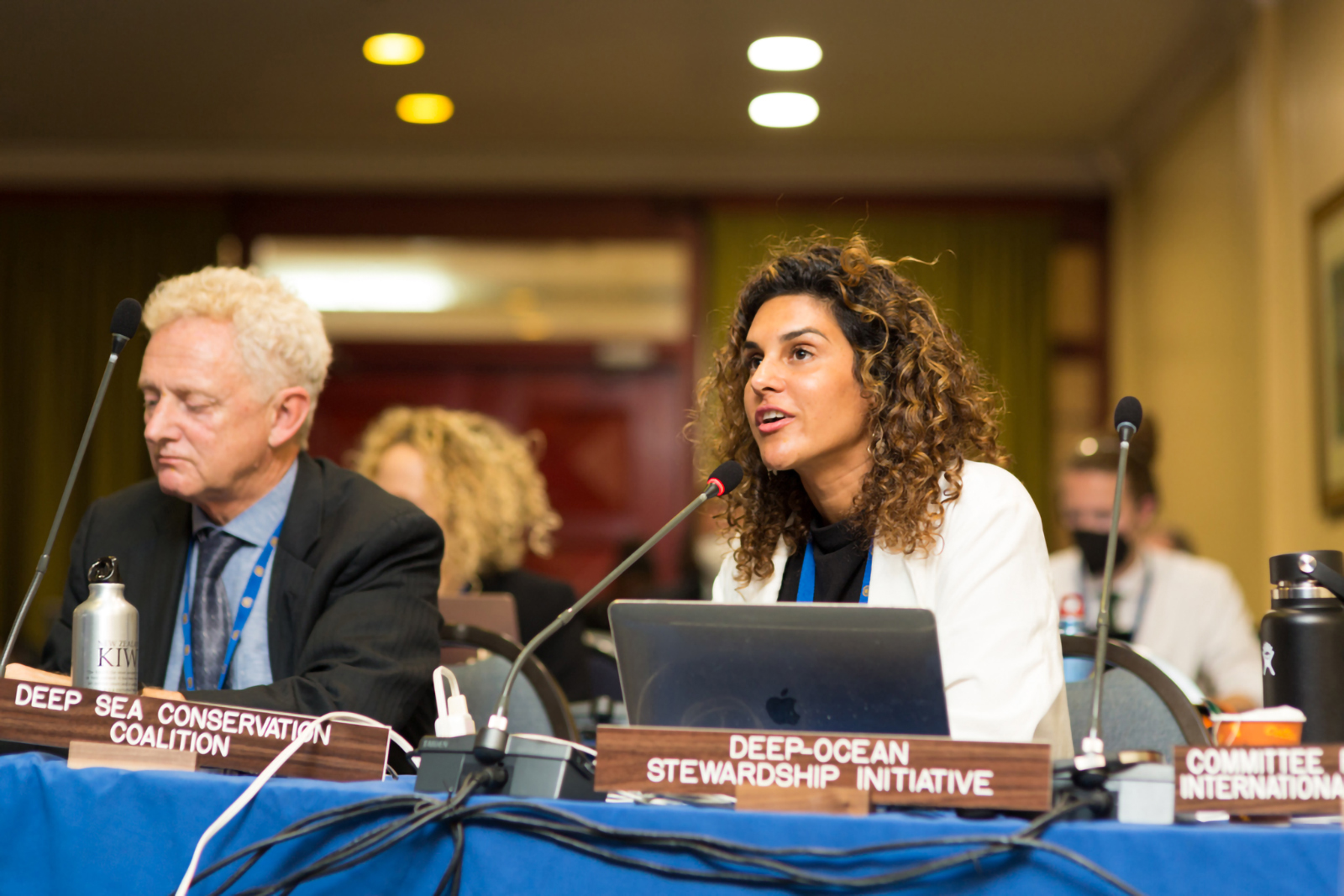
It is at these depths where thousands of species—the majority of which have yet to be identified or described—have specially adapted to live, she said.“From sharks that glow in the dark, to blind white crabs that farm bacteria on their chests that they eat, to corals that can live for millennia.”
Much of this life revolves around or depends upon the polymetallic nodules that mining companies plan to extract using massive industrial machinery.
“That process is going to destroy any biodiversity in the path of the vehicle because a lot of these animals can’t move,” Amon said.
Similar to a pearl, each of these nodules once began as a shark tooth or single piece of sediment that accrued layers of metals and minerals from the seawater “at a rate of just a few millimeters per million years,” the marine biologist said. These nodules litter parts of the seafloor in patches, like cobblestones on a street, she said.
Some of them are millions of years old, Amon said, and comprise a key part of the deep sea ecosystem–“a whole thriving community down there”–so colorful and diverse that it conjures images of a Dr. Seuss book.
Purple, yellow and white sea cucumbers. Brittle stars that resemble starfish but have long flexible arms. And corals, sponges and anemones that use the polymetallic nodules as anchors to hold still and thrive on a seabed of silt which when mined will be upturned and transformed into sediment plumes.
The plumes likely will form a sort of blinding “dust cloud” that will travel vertically and horizontally in the water far from the original mining sites, Amon said. The cloud may disorient and impair the vision of marine life that depend on sight to navigate or hunt for prey—or smother others.
“You can very safely say this mining would essentially lead to irreversible damage,” she said.
About This Story
Perhaps you noticed: This story, like all the news we publish, is free to read. That’s because Inside Climate News is a 501c3 nonprofit organization. We do not charge a subscription fee, lock our news behind a paywall, or clutter our website with ads. We make our news on climate and the environment freely available to you and anyone who wants it.
That’s not all. We also share our news for free with scores of other media organizations around the country. Many of them can’t afford to do environmental journalism of their own. We’ve built bureaus from coast to coast to report local stories, collaborate with local newsrooms and co-publish articles so that this vital work is shared as widely as possible.
Two of us launched ICN in 2007. Six years later we earned a Pulitzer Prize for National Reporting, and now we run the oldest and largest dedicated climate newsroom in the nation. We tell the story in all its complexity. We hold polluters accountable. We expose environmental injustice. We debunk misinformation. We scrutinize solutions and inspire action.
Donations from readers like you fund every aspect of what we do. If you don’t already, will you support our ongoing work, our reporting on the biggest crisis facing our planet, and help us reach even more readers in more places?
Please take a moment to make a tax-deductible donation. Every one of them makes a difference.
Thank you,

Teresa Tomassoni
Oceans Correspondent
Teresa Tomassoni is an environmental journalist covering the intersections between oceans, climate change, coastal communities and wildlife for Inside Climate News. Her previous work has appeared in The Washington Post, NPR, NBC Latino and the Smithsonian American Indian Magazine. Teresa holds a graduate degree in Journalism from the Craig Newmark Graduate School of Journalism. She is also a recipient of the Stone & Holt Weeks Social Justice Reporting Fellowship. In addition to reporting on oceans, Teresa teaches climate solutions reporting for The School of the New York Times.