Advertisement
Advertisement

Singapore

GE2025: Landslide victory for Singapore's ruling PAP in PM Wong's first electoral test - as it happened

"It is a clear signal of trust, stability and confidence in your government," Prime Minister Lawrence Wong said at a media conference.

GE2025: Landslide victory for Singapore's ruling PAP in PM Wong's first electoral test - as it happened
Clockwise from top left: PM Lawrence Wong takes questions from the media during a press conference at The Treasury; WP supporters at Serangoon Stadium cheer after hearing that the party won Aljunied GRC; PAP’s Desmond Lee and other candidatessee more
Read a summary of this article on FAST.
FAST

SINGAPORE: The ruling People's Action Party (PAP) has won a landslide victory in Prime Minister Lawrence Wong's first electoral test as leader of the government.

The party secured 65.57 per cent of the national vote, improving on its 2020 performance by 4 percentage points.

It won all battleground constituencies, including the single-seat ward of Jalan Kayu, putting labour chief Ng Chee Meng back in parliament. The PAP also took Punggol GRC, which is led by Deputy Prime Minister Gan Kim Yong, as well as West Coast-Jurong West GRC, which saw the closest fight in the last election.

The Workers' Party (WP) retained Aljunied GRC, Sengkang GRC and Hougang SMC. It would have an increased 12-seat presence in parliament, including two Non-constituency MP seats.

Thanking voters for their support, Mr Wong said he is "deeply humbled and grateful" for the results. "It is a clear signal of trust, stability and confidence in your government," he said at a media conference.

Catch up on our live coverage.

It’s a wrap!

After 12 hours of voting, countless cups of coffee, and a newsroom buzzing well into the wee hours of the morning, Singapore’s 2025 General Election has ended with a resounding victory for the People’s Action Party (PAP).

As the final results rolled in, it became clear that the ruling party had secured a commanding majority with a higher vote share compared with the election in 2020, delivering what Prime Minister Lawrence Wong called a “clear signal” of trust and confidence in his government.

This was his first electoral test as prime minister, and Mr Wong said he looks forward to the contributions of opposition members in parliament.

Opposition parties had hoped to chip away at the PAP’s parliamentary numbers, and while some races were closely fought, there were no breakthroughs.

As Singapore wakes up to a familiar leadership, we’ll be catching a few hours of sleep before diving right back into what comes next, including the thank you parades by the various parties - and the big question of who will be in the new Cabinet.

Until then, good night (or good morning) from all of us at the live blog.

This page was edited by Gladys Ow, Aaron Chew, Low Zoey, Michael Yong, Ng Hong Siang, Firdaus Hamzah, Rachel Lim, Daphne Yow and Chelsea Ong.
"Resounding victory and an authoritative mandate" for PAP: Analyst

In the first General Election under Mr Wong, the PAP won 87 of the 97 seats, increased its vote share, won hotly contested constituencies and extended its margin of victory in several areas.

Besides the WP, none of the nine other opposition parties contesting in the polls managed to secure a seat.

Singapore Management University law don Eugene Tan called the result a “resounding victory and an authoritative mandate” for the PAP.

“The transition to the 4G leadership is now complete as the latest generation of leaders has secured a mandate that the 3G team would be proud of,” he added.

National University of Singapore political scientist Chong Ja Ian described Singaporean voters as typically “risk-averse”.

“They like what is familiar … Whether that’s good or bad is a different story,” he said. “The WP is also a beneficiary of voters voting for what is familiar.”
WP to be the only opposition in parliament

The Workers' Party will be the only opposition party in parliament – holding on to its 10 seats in two GRCs and one SMC.

It failed to gain any inroads in new areas, but its winning margins increased in both Sengkang GRC and Hougang SMC from 2020. 

In its stronghold of Aljunied GRC, the party's vote share of 59.68 per cent was marginally smaller than the 59.93 per cent in 2020.

The party will also be offered two NCMP seats, having lost by the slimmest of margins in Jalan Kayu SMC and Tampines GRC. In the last parliament, the two NCMP seats were taken by PSP's Leong Mun Wai and Hazel Poa.

Party chief Pritam Singh declined to speak to the media after the results were announced, but each team of candidates took to the stage at Serangoon Stadium to thank supporters and volunteers.
Missed the action earlier? Here’s a quick recap of the best-performing constituencies for the PAP and WP:
SDP counts its losses

The Singapore Democratic Party will extend its nearly three-decade wait for a seat in parliament, after the party lost in all four constituencies that it contested.

Party chief Chee Soon Juan came closest, losing to PAP's Poh Li San in Sembawang West SMC after taking 46.81 per cent of the votes. 

It was the third-closest contest of the night after the Workers’ Party lost by the slimmest margins in Jalan Kayu SMC and Tampines GRC.

SDP chairman Paul Tambyah lost to PAP’s Liang Eng Hwa with 38.59 per cent of the votes in Bukit Panjang SMC – a rematch from 2020.

The party's teams in Sembawang GRC and Marsiling-Yew Tee GRC also gained less than 30 per cent of the votes in their respective constituencies.
US congratulates PAP on GE2025 victory

The United States congratulated Singapore on the General Election, as well as PM Lawrence Wong and the PAP on their victory. 

In a press statement, US Secretary of State Marco Rubio noted that the US and Singapore have shared a "strong and enduring strategic partnership" for nearly 60 years.

Both countries also share a commitment to a "secure, free and prosperous Indo-Pacific region", he added.

"We look forward to continuing to work closely with the newly elected government and Prime Minister Wong to strengthen economic growth and our bilateral defense and security ties, which benefit Americans, Singaporeans, and others across the region," Mr Rubio said.
Key points from PM Wong during PAP's press conference:

The PAP press conference wrapped up after about an hour. Here's a quick summary of Prime Minister Lawrence Wong's key messages. 

On the election outcome:
Mr Wong said he was "deeply humbled and grateful" for the results, and that the PAP will work even harder with this mandate to ensure concrete progress for Singapore.

He added that the election outcome will put Singapore in a better position to face a turbulent world.

"It's a clear signal of trust, stability and confidence in your government," said Mr Wong. "Singaporeans, too, can draw strength from this and look ahead to our future with confidence."

Working with the opposition:
"I respect the opposition presence in parliament - always taken suggestions and views seriously, and I will continue to do so," said Mr Wong.

He said he looks forward to the contributions of opposition members in parliament, which will comprise 12 members of the Workers' Party - 10 elected MPs and two NCMPs.

New Cabinet:
Mr Wong said his new Cabinet will be revealed "in good time". He added that labour chief Ng Chee Meng would "potentially have a role" in the line-up.

On negative politics:
Both the PAP and the opposition were able to discuss most of the issues calmly, said the prime minister when asked about "negative politics" during the GE campaign.

He pointed out that election campaigns would always have heated and robust debates, adding that he noticed negative personal attacks moderating after he raised the issue. 
Prime Minister Lawrence Wong takes questions from the media during a press conference at The Treasury on May 4, 2025. (Photo: CNA/Jeremy Long)
Prime Minister Lawrence Wong, Deputy Prime Minister Gan Kim Yong and other ministers leave after press conference at The Treasury in the early hours of May 4, 2025. (Photo: CNA/Raydza Rahman)
"If you take care of the residents, the residents will take care of the results": Chan Chun Sing

Education Minister Chan Chun Sing said the credit goes to the residents and the team.

His PAP team took Tanjong Pagar GRC with 81.03 per cent of the votes.

"Our focus is always on the residents. And we have said before, that if we take care of the residents, the residents will take care of the results, and that remains our belief and our focus."

He said the PAP team will be back in the constituency "first thing in the morning" and doing their rounds.
Chan Chun Sing taking questions from the media during a press conference in The Treasury on May 4, 2025. (Photo: CNA/Jeremy Long)
On "negative politics"

When asked about "negative politics" in this election, Mr Wong said both sides were able to discuss most of the issues calmly.

"In the election campaign, there will always be heat, very robust debates and throwing different views. 

"But generally speaking, I thought ... all parties were able to highlight the issues, and we had good discussions and debates on these issues, including an issue like cost of living, where the other political parties will have a different view."

As for the "specific instance of negative personal attacks" that he highlighted, he said he noticed the attacks "started moderating" after he brought it up.

"It was one particular instance, I highlighted it, and I think after that, the situation did improve.

"So overall, I'm not ... overly concerned about extrapolating one incident to a trend that may happen in future."
Lessons to be learnt in every election

Mr Wong said the PAP can learn from every election, regardless of whether it did well. 

The party will do its usual post-mortem of the results, in areas such as communications, as well as engaging young people and Singaporeans of different communities, he said.

It will also look into what it can do better in specific constituencies. 
Prime Minister Lawrence Wong taking questions from the media during a press conference in The Treasury on May 4, 2025. (Photo: CNA/Jeremy Long)
Serve all Singaporeans
 
“As the government, we will serve everyone,” Mr Wong said in response to a question about how the PAP plans to engage with Singaporeans who voted for the opposition. 
 
He said the PAP will reflect and learn from the results of GE2025, and also look at areas where both the party and the government can do better.

“We think that we can do more to engage Singaporeans … to connect better with Singaporeans, young and old, and we will strive to do so in the coming years.”
Source: CNA/ac/gs

Sign up for our newsletters

Get our pick of top stories and thought-provoking articles in your inbox

Subscribe here
Inbox
FAST
Advertisement

Singapore

GE2025: Important not to be 'boxed in' by electoral boundary changes, says Workers' Party chief Pritam Singh

The WP entrenched its positions in Aljunied GRC, Sengkang GRC and Hougang SMC in the General Election but failed to make new gains in other constituencies.
 

GE2025: Important not to be 'boxed in' by electoral boundary changes, says Workers' Party chief Pritam Singh

The Workers’ Party team at a media interview at Aljunied estate on May 4, 2025. (Photo: CNA/Syamil Sapari)

New: You can now listen to articles.

This audio is generated by an AI tool.

Read a summary of this article on FAST.
FAST

SINGAPORE: Workers’ Party (WP) leaders said on Sunday (May 4) that it was important for the opposition party “not to be boxed in” by electoral boundary changes, adding that the results of GE2025 may still bring opportunities for the party’s renewal plans.

WP secretary-general Pritam Singh, flanked by party chair Sylvia Lim and other Aljunied GRC candidates Gerald Giam, Fadli Fawzi and Kenneth Tiong, spoke to the media hours after the results for the General Election were announced.

Singapore's largest opposition party retained Aljunied GRC, Sengkang GRC and Hougang SMC – meaning that it will be the only opposition party in parliament, with 10 seats – but failed to make inroads in new areas.

It will also be offered two Non-Constituency MP seats, having lost by the slimmest of margins in Jalan Kayu SMC and Tampines GRC.

Responding to a question on whether the party could have fielded its strong candidates in one constituency, Mr Singh said: “On hindsight, everybody is a master, but I am actually very warmed by how the party responded to the EBRC (Electoral Boundaries Review Committee) report.

"I think it is important for the Workers’ Party not to be boxed in by the EBRC,” he said on the sidelines of a walkabout to thank the residents of Aljunied GRC.

“And if we have the capacity to break out and move into other areas and do well, do commendably – I think it speaks well of the party organisationally,” Mr Singh added, citing the party’s ability to pivot quickly from Marine Parade, where it had been walking the ground for years, to the newly carved out Punggol GRC.

“We saw what happened in Marine Parade and we decided not to walk into that ... So no matter what the EBRC does, we must be on our toes. And I think that has to be something that any political party worth its salt must keep in mind.”

He called on Singaporeans to make their views heard about changing electoral boundaries, noting that “nothing is more powerful than the people's voice”.

In the constituencies which the WP contested this year, Aljunied GRC and East Coast GRC and Tampines GRC had their boundaries redrawn; while Jalan Kayu SMC, Tampines Changkat SMC and Punggol GRC were newly formed.

Sengkang GRC and Hougang SMC were left untouched.

“WE’VE DONE VERY COMMENDABLY”

For GE2025, the WP's overall vote share dipped slightly to 50.04 per cent, from 50.5 per cent in the 2020 polls.

The ruling People's Action Party (PAP) meanwhile returned to power with 65.57 per cent of the popular vote, a commanding swing from 61.24 in the last elections.

“I suppose if you’ve about 5 per cent national swing ... I think we've done very commendably,” said Mr Singh.

He added he was “very proud” of the party’s results in Hougang SMC, Aljunied GRC and Sengkang GRC; and that the WP teams in other constituencies had fought hard and “did a very, very good job”. 

“They tried very hard for each vote, and I think they should be proud of themselves, and I'm very proud of them,” said Mr Singh.

Workers’ Party’s Pritam Singh exchanges handshake with supporters at Aljunied estate on May 4, 2025. (Photo: CNA/Syamil Sapari)

Asked again if the WP could have gained more ground if it had fielded a strong team with fewer newcomers, Mr Singh said he could understand the sentiment.

"But you see, if you put somebody else, then either you weaken another team, or you strengthen another team, and then your overall strategy is … not in equilibrium anymore,” he said.

In closely watched Jalan Kayu SMC, WP's electoral debutant Andre Low received 48.53 per cent of the vote, losing to labour chief Ng Chee Meng from the PAP.

Over at Tampines GRC, where there was a rare four-way race, WP achieved 47.37 per cent of the vote, coming in behind a PAP team led by Minister for Social and Family Development Masagos Zulkifli.

In Punggol GRC, WP’s star candidate Harpreet Singh and his team achieved 44.83 per cent of the vote, losing to the PAP’s team led by Deputy Prime Minister Gan Kim Yong.

Over at Tampines Changkat SMC, WP candidate Kenneth Foo lost to PAP's Desmond Choo with 43.83 per cent of the vote.

And a WP East Coast GRC team led by former NCMP Yee Jenn Jong got 41.24 per cent against a PAP slate helmed by Culture, Community and Youth Minister Edwin Tong.

“OPPORTUNITY” FOR PARTY RENEWAL

Asked if the results were a setback for the party’s renewal plans, Ms Lim said it was an “opportunity”.

“If you look at the 10 MPs that are elected, actually three of them have not been in parliament before,” she said, pointing to Aljunied GRC's Mr Fadli and Mr Tiong, as well as Sengkang GRC’s new face Abdul Muhaimin.

“So these are our up-and-coming young leaders that will now have a seat in parliament and demonstrate what they can do and what the party can do for our electorate and for Singaporeans in general,” she said.

She added that while the party has not yet decided on who will take up the two NCMP seats, this was “another opportunity for us to again bring in some new blood if the party should decide to do so”.

“Politics is a long road, and every milestone that you reach, there will always be something that you can make use of and help the party to grow further,” said Ms Lim.

Party chief Pritam Singh's assessment of a “difficult election" boiled down to two main factors: Singaporeans’ desire to give Prime Minister Lawrence Wong the mandate in his first election as leader of the country, and concerns about the international environment which “resonated with some voters”. 

The Workers’ Party team making the rounds in the Aljunied estate on a celebratory lorry on May 4, 2025. (Photo: CNA/Syamil Sapari)

Nevertheless, he reiterated WP's role as a “force for good”. 

“We did our best … the PAP is going to do everything it can to make sure that the tide of the opposition is halted, and it's our job to try and make sure that we can communicate our message to the public and inform them why it is in our self-interest to move towards a more balanced political system,” Mr Singh told reporters. 

On an ending note, he said the party was back to serving residents, with his own Meet-The-People session at Aljunied GRC starting on Monday. 

“Elections are now over, and we get back to the business of making this the best home for all of us,” he said, concluding the media interview to cheers from onlookers.

(Left to right) Workers’ Party’s Pritam Singh, Sylvia Lim, and Gerald Giam greeted by residents of the Aljunied estate on May 4, 2025. (Photo: CNA/Syamil Sapari)
Source: CNA/sk(jo)

Sign up for our newsletters

Get our pick of top stories and thought-provoking articles in your inbox

Subscribe here
Inbox
FAST
Advertisement

Singapore

GE2025: US congratulates PM Wong, PAP on election win

For nearly 60 years, the US and Singapore have shared a strong and enduring strategic partnership, says Secretary of State Marco Rubio.

GE2025: US congratulates PM Wong, PAP on election win

Prime Minister Lawrence Wong greeting residents at Yew Tee Square on May 4, 2025. (Photo: CNA/Ili Mansor)

New: You can now listen to articles.

This audio is generated by an AI tool.

Read a summary of this article on FAST.
FAST

SINGAPORE: The United States has congratulated Singapore Prime Minister Lawrence Wong and the ruling People's Action Party (PAP) on their landslide victory in the General Election on Saturday (May 3).

In a statement, US Secretary of State Marco Rubio said the Trump administration looked forward to working closely with the newly elected government.

"For nearly 60 years, the United States and Singapore have shared a strong and enduring strategic partnership and a commitment to a secure, free, and prosperous Indo-Pacific region," he added. 

"We look forward to continuing to work closely with the newly elected government and Prime Minister Wong to strengthen economic growth and our bilateral defense and security ties, which benefit Americans, Singaporeans, and others across the region."

In its first General Election under Mr Wong, the ruling PAP won 87 out of 97 seats, increased its vote share from 61.2 per cent to 65.57 per cent, won hotly contested wards and extended its margin of victory in most constituencies.

Deputy Prime Minister Gan Kim Yong chairs the Singapore Economic Resilience Taskforce, which is looking into the impact of US tariffs on the country.

US President Donald Trump on Apr 2 announced sweeping tariffs on all imports, with a baseline rate of 10 per cent on countries that include Singapore. Dozens of other trading partners, including China, were slapped with higher tariffs.

While there is now a 90-day pause on most of the hefty "reciprocal tariffs", the baseline 10 per cent duty still stands.

Mr Gan, who is also Minister for Trade and Industry, said on Apr 27 that he had spoken to US Commerce Secretary Howard Lutnick and both sides had discussed concessions on the global tariffs imposed by the Trump administration.

While Mr Lutnick explained during their call on Apr 25 that the 10 per cent baseline tariff is an umbrella one which is “not likely to be subject to negotiation”, Mr Gan said the US wants to explore “creative solutions” for some critical exports from Singapore, including pharmaceuticals.

Pharmaceutical exports, which contribute over 10 per cent of the country’s exports to the US, is something that is “very important” to Singapore, Mr Gan added.

Artificial intelligence chips was another area he discussed with Mr Lutnick.

"It's an area that we are very concerned about, and we want to make sure that our companies will continue to have access to this critical technology. It’s important for us in areas such as data centres," Mr Gan said then.

While the US is concerned about the export controls on such chips, not just in Singapore, Mr Gan also told Mr Lutnick about Singapore's export control system and how both countries have been working together on this front.

“We also do not condone companies taking advantage of their presence in Singapore to undermine export controls by other countries,” the deputy prime minister then said.

Source: CNA/sn

Sign up for our newsletters

Get our pick of top stories and thought-provoking articles in your inbox

Subscribe here
Inbox
Advertisement

Singapore

GE2025: Malaysia PM Anwar, Indonesia President Prabowo congratulate Prime Minister Wong on election victory

"We look forward to deepening this special relationship in the years ahead," says Malaysian Prime Minister Anwar Ibrahim.

GE2025: Malaysia PM Anwar, Indonesia President Prabowo congratulate Prime Minister Wong on election victory
Singapore Prime Minister Lawrence Wong and Malaysia Prime Minister Anwar Ibrahim at the Malaysia-Singapore Leaders' Retreat in Putrajaya. (File photo: CNA/Fadza Ishak)
New: You can now listen to articles.

This audio is generated by an AI tool.

Read a summary of this article on FAST.
FAST

SINGAPORE: Malaysian Prime Minister Anwar Ibrahim on Sunday (May 4) congratulated his Singapore counterpart Lawrence Wong on his election victory, as did Indonesia President Prabowo Subianto.

"Warmest congratulations to Prime Minister Lawrence Wong on leading the People’s Action Party (PAP) to victory in Singapore’s General Election," Mr Anwar said in a Facebook post, while hailing the "enduring ties" between both countries.  

The PAP returned to government in a stunning victory, winning 87 out of 97 seats - or almost 90 per cent of the seats - and staving off challenges from the opposition Workers’ Party (WP) without conceding any new ground to its rivals. 

The Malaysian leader also wished Mr Wong and his team "continued success as you carry forward the responsibilities of leadership in this new term".

Mr Anwar noted that the "prosperity and security" of Malaysia and Singapore are indivisible.

He said: "We are bound not only by geography, but by enduring ties of kith and kin. As we look to the future, our two countries are building a habit of deep collaboration at all levels – a vital foundation as we navigate profound challenges to global order and international trade."

He added that both countries together have the opportunity to make the Johor–Singapore Special Economic Zone a "shining example" of what neighbour countries can achieve, "with conviction and shared purpose".

"We look forward to deepening this special relationship in the years ahead," he said.

Mr Prabowo on Sunday said Mr Wong's decisive victory reflects the "trust and stability and confidence" of Singaporeans in his and the PAP's "strong leadership". 

"My heartfelt congratulations to the Honourable (Lawrence Wong) on the victory of The People’s Action Party (PAP) of Singapore," he wrote on X.

"I believe that the new government will continue its success to lead Singapore." 

Mr Prabowo also said he looked forward to continuing and strengthening Indonesia's partnership with Singapore under Mr Wong's leadership. 

Source: CNA/rj(sn)

Sign up for our newsletters

Get our pick of top stories and thought-provoking articles in your inbox

Subscribe here
Inbox
Advertisement

Singapore

GE2025: Singaporeans remain united in wanting the best future for the country, says President Tharman

He also noted Singapore had neither seen "a loss of trust in politics nor the sharp polarisation of views that engulfs many other countries".

GE2025: Singaporeans remain united in wanting the best future for the country, says President Tharman

A general view of the Parliament House in Singapore on Jun 2, 2016. (File photo: REUTERS/Edgar Su)

New: You can now listen to articles.

This audio is generated by an AI tool.

Read a summary of this article on FAST.
FAST

SINGAPORE: As the dust settles on the landslide victory for the People’s Action Party (PAP) in the General Election, President Tharman Shanmugaratnam on Sunday (May 4) morning said Singaporeans "remain united in wanting the best future for our country".

He said in a Facebook post that Singaporeans had neither seen "a loss of trust in politics nor the sharp polarisation of views that engulfs many other countries". Over the past week, Australia's Labour Party and Canada's Liberal Party - both left-leaning - triumphed in their respective elections that were shaped by inflation woes and Trump tariffs

"As emotions settle following the General Elections, one thing is clear. Singapore is the winner," Mr Tharman added.

In its first General Election under Prime Minister Lawrence Wong, the ruling PAP won 87 out of 97 seats, increased its vote share from 61.2 per cent to 65.57 per cent, won hotly contested wards and extended its margin of victory in most constituencies.

Mr Tharman congratulated Mr Wong, who is also the secretary-general of the PAP, following the win.

He said he had written to Mr Wong to congratulate him on the strong mandate for the PAP and to formally invite him to form the next government.

Mr Tharman added: "I commend all the parties and candidates for contesting the elections with full effort. Many were new faces in politics, but brought fresh ideas and talent.

"Credit also to all Singaporeans, for the calm and composure with which you followed the campaigns and made your choices."

Mr Tharman expressed his hope that the country's future would be "one that gives every Singaporean opportunity and dignity".

"A future that is staunchly multiracial. One where Singapore continues to be held in high regard internationally," he said. "And one that encourages those who care deeply, and think independently and creatively, to help expand what we are collectively capable of achieving. Our best years are still ahead of us."

He also urged PAP and Workers' Party (WP) MPs to debate "policies thoughtfully and respectfully" in the next parliament and find "common cause in building the most promising future for Singaporeans".

WP will be the only opposition party in parliament, having won 10 seats in total. It will also be offered two NCMP seats, having lost by the slimmest of margins in two constituencies – it garnered 48.53 per cent of votes in Jalan Kayu SMC and 47.37 per cent in Tampines GRC, which was a four-way race.

Source: CNA/sn(rj)

Sign up for our newsletters

Get our pick of top stories and thought-provoking articles in your inbox

Subscribe here
Inbox
Advertisement

Commentary

Snap Insight: GE2025 – early lessons for PAP and opposition parties alike

Singapore handed the ruling party a decisive victory, but it wasn’t just due to the “Trump effect”, says former Nominated Member of Parliament Nicholas Fang.

Snap Insight: GE2025 – early lessons for PAP and opposition parties alike

Prime Minister Lawrence Wong's, from People's Action Party (PAP) thanks his supporters and voters at an assembly area for People's Action Party supporters, on the day of the general election in Singapore, Saturday, May 3, 2025. (AP Photo/Vincent Thian)

New: You can now listen to articles.

This audio is generated by an AI tool.

Read a summary of this article on FAST.
FAST

SINGAPORE: Historically, an uncertain global environment might have boded well for the incumbent. But the result from Singapore’s last election in 2020, held amid the COVID-19 pandemic, seemed to suggest that the ruling People’s Action Party (PAP) was not viewed by all voters as the option for a theoretical “flight to safety”.

But on Saturday (May 3), the country delivered a strong endorsement of Prime Minister Lawrence Wong, in his first election test as PAP secretary general and as the leader of the fourth generation (4G) team.

With 65.57 per cent of the national vote, Mr Wong has bucked the trend: In Singapore’s history, each new prime minister contesting his first election has performed worse than the previous polls, by about 2 to 8 percentage points. In contrast, Mr Wong posted an improvement of more than 4 percentage points from 2020.

Mr Wong had asked voters for a strong mandate to enable him and his team to lead the country more effectively, especially given the global geopolitical turmoil and uncertainty in the face of two ongoing military conflicts and a burgeoning global trade war.

There are clear grounds to say that he has received it.

WHAT DROVE A STRONG PERFORMANCE

While there was some scepticism about whether the PAP could reverse the downward trend seen in the 2020 election, the situation facing Singaporeans is quite different today.

The COVID-19 pandemic and the measures deployed to address the crisis, including a circuit breaker, mask mandates and other restriction measures, as well as the intense uncertainty over the outbreak of a new and unknown virus, meant that some voters were unhappy over why an election had to be called under such conditions.

In contrast, the current tariff turmoil sparked by United States President Donald Trump has raised serious doubts about the possible impact on inflation and cost of living, a looming economic recession, and challenges in the job market. Potentially, this led more voters to shy away from any future turbulence in the form of political upheaval.

On its part, the PAP took some risks in the 11th-hour manoeuvrings of Nomination Day on Apr 23, notably Deputy Prime Minister Gan Kim Yong’s move to a different constituency, and ensuing warnings about potentially losing an experienced minister.

There was some concern this would backfire if voters felt like they were treated as political pawns. This issue was taken up by opposition parties during rallies and on social media, prompting a concerted response by the PAP, to shore up support for Mr Gan in Punggol against a slate of Workers’ Party newcomers.

However, the rhetoric online and in rally speeches seems to have been popular as entertainment, but was ultimately not sufficient in the polling booths. The gambit paid off, and it’s likely because the PAP narrative of experienced and stable leadership, coupled with a dedicated efforts to engage voters on the ground, still has broad appeal among Singaporeans.

At the same time, the leading opposition Workers’ Party (WP) deployed a relatively conservative strategy.

Despite a raft of qualified candidates who captured the public imagination, the WP was unable to build on its momentum and secure another constituency.

If more of its senior leadership, including secretary general and Leader of the Opposition Pritam Singh and party chair Sylvia Lim, had ventured out of its Aljunied stronghold and contested in other constituencies, the outcome may have been different.

MESSAGE FROM VOTERS

While it will take some time for the dust to fully settle around GE2025, there are some early signs of possible lessons for political parties looking to succeed in Singapore in the years ahead.

The call for more support for opposition to check the PAP seems to have lost its allure, other than in some WP-contested areas. This seems to suggest that the quality of the opposition opponent matters to voters, rather than just a generic desire for checks and balances.

As such, some soul-searching about how to build their brand and appeal among Singaporeans will be required if opposition parties are to improve on their performance going forward.

For the ruling party, the strong mandate for Mr Wong and his 4G team will be welcome as they seek to establish themselves and also address the broader geopolitical and domestic challenges facing Singapore and Singaporeans.

If the latest electoral contest is anything to go by, there will likely be increasing competition for the PAP in future polls. As the electorate and political environment continues to change and evolve, it will be imperative for all parties to do so as well.

Nicholas Fang is senior advisor for The Asia Group, and managing director of strategic consultancy Black Dot. He is a former nominated member of parliament.

Source: CNA/ch

Sign up for our newsletters

Get our pick of top stories and thought-provoking articles in your inbox

Subscribe here
Inbox
Advertisement

Singapore

GE2025: 'Clear and strong mandate' for PAP will put Singapore in better position to face turbulent world, says PM Wong

PM Lawrence Wong called the election results, where the People’s Action Party took 65.57 per cent of the national vote, a “clear signal of trust, stability and confidence in your government”.

GE2025: 'Clear and strong mandate' for PAP will put Singapore in better position to face turbulent world, says PM Wong

PM Lawrence Wong speaking to the media during a press conference in The Treasury on May 4, 2025. (Photo: CNA/Jeremy Long)

New: You can now listen to articles.

This audio is generated by an AI tool.

Read a summary of this article on FAST.
FAST

SINGAPORE: The strong showing by the People’s Action Party (PAP) at the polls gives the ruling party a “clear and strong mandate to govern”, said Prime Minister Lawrence Wong at a post-results press conference at The Treasury building around 3am on Sunday (May 4).

In a landslide victory, the PAP took 65.57 per cent of the national vote, improving on its 2020 performance by more than 4 percentage points. 

The ruling party won a total of 87 seats, with victories in 15 GRCs and 14 SMCs on election night, adding 82 seats to the five it picked up in its walkover win in Marine Parade-Braddell Heights GRC.

Addressing the media alongside a panel comprising mostly members of the PAP’s leadership, Mr Wong said he was “deeply humbled and grateful” by the results. It is Mr Wong’s first election as prime minister and as secretary-general of the PAP. 

“It's a clear signal of trust, stability and confidence in your government. Singaporeans, too, can draw strength from this and look ahead to our future with confidence,” said Mr Wong. 

He said that going into his first campaign as party leader, he just wanted to do his best together with the rest of his team, and that "in the end, Singaporeans will decide, and we will respect the decisions of Singaporean voters".

"Am I satisfied with the outcome of the elections? Yes, I am," said Mr Wong.

"We are very happy that Singaporeans have given us this mandate in this election. We don't take this support and trust for granted at all. And with the results, it motivates me, it motivates all of us in this team to work even harder to do our best for everyone in Singapore."

Noting that the election took place at a “critical time” for Singapore, Mr Wong echoed a campaign slogan of the “changed world” Singapore finds itself in amid an economic slowdown, fundamental shifts in the international order and the nation’s leadership transition.

“The results will put Singapore in a better position to face this turbulent world. Many are watching the elections closely, whether it's international media, investors or foreign governments, they will have taken note of tonight's results,” said Mr Wong.

“My team and I will use this mandate to serve with humility and responsibility. We will serve all Singaporeans, whether you voted for the PAP or you voted for another party, everyone matters. We will serve all of you.”

Senior Minister Lee Hsien Loong also highlighted the importance of a strong mandate for the PAP.

“This election took place at a crucial time – in the world, and in Singapore. It was vital that PM Lawrence Wong won a good mandate in this election, to show Singaporeans, and show the world, that he has the full support of a united nation. This election result achieves that,” he said in a Facebook post.

“The election showed that Singaporeans understood what was at stake. We knew it was crucial to come together to deal with the immense challenges ahead,” Mr Lee added.

“Important issues of race and religion also came up during this election. The results show clearly that Singaporeans accept and uphold the multiracial and multicultural values and norms which are so fundamental to our nation.”
PM Lawrence Wong speaking to the media during a press conference in The Treasury on May 4, 2025. (Photo: CNA/Jeremy Long)

KEY ISSUES IN THIS ELECTION

Mr Wong highlighted that an issue in this year’s election was the desire for more opposition members and alternative voices in parliament and that he respected these views. 

However, he addressed Singaporeans with these views and asked that these voters consider the merits of having “the perspective of having a good, strong team in government to work effectively for you”. 

Beyond engaging Singaproeans about the plans laid out in the PAP’s manifesto, Mr Wong said that more concrete plans would come in the coming years.

On other hot button issues of the cost of living and housing, Mr Wong said: “We have been working on these issues, and I assure you, we will redouble our efforts in the coming term to tackle these issues of concern.” 

He added that the PAP government’s “comprehensive approach” to address cost-of-living concerns had already been shared and is currently in motion. 

One particular priority in the near future would be to deal with economic uncertainty, which could cause people to “feel the squeeze even more”. 

“So we are focused not just on cost of living, but the broader economic situation, and looking at whether there's a need for additional measures. We are preparing drawer plans. We are prepared to activate them if the situation worsens,” said Mr Wong.  

PM Lawrence Wong walking into a press conference in The Treasury on May 4, 2025. (Photo: CNA/Raydza Rahman)

“TOUGH FIGHT” FROM OPPOSITION 

Mr Wong said that the opposition, in particular the Workers’ Party (WP), had fielded a strong slate of candidates, including many young people with a desire to contribute and serve. 

After giving the PAP a “tough fight”, the WP will now have 10 elected seats as well as two non-constituency MP (NCMP) seats, should they choose to accept them, said Mr Wong.

The Workers’ Party retained all its seats, winning in Aljunied GRC, Sengkang GRC and Hougang SMC, and was involved in the two closest contests of the night. 

The WP lost to the PAP in Jalan Kayu SMC by less than 3 percentage points, and in Tampines GRC by less than 5 percentage points, thus qualifying for the NCMP seats. 

“The opposition presence will increase, at least, from the Workers' Party point of view, from 10 to 12, and they will continue to have a good, strong presence there, and we will continue to have constructive and robust debates in Parliament,” said Mr Wong. 

Responding to a question from the media, Mr Wong said he looks forward to contributions from opposition members in parliament, given that parliament is where key national issues are discussed.

“On some issues, we may have to agree to disagree, but at the same time, we must, where critical national issues are concerned, uphold a shared responsibility to come together and to advance Singapore's interests together in this changed and turbulent world,” he added.

PM Lawrence Wong, DPM Gan Kim Yong and other ministers leaving after the press conference in The Treasury on May 4, 2025. (Photo: CNA/Raydza Rahman)

ON PAP’S APPROACH TO PUNGGOL GRC 

Responding to a question from the media on whether it was the right decision to field Deputy Prime Minister Gan Kim Yong in Punggol GRC, Mr Wong explained his considerations and said he believed it was the right decision to make.

Mr Gan’s surprise presence as anchor minister was a subject of much discussion during the hustings, as Mr Wong and Senior Minister Lee Hsien Loong had emphasised Mr Gan’s experience as one that could not be easily replaced should WP have won.

“Teo Chee Hean was stepping down in Punggol. It's a new GRC, and I needed someone to replace Chee Hean, who is a heavyweight, not only looking at Punggol, but looking at the wider area around Punggol.

“I think that also accords or says to Punggol residents that I’m taking them seriously, I’m not just putting in a new person to take over, but I am treating their needs seriously. They had a very senior person in charge. I'm looking for someone suitable to replace,” said Mr Wong. 

The decision to move Mr Gan to Punggol GRC led to subsequent decisions to field Dr Tan See Leng in Chua Chu Kang to fill Mr Gan’s gap, he added. 

“Chua Chu Kang no longer has a DPM, but if you look at the overall picture, there's a better distribution of leadership because, I'm in the West, I'm just next to Chua Chu Kang, SM Lee is in the centre, and then DPM Gan can be in the East.” 

(From left to right) Grace Fu, K Shanmugam, Desmond Lee, Gan Kim Yong, Lawrence Wong, Chan Chun Sing, Masagos Zulkifli, Ong Ye Kung, Chan Hui Yuh at a press conference in The Treasury on May 4, 2025. (Photo: CNA/Jeremy Long)

APPOINTING A NEW CABINET

Mr Wong said that one immediate task he has is to form the country's next Cabinet.

"I'm grateful that all my key members have been voted in, and Singaporeans have now given me a chance to put together the best team to serve you and to serve Singapore," he said.

He added that the new Cabinet line-up will be revealed "in due course", with a press conference followed by a swearing-in ceremony.

Even before the new Cabinet is appointed, the ministers have already been continuing with their existing portfolios since Parliament was dissolved, said Mr Wong.

"Before the campaign, during the campaign, the work has been continuing. Even now, the work of government is continuing," he said.

With gaps from the retirement of four Cabinet ministers - Mr Teo Chee Hean, Dr Ng Eng Hen, Mr Heng Swee Keat and Dr Maliki Osman - Mr Wong said that he will have to look at the individuals on his team, and "see how best to assign them to the right responsibilities based on their strengths, based on their contributions", so that there can be a "good, solid team that can work together, complement each other based on different skill sets, and work effectively for Singapore".

Mr Wong added that NTUC secretary-general Ng Chee Meng will potentially have a role in his next Cabinet, based on the roles of the nation's labour chiefs in previous Cabinet line-ups.

NEGATIVE POLITICS IN SINGAPORE

Mr Wong said that in this election's campaign, political parties were generally "able to discuss most of the issues calmly".

"Yes, in the election campaign, there will always be heat, very robust debates, doing and throwing different views. But generally speaking, I thought all parties were able to highlight the issues and there was good discussion and debates on these issues, including an issue like cost of living, where the other political parties will have a different view," he said.

"They will say it's the government's fault. But we have a different view. We explain our views. And I think Singaporeans were able to listen to both sides and consider for themselves what they think is the right perspective. And I think that's good."

Mr Wong said that for the specific instance of the negative personal attacks which he highlighted during the campaign, the WP later said "it was not negative attacks, but hard questions".

"But I do notice that the negative personal attacks started moderating too. So it was one particular instance, I highlighted it, and I think after that, the situation did improve," Mr Wong said.

The prime minister also said he was not "overly concerned about extrapolating one incident or one instance to a trend that may happen in future", adding that the same would apply to the issue over the mixing of race and religion into politics.

"It's a concern. I highlighted it. The situation did improve as well. Will it get worse in future? I don't know. But these are instances where, if there are areas where we think it goes beyond a certain line and goes beyond what we think is appropriate, I think it's right for us to highlight it, to call it out, and we hope Singaporeans will support what we say. 

"And I think in both instances, whether it's on the negative personal attacks as well as on race and religion, I would say by and large, Singaporeans do support."

In response to a question from CNA on what the PAP can learn from an election in which it performed well, Mr Wong added that in every election, there will be areas where the party can reflect and find opportunities to do better, whether it had done well in the contest or not.  

"There will always be areas for improvement. So we will reflect, we will do our usual post-mortem. We do it after every election, whether it's in the area of communication, whether it's in the area of social media, engaging young people and engaging different communities," he said.

"In a specific constituency that we may not have done as well in, are there lessons for us? So I'm sure there will be. That's the attitude we take. It doesn't mean that we only learn from an election where the outcome wasn't good."

Source: CNA/ny/gr

Sign up for our newsletters

Get our pick of top stories and thought-provoking articles in your inbox

Subscribe here
Inbox
Advertisement

Singapore

GE2025: PAP wins four-way fight in Tampines GRC, WP to get one NCMP seat

The teams from National Solidarity Party and People’s Power Party, with their low vote share, will lose their election deposits.

GE2025: PAP wins four-way fight in Tampines GRC, WP to get one NCMP seat

The People's Action Party's team won Tampines Group Representation Constituency at the General Election on May 4, 2025. From left: Mr David Neo, Mr Baey Yam Keng, Mr Masagos Zulkifli, Dr Koh Poh Koon and Ms Charlene Chen. (Photo: CNA/Raydza Rahman)

New: You can now listen to articles.

This audio is generated by an AI tool.

Read a summary of this article on FAST.
FAST

SINGAPORE: The People’s Action Party (PAP) has emerged as the winner in a four-way fight for Tampines Group Representation Constituency (GRC), getting 52.02 per cent of the vote in Singapore’s General Election on Saturday (May 3).

A PAP team led by Social and Family Development Minister Masagos Zulkifli defeated teams from the Workers’ Party (WP), National Solidarity Party (NSP) and People’s Power Party (PPP).

PAP’s victory this year was significantly lower than its winning margin in 2020, when it defeated a team from NSP with about 66.4 per cent of the vote.

This round, it was the WP team led by former Aljunied GRC Member of Parliament (MP) Muhamad Faisal Abdul Manap that chipped away at the incumbent’s vote share, with the opposition party winning 47.37 per cent of the vote share in its first outing in the constituency.

The contesting teams from NSP, which had 0.18 per cent of the vote, and PPP with 0.43 per cent, both lost their election deposits. 

A Non-Constituency MP (NCMP) seat will also be offered to a member of the WP’s team, given its narrow loss to PAP.

In his speech after the results were announced, Mr Masagos thanked the party’s voters and volunteers and called for unity moving ahead.

“Now that the General Election is over, let's come together as one united people,” he said.

“Let's work together to make Tampines a caring community, because this is how we forge ahead as we face critical challenges and embrace opportunities that are before us.”

Separately, the WP team thanked its supporters during its speech, while party member Michael Thng dedicated special thanks to Mr Faisal.

“For taking the brave step to come forward and join our team and take the risk with us and put yourself out there for Tampines, for that we will be eternally grateful and we really thank you, Faisal,” Mr Thng said.

From left: The Workers' Party's candidates Ong Lue Peng, Eileen Chong, Faisal Abdul Manap, Michael Thng and Jimmy Tan on stage at the Serangoon Stadium on May 4, 2025, after the result was out for Tampines Group Representation Constituency. (Photo: CNA/Wallace Woon)

SPOTLIGHT ON RELIGION AND POLITICS

Tampines GRC was the most contested constituency out of the 33 in this General Election.

NSP, which contested the GRC at the last three elections, won almost 34 per cent of vote in 2020. 

For its fourth attempt this year, it fielded a team comprising party president Reno Fong and vice-president Mohd Ridzwan Mohammad, who both contested in the GRC in 2020 along with three other members.

PPP and WP are contesting the constituency for the first time this year, with political observers noting that for WP, which is Singapore’s largest opposition party, entering the fray in Tampines is part of its strategy to concentrate efforts in the eastern region.

During the hustings, a spotlight was cast on Tampines GRC after the authorities directed Meta, the parent company of Facebook and Instagram, to block Singapore users’ access to several instances of online election advertising for posts on Facebook by two Malaysian politicians and a former Internal Security Act detainee who is now a citizen of Australia. 

Among other things, they criticised the Singapore government's handling of sensitive religious issues and urged Singaporeans to vote along religious lines. 

Malaysia-based Singaporean religious teacher Noor Deros also took to social media to criticise Mr Masagos while calling on voters to cast their ballots for Mr Faisal, while claiming to have met the WP’s Malay candidates to convey a list of demands in exchange for support at the polls.

When asked by the media about this during campaigning, Mr Faisal insisted that the contest for Tampines GRC was about "a team versus another team" and that he did not see himself as “going against Masagos”.

Mr Faisal also said then that he was open to meeting “everyone for the sake of listening”, but that listening did not mean agreeing.

Before that, Prime Minister Lawrence Wong said that foreigners urging Singaporeans to vote along religious lines have "crossed the line" and that Singaporeans alone should decide on Singapore politics.

Several opposition parties, including WP, followed suit in speaking out against foreign interference in the General Election.

During a visit to Tampines GRC, Senior Minister Lee Hsien Loong cautioned against the “very vicious” set of conversations sparked by the foreign posts and asked Singaporeans to “understand the games being played online”.

The fight for Tampines GRC was enough for Prime Minister Lawrence Wong to do a walkabout there during the election campaign. Asked what his visit signalled at the time, he said it showed that PAP took the election seriously, both at the national and constituency levels.

Tampines GRC saw its electoral boundaries changed this year. Parts of the GRC were carved out to create Tampines Changkat Single Member Constituency, while areas in Tampines West – east of Bedok Reservoir – were absorbed from Aljunied GRC.

WP "BRANDING" CONTRIBUTED TO STRONG SHOWING

Political analyst and former nominated MP Eugene Tan pointed to three factors that contributed to WP’s relatively strong showing at Tampines GRC: “The party branding, a relatively strong slate and a controversy stirred voters.”
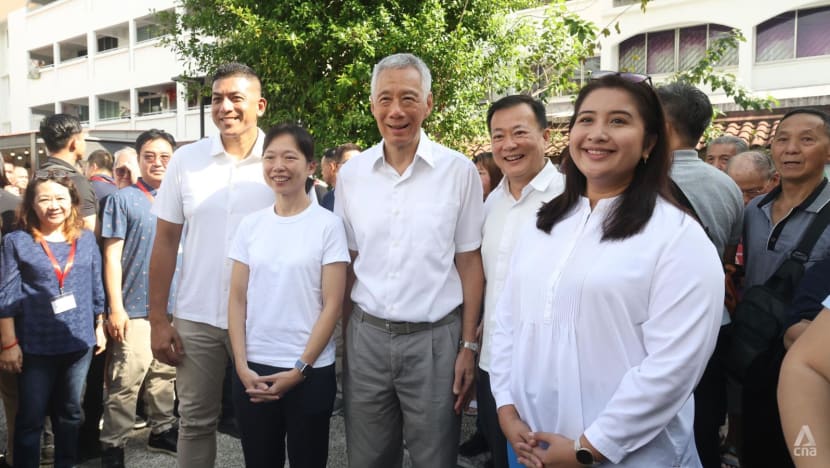
The associate professor of law at Singapore Management University said that Tampines GRC was a “battleground constituency” given the racial make-up of the constituents there, as well as the face-off between Mr Masagos and Mr Faisal as “they had previously clashed in parliament over Malay-Muslim community issues”.

During PAP’s press conference after the election results were announced, Mr Wong, who is also the party’s secretary-general, acknowledged the occurrence of "negative politics" in terms of calls to vote along racial or religious lines during the campaigning period.

“I had to call it out in the middle of the campaign, because this was such an important matter.

"The situation did improve after that, but there were still views, comments online and some of them were quite vicious. And they would continue to circulate, although less than before the press conference I held,” he said. 

Asked about his assessment of the support that PAP received from the Malay-Muslim community against this backdrop, Mr Wong said: “At this stage, we haven't done deep dives or detailed analysis on which groups, which segments, voted or didn't vote for us, and what were the considerations.

"Did it have an impact on the election outcomes? Perhaps, some. How much? I don't know, because we'll have to do a more detailed analysis after today.”

Mr Masagos, speaking in Malay, said at the press conference that he would take a new approach moving forward, to reach out to the Malay-Muslim community in order to better understand their concerns and ensure that the issues they raise would be addressed.

“But I also urge the community, after the end of this General Election, let us unite and build our community together, because there’s so much that we can achieve together.”

On the other opposition parties’ performance in Tampines GRC, Assoc Prof Tan from SMU told CNA that it shows how voters are discerning and will not split their votes if they intend to vote for the opposition.

“It also indicates that some opposition parties are increasingly irrelevant in the political landscape with both PPP and NSP losing their deposits,” he added.

On the NCMP seat to be given to one of WP’s Tampines GRC team members, independent political observer Felix Tan commented that it would likely go to Mr Thng, pointing to his performance during a televised roundtable discussion and his ability to put across his party’s policies to the audience.

“But of course, the policies come from the party itself, not just from him, but I think he's able to consolidate and collate the thoughts more coherently and ... able to present them to the voters, to Singaporeans as well," Dr Felix Tan said during a Polling Day special programme broadcast on CNA.

"And I think he would perform pretty well in parliament as an NCMP.”

Over at PAP’s Tampines GRC team, former Chief of Army David Neo was earlier pointed out by Prime Minister Lawrence Wong as a candidate with the potential to hold political office.

Asked on the CNA programme about whether this would have mattered to voters, Dr Mustafa Izzuddin, a senior international affairs analyst with policy and business consultancy Solaris Strategies Singapore, said that although “the prime minister can send such a message”, what contributes to the voters’ decision is the candidate’s own performance on the ground.

Source: CNA/tq(sf)

Sign up for our newsletters

Get our pick of top stories and thought-provoking articles in your inbox

Subscribe here
Inbox
Advertisement

Singapore

GE2025: Stunning victory for PAP, winning 87 of 97 seats with higher national vote share in PM Wong's first electoral test

In leading the PAP to 65.57 per cent of the popular vote, up from 61.24 per cent in GE2020, PM Wong bucked a trend of dips in the ruling party's vote share after a new prime minister takes office. 

Prime Minister Lawrence Wong celebrates at the PAP's gathering centre on May 4, 2025. (Photo: AFP/Roslan Rahman)

New: You can now listen to articles.

This audio is generated by an AI tool.

Read a summary of this article on FAST.
FAST

SINGAPORE: In an election held amid global economic uncertainties, the People’s Action Party (PAP) returned to government in a stunning victory, winning 87 out of 97 seats - or almost 90 per cent of the seats - and staving off challenges from the Workers’ Party (WP) without conceding any new ground to its rivals. 

Against the backdrop of party renewal and leadership transition, Singaporeans at the ballot box on Saturday (May 3) chose political stability and economic safety over the opposition’s calls for greater checks and balances.

In all, 65.57 per cent of the 2,386,452 valid votes cast went to the PAP – up from 61.24 per cent in the 2020 General Election - in what was Prime Minister Lawrence Wong's first electoral test leading the ruling party.  

In leading the PAP to an increased vote share, Mr Wong bucked a trend: Previous GEs in 1991 and 2006 saw dips in the PAP's vote share after a new prime minister took office. 

The ruling party also garnered over 75 per cent of the vote in 10 constituencies. The best performing PAP constituency was Queenstown Single Member Constituency (SMC), where Mr Eric Chua won 81.12 per cent of the votes. 

The last result - for Tampines GRC - of the elections was announced close to six hours after the polls closed - at nearly 2am on Sunday.  Speaking at the PAP’s post-election press conference held about an hour later, Mr Wong said that Singaporeans have given the party “a clear and strong mandate to govern”.

Reiterating that the bigger contest is not between political parties but between Singapore and the challenges it faces, Mr Wong noted that the election took place at a critical time for Singapore, as the world faces an economic slowdown as well as fundamental shifts in the international order.

“The results will put Singapore in a better position to face this turbulent world ... It's a clear signal of trust, stability and confidence in your government,” said Mr Wong. "Singaporeans, too, can draw strength from this and look ahead to our future with confidence."

He added that he was "deeply humbled and grateful" for the results, and that the PAP will work even harder with this mandate to ensure concrete progress for Singapore.

Senior Minister Lee Hsien Loong, who handed over power to Mr Wong in August last year, said on Facebook that he was "very happy and relieved with the results of GE2025". 

"This election took place at a crucial time – in the world, and in Singapore. It was vital that PM Lawrence Wong won a good mandate in this election, to show Singaporeans, and show the world, that he has the full support of a united nation. This election result achieves that," he said. 

The 4.33 percentage point swing towards the PAP meant that WP’s much vaunted push in eastern Singapore – Punggol, Tampines and East Coast Group Representation Constituencies (GRCs), as well as the single-member wards of Tampines Changkat and Jalan Kayu – failed to translate to seats.

In the four-member Tampines GRC, where WP fielded its party vice-chair Faisal Manap against PAP’s Social and Family Development Minister Masagos Zulkifli, the PAP came up on top, securing 52.02 per cent of votes.

In the hot seat of Jalan Kayu SMC, where former PAP Cabinet minister and labour chief Ng Chee Meng was pitted against WP new face Andre Low, it was ultimately Mr Ng who triumphed with 51.47 per cent of votes.

Over at Punggol GRC, where WP had focused its attacks on the PAP’s last-minute move to field Deputy Prime Minister Gan Kim Yong there, the opposition party's team led by senior counsel Harpreet Singh only managed to garner 44.83 per cent of the votes.  

PAP’s Desmond Lee and other candidates of West Coast-Jurong West GRC thanking their supporters at Bukit Gombak Stadium on May 4, 2025. (Photo: CNA/Mak Jia Kee)

PAP STAVES OFF WP CHALLENGE 

Nevertheless, WP managed to retain its 10 parliamentary seats from Aljunied and Sengkang GRCs, as well as its stronghold of Hougang SMC. While it failed to make further inroads, WP was able to either match or improve its margins of victory in these three constituencies.

The opposition party will also be offered two Non-Constituency Member of Parliament (NCMP) seats. Under the NCMP scheme, if there are fewer than 12 opposition MPs elected, the best-performing losing opposition candidates are offered NCMP seats to make up the shortfall.

The two NCMP seats will be offered to WP's Jalan Kayu SMC candidate Andre Low and a member of WP's Tampines GRC team. 

This would grow the WP’s overall parliamentary presence to 12 seats – the largest in its history – should the party accept the NCMP roles. 

For the constituencies it contested in, WP garnered a vote share of 50.04 per cent, a slight 0.45 percentage point drop from the previous election. 

The WP team for Aljunied GRC (left to right) Kenneth Tiong, Fadli Fawzi, Pritam Singh, Gerald Giam and Sylvia Lim give their victory speech at Serangoon Stadium on May 4, 2025. (Photo: CNA/Wallace Woon)

At WP’s assembly point at Serangoon Stadium, WP chief Pritam Singh thanked supporters for helping to achieve a more balanced parliament and urged them to continue the work. “It was always going to be a difficult election. The slate is wiped clean, we start work again tomorrow, and we go again,” Mr Singh said.

Progress Singapore Party’s Leong Mun Wai speaking to the media outside PSP’s headquarters on May 3, 2025. (Photo: CNA/Marcus Mark Ramos)

HOW OTHER OPPOSITION PARTIES FARED 

It was a dismal night for the Progress Singapore Party (PSP) as the election results streamed in – the party lost in all of its contests and also its two NCMP seats from the previous polls.

In West Coast-Jurong West GRC, the party fielded a team of heavyweights consisting of founder Tan Cheng Bock, party chief Leong Mun Wai and vice-chair Hazel Poa, but the result ultimately went in the favour of the PAP team led by National Development Minister Desmond Lee, which got 60.01 per cent against PSP’s 39.99 per cent.

PSP’s other attempts in Chua Chu Kang GRC and the single-member wards of Bukit Gombak, Kebun Baru, Marymount and Pioneer performed worse, garnering less than 35 per cent of the vote in these wards.

Speaking to reporters outside PSP’s headquarters in Bukit Timah Shopping Centre, Mr Leong thanked voters who had supported the party and accepted the results.

“The results are very shocking to us, but the people have spoken,” he said, adding that the party will study the results "seriously and humbly" and reconsider how it can gain further trust from Singaporeans.

“We need to regroup ourselves so that we can fight another day.” 

The Singapore Democratic Party, which embarked on a “northern strategy” by contesting Sembawang GRC and Sembawang West SMC, did not yield the results that party chief Chee Soon Juan had hoped for.

“Obviously, it’s really upsetting,” Dr Chee told reporters. “Across the board, with what happened in Bukit Panjang and our constituencies and the rest of the opposition as well, it’s quite a surprise.”

With WP winning 10 seats, Dr Chee was on track to be offered one of the NCMP seats - in what would have been his first entry into parliament after 33 years of politics - until the last result for Tampines GRC was announced at close to 2am. 

For Dr Chee, the 46.81 per cent he got in Sembawang West SMC against PAP’s Poh Li San would not qualify him for an NCMP seat as the WP performed better in Tampines GRC (47.37 per cent) and Jalan Kayu SMC (48.53 per cent).

SDP chair Paul Tambyah also lost his contest in Bukit Panjang SMC, with 38.59 per cent of the vote against PAP stalwart Liang Eng Hwa.

The May 3 poll returned the PAP to power with a super majority. Not all seats were contested, with the five-member Marine Parade-Braddell Heights GRC being declared a walkover on Nomination Day. 

A total of 2,429,281 votes, including rejected votes, were cast in the country’s 14th election since independence. 

This made up 92.47 per cent of the 2,627,026 registered electors in all contested divisions – a record low voter turnout. The previous record was in the 2011 General Election, in which 93.06 per cent of voters turned up to cast their ballot.

SDP’s Chee Soon Juan arrives at MOE (Evans) Stadium on May 4, 2025. (Photo: CNA/Lauren Chian)
Source: CNA/js

Sign up for our newsletters

Get our pick of top stories and thought-provoking articles in your inbox

Subscribe here
Inbox
Advertisement

Singapore

GE2025: Red Dot United says election results encouraging despite losses, vows to return in 5 years

“I think the politics of Red Dot United is acceptable to the people of Singapore, and that is what we will continue to push in the next five years,” party chief Ravi Philemon said.

RDU secretary-general Ravi Philemon speaking to the media outside Yishun Town Secondary School after sample count results were released on May 3, 2025. (Photo: CNA/Clemens Choy)

New: You can now listen to articles.

This audio is generated by an AI tool.

Read a summary of this article on FAST.
FAST

SINGAPORE: The swing in votes towards the ruling People’s Action Party (PAP) this General Election was not a surprise, but the results were encouraging for Red Dot United (RDU), party secretary-general Ravi Philemon said.

Speaking to reporters in the early hours of Sunday (May 4) near RDU’s office in Ubi Crescent, he said the world is in a time of turmoil, and it is reasonable for voters to look for a “safe harbour” in these times.

“I think in this GE, the people have spoken,” he said. 

“The PAP has been the government for the past 60 years, and it is understandable why the people have given the PAP the kind of mandate that they have.”

Mr Philemon congratulated Prime Minister Lawrence Wong, describing the win as a “heavy responsibility”.

“I hope he keeps the trust of the people. Red Dot United will keep our prime minister on his toes in the next five years, that is for sure,” he said.

While RDU did not get the mandate in any of the constituencies it contested, the results were “very, very encouraging”, he added. 

HOW DID RED DOT UNITED DO?

RDU fielded 15 candidates across three Group Representation Constituencies (GRC) and one Single Member Constituency (SMC). Nine of its candidates stood for election for the first time. 

The party’s Nee Soon team performed best, receiving 26.19 per cent of the vote in the GRC. In Jurong East-Bukit Batok GRC, the RDU team finished with 23.34 per cent of the vote.

Its candidates in Holland-Bukit Timah GRC obtained 20.71 per cent of the vote, while Ms Kala Manickam got 19.49 per cent in Jurong Central SMC.

“I think the politics of Red Dot United is acceptable to the people of Singapore, and that is what we will continue to push in the next five years,” Mr Philemon said.

“A politics that is based on values, a politics that's very, very little based on personalities, a politics that is always for the people of Singapore.”

Mr Philemon said the "ground was uneven" for RDU from the beginning of the electoral race, but the results were an achievement. 

"We were competing in a very unfair, in a very disadvantaged environment," he said.   

"Considering the odds that were against us ... the global events that were working against us ... the fact that some of the voters had very little time to get to know us, I think Red Dot United did very well in GE2025."

RDU WILL CONTINUE ENGAGEMENT 

Pointing to Singapore Democratic Party (SDP) chief Chee Soon Juan’s more than three decades of political experience, Mr Philemon said opposition politics is a marathon and not a sprint. 

RDU will be “more than ready” when the next election comes around, and is prepared to run this marathon, he said. 

Mr Philemon was part of the party’s Nee Soon GRC line-up. He said his team will remain engaged with residents in the five-member constituency even after the election.

“For Red Dot United, it is always about the people, and we will continue to stay engaged, all five of us,” he told reporters earlier on Saturday outside Yishun Town Secondary School, where he was observing the vote count. 

“That is the promise that we give to the voters in Nee Soon GRC ... and you will see us again in the next five years. That's for certain.”

RDU’s Syed Alwi Ahmad, David Foo, Ravi Philemon, Sharon Lin and Pang Heng Chuan outside Yishun Town Secondary School after sample count results were released on May 3, 2025. (Photo: CNA/Clemens Choy) (edited)

RDU received 44 per cent of the votes at one of the polling stations, he said.

He added the message he received from voters is that they want RDU to be a “force to be reckoned with” in Singapore’s political scene. 

“That’s what we’ll try our best to do and to be.” 

He also noted that RDU only started walking the ground in Nee Soon last August, whereas Law and Home Affairs Minister K Shanmugam has served in the GRC for more than 30 years.

“Mr Shanmugam is an indomitable opponent. He is banking on his 40 years of incumbency … and that should never be taken lightly,” said Mr Philemon. 

"ONLY THE BEGINNING"

The party’s other candidates also took turns to speak to the media. They said they were committed to continuing their work and walking the ground in the various constituencies, and highlighted the support they were able to garner despite the short campaigning period.

In particular, the candidates for Holland-Bukit Timah noted that their team was only formed about two weeks ago after SDP said it was unlikely to contest the GRC.

Ms Manickam also noted that she was initially going to stand for election in Jalan Kayu SMC.

RDU said it did not regret stepping away from Jalan Kayu or contesting Holland-Bukit Timah GRC. 

“I think it was the right decision,” said Mr Philemon, adding it would have been challenging for the party to field candidates in Tanjong Pagar GRC and Radin Mas SMC, which was its original plan. 

“We could have still perhaps pulled it off as well, but it could have been a stretch,” he said, pointing out that RDU is a “fairly new” party.

RDU was formed in May 2020, months before the General Election that year. It contested Jurong GRC against a PAP team led by then-Senior Minister Tharman Shanmugaratnam and garnered 25.39 per cent of votes that year.

GE2025 is the party's second election.

"This is only the beginning. The people have not given us their mandate. We will continue to punch above our weight," said Mr Philemon, adding that the party will continue to make sacrifices for Singapore.

Source: CNA/an

Sign up for our newsletters

Get our pick of top stories and thought-provoking articles in your inbox

Subscribe here
Inbox
Advertisement

Singapore

GE2025: Analysis - how the PAP scored a landslide win and why the opposition failed to make inroads

Political analysts are divided on whether the main opposition Workers’ Party had any positive takeaways from its electoral results.

Prime Minister Lawrence Wong taking questions from the media during a press conference at The Treasury on May 4, 2025. (Photo: CNA/Jeremy Long)

New: You can now listen to articles.

This audio is generated by an AI tool.

Read a summary of this article on FAST.
FAST

SINGAPORE: Singapore’s ruling People’s Action Party on Saturday (May 3) swept to the strong mandate that Prime Minister Lawrence Wong had called for, by outstrategising the opposition - particularly its main rivals the Workers’ Party - as well as by banking on voters appearing to opt for continuity and stability over greater checks and scrutiny, analysts said.

In its first General Election under Mr Wong, the PAP won 87 out of 97 seats, increased its vote share from 61.2 per cent to 65.57 per cent, won hotly contested wards and extended its margin of victory in most constituencies.

The WP meanwhile held on to its wards of Hougang, Aljunied and Sengkang; and came close enough in Jalan Kayu SMC and Tampines GRC to be offered two “best loser” Non-Constituency MP seats. 

None of the nine other opposition parties contesting in the polls managed to secure a seat.

“It is a great mandate for the PAP,” said the party’s former MP Inderjit Singh. “Given the many issues Singaporeans faced and yet the PAP had such a big turnaround from GE2020 is a feather in the cap of PM Wong.”

Singapore Management University law don Eugene Tan called the GE2025 result a “resounding victory and an authoritative mandate” for the PAP.

“The transition to the 4G leadership is now complete as the latest generation of leaders has secured a mandate that the 3G team would be proud of,” he added.

Associate Professor Tan noted that Mr Wong had bucked the trend of new Prime Ministers overseeing a drop in the PAP’s vote share during the leadership transition.

“It is also significant that PM Wong continues a trend of the PAP not allowing the opposition to make gains in two consecutive elections,” he said.

Experts also cited the PAP’s strategy of warning of the consequences of losing both present and future ministers, as a contributing factor - and a sign of voters choosing safety and security as trade-reliant Singapore navigates a period of global unease and economic turbulence.

Mr Wong had argued during the hustings that voting in more opposition candidates into parliament could mean losing potential officeholders and weakening the PAP government.

It led to a back-and-forth with WP leaders, which Institute of Policy Studies (IPS) research fellow Teo Kay Key said “had an effect in the PAP’s favour”.

“There seems to be a consolidation around status quo in this election, perhaps to try to ensure that the country has a tried-and-tested team leading us into these uncertain times,” she added.

National University of Singapore (NUS) political scientist Chong Ja Ian described Singaporean voters as typically “risk-averse”.

“They like what is familiar … Whether that’s good or bad is a different story,” he said. “The WP is also a beneficiary of voters voting for what is familiar.”

A “GOOD” SHOWING FOR WP, OR “SLOW PROGRESS”?

For the constituencies it contested in, WP garnered a vote share of 50.04 per cent, a slight 0.45 percentage point drop from the previous election. 

While it failed to make further inroads, WP was able to either match or improve its margins of victory in its three constituencies. Should the party accept the NCMP roles, its overall parliamentary presence to 12 seats will be the largest in its history. 

Political observers CNA spoke to were split on whether there were positive takeaways from the performance of Singapore’s main opposition party in the elections.

Associate Professor Chong noted that the WP had bucked the wider trend of a national swing away from opposition parties and towards the PAP, by not only retaining but increasing its vote share in constituencies it was defending.

“It’s in some ways a good election; of course they would have liked to do better, I’m sure,” he added. “They have momentum going into the next parliamentary session and the next election.” 

Dr Teo noted that the WP had secured over 40 per cent of the vote in all new constituencies it contested, while the only other opposition party to do so was the Singapore Democratic Party, whose chief Chee Soon Juan managed 46.81 per cent in Sembawang SMC.

“It does show that the WP has grown its brand significantly amongst voters,” she said.

Mr Singh, the former PAP MP, said however that the WP “should be seen as making too slow a progress”. 

“I am sure winning another GRC will give them more credibility than just winning a few more votes overall,” he said.

He said the WP had spread its stronger candidates too thinly across constituencies when they should have focussed in one “sure-win” GRC and SMC each.

“PAP also outsmarted WP with DPM Gan’s move to Punggol and therefore denying WP's star catches a win,” Mr Singh added, referring to Deputy Prime Minister Gan Kim Yong’s last-minute switch from Chua Chu Kang GRC to Punggol GRC, where the WP fielded senior counsel Harpreet Singh. 

The PAP team won with 55.17 per cent of the vote to the WP’s 44.83 per cent, in a constituency many had expected to be closely contested.

Experts suggested that the GE2025 results could be viewed as a “serious loss” for the other opposition parties, who now trail further than ever behind the WP and could be entering decline.

The Progress Singapore Party, led by former PAP MP Tan Cheng Bock, managed 39.99 per cent of the vote in West Coast-Jurong West GRC – down from 48.3 per cent it got in 2020. It will mean the loss of two NCMP seats it held in the last parliament.

The SDP’s other high-profile candidate, Dr Paul Tambyah, saw his vote share in Bukit Panjang SMC drop from 46.27 per cent to 38.59 per cent.

“There will have to be much soul-searching by the PSP,” said Assoc Prof Tan from SMU. “With a subpar performance and now entering a new post-Tan Cheng Bock era, the PSP is staring at being a marginal player, perhaps even political irrelevance.

“How their star has faded in just one GE means that the PSP has their work cut out for them.”

Noting a record number of opposition candidates losing their election deposits - in seven constituencies - he added: “It's a crowded and increasingly fragmented opposition landscape and the status quo for the opposition is untenable.”

The analysts pointed to a two-party system as the way forward, as Singaporean voters become increasingly selective and keen to hold the opposition to similar standards as the PAP.

“People in Singapore like to talk about opposition unity. There are two ways you can get opposition unity: One is by coordination and cooperation, the other is by consolidation. I think we are starting to hit consolidation,” said Assoc Prof Chong.

“Voters are being more discerning. They will vote for parties they think are viable, all these smaller parties who they think are not viable are just going to see an increased drop in support.”

Source: CNA/mt(jo)

Sign up for our newsletters

Get our pick of top stories and thought-provoking articles in your inbox

Subscribe here
Inbox