There was an HN topic less than a month ago or so where somebody wrote a blog post speculating that you end up with some people using AI to write lengthy emails from short prompts adhering to perfect polite form, while the other people use AI to summarize those blown-up emails back into the essence of the message. Side effect, since the two transformations are imperfect meaning will be lost or altered.
This is a plot point in a sci-fi story I'd read recently, though I cannot place what it was. Possibly in Cloud Atlas, or something by Liu Cixin.
In other contexts, someone I knew had written a system to generate automated emails in response to various online events. They later ran into someone who'd written automated processing systems to act on those emails. This made the original automater quite happy.
(Context crossed organisational / institutional boundaries, there was no explicit coordination between the two.)
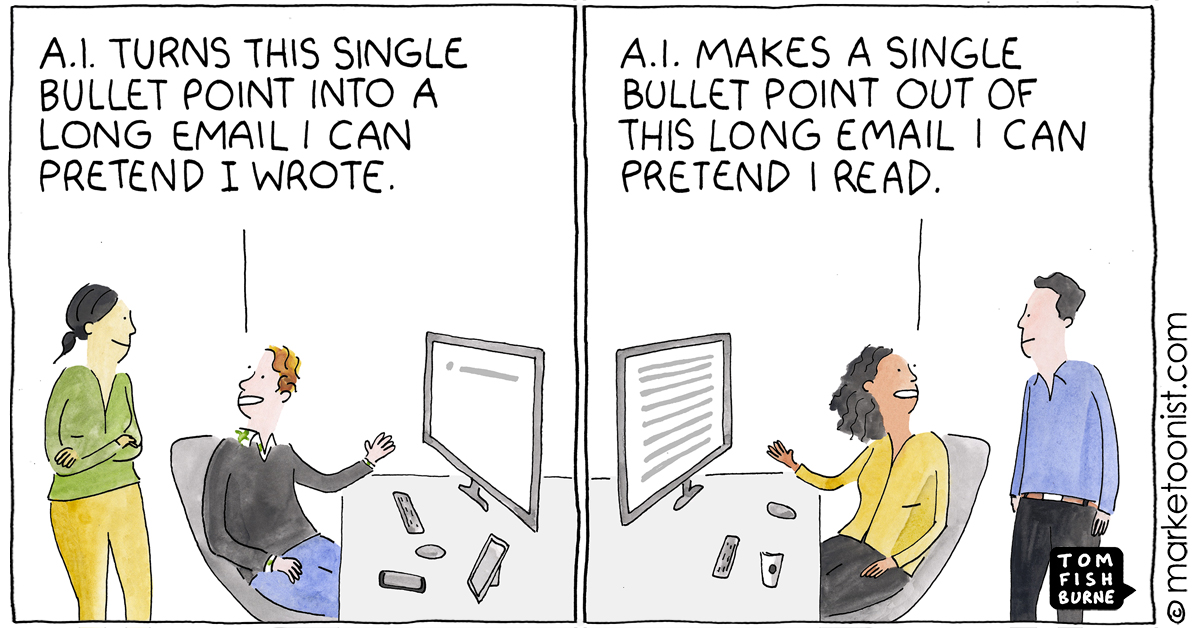
There's a cartoon going around where in the first frame, one character points to their screen and says to another: "AI turns this single bullet point list into a long email I can pretend I wrote".
And in the other frame, there are two different characters, one of them presumably the receiver of the email sent in the first frame, who says to their colleague: "AI makes a single bullet point out of this long email I can pretend I read".
The cartoon itself is the one posted above by PyWoody.
In this day and age, you can do this for FREE and on the side, whenever you have time!
There are tons of very well-done professional level video courses on Youtube.
There are more organized courses that only ask you for money for the "extras", like some tests and a certificate, but the main parts, texts and videos, are free.
You could start with a really good teaching professor (Eric Lander, MIT) and his course: https://www.edx.org/learn/biology/massachusetts-institute-of... (the "Audit" track is free, ignore the prices; also ignore the "expires" - this course restarts every few months and has been available in new versions for many years now)
It's very engaging!
There's similar courses for everything in the life sciences, there on edX, on Youtube, many other places.
I feel the true Internet is soooo underutilized by most people! Forget news sites, opinion blogs, or social media. Knowledge is there for the taking, free. Only the organized stuff, where you end up with a certificate costs money, but they usually still provide the actual content for free.
Time and energy are also at a premium in the current economy. Good luck learning biochemistry by watching YouTube videos after 8+h of coding and meetings plus commute plus making dinner plus cleaning up.
That reminds me of the Meaning of Life sketch playing a rugby match with the boys team against the masters as punishment for not paying attention in sex education class :)
Or they wanted this, because this could be part of the privatization of many government functions. They, or at least some of them, could see this as controlling this function for money. It's a regular stream too, the valuable subscription model and customers who really need the service (and if they don't, just add a new law in the name of IT security forcing firms to sign up).
> Isn't the US supposed to be the birthplace of modern democracy?
I would not dare not mention the revolutions in England and in France. And before that some Greece city states, and definitely Rome. The US declaration of independence is just another point.
> There is still a working pipeline available and Russia stated clearly if would continue delivering gas, if Germany wants to.
You conveniently leave out that minor detail that it was RUSSIA who stopped the gas.
Germany tried hard to keep it going, even making a sanction-exemption or a Siemens turbine repaired in Canada, which according to Russia was needed. Only that when they were to receive it nothing happened, gas stopped anyway.
Nordstream 1 which had if I recall correctly one working turbine left and went into inspection during which an oil spill was noticed and the restart of the service was postponed. Shortly after Nordstream 1 Pipeline A + B and Nordstream 2 Pipeline A was been blown up.
It’s up to debate if the oil spill which was uncovered during the inspection which postponed the gas delivery was a political move.
The turbine, which underlies sanctions, should have been still in transit during that time and even if delivered useless.
There is still Nordstream 2 Pipeline B intact available to deliver gas and it uses Russian made turbines compared to Nordstream 1.
The whole discussion is very special to say the least if you leave out that some adversary blow up the infrastructure.
I'm German, I followed those developments closely at the time. Russia refused to deliver gas! The blowing up of the pipes happened quite some time after that!
That shows that Russia prepared for using gas as an economic weapon against Germany especially well before they even started the war.
From the Zeit article:
German
> "Die Gasflüsse über die deutschen Grenzen sind unüblich niedrig für diese Jahreszeit - mit Ausnahme von Nord Stream 1, die sind konstant hoch", sagt Fabian Huneke. Es sei verwunderlich, dass vor dem Hintergrund der hohen Preise und der hohen Nachfrage die Gaslieferkapazitäten Richtung Europa so wenig genutzt würden. "Wenn Gazprom sich marktrational verhalten würde, würden sie die Gaslieferungen nach Europa auch durch die Pipelines, die durch Belarus und die Ukraine führen, verstärken." Den Grund für dieses Verhalten sieht der Energiemarktexperte in der Ukraine-Krise.
English, translated by Google
> "The gas flows across the German borders are unusually low for this time of year - with the exception of Nord Stream 1, which are consistently high," says Fabian Huneke. It is surprising that, given the high prices and high demand, the gas delivery capacities to Europe are so little used. "If Gazprom behaved in a market-rational manner, they would also increase gas supplies to Europe through the pipelines that run through Belarus and Ukraine." The energy market expert sees the reason for this behavior in the Ukraine crisis.
The transport of the turbine was accompanied by sanctions and each party didn’t wanted to get punished, awaiting exemption documents for delivery. As the article already states in the headline and further acknowledges in the content Russia was not refusing to get their turbine back but waiting for documents themselves which the article beautifully conceals with the little word ‘apparently’.
The unusual low gas storage reserves at the beginning of the year 2022 in Germany with 45% compared to usual 75% while Nordstream 1 is delivering at full capacity could be related to the sanctions which lead Poland to stop transit through the Jamal pipeline and other transit routes through Ukraine and possibly gas market trade activities. Having just the ‘economic weapon’ argument is lacking, especially in regard that Russian gas is still to today reaching Germany and it is in the interest of Russia to deliver.
Tangentially... how did the German name of the city/region get into _that_ form? Is it a loan from English?? Germany and Russia have been closely entwined for centuries.
Wikipedia has a comment which appears to make no sense:
> The [old] form Moskovĭ has left traces in other languages, including English: Moscow; German: Moskau; French: Moscou; Portuguese: Moscou, Moscovo; and Spanish: Moscú.
But all of the older forms include a /v/. How did that drop out of every language except Portuguese?
(There is an English term Muscovy for the region, but wiktionary suggests that it derives from the formal name given to the region in international Latin rather than deriving from Russian. In that case, a /w/ would also generate a letter V, so there's no explanatory power.)
U, v and w are all derived from the same letter v, for which no distinction existed in latin (same for i, j and y).
Apparently, when different languages started to make the distinction, they picked a different letter combination: ov, ou, ow, au, ú, etc. probably depending on the local way of pronouncing the word.
Same for latin ivvenis, modernized to juvenis, which gave young, jeune, jung, joven, etc.
The letters "U", "V", and "W" are all derived from the same letter, the Latin "V". The sounds /u/, /v/, and /w/ are different.
We're talking about a period many centuries after Latin phonology might have been relevant. The word doesn't come from Latin. Old English has no confusion between [v] and [w] to begin with; [w] is part of the phoneme /w/ and [v] is part of the phoneme /f/. In Middle English there's a distinction between /f/ and /v/, where we see French-derived words like village and vine distinguished from English-derived words like fill and fire, and from French-derived words like fine.
So what happened?
> Same for latin ivvenis, modernized to juvenis, which gave young, jeune, jung, joven, etc.
Please don't just invent things that sound good to you. Young and (German, I assume) jung don't come from Latin either.
> U, v and w are all derived from the same letter v, for which no distinction existed in latin (same for i, j and y).
Again, please don't just make up random non-facts. Latin has no letter J. It does recognize Y, as the Greek letter upsilon, which it distinguishes from all Latin vowels. The fact that Romance languages name "Y" the "Greek I" should have been a hint of this. You can hardly read any Latin that mentions Greeks without running into it; compare Pyramus, Thucydides.
Except here in Germany, at least the restaurants (but the art of cooking has declined too, favoring frozen pizza and similar foods). Especially since COVID. Our restaurant food is not good, and will still get five stars in the restaurant reviews all the time.
After COVID it got even worse. In my major city I saw food in well-known central restaurants become really bad, despite significant increases in price, and I mean "bad" and not just "it is not as tasty as I would like".
What is thriving are Döner (kebab shops) - often using questionable "meat", dirt-cheap Asian places (nowadays often with "Sushi", at very low prices), and burger shops. Italian restaurants focus on pizza and pasta - the cheapest-to-prepare easy-carbs-focused options.
I miss the Bay Area and its food options (I used to live there for quite a few years).
> The EU uses the precautionary principle, demanding a pre-market authorisation for any GMO to enter the market and a post-market environmental monitoring.
Much of the monitoring is to avoid or trace cross-contamination between fields, and ultimately the reason for that is significant consumer demand for non-GMO food, so that farmers who are non-GMO don't want their crops contaminated by a neighboring field that has GMO plants.
> GMO is not forbidden. It just has to get approved case by case.
Allowlisting makes so much more logical sense. New ideas shouldn't be allowed by default.
Especially when so many variables are at play, the FDA's denylist model across a massive population makes it very difficult to narrow down what is causing a problem. If I could make only 1 change to US health policy, it would be switching the FDA to allowlisting.
He is 94. No matter how much experience he has, I question the value of anything he might say these days, at least in comparison. There should be other people to listen to by now - probably even from his same organization, if you want to.


reply