Classical Physicist
-
Posts
33 -
Joined
-
Last visited
Recent Profile Visitors
1162 profile views

Classical Physicist's Achievements

Quark (2/13)
1
Reputation
-
ok so rolling friction is just F= μR
-
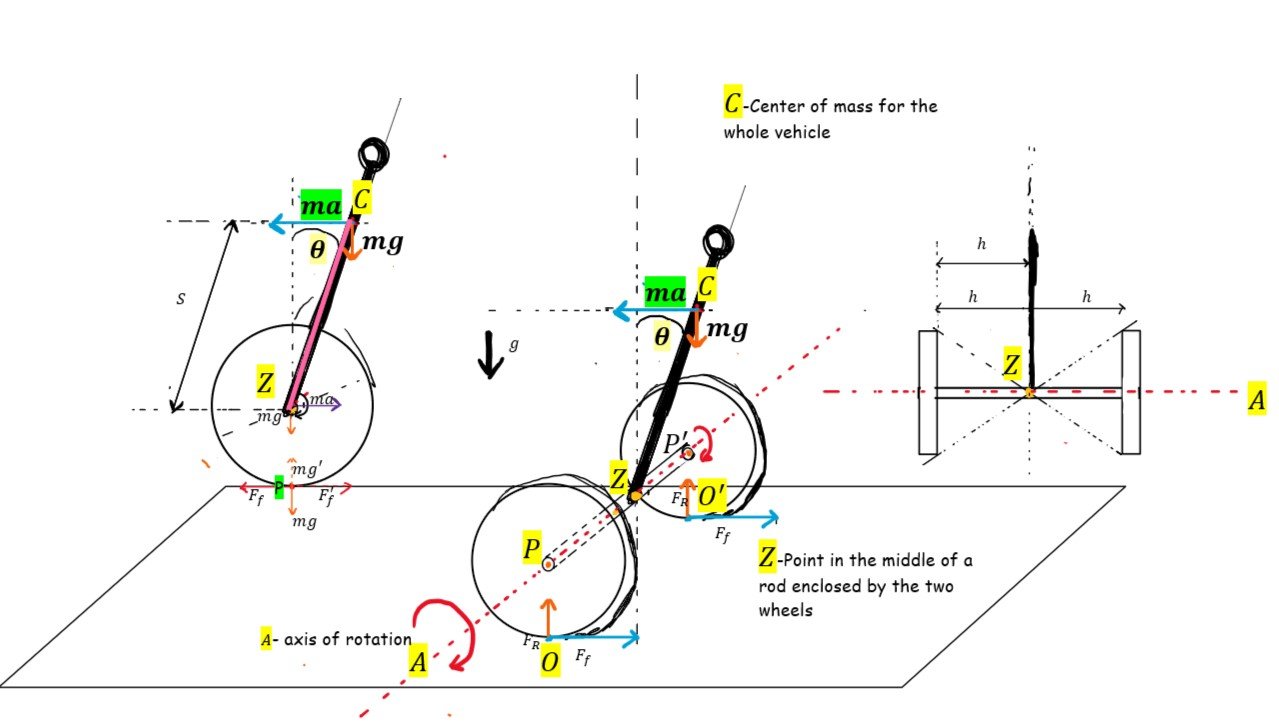
force applied to a wheel F=ma rolling friction is F=-μR normal force R=-mg Is that right? going back to the Two-wheeled inverted pendulum that i have to find acceleration of, by using the point c that is the centre of mass of the whole vehicle, how do I go about finding the torque at that point, which is on a line that is displaced at exactly the center of the rod that is in the axis...


-
sure But what forces do I need? Torque at the point A, Rolling friction, normal force R, and …. force that is applied to a wheel?
-
OKAY I need some serious help with it right now. What should I do to find this acceleration?
-
Yes, It's easier to draw few FBD's for each of the wheels/ points, instead of making complex sketches full of informations… Also what a cute car did You draw! - It's looks just like an Aston Martin! I will send Wheel FBD's here shortly. After this we should go back to finally analyzing the motion, right?
-
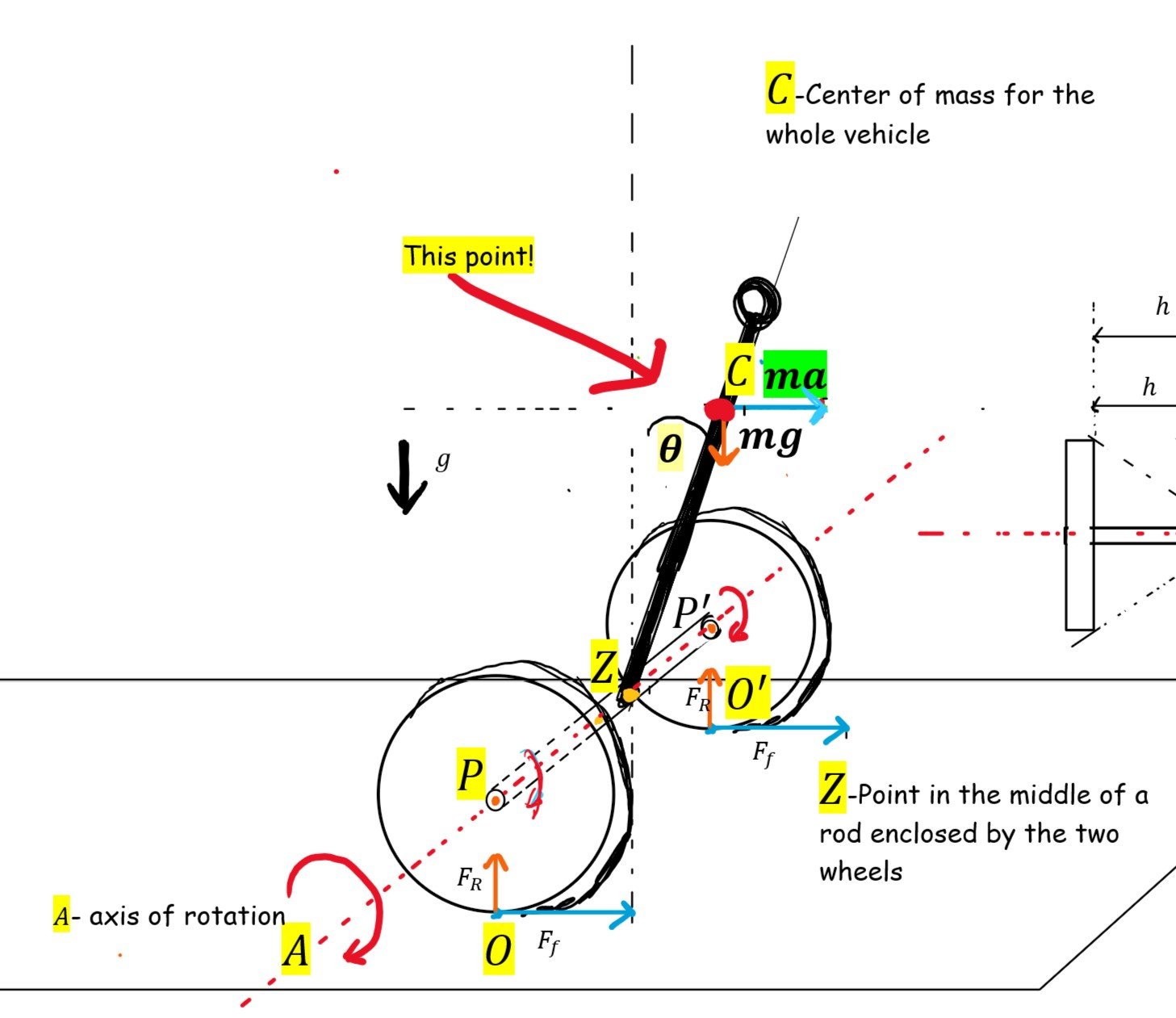
I'd say that the only net forces acting on a point C of a vehicle are torque (2h mg sin θ ) force that gives us acceleration of a vehicle (2h ma cos θ ) and torque of a point C that is τ=Iω Image: Sorry I've been trying to figure it out for days and I still have trouble with applying these forces in order to solve this problem, so I may have a flawed understanding of it right now. As I...

-
I think I can- but it's really not that simple when there's so many parts here to consider. It simply moves (accelerates uniformly with this unknown yet constant acceleration) in the right direction as the picture suggests. So it's not moving upwards/downwards- just rolling without slipping we assume here that this motion is in the right direction of this horizontal...
-
Okay so having all of these Drawn out, how can I find acceleration a that is at the point c which is centre of mass of a vehicle like this? @studiot, @Lizwi And am I Missing some important factors here? - θ is the angle that the pink/black rod moves from the equilibrium position that is on the normal line to the surface in order to accelerate a vehicle- something like a segway/...

-
Great!, I will look into it in a moment. But first that's what I did to find acceleration of this whole wheel, is it even partially correct? whoops my bad, not sure what happened with formatting of ω either. - reuploaded I'm Reading the chapter You've just sent right now

-
Let's picture a Rolling without slipping Wheel, that constantly accelerates. radius of a wheel/circle is rr. Basically any wheel of a vehicle is rotating around its fixed axis - AoR -(axis of rotation) Most of the times wheels have this AoR perfectly in the center of the circle/wheel/cylinder. What I want to understand is how can we describe the torque of such a wheel? Because as I...

-
Unusual problem from Electromagnetism.
Classical Physicist replied to Classical Physicist's topic in Classical Physics
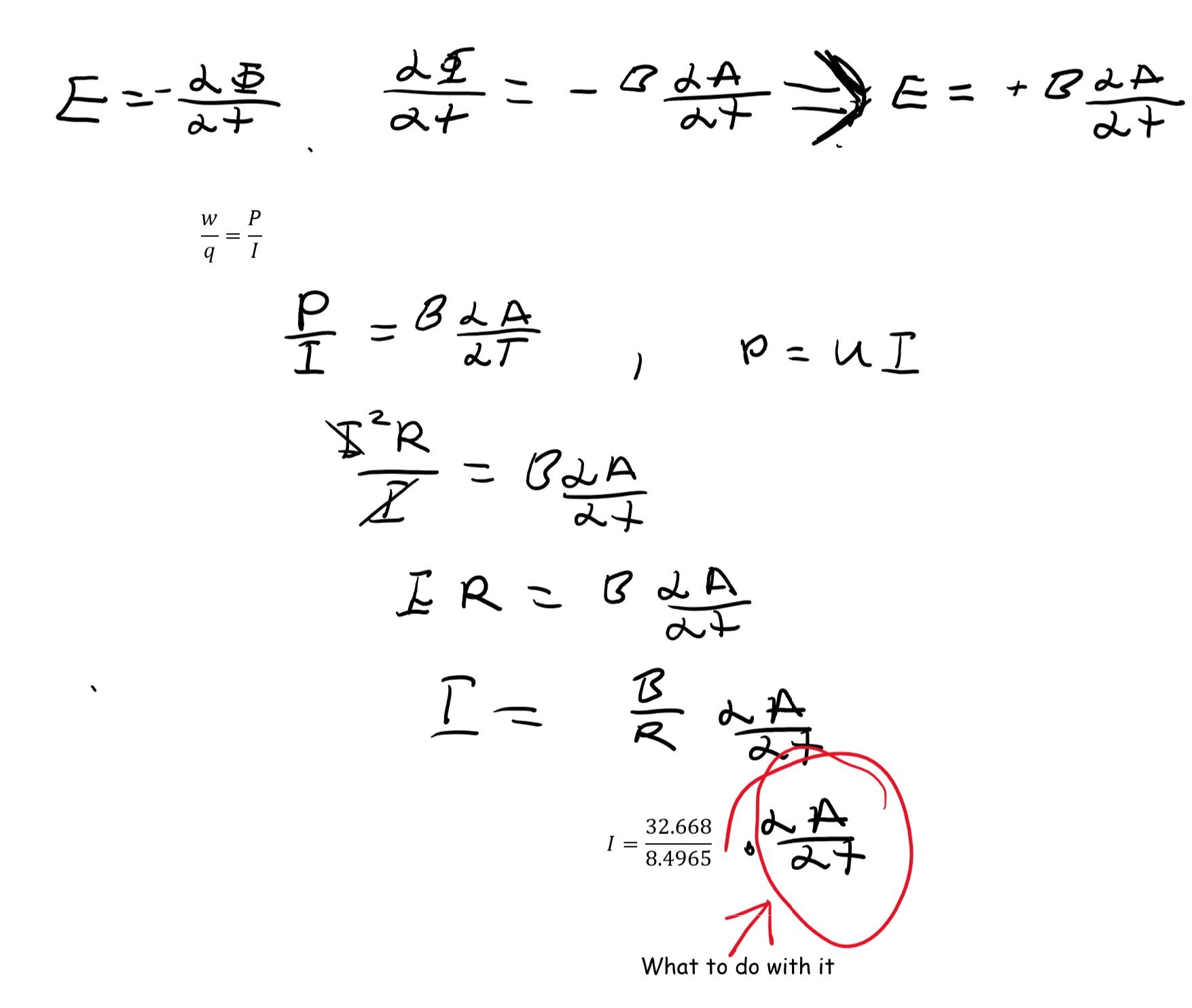
oh I forgot about it so I got this: is this correct?
-
Simple pendulum with a twist
Classical Physicist replied to Classical Physicist's topic in Homework Help
@studiot I guess I have to yet find the third period that is of the overall system so (0.867+1)/2 = T3 That is 0.93? -
hey It's me again, I need Help with this pendulum problem, it is easy : The frequency of vibrations (fluctuations) with a small amplitude of the ball attached to a weightless string is 1 Hz. I have to find the frequency of small vibrations of this body suspended on the same string near the edge shown in the picture. The distance d of the edge from the suspension point is 1/4...


-
Unusual problem from Electromagnetism.
Classical Physicist replied to Classical Physicist's topic in Classical Physics
Love it, Thanks again, I'll post the further answer shortly, …. so how can I insert the maths in here? beause I tried with LateX syntax but it didn't output this nice formatting that you post here? -
Unusual problem from Electromagnetism.
Classical Physicist replied to Classical Physicist's topic in Classical Physics
I'm confused The “height” of the triangular area enclosed by the underneath wire and the one above is the same as the distance traveled in time v: d = vt, also the base of the triangle like that equals to λ (as in picture) so we get 1/2* λ*vt=A Do I understand correctly that λ is the length of the wires? - in which case the bent one has λ as a sum of these "sides",so that each side is...