


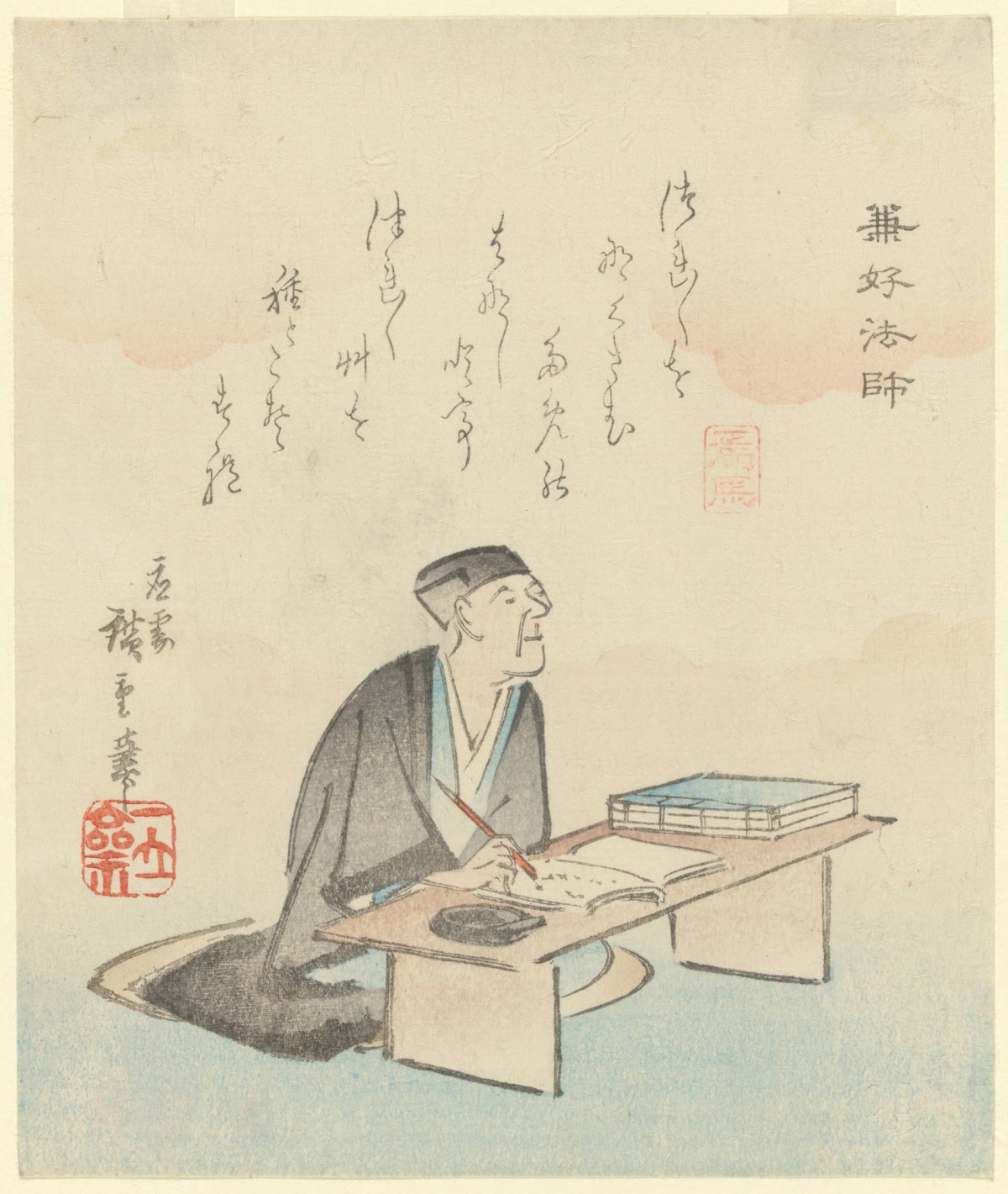
The very title is beguiling: “Tsurezuregusa” — literally, “Grasses of Idleness.” A celebration of idleness! There are “grasses” in all of us whose soil is idleness. In it they grow. Deprived of it they wither. Yet it’s a busy world — true now, true 700 years ago when a monkish aristocrat, or aristocratic monk, named Yoshida no Kenko (c. 1283-1350) “left the world” and penned his classic volume.
It was written between 1330 and 1332. This was not, says Donald Keene in the introduction to his translation, “a propitious time for a work of reflection and comment.” Very far from it, as we’ll see shortly.
There were many ways and degrees of “leaving the world.” Men and women oppressed by commotion and turmoil around them and within them — oppression heightened by a sense of the sheer futility of it all, the perceived unreality of this transient dreamlike soap-bubble world in which we are born to no purpose and die for no reason — took Buddhist vows, shaved their heads, donned drab monkish or nunnish robes and withdrew to monasteries, nunneries or hermitages, there to “lose themselves in prayer,” either enduring, more or less serenely, their live burial, as it must have seemed to their more worldly contemporaries, or awakening to real life, whose meaning and essence are not to be found in this life of birth and death from which only prayer can free us.
Kenko, born into a family of Shinto priests, flourished for a time as a court poet and took holy orders in 1324 after the death of retired emperor Go-Uda, whom he had served. “Many theories have been put forward to explain Kenko’s reasons for ‘leaving the world,’” writes Keene, “but nothing in his writings suggest that it was an act of despair.” He “bears little resemblance to the hermit-priests whose writings dominate medieval Japan. Kenko remained in the city (Kyoto), as familiar with worldly gossip as with pious reflections on the vanity of this world.”
He is remembered principally for three utterances that have shaped Japanese thought and feeling down the centuries. One we quoted last month:
“If man were never to fade away like the dews of Adashino, never to vanish like the smoke over Toribeyama (Kyoto’s graveyard and crematory), but linger on forever in the world, how things would lose their power to move us! The most precious thing in life is its uncertainty.”
Scarcely less precious, to him, are asymmetry and imperfection: “In everything, no matter what it may be, uniformity is undesirable. Leaving something incomplete makes it interesting, and gives one the feeling that there is room for growth.”
And this: “Are we to look at cherry blossoms only in full bloom, the moon only when it is cloudless? ... Branches about to blossom or gardens strewn with faded flowers are worthier of our admiration.” Longing for the blossoms is more moving, hence more beautiful, than the blossoms themselves. Likewise the moon and anything beautiful — they are more beautiful in their absence than in their presence, in contemplation than in seeing. Their primary beauty is in the emotions they call forth, whether happy or sad. The sight of them, to the truly cultivated, is secondary, perhaps unnecessary altogether — perhaps even a distraction: “Are we to look at the moon and the cherry blossoms without eyes one? How much more evocative and pleasant it is to think ‘bout the spring without stirring from the house, to dream of the moonlit night though we remain in our room!”
Was Kenko a saint? Not really. A sage? Hardly that either. One scarcely has the feeling, reading him, of being in the company of someone awesome, holy, inaccessible. “Man of leisure” seems a more apt description of him — and to the extent that he is, yes, he is above the cares of this world. So would we all be, similarly placed. Give him credit by all means for freedom from greed and ambition. Still — simplicity of taste, though admirable, is a long way from the rapturous embrace of the bleak austerities that enlighten the souls of the truly saintly.
His thoughts are as simple as his tastes:
“They flock together like ants, hurry east and west, run north and south... But what does all this activity mean? There is no ending to their greed for long life, their grasping for profit.”
“I am happiest when I have nothing to distract me and I am completely alone. If a man conforms to society, his mind will be captured by the filth of the outside world, and he is easily led astray; if he mingles in society, he must be careful that his words do not offend others, and what he says will not be at all what he feels in his heart.”
“The pleasantest of all diversions is to sit alone under the lamp, a book spread out before you, and make friends with people of a distant past you have never known.”
The distant past — how much better it was than the vulgar present! “In all things I yearn for the past: modern fashions seem to keep on growing more and more debased.”
Don’t suppose that, in renouncing the world, Kenko renounced love. Not he. True, he says, “The senses give rise to many desires, but it should be possible to shun them all.” But he also says, “A man may excel at everything else, but if he has no taste for lovemaking, one feels something terribly inadequate about him. ... When I recall the months and years I spent as the intimate of someone whose affections have now faded like the cherry blossoms scattering even before a wind blew, I still remember every word of hers that once so moved me.”
Can this be the same man who said, “Women are perverse by nature. They are deeply self-centered, grasping in the extreme, devoid of all susceptibility to reason”?
Kenko is hard to leave — in fact, let us linger with him a moment longer. The question arises: How is one to attach a brace of pheasants to a branch of red plum blossoms? Various authorities are consulted; they are baffled. This much at least seems certain: “Even if a snowfall is the first of the year, a pheasant should not be offered if the snow is too scant to cover the toe of the shoes.”
Was it perhaps in self-reproach that he observed later: “To engage in useless activities, to talk about useless things, and to think about useless things ... is not only to waste time but to blot out days that extend into months and eventually into a whole lifetime.”
Had Kenko no thoughts to spare for the convulsions shattering all calm other than his own? That is “leaving the world” indeed! While he mused, the reigning emperor revolted against the ruling shogun, was triumphant for a time, overplayed his hand, was captured, manhandled, stripped of all imperial and even human dignity and exiled to a remote island.
He escaped, returned, reigned again, was deposed again after one of the great battles of the samurai age, died in obscurity — only to be resurrected as a hero in times much closer to our own than to his. Go-Daigo is his name. With him our story resumes next month.





With your current subscription plan you can comment on stories. However, before writing your first comment, please create a display name in the Profile section of your subscriber account page.