


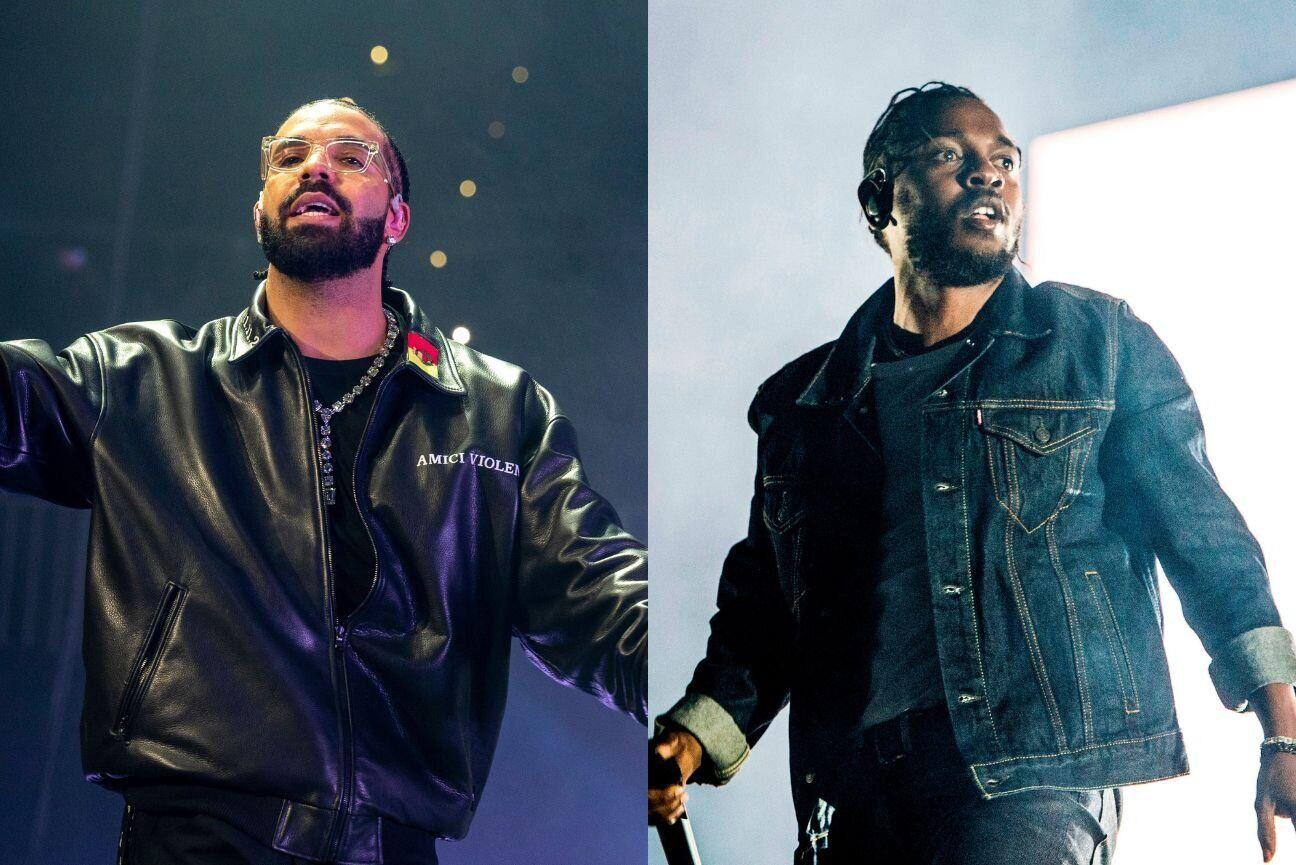
After thoroughly thrashing Drake during their high-profile rap beef last year (and winning five Grammys for his efforts), it appears Kendrick Lamar may be ready for more while headlining the Super Bowl halftime show this Sunday.
While few details about the performance have been confirmed, the Compton-born rapper is reportedly intent on performing his smash hit “Not Like Us” before an expected TV audience of more than 100 million on Sunday — much to the dismay of Toronto’s Drake and his lawyers.
It would be the crown jewel on a blowout run for the Pulitzer Prize-winning artist, who has dominated pop culture ever since he challenged rivals Drake and J. Cole for the hip-hop throne in early 2024.
In a rare interview Thursday, the reclusive Lamar elaborated on his perspective of hip-hop as a “sport,” and what viewers might expect during Sunday’s show.

“Not Like Us” has been ubiquitous during Super Bowl week and is expected to be a showpiece of Sunday’s halftime show, while Drake tours far away.
What we know about Lamar’s Super Bowl performance
On Sunday, Lamar will become the first solo hip-hop act to headline the Super Bowl halftime show — not that he’s a stranger to the stage, having performed in 2022 alongside Dr. Dre, Snoop Dogg, Eminem, 50 Cent and Mary J. Blige.
Now, the spotlight is on Lamar, along with special guest and frequent collaborator SZA. No other guest performers have yet been confirmed.
When asked what to expect from the show during an Apple Music press conference Thursday, Lamar answered: “Storytelling.”
“I’ve always been very open about storytelling through all my catalogue and my history of music. And I’ve always had a passion about bringing that on whatever stage I’m on,” he said.
“It reminds me of the essence and the core response of rap and hip-hop and how far it can go,” Lamar continued, reflecting on his upcoming performance. “It puts the culture at the forefront, where it needs to be and not minimized to just a catchy song or verse. This is a true art form, so to represent it on this type of stage is like everything that I’ve worked for.”
While he didn’t directly touch on his feud with Drake, Lamar added that his intention, both with the beef and his recent music, was to bring “grit” back into the genre. “My intent, I think from day one, was to always keep the nature of it as a sport,” he said. “I still watch battle raps … This has always been the core definition of who I am, and it’s been that way since day one.”

The Kansas City Chiefs and Philadelphia Eagles will face off on Sunday in New Orleans.
In keeping with halftime show tradition, details of the performance, including the set list, have been kept under wraps. But TMZ, citing sources close to Lamar, confirmed that “Not Like Us,” the Grammy-winning, knockout blow in the two rappers’ showdown, will be played — despite it being the subject of an ongoing defamation lawsuit. It’s unclear whether parts of the song will be censored during the broadcast.
Also unknown is how Lamar, whose politically-charged songs have drawn the ire of conservative politicians and media alike, intends to act given that U.S. President Donald Trump is expected to be in attendance.
Kendrick’s historic beef with Drake
More than a decade’s worth of subliminal digs and accumulated hatred finally boiled over into a wildly entertaining and, at times, equally disturbing lyrical beatdown last year.
What started with a guest verse by Lamar on rapper Big Sean’s 2013 song “Control,” which saw him throw shots at Drake and a number of his other contemporaries, exploded into arguably the biggest hip hop beef since Tupac and Biggie Smalls.
Carried out over eight direct diss songs from both artists, the lyrical showdown soon spiralled out of control with both sides making unsubstantiated allegations toward the other.
In his song “Family Matters,” Drake first accused Lamar of domestic abuse and claimed his long-time partner had a child with his best friend and manager. Lamar retaliated a mere 30 minutes later by releasing “Meet the Grahams,” a song that implied Drake was engaged in sex trafficking, that members of his team were “sex offenders” and that he was hiding an illegitimate 11-year-old daughter.
Lamar dropped smash hit “Not Like Us” the very next morning, an uptempo banger that accused Drake and his label of being “certified pedophiles” and likened the Toronto rapper to a musical colonizer. “Not Like Us” struck a chord with listeners, debuting at number one on the Billboard Hot 100 and quickly surpassing one billion streams on Spotify.
Ironically, rapper J. Cole, whose verse on Drake’s “First Person Shooter” became part of 2024’s feud and who launched the first salvo at Lamar with diss song “7 Minute Drill,” bowed out of the fight almost immediately and issued a public apology to Lamar.
The Toronto rapper filed a second legal action accusing UMG of defamation related to Kendrick Lamar diss track “Not Like Us.”
Months after the beef died down, Drake would start a legal spat with Universal Music Group (UMG), eventually filing a lawsuit against the entity — but not Lamar — for defamation. UMG should not have promoted “Not Like Us,” according to the suit, because it allegedly advanced “the false and malicious narrative that Drake is a pedophile” and supposedly incited the public to “vigilante justice in response.”
Despite the legal action, which UMG dismissed as “illogical,” “Not Like Us” was showered in accolades, taking home five Grammys including best rap song, best rap performance and best music video.
Who is Kendrick Lamar?
Lamar’s beef with Drake and ensuing album “GNX” appeared a stark departure from his usually introspective, politically dense lyricism that won him numerous accolades and a devoted following — including the first Pulitzer Prize for music outside the jazz and classical genres.
Lamar’s 2012 studio album, “Good Kid, M.A.A.D. City,” a semi-autobiographical retelling of his childhood on the poverty and violence-stricken streets of Compton, California, opened to critical and commercial success. It debuted at number two on the U.S. Billboard 200 and stayed on the charts for the next 10 years, becoming the first rap album to hit this milestone.
Building off this momentum, and fresh off a pilgrimage to South Africa, Lamar would release his magnum opus, “To Pimp a Butterfly,” three years later in 2015. The complex, lyrically dense concept album tackled themes ranging from systemic racism and the exploitation of Black workers by corporate America, to Lamar’s personal struggles with depression and suicidal ideation, all before a musically diverse backdrop ranging from jazz to funk and soul.
“To Pimp a Butterfly” was showered with accolades, including multiple Grammy nominations. California’s senate named Lamar a “generational icon” after its release, and the album has been enshrined at Harvard Library. It has also been named one of the greatest albums of all time by Rolling Stone Magazine.
Then, in 2017, Lamar released “DAMN.” — yet another jam-packed concept album that, while adopting a more commercial sound than his “To Pimp a Butterfly” era, was still laden with sharp political and social commentary. Lamar, a devout Christian, also used the album to explore themes of what drives us to sin or redemption, or as he puts it, “wickedness or weakness.”

The co-headlining concert will take place on June 12, 2025.
Not only did “DAMN.” take home five Grammys, it also won the 2018 Pulitzer Prize in music. On its website, the Pulitzer Prizes described the album as a “virtuosic song collection unified by its vernacular authenticity and rhythmic dynamism that offers affecting vignettes capturing the complexity of modern African-American life.”
Lamar’s last album before the beef, “Mr. Morale and the Big Steppers,” was arguably his most introspective, taking a microscope to the generational traumas and shifts in perspective that shaped him as a person. It was a surprise, then, that Lamar would go from an album fans have described as a “therapy session” straight into one of the most intense verbal beat-downs in hip-hop history.
After the beef, listeners were introduced to a new side of Lamar — a pettier, more commercially palatable side that, while still retaining some of the “conscious” lyricism he was known for, seemed to lean more into the combative and gloating persona cultivated during his feud.
This shift was exemplified by his most recent album “GNX,” a collection of West Coast bangers reminiscent of a mixtape that, while pleasant on the ears, feels less substantive than his previous works. “GNX” probably won’t be studied in university classrooms, nor was it intended to be — but it provides perfect fodder for the Super Bowl.
As K Dot closes out his blowout run with the Super Bowl and embarks on his Grand National Tour across the U.S. and Canada, it’s clear no one but Lamar knows what the secretive rapper will aim for next.


To join the conversation set a first and last name in your user profile.
Sign in or register for free to join the Conversation
Conversation
All Comments