
 Afrikaans
 Shqip
Shqip አማርኛ
አማርኛ العربية
 Հայերեն
 Azərbaycan dili
 Euskara
 Беларуская мова
 বাংলা
বাংলা Bosanski
 Български
 Català
 Cebuano
 Chichewa
 简体中文
简体中文 繁體中文
繁體中文 Corsu
Corsu Hrvatski
 Čeština
 Dansk
Dansk Nederlands
 English
 Esperanto
 Eesti
Eesti Filipino
 Suomi
Suomi Français
 Frysk
Frysk Galego
 ქართული
 Deutsch
 Ελληνικά
 ગુજરાતી
 Kreyol ayisyen
 Harshen Hausa
 Ōlelo Hawaiʻi
 עִבְרִית
 हिन्दी
 Hmong
Hmong Magyar
 Íslenska
 Igbo
Igbo Bahasa Indonesia
 Gaeilge
 Italiano
 日本語
日本語 Basa Jawa
 ಕನ್ನಡ
ಕನ್ನಡ Қазақ тілі
 ភាសាខ្មែរ
 한국어
한국어 كوردی
كوردی Кыргызча
 ພາສາລາວ
 Latin
Latin Latviešu valoda
 Lietuvių kalba
 Lëtzebuergesch
 Македонски јазик
 Malagasy
 Bahasa Melayu
 മലയാളം
 Maltese
 Te Reo Māori
 मराठी
मराठी Монгол
 ဗမာစာ
ဗမာစာ नेपाली
 Norsk bokmål
 پښتو
پښتو فارسی
فارسی Polski
 Português
 ਪੰਜਾਬੀ
 Română
 Русский
 Samoan
 Gàidhlig
 Српски језик
 Sesotho
 Shona
Shona سنڌي
سنڌي සිංහල
සිංහල Slovenčina
 Slovenščina
 Afsoomaali
 Español
 Basa Sunda
 Kiswahili
 Svenska
 Тоҷикӣ
 தமிழ்
தமிழ் తెలుగు
 ไทย
ไทย Türkçe
 Українська
 اردو
اردو O‘zbekcha
 Tiếng Việt
 Cymraeg
 isiXhosa
 יידיש
יידיש Yorùbá
 Zulu
Zulu

The following is from X
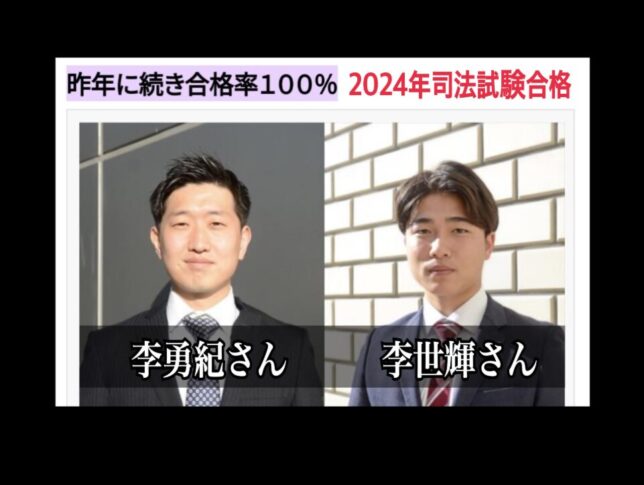
【NatsukiPosted by:
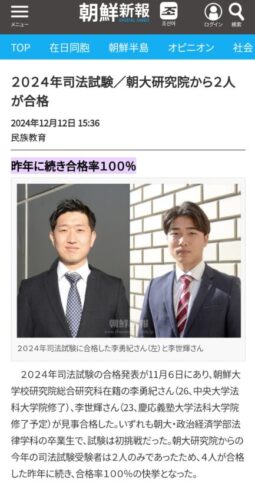
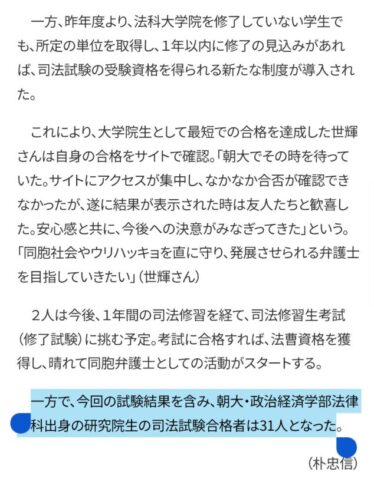
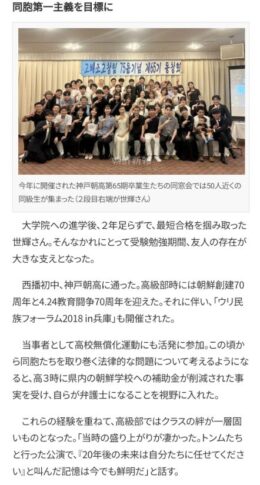
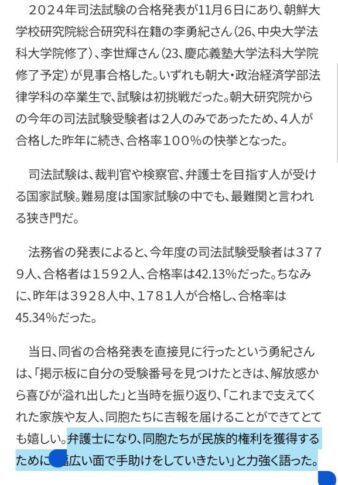
The passing rate for the bar exam for graduates of Korean universities has been 2% for two consecutive years, with 100 people having passed so far. I didn't understand the meaning of "We want to protect our schools," so I looked it up and found out it was about Korean schools. There is no mention anywhere of wanting to protect Japanese people in court. It's all about "compatriotism first."


引用元 https://x.com/xholic_natsu/status/1883538629043355824?s=51&t=y6FRh0RxEu0xkYqbQQsRrQ- main
-
Social Media
-
Sports
-
Animal
-
Domestic
-
Politics
-
Overseas
-
Features
-
Economy
-
Entertainment
 [Biden signs with talent agency] Trump says he's in the same agency as Shohei Ohtani, "Are you kidding me?"NEW
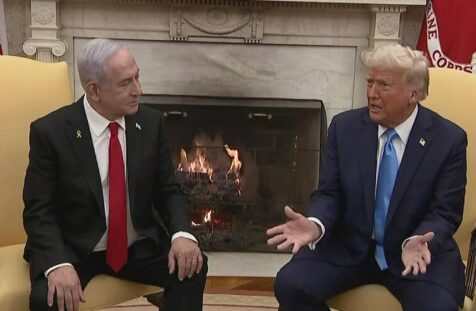
- [Breaking News] President Trump Meets with Prime Minister Netanyahu: "The U.S. Owns the Gaza Strip"NEW
- Trump Administration Considers Dismantling Department of Education Through Executive OrderNEW
- [Breaking News] President Trump signs executive order to withdraw from the UN Human Rights Council, withdrawing in 1 during his first termNEW
- [Education for children without resident status] Osaka citizens' group provides scholarships of 120,000 yen per year per person, calling for donations to continue support [Yomiuri Shimbun]NEW
- Government to reconsider high-cost medical care policyNEW
- "I never said I would do nothing" Prime Minister Ishiba gets angry on his birthday... He argues from his seat and is reprimanded at the Budget CommitteeNEW
- Joint statement to clarify U.S. commitment to Japan's defense as "unwavering"NEW
- X-people: "Looks like it's not going to be completed after all lol" 2 months until the opening of the Osaka Expo, difficulties continue... Crying to "political opponents" over poor ticket sales, overseas pavilions completed in only a few countriesNEW
- [SNS] X, "Community" posts now visible to everyone, users confused, "Worst update ever"NEW
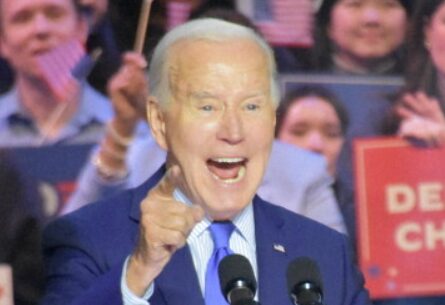
 Sanae Takaichi announces her plan to expand the use of nicknames: "It will eliminate inconveniences"NEW
- Former Fuji TV announcer Kasai: "Right now, Fuji TV employees are in a dire situation, asking, 'Are we going to get summer bonuses?'"NEW
- 10 killed in mass shooting in southern Sweden, the country's worst in historyNEW
- Trump to hold phone call with President Xi soon; tariffs on China may be on the agendaNEW
- Prime Minister Ishiba gives no clear timeline for gasoline tax cuts; Minister Iwatake emphasizes the importance of visa easingNEW
- [Image] I don't know what the hole in Saitama is doing anymoreNEW
- The Iwaya and Ishihara Diet Members' Association invites Makoto Takada, who mocks the "Abe administration as criminals," as a lecturerNEW
- Child and Family Agency to increase 2 trillion yen from last year to 7 trillion yen Is this organization helping to stem the decline in the birthrate? Is it really necessary?NEW
- [Politics] Prime Minister Ishiba says Gaza residents "will make efforts to accept them" → Joint statement by Arab foreign ministers: "We will refuse to transfer Palestinians from Gaza under any circumstances"NEW
- Ishiba: "Even if the number of children increases, it will be 18 years before they will be able to vote. By then, we won't be politicians anymore." ← The reason why politicians are uninterested in measures to combat the declining birthrateNotice
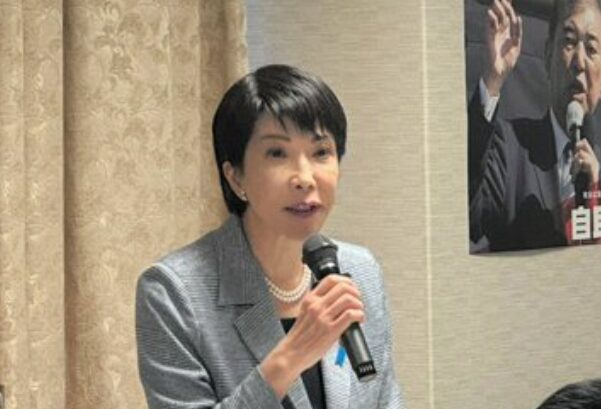
 Minister of Foreign Affairs of Japan Iwasaki: "It is not our purpose to settle in Japan" regarding the acceptance of Gaza residents
- Fuji TV issue: "License cannot be revoked even for serious compliance violations" says Minister of Internal Affairs and Communications
- Prime Minister orders acceleration of response to rising prices, using government rice reserves
- Prime Minister Ishiba criticizes "two-horsepower election" as wrong no matter how you look at it, House of Representatives Budget Committee
- Driver remains unknown one week after collapse
- [Kojima Ruriko is rushed to hospital, husband dies]
- Prime Minister Ishiba: "The world will suddenly become rosy just by saying things like 'abolish the consumption tax' or 'lower it.' It's not that simple a world we live in."
- [Attention] Constitutional lawmakers demand the abolition of the consumption tax exemption for foreign tourists / Prime Minister Ishiba is negative
- [Subversive behavior in Japan] Prime Minister Shigeru Ishiba considers accepting Palestinian residents of the Gaza Strip into Japan →→ "And then those residents turn into 'anti-Israel' Islamic warriors and go on a rampage in Japan."
- Minister Iwatake asked, "Did you check for wiretapping?" Committee room stirs over response to suspicious person intrusion into his room
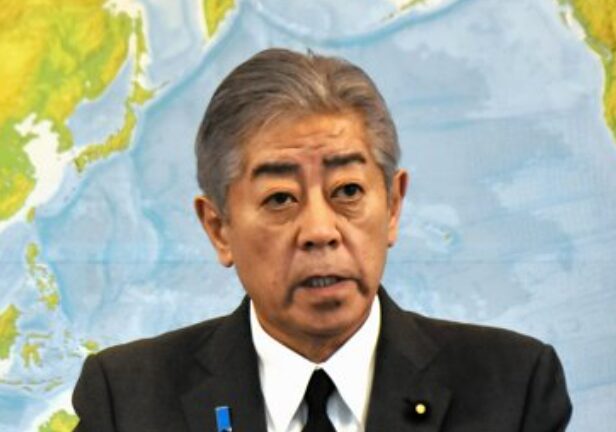
 [Breaking News] Prime Minister Ishiba officially announces US visit from the 6th to the 8th, summit meeting with President Trump
- China to impose retaliatory tariffs on US goods on the 10th, including coal, crude oil, agricultural machinery, etc.
- Belgium's new Prime Minister De Wever takes office, five-party coalition government launched
- [Nara Prefecture] Villagers outraged over mountain's "1 million yen toilet" - "It's ridiculous that price for something of that size"... Why was it built?
- China imposes additional tariffs of up to 15% on U.S. imports as a retaliatory measure against the U.S. Google also under investigation for antitrust violations
- Life sentence sought for sexual assault of 10 children
- US to close foreign aid agency: Masks "criminal organization," Trump calls "run by radical psychopaths"
- Panama's withdrawal from the Belt and Road Initiative deals a blow to China... Panama Canal becomes new source of conflict between the U.S. and China
- [Breaking News] American investment fund demands Hieda's resignation from Fuji TV
- Sea Shepherd founder Paul Watson made an honorary citizen of France
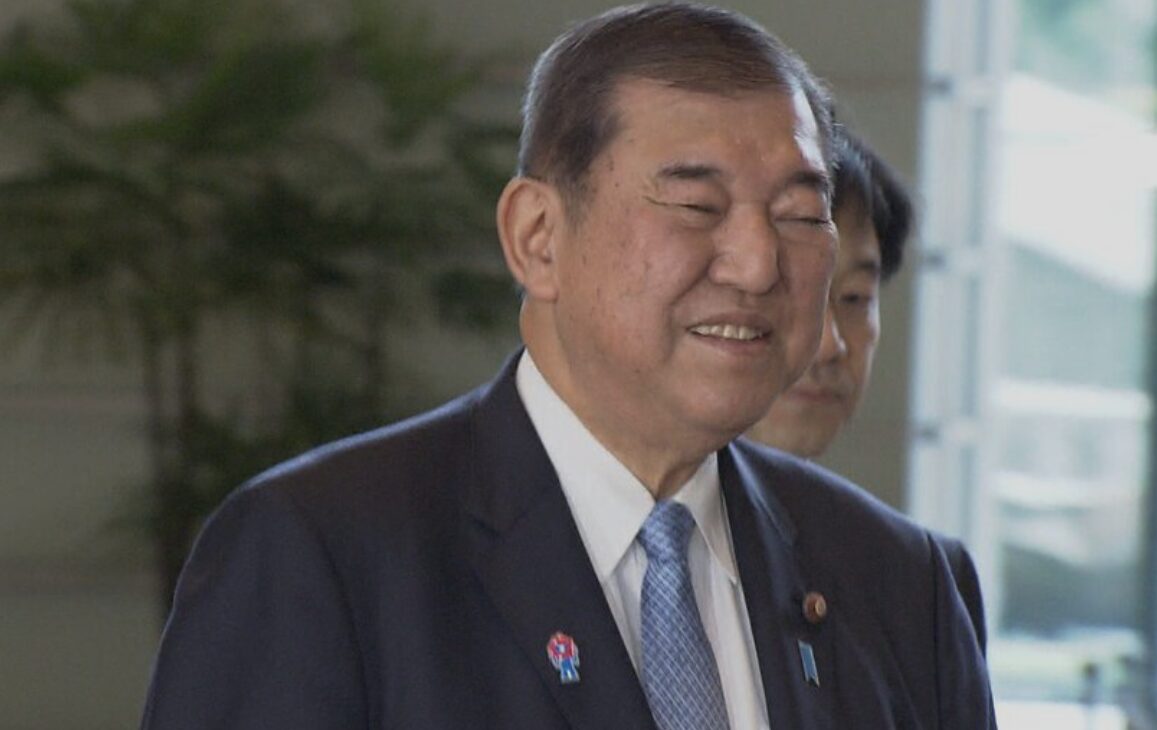
 National Police Agency calls on industry to take measures against organized shoplifting, including in-store announcements in foreign languages
- President Trump to set up government-backed fund in possible TikTok acquisition
- [South Korean Report] Approximately 24 Korean cultural heritage items were stolen or plundered overseas, with 7% ending up in Japan
- [Fukuoka, Chinese national not indicted] A Chinese woman arrested in the act of using a stun gun on a man she met on a dating site was not indicted... The reason given was "considering various circumstances."
- Trump says EU tariffs 'will definitely happen'
- North Korea condemns US Secretary of State Rubio's "rogue nation" remarks
- [X people] This is absolutely unacceptable. The "counterfeiting" of "Chinese zippers" continues, so I called the Chinese factory.
- [Minamide Kenichi, Mayor of Izumiotsu City, Osaka Prefecture] Izumiotsu City predicted that food prices would continue to rise and took measures, which has allowed us to improve the quality of school lunches without increasing the burden on parents.
- Video [Constitutional Democratic Party] Tax increase party Yoneyama: "I would like those in favor of tax cuts to stop labeling those who do not support tax cuts as tax increase supporters. It's a lie! I have never said that I would increase taxes." Morinaga: "But I heard it directly from Secretary General Ogawa."
- OpenAI CEO announces development of AI device, aiming for the biggest revolution since iPhone
 [SNS] X, "Community" posts now visible to everyone, users confused, "Worst update ever"NEW
- [Breaking News] Today's Sazae-san with no sponsors and zero sponsors makes NicoNico Live even more excited than last week lol (video included)
- [Cybozu CEO Aono] Separate surnames for married couples is "a necessity, and everyone from individuals to the Japan Business Federation has been calling for it..." Internet → "The Japan Business Federation and the Japan Federation of Bar Associations are forcing it..." "But changing the system is going to cost a ton of money"
- Video [Sad news] Assassin's Creed Yasuke "can attack Japanese people as much as he wants" but can't attack white people, sparking outrage lol
- [Sad news] Freedom in Japan is about to disappear due to SNS and speech restrictions... The government can decide whether information is correct or not. However, TV is not subject to this, so the government can freely broadcast any information that suits its needs, even if it is a lie.
- [Moe Fukada] "If you want us to stop using anonymous accounts on social media, then first ban politicians from using aliases! We don't even know where you're from or what your real names are," a scathing remark to Rui Matsukawa
- Restrictions on Deepseek usage spreading Hundreds of companies and government agencies worldwide concerned about data leaks
- I am a foreigner and a linguist, and I am certain that Japan does not need another official language, and that if it were to make English the official language, it would be cultural suicide.
- [Chinese AI chat] Deep Seek was asked to write 10 scenarios for the collapse of the current Chinese government, and the answers were insane!
- [Collecting more taxes than necessary is legal robbery.] Please put this up in the National Diet!!

 [China] TikTok US business considering sale to Musk - X may acquire management rights
- [Hosei University Hammer Incident] Chinese internet praises the culprit: "Korean female college student is a hero," "Korean Hammer Queen," "I order this female college student to become the president of South Korea"
- [Third generation Korean resident] I am speaking as a naturalized Korean born in Japan. The reason why people are being asked to give up their Korean names is not because they are criminals, but because they have the attribute of being a Korean resident in Japan. As a sign of sincerity to the Japanese people, they should take the initiative in giving up their Korean resident privileges.
- [Sad news] He has finally started writing that he lives in the Kawaguchi Autonomous Region of China. Japan is now treated as an autonomous region by the Chinese.
- It really hurts to be called a racist for simply tweeting a population figure...
- [Breaking News] Iwaya X deletes and escapes
- It seems that TV stations want to regulate SNS, but I'm glad that Elon Musk bought X. If it was a Japanese SNS, it would be over.
- TV Tokyo reporter warns: "I feel a strong sense of discomfort and contempt for using the occupational discriminatory term 'mass garbage' to refer to the people involved" → What else should we call them? 2000+ comments
- [Video] A large-scale "solar flare" occurred on Earth after midnight on the 10th. →The Ministry of Internal Affairs and Communications has stated that in the worst case scenario, a large-scale solar flare, which occurs less than once every 100 years, could cause mobile phones to be unusable for up to two weeks.
- [Korean TV Station] "Do you know that the pattern resembles the rising sun flag, a symbol of Japanese imperialism?" Protest against the pattern on a top Australian surfer's surfboard → Australia withdraws use

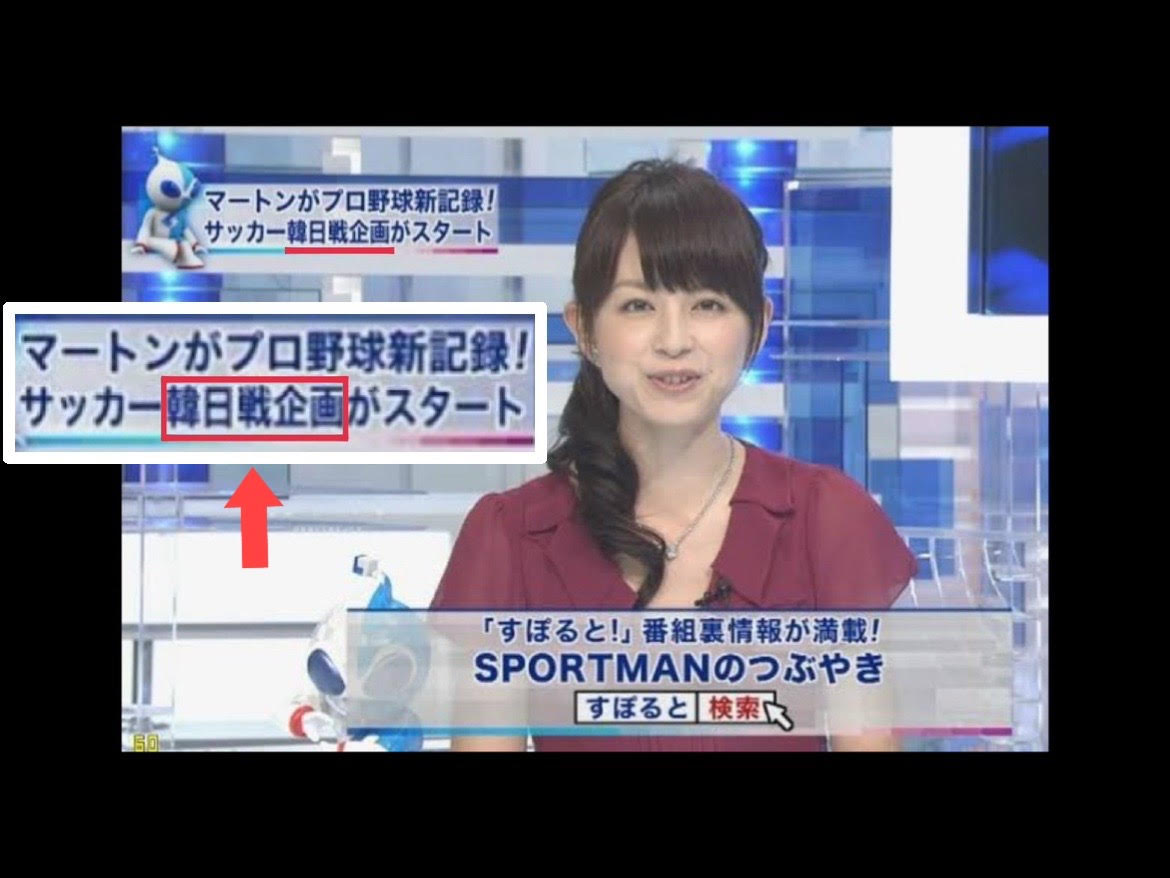
 [Fuji TV] It was discovered that the show had previously been written as "Korea-Japan Match"
- [Nippon Ham] Manager Tsuyoshi Shinjo: "Don't let Korea in" "There are too many dead balls" - Refuses to play a game against the Korean professional baseball team
- Elementary school student karate tournament: Athlete's association apologizes for dangerous behavior, announces punishment for second, suspends indefinitely, and covers medical expenses
- [Video] Ohtani stubbornly refuses to speak English when asked to do so in an interview, but speaks fluent English in his speech to all Dodgers fans at the victory parade
- [Video] Otani refuses to be interviewed by Fuji TV after his house was exposed lol
- Shohei Ohtani achieves his long-awaited first World Series victory! The Dodgers defeat the Yankees to become world champions for the 4th time in 8 years. In his first PS, he played in every game and hit 3 home runs.
- [Breaking News] Dodgers win, moving on to a dream showdown with the Yankees in the World Series!
- [Video] Chinese manager headbutts referee
- [Chinese soccer supporters] Shouting "Kill them! Kill them! Kill them!" during a match against Japan
- Video [Breaking News] Ohtani becomes the first player in history to hit 50 home runs and steal 50 bases with home runs in two consecutive at-bats -- Major League Baseball
 A Korean player elbows a Japanese player and breaks his front tooth. It is up to you to decide whether it was intentional or not.
- [Flooded with criticism!] Japan national team victim of laser pointer attack... Bahraini spectators' malicious disruption → "Disgusting behavior" and "Low level of civility" trend on X - World Cup Asian final qualifying round


 [Education for children without resident status] Osaka citizens' group provides scholarships of 120,000 yen per year per person, calling for donations to continue support [Yomiuri Shimbun]NEW
- X-people: "Looks like it's not going to be completed after all lol" 2 months until the opening of the Osaka Expo, difficulties continue... Crying to "political opponents" over poor ticket sales, overseas pavilions completed in only a few countriesNEW
- Former Fuji TV announcer Kasai: "Right now, Fuji TV employees are in a dire situation, asking, 'Are we going to get summer bonuses?'"NEW
- [Image] I don't know what the hole in Saitama is doing anymoreNEW
- Fuji TV issue: "License cannot be revoked even for serious compliance violations" says Minister of Internal Affairs and Communications
- Driver remains unknown one week after collapse
- [Kojima Ruriko is rushed to hospital, husband dies]
- [Nara Prefecture] Villagers outraged over mountain's "1 million yen toilet" - "It's ridiculous that price for something of that size"... Why was it built?
- Life sentence sought for sexual assault of 10 children
- [Breaking News] American investment fund demands Hieda's resignation from Fuji TV
- National Police Agency calls on industry to take measures against organized shoplifting, including in-store announcements in foreign languages
- [Fukuoka, Chinese national not indicted] A Chinese woman arrested in the act of using a stun gun on a man she met on a dating site was not indicted... The reason given was "considering various circumstances."
- [Minamide Kenichi, Mayor of Izumiotsu City, Osaka Prefecture] Izumiotsu City predicted that food prices would continue to rise and took measures, which has allowed us to improve the quality of school lunches without increasing the burden on parents.
- Defendant in attack on former Prime Minister Kishida denies intent to kill - First hearing at Wakayama District Court
- Trump announces one-month delay in imposing high tariffs; agreement reached with Mexico and Canada
- Fuji TV's 9pm filming cooperation notice disappears
- Possible asteroid collision with Earth in 2032
- [Hokkaido] Residential area planned in Niseko for resort employees, housing 1200 people... Most of them foreigners, to alleviate housing shortage
- Prime Minister Ishiba considers accepting Gaza residents into Japan: "The government would like to make efforts to make this a reality"
- [Ministry of Agriculture, Forestry and Fisheries] "Deep regret" over delay in measures to deal with soaring rice prices [House of Representatives Budget Committee]
 Government to reconsider high-cost medical care policyNEW
- "I never said I would do nothing" Prime Minister Ishiba gets angry on his birthday... He argues from his seat and is reprimanded at the Budget CommitteeNEW
- Joint statement to clarify U.S. commitment to Japan's defense as "unwavering"NEW
- Sanae Takaichi announces her plan to expand the use of nicknames: "It will eliminate inconveniences"NEW
- Prime Minister Ishiba gives no clear timeline for gasoline tax cuts; Minister Iwatake emphasizes the importance of visa easingNEW
- The Iwaya and Ishihara Diet Members' Association invites Makoto Takada, who mocks the "Abe administration as criminals," as a lecturerNEW
- Child and Family Agency to increase 2 trillion yen from last year to 7 trillion yen Is this organization helping to stem the decline in the birthrate? Is it really necessary?NEW
- [Politics] Prime Minister Ishiba says Gaza residents "will make efforts to accept them" → Joint statement by Arab foreign ministers: "We will refuse to transfer Palestinians from Gaza under any circumstances"NEW
- Ishiba: "Even if the number of children increases, it will be 18 years before they will be able to vote. By then, we won't be politicians anymore." ← The reason why politicians are uninterested in measures to combat the declining birthrateNotice
- Minister of Foreign Affairs of Japan Iwasaki: "It is not our purpose to settle in Japan" regarding the acceptance of Gaza residents
 Prime Minister orders acceleration of response to rising prices, using government rice reserves
- Prime Minister Ishiba criticizes "two-horsepower election" as wrong no matter how you look at it, House of Representatives Budget Committee
- Prime Minister Ishiba: "The world will suddenly become rosy just by saying things like 'abolish the consumption tax' or 'lower it.' It's not that simple a world we live in."
- [Attention] Constitutional lawmakers demand the abolition of the consumption tax exemption for foreign tourists / Prime Minister Ishiba is negative
- [Subversive behavior in Japan] Prime Minister Shigeru Ishiba considers accepting Palestinian residents of the Gaza Strip into Japan →→ "And then those residents turn into 'anti-Israel' Islamic warriors and go on a rampage in Japan."
- Minister Iwatake asked, "Did you check for wiretapping?" Committee room stirs over response to suspicious person intrusion into his room
- [Breaking News] Prime Minister Ishiba officially announces US visit from the 6th to the 8th, summit meeting with President Trump
- Video [Constitutional Democratic Party] Tax increase party Yoneyama: "I would like those in favor of tax cuts to stop labeling those who do not support tax cuts as tax increase supporters. It's a lie! I have never said that I would increase taxes." Morinaga: "But I heard it directly from Secretary General Ogawa."
- [Kawaguchi City Council Member, Okutomi] "After accepting them, it will be left entirely up to the local government and local residents, so it's better to stop it. Prime Minister Ishiba won't take care of them anyway." Criticizing the Prime Minister's consideration of accepting Gaza residents into Japan
- [Mihara Junko] I'm sorry. I wanted to abolish the child allowance and use it for the reconstruction of the disaster-stricken areas... [2011] ← Current Minister of State for Child Policy / Internet "Child allowances are the first thing to be considered for abolition, not from politicians' salaries..."
 [Biden signs with talent agency] Trump says he's in the same agency as Shohei Ohtani, "Are you kidding me?"NEW
- [Breaking News] President Trump Meets with Prime Minister Netanyahu: "The U.S. Owns the Gaza Strip"NEW
- Trump Administration Considers Dismantling Department of Education Through Executive OrderNEW
- [Breaking News] President Trump signs executive order to withdraw from the UN Human Rights Council, withdrawing in 1 during his first termNEW
- 10 killed in mass shooting in southern Sweden, the country's worst in historyNEW
- Trump to hold phone call with President Xi soon; tariffs on China may be on the agendaNEW
- China to impose retaliatory tariffs on US goods on the 10th, including coal, crude oil, agricultural machinery, etc.
- Belgium's new Prime Minister De Wever takes office, five-party coalition government launched
- China imposes additional tariffs of up to 15% on U.S. imports as a retaliatory measure against the U.S. Google also under investigation for antitrust violations
- US to close foreign aid agency: Masks "criminal organization," Trump calls "run by radical psychopaths"
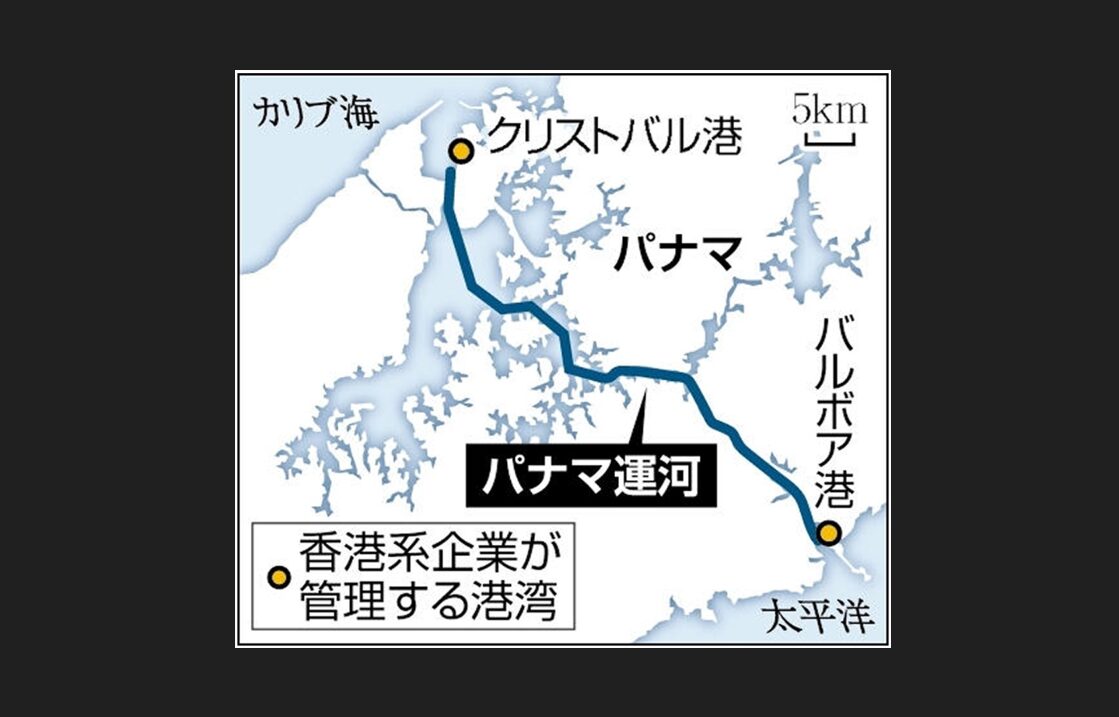
 Panama's withdrawal from the Belt and Road Initiative deals a blow to China... Panama Canal becomes new source of conflict between the U.S. and China
- Sea Shepherd founder Paul Watson made an honorary citizen of France
- President Trump to set up government-backed fund in possible TikTok acquisition
- [South Korean Report] Approximately 24 Korean cultural heritage items were stolen or plundered overseas, with 7% ending up in Japan
- Trump says EU tariffs 'will definitely happen'
- North Korea condemns US Secretary of State Rubio's "rogue nation" remarks
- [X people] This is absolutely unacceptable. The "counterfeiting" of "Chinese zippers" continues, so I called the Chinese factory.
- OpenAI CEO announces development of AI device, aiming for the biggest revolution since iPhone
- President Trump: "We don't need Canadian products" Nikkei Stock Average drops sharply over retaliatory tariffs
- [USA] "I want to get away from President Trump's America" - immigration fever quietly growing, Japan third in popularity
 Earn money through self-affiliation! Only these 5 ASPs have self-packs
- To make money with FX, it's important to know which company to use! 7 FX company comparison rankings
- Earn tons of extra money with point activities! 8 recommended points sites
- Earn money through surveys! How to choose a site? 7 recommended survey sites
- Earn money easily with game apps! 7 recommended and fun smartphone games

 Samsung plans to release new folding models, including a tri-fold smartphone, in 2025
- Osaka Prefecture to implement fourth round of "Rice Coupons" - Increased to 4 yen due to rising rice prices
- Keidanren: "6% wage increase for small and medium-sized companies is tough" - Comments on Rengo's demands
- [Ishiba Administration] EV purchase subsidy to be increased by up to 5 yen
- [Ministry of Health, Labour and Welfare] 5600 billion yen in living expenses loans waived during the COVID-XNUMX pandemic
- Government and ruling parties adjust plan to raise "103 million yen annual income barrier" to 150 million yen
- [Analysis by Heizo Takenaka] With President Trump inaugurated, the world economy "cannot improve" and "the standard of living of the American people will decrease"
- [Breaking News] Bank of Japan to decide on additional interest rate hike
- Minister of Economy, Trade and Industry Akazawa criticized the Democratic Party for the People, saying, "It is not as simple as just returning the increased tax revenue to the people."
- [Governor Kuroda, a former Finance Ministry employee] Lifetime salary of over 12 billion yen? He bought a multi-million-yen mansion with cash! It's an amazing system that increases the finance ministry's coffers when the consumption tax is raised!

 Tamogami: "Japan's total assets will be 2024 trillion yen by the end of 1!"
- "The dollar will be worth 1 yen" - Former Morgan Bank Tokyo branch manager gives final warning to Japan! "The day will soon come when banknotes will be worthless" - The yen's depreciation cannot be stopped any longer
- [Prime Minister Ishiba] Request for cooperation in passing on price hikes to ensure wage increases that do not fall behind inflation
- Chief Cabinet Secretary Yoshimasa Hayashi: "There is no such thing as tax revenue that can be lost"... Discusses the 103 million yen barrier and the provisional gasoline tax rate
- [Sad news] The number of bankruptcies in November 2024 will be 11, the highest annual total since 834 → "The government has no policy. Politicians can live comfortably."
- [China] Imports of Japanese seafood to resume ← The timing makes it seem like the only way to settle the "death of a male student at a Japanese school" issue...
- [The reality of the weak yen] Foreign tourists "enjoy 42 days for 10 yen" while Japanese "live on 15 yen a month..." What is the difference?
- [Constitutional Democratic Party of Japan, Kazuhiro Haraguchi] "Finally, Japan is ranked 10th in high-tech exports! It's time to wake up. Japan's decline! Let's put a stop to it. Japan's decline!"
- Toyota's Mirai to be used as official vehicle for Paris Olympics; academics and engineers demand withdrawal
- [The flat-rate tax cut was meaningless] Real wages have fallen for 26 consecutive months… This year too, ordinary people will definitely have a “summer of saving”
 [Sad news] Nakai Masahiro may be bankrupt due to numerous damages
- [Breaking News] Nakai Masahiro announces retirement from showbiz
- [Takafumi Horie] There was a tip-off that a Fuji TV executive forced him onto the set, saying, "You'll be able to see AKB48 in their underwear, right?"
- [All six of Nakai's regular shows are gone] TV Asahi announces the cancellation of "Masahiro Nakai's Saturday Gathering"
- [Breaking News] Request to suspend broadcast of "Kuishinbo! Banzai" / Kikkoman has been asked by Fuji Television to suspend the broadcast of the long-running program, which has been sponsored by only one company for 1 years, from the 50th.
- Come to think of it, back then I always felt uncomfortable seeing a group of women in red clothes and miniskirts just sitting in a row behind the MC of the show, not doing anything.
- Former female announcer Kanon Aoki said, "The production staff at Fuji TV are aggressive in a bad way. When I was an announcer, I couldn't get out of a Fuji production staff member's car until I kissed him and touched him, and when I refused, he got angry. I was mentally cornered and started taking drugs."
- [Yuta Misaki] I might get in trouble for saying this, but pensions are an investment product that you are forced to join and will definitely result in a loss. It's so crazy. Namu Amida Butsu.
- [Fifi] What was the real meaning behind calling Fuji TV's female announcers by adding "~pan~pan" to their names?
- Masahiro Nakai's case featured in Bloomberg

 Kyoko Koizumi: "Sigh... I guess tax returns are stupid. You should have paid your taxes first and then said this" - angry at politicians and the government for their secret funds
- [Fifi] If the number of foreigners who don't follow the rules increases, the impression of foreigners will get worse and they will become a nuisance, so I want them to be strictly regulated. Foreigners are the ones raising their voices in this regard, so this isn't exclusionary or anything.
- The information program desk said, "We were criticized for asking her sister, Shinobu Nakayama, for a comment, but the scene was orderly, and Shinobu's comments were not forced and were in accordance with the rules." → No regrets
- [Video] Katayama: "(SNS) is true and false. There is no punishment or check. You can say whatever you want and whoever says it first wins." Higashino: "It's the same on TV." → Higashino is stating a very reasonable opinion.
- Megumi Toshiaki's personal opinion on the results of the Hyogo Prefectural Governor election: "When I see a delinquent kid walking around with his grandma on his back, I think he might actually be a good guy." "He was a total bad guy..."
- A Korean copyright management organization revealed that "K-POP is not selling at all overseas," and calculated the amount of tax collected in each country...
- Hollywood celebrities who said they would leave the US if Trump was re-elected are actually fleeing the US
- Matsumoto Hitoshi is a total winner! He will be returning to his seven regular shows from the beginning of the new year!
- [Breaking News] Matsumoto Hitoshi's side to withdraw lawsuit and apologize for defamation lawsuit over weekly magazine article
- Matsuko: The reason why it's hard to find the "egg section" in supermarkets... "It's scary..." to the unexpected truth. Ariyoshi: "That's an amazing reason."

Everyone's comments
- I think it's abnormal that the passing rate of the bar exam is 100%. I can't help but wonder if the fairness of the exam is really being maintained.
- The very fact that people who advocate the principle of putting their fellow citizens first enter the Japanese judiciary is likely to pose a risk in the future.
- If those who are meant to uphold the law continue to give priority to certain ethnic groups or groups, Japan's legal order will collapse.
- If one uses his position as a lawyer to prioritize the interests of his fellow citizens, that is far from judicial fairness.
- It makes me feel really frustrated to think that the consequences of the Democratic Party administration are now coming back to haunt us.
- This is a typical example of how the risks of accepting immigrants manifest themselves in this way.
- If you work as a lawyer in Japan, you should put Japan's national interests first.
- What the trial should protect is Japan's laws and the safety of its people, and it is problematic for it to act on behalf of a specific community.
- If this trend continues, it is entirely possible that Japan's judiciary system will be taken over in the future.
- Trials should be fair regardless of nationality, but it is far too dangerous to give preferential treatment to those in a particular position.
- We need to thoroughly investigate why Korean universities have such a high bar exam pass rate.
- If immigrants begin to think only of their own interests, it will only be a matter of time before the country's order falls apart.
- We need to consider whether it is really a safe situation for people from an enemy country to be dealing with Japanese law.
- I am afraid that the more lawyers there are, the more likely it is that a trend of only thinking about the interests of fellow lawyers will spread.
- I believe that only people who have a solid understanding of Japanese law and can consider the interests of the country as a whole should be involved in the judiciary.
- With the judicial system lacking fairness moving forward, I can only see a future in which Japanese people will end up losing out.
- If a 100% pass rate for Korean universities becomes the norm, won't Japanese people have fewer opportunities to pass the bar exam?
- Immigration issues have become social problems in every country, so Japan should feel a greater sense of crisis.
- If things continue as they are, I am worried that certain forces will expand not only in the judiciary but also in other fields.
- Ultimately, we must avoid Japanese laws being bent and Japanese people being put at a disadvantage.
Editor A's opinion
The news that graduates from Korea University have achieved a 2% pass rate in the Japanese bar exam for two consecutive years, with 100 students having passed in the past, raises many thoughts. There is no doubt that this result is the result of the efforts of the test takers and the educational system. However, at the same time, I think we need to be careful about the impact on the Japanese legal profession.
What is particularly worrisome is that the direction they are aiming for is stated to be "compatriotism first." The role of the judiciary is to apply the law impartially and maintain social order, regardless of nationality or position. Nevertheless, the slogan "We want to protect our schools" has been raised, and the attitude of prioritizing the interests of Korean schools and Koreans seems to be a cause for concern for the Japanese legal profession.
Living in Japan, the basic premise is that one must adhere to a fair judicial system that follows Japanese law. Despite this, the spread of thinking that prioritizes the interests of certain ethnic groups or organizations calls into question the neutrality of the judiciary. In Japanese society, passing the bar exam requires a deep understanding of Japanese law and ethics, and the ability to put them into practice. However, when the idea of "compatriotism" comes to the forefront, many people are concerned about whether they will be able to fulfill their duties in an impartial manner.
It is also surprising that the success rate of Korean school graduates is 100%. The bar exam is generally considered to be extremely difficult, and the success rate is not particularly high. Given this, what factors are behind the outstanding success rate of Korean universities? One factor may be the rich educational environment and support system, but there are some aspects that cannot be explained by that alone. It is possible that the uniqueness of the exam preparation and curriculum has an impact, but shouldn't this be examined in more detail from the standpoint of fairness and transparency?
Furthermore, we should keep a close eye on what kind of activities they will carry out in the judicial system. The legal profession is a place that must uphold fairness under the law and must not be biased based on specific interests. If the attitude of prioritizing the interests of specific groups and organizations were to undermine the credibility of the judicial system in the future, it would cause anxiety among the public.
In addition, while the number of people passing the bar exam in Japan is increasing, there are concerns about an oversupply of lawyers and intensifying competition. Under these circumstances, the expansion of influence of certain groups in Japan's legal profession could threaten the fairness based on the values of Japanese society. In order to protect the independence of the judiciary, it will be necessary to ensure transparency regarding the fairness of the exam and the content of the training.
Furthermore, a distinctive feature of the Japanese judicial system is that it places great importance on equality under the law. Whether Japanese or foreign nationality, people should be tried fairly and should not be treated differently based on their ethnicity or origin. Therefore, when graduates of Korea University enter the Japanese legal profession, they are expected to respect Japanese laws and values and provide equal judicial services to all people.
In addition, this issue needs to be discussed by Japanese society as a whole. Rather than simply praising the high pass rate, it is important to calmly assess how the ideology and educational policy behind it are consistent with Japan's legal system.
On the other hand, it is also necessary to keep an eye on what career paths successful applicants from Korea University will choose and what activities they will pursue. If they comply with Japanese law and contribute to the justice system in an impartial manner, this may be something to be welcomed. However, if they are biased toward the interests of certain groups or communities, this will have a negative impact on the entire Japanese justice system.
The judiciary is an important institution that supports the foundation of the nation, and maintaining its neutrality and credibility is of utmost importance. That is why I strongly believe that what is required of those who pass the bar exam is an unbiased perspective that goes beyond any particular interest.
Written by: Editorial Department A
Recent Posts
-
[Biden signs with talent agency] Trump says he's in the same agency as Shohei Ohtani, "Are you kidding me?"
-
[Breaking News] President Trump Meets with Prime Minister Netanyahu: "The U.S. Owns the Gaza Strip"
-
Trump Administration Considers Dismantling Department of Education Through Executive Order
-
[Breaking News] President Trump signs executive order to withdraw from the UN Human Rights Council, withdrawing in 1 during his first term
-
[Education for children without resident status] Osaka citizens' group provides scholarships of 120,000 yen per year per person, calling for donations to continue support [Yomiuri Shimbun]


Comment