
 Afrikaans
 Shqip
Shqip አማርኛ
አማርኛ العربية
 Հայերեն
 Azərbaycan dili
 Euskara
 Беларуская мова
 বাংলা
বাংলা Bosanski
 Български
 Català
 Cebuano
 Chichewa
 简体中文
简体中文 繁體中文
繁體中文 Corsu
Corsu Hrvatski
 Čeština
 Dansk
Dansk Nederlands
 English
 Esperanto
 Eesti
Eesti Filipino
 Suomi
Suomi Français
 Frysk
Frysk Galego
 ქართული
 Deutsch
 Ελληνικά
 ગુજરાતી
 Kreyol ayisyen
 Harshen Hausa
 Ōlelo Hawaiʻi
 עִבְרִית
 हिन्दी
 Hmong
Hmong Magyar
 Íslenska
 Igbo
Igbo Bahasa Indonesia
 Gaeilge
 Italiano
 日本語
日本語 Basa Jawa
 ಕನ್ನಡ
ಕನ್ನಡ Қазақ тілі
 ភាសាខ្មែរ
 한국어
한국어 كوردی
كوردی Кыргызча
 ພາສາລາວ
 Latin
Latin Latviešu valoda
 Lietuvių kalba
 Lëtzebuergesch
 Македонски јазик
 Malagasy
 Bahasa Melayu
 മലയാളം
 Maltese
 Te Reo Māori
 मराठी
मराठी Монгол
 ဗမာစာ
ဗမာစာ नेपाली
 Norsk bokmål
 پښتو
پښتو فارسی
فارسی Polski
 Português
 ਪੰਜਾਬੀ
 Română
 Русский
 Samoan
 Gàidhlig
 Српски језик
 Sesotho
 Shona
Shona سنڌي
سنڌي සිංහල
සිංහල Slovenčina
 Slovenščina
 Afsoomaali
 Español
 Basa Sunda
 Kiswahili
 Svenska
 Тоҷикӣ
 தமிழ்
தமிழ் తెలుగు
 ไทย
ไทย Türkçe
 Українська
 اردو
اردو O‘zbekcha
 Tiếng Việt
 Cymraeg
 isiXhosa
 יידיש
יידיש Yorùbá
 Zulu
Zulu

The following is from X

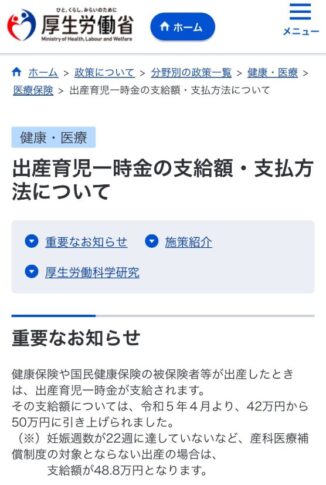
【Masanori SeraPosted by:


Source: Ministry of Health, Labour and Welfare website
Revised May 5, 5, Hoho No. 24 No. 0524
(Official seal omitted)
When an insured person or dependent receives medical treatment overseas (medical expenses paid pursuant to Article 11 or Article 70 of the Health Insurance Act (Act No. 87 of 110) and Article 14 or Article 73 of the Seamen's Insurance Act (Act No. 64 of 76); hereinafter referred to as "overseas medical expenses"), and when an insured person or dependent gives birth overseas (hereinafter referred to as "overseas childbirth"), the childbirth and childcare lump-sum payment or family childbirth and childcare lump-sum payment (childbirth and childcare lump-sum payment or family childbirth and childcare lump-sum payment paid pursuant to Article 11 or Article 70 of the Health Insurance Act (Act No. 101 of 114) and Article 14 or Article 73 of the Seamen's Insurance Act (Act No. 73 of 81); hereinafter referred to as "childbirth and childcare lump-sum payment, etc."), each insurer endeavors to conduct appropriate examinations.As indicated in the "Comprehensive Measures for Accepting and Living with Foreign Talent" (approved by the Ministerial Conference on Accepting and Living with Foreign Talent on December 30, 12), in order to prevent fraudulent receipt of lump-sum childbirth and childcare benefits by falsifying the fact that one gave birth overseas, it is necessary to standardize the documents required for claims for lump-sum childbirth and childcare benefits, etc., and to tighten screening, based on the measures implemented so far for overseas medical expenses.Therefore, it is necessary to continue to publicize and promote the implementation of measures to prevent fraudulent receipt of overseas medical expenses.
Therefore, with regard to overseas medical expenses, as described below, we have issued two notifications since fiscal year 25 and have taken measures to improve the fairness of payments. Therefore, we ask insurers to once again understand the intent of these notifications and take measures to further improve the fairness of payment procedures.
In addition, regarding the payment of lump-sum childbirth and childcare benefits for overseas births, we have decided to present the following measures to improve the appropriateness of payments, taking into account the measures for overseas medical expenses. Insurers are requested to understand the contents and take appropriate action. [Click the source for the full text...]
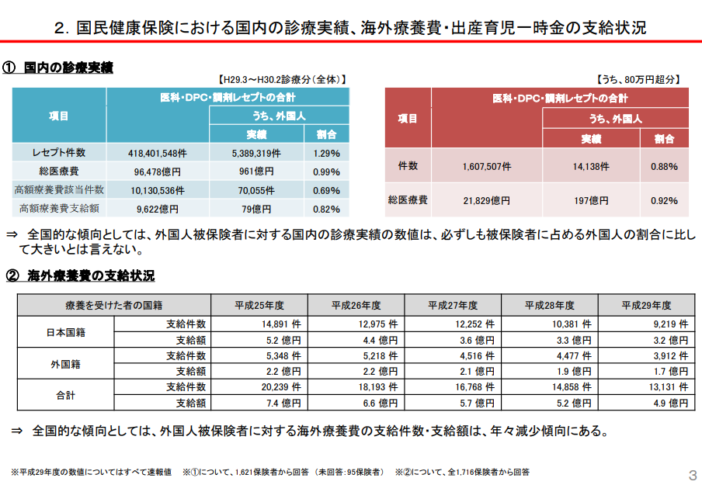
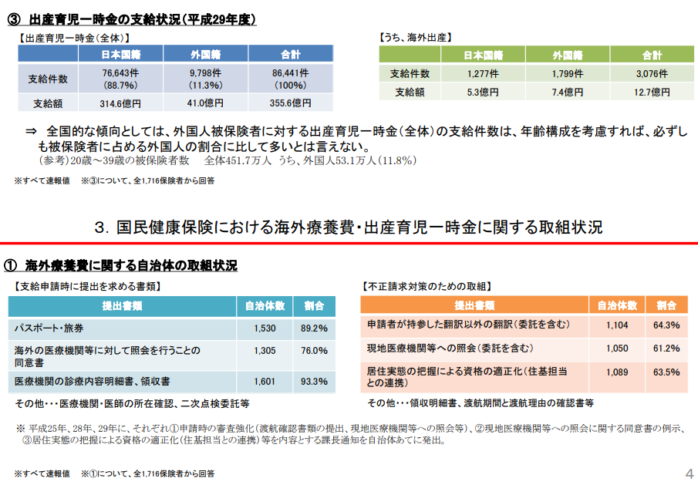
According to the Tokyo Immigration Bureau Naturalization Application Support Office:
Enrollment in National Health Insurance for Foreigners
As of July 7, 9, foreign residents have also become subject to the "Basic Resident Registration System."Foreigners staying in Japan for more than three monthsIt is,Join the National Health InsuranceThis is also a major factor in determining whether or not permission is granted during immigration procedures.
To complete this procedure, present your residence card or alien registration card at the National Health Insurance counter of the city, town or village office where you registered as a resident.An insurance card will be issued.[See source for full text...]
引用元 https://www.mhlw.go.jp/stf/seisakunitsuite/bunya/kenkou_iryou/iryouhoken/shussan/index.html

https://www.visa-amitie-gyosei.com/14592082794899

https://www.mhlw.go.jp/content/12401000/000517334.pdf

https://www.mhlw.go.jp/web/t_doc?dataId=00tc7702&dataType=1&pageNo=1- main
-
Social Media
-
Sports
-
Animal
-
Domestic
-
Politics
-
Overseas
-
Features
-
Economy
-
Entertainment
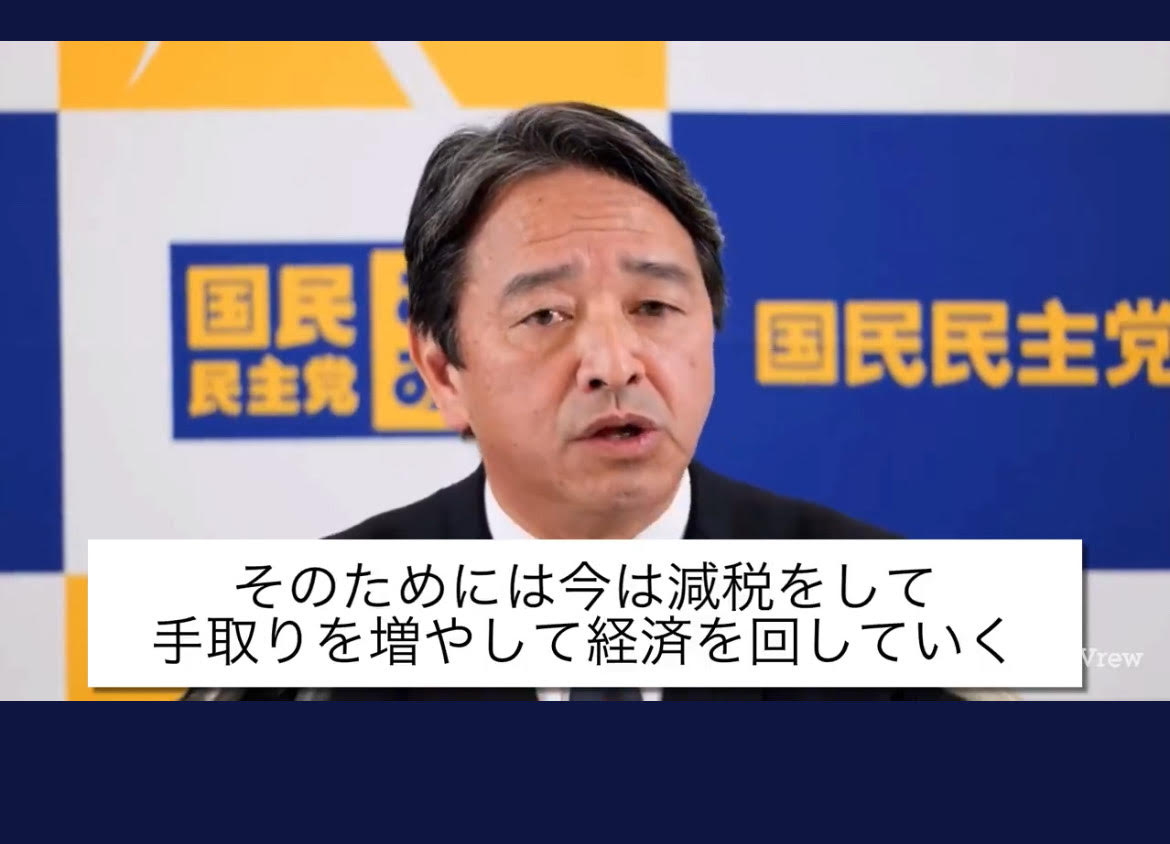
 Video [Mr. Shiba] Not only young people but people living today are suffering... Now is the time to cut taxes, increase take-home pay, and get the economy going. I can't work with people who disagree with that.NEW
- Video [Sad news] Assassin's Creed Yasuke "can attack Japanese people as much as he wants" but can't attack white people, sparking outrage lolNEW
- [Sad news] Freedom in Japan is about to disappear due to SNS and speech restrictions... The government can decide whether information is correct or not. However, TV is not subject to this, so the government can freely broadcast any information that suits its needs, even if it is a lie.NEW
- [Fifi] It is not Japan's fault that illegal immigrant children find themselves in difficult situations, but the fault of their parents. I also want the organizations that defend them to feel responsible for creating a cycle of misfortune.NEW
- Ishiba: "Even if the number of children increases, it will be 18 years before they will be able to vote. By then, we won't be politicians anymore." ← The reason why politicians are uninterested in measures to combat the declining birthrateNotice
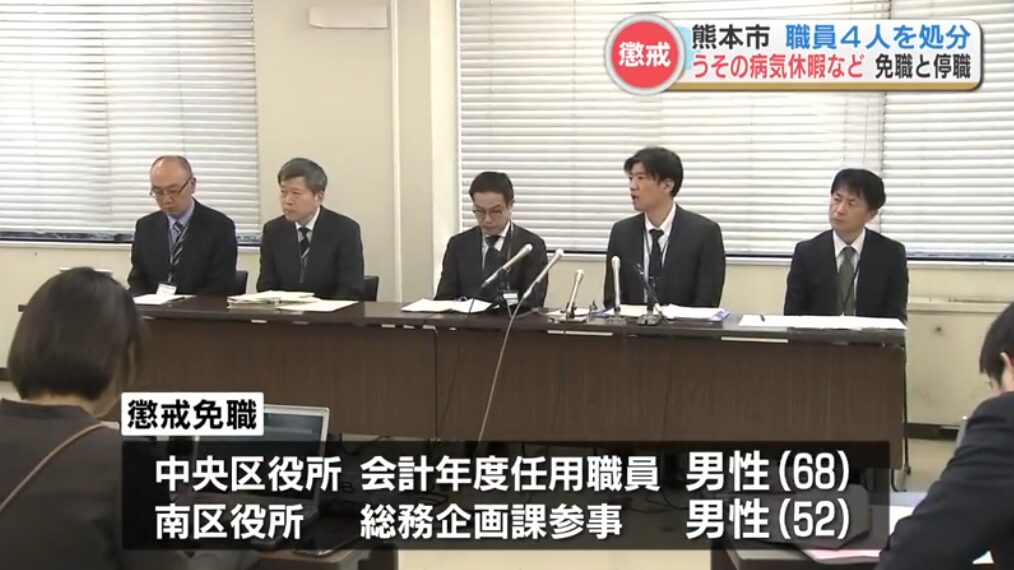
- Kumamoto city employee dismissed for gambling with welfare recipient's cash, saying "I can pay it back with the winnings"; 3 others dismissed or suspended
- White House confirms COVID-19 started after leak from laboratory in Wuhan, China
- Should Kiyomi Tsujimoto, who has a criminal record, remain a member of the Diet?
- [Updated regularly] Trump signs executive orders one after another - A list of policies at a glance
- President Trump: "DEI was going to destroy our country. But now it's over." (DEI = respect for diversity, providing equal opportunities, and creating an environment where everyone can thrive)
 [Kotoe Hashimoto] Japan is the only country on earth that imposes the same consumption tax on milk and diapers as other countries. This is objective evidence that the Ministry of Finance is planning to exterminate the Japanese people.
- Video [Kishida Fumio] Doesn't this sound like he's saying, "Japanese people are racist"?
- [Increase in number of missing technical intern trainees] It's time to ban Vietnamese
- [Topic] Lump-sum childbirth and childcare allowance to be increased from 42 to 50 (from 5) - Foreigners are also eligible, and will be paid even if they give birth overseas. National health insurance available for those residing in Japan for 3 months or more
- Video [Mr. Mihara, Child and Family Agency] Are you worried or anxious about something? We want to work with you to create a society where people can feel that there are adults they can trust.
- Trump: "We'll do something important" in meeting with Putin
- [Sad news] Japan is promoting tax increases such as childcare support subsidy (single tax) +12,000 yen per year, tobacco tax (+1 yen per pack), income tax (+30%), mileage tax (under consideration), retirement allowance tax (reduced deduction amount), commuting allowance tax (under consideration), and pension insurance premium (+1 yen).
- [USA] Forced deportation of illegal immigrants begins, affecting Korean residents in the US
- [Sad news] Japan may provide 7 trillion yen in aid to the US
- Trump administration responds to Selena Gomez's protests over deportation of illegal immigrants by releasing video of crime victim's mother
 Three female TV announcers "entertained like hostesses" with top athlete...Anonymous TV announcer reveals shocking revelation on TBS "Special Report"
- [Video] Kuniko Yamada: "It's not good to call all illegal immigrants criminals"
- Minister Iwatake Naotoshi, ahead of the summit, said, "Both the prime minister and Trump were elected by the people in difficult times. I hope they will demonstrate proper leadership."
- Samsung plans to release new folding models, including a tri-fold smartphone, in 2025
- WHO (World Health Organization) in trouble! USA, Malaysia, Argentina, Kenya, Italy, and India announce their intention to withdraw from the organization
- Communist Party: "We should seriously consider the issue of a female imperial family, a female emperor, and an emperor through the female line"
- "Korean high school student commits sex crime in Japan"... Even the "bothered" Korean scholar demands severe punishment, saying "it's a disgrace to the whole country!"
- LDP official: "Rather than a fun Japan, a strong Japan is the first priority, Mr. Ishiba."
- Sapporo's birth rate in 23 reaches record low of 0.96, falling below 18 for the first time in 1.0 years
- [Fuji TV] Can't pay just 5000 million yen? Possibility of bankruptcy as "FNS Song Festival" with production costs of 5000 million yen is canceled
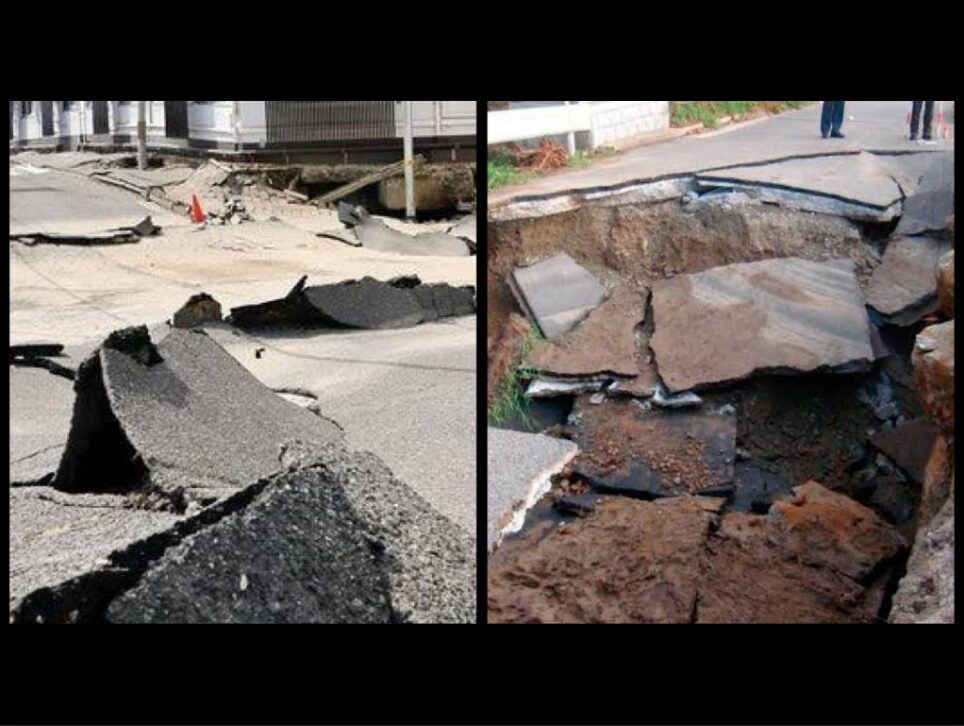
 "If water privatization continues, sinkhole accidents will occur all over Japan" - Posted by X-min
- Brazil court officially registers one child with three fathers and one mother
- [Seventh arrest] A 27-year-old Chinese graduate student was arrested on suspicion of fraud. He used another person's electronic payment code on his smartphone, causing losses of approximately 3000 million yen. Kawagoe, Saitama
- Foreign workers reach record high of 230 million, up 12.4%, with more than 20 specific skilled workers
- Governor Yamashita: Nara K-POP concert "will not be canceled" - Will donations be collected? Will it be scaled down and held indoors? Plans to meet with South Korean Governor Kim in February
- [Topic] "Consideration of tax on commuting allowances" becomes a hot topic again, with complaints such as "Does this mean I shouldn't commute?" and "Working is stupid"
- [This year's Setsubun is February 2nd, beware of beans]
- Elon Musk: "About 80% of refugees are just on vacation..."
- Minister of Internal Affairs and Communications Murakami: "There is no such thing as amakudari!" "There is no such thing as amakudari!" ← "I've never heard of such a thing... (confused)"
- President Trump to meet with Prime Minister Ishiba next week to confirm cooperation against China
 Video [Road collapse accident in Yashio City, Saitama Prefecture] The video of the moment the collapse occurred is too scary
- "The matter has been settled," says PM, backtracking on investigation into secret funds; Constitutional Democratic Party "has not responded"
- [Sad news] The Japanese government announces that about 17 tons of rice (equivalent to 26 billion rice bowls) are missing
- [Video] LDP Secretary-General Hiroshi Moriyama revealed to be a second-generation Korean resident of Japan
- "They collect tax money endlessly. They create slush funds. But they won't tell you how they spend it. That's the Liberal Democratic Party." Posted by X-member
- Constitutional Democratic Party's Sakai: "Expanding the use of maiden names as common names will not resolve the problem"
- Video [Chinese man who just arrived in Japan] "My biggest goal in life is to marry a Japanese woman." "In Shanghai, it's hard to get married unless you have a house or a car." "I prefer high school girls around 18 years old."
- [About 70 people including Hagiuda, Inada, and Noda attend Ishihara's apology] Former Secretary-General Motegi may be starting a study group! The power structure within the LDP is in chaos!
- [Sad news] Dentsu's sales for Olympic collusion are about 76 billion yen, profits are about 8 million yen, but a fine of 3 million yen means they're making a huge profit
- Trump administration to detain 3 immigrants at Guantanamo Bay

 Video [Sad news] Assassin's Creed Yasuke "can attack Japanese people as much as he wants" but can't attack white people, sparking outrage lolNEW
- [Sad news] Freedom in Japan is about to disappear due to SNS and speech restrictions... The government can decide whether information is correct or not. However, TV is not subject to this, so the government can freely broadcast any information that suits its needs, even if it is a lie.NEW
- [Moe Fukada] "If you want us to stop using anonymous accounts on social media, then first ban politicians from using aliases! We don't even know where you're from or what your real names are," a scathing remark to Rui Matsukawa
- Restrictions on Deepseek usage spreading Hundreds of companies and government agencies worldwide concerned about data leaks
- I am a foreigner and a linguist, and I am certain that Japan does not need another official language, and that if it were to make English the official language, it would be cultural suicide.
- [Chinese AI chat] Deep Seek was asked to write 10 scenarios for the collapse of the current Chinese government, and the answers were insane!
- [Collecting more taxes than necessary is legal robbery.] Please put this up in the National Diet!!
- [China] TikTok US business considering sale to Musk - X may acquire management rights
- [Hosei University Hammer Incident] Chinese internet praises the culprit: "Korean female college student is a hero," "Korean Hammer Queen," "I order this female college student to become the president of South Korea"
- [Third generation Korean resident] I am speaking as a naturalized Korean born in Japan. The reason why people are being asked to give up their Korean names is not because they are criminals, but because they have the attribute of being a Korean resident in Japan. As a sign of sincerity to the Japanese people, they should take the initiative in giving up their Korean resident privileges.

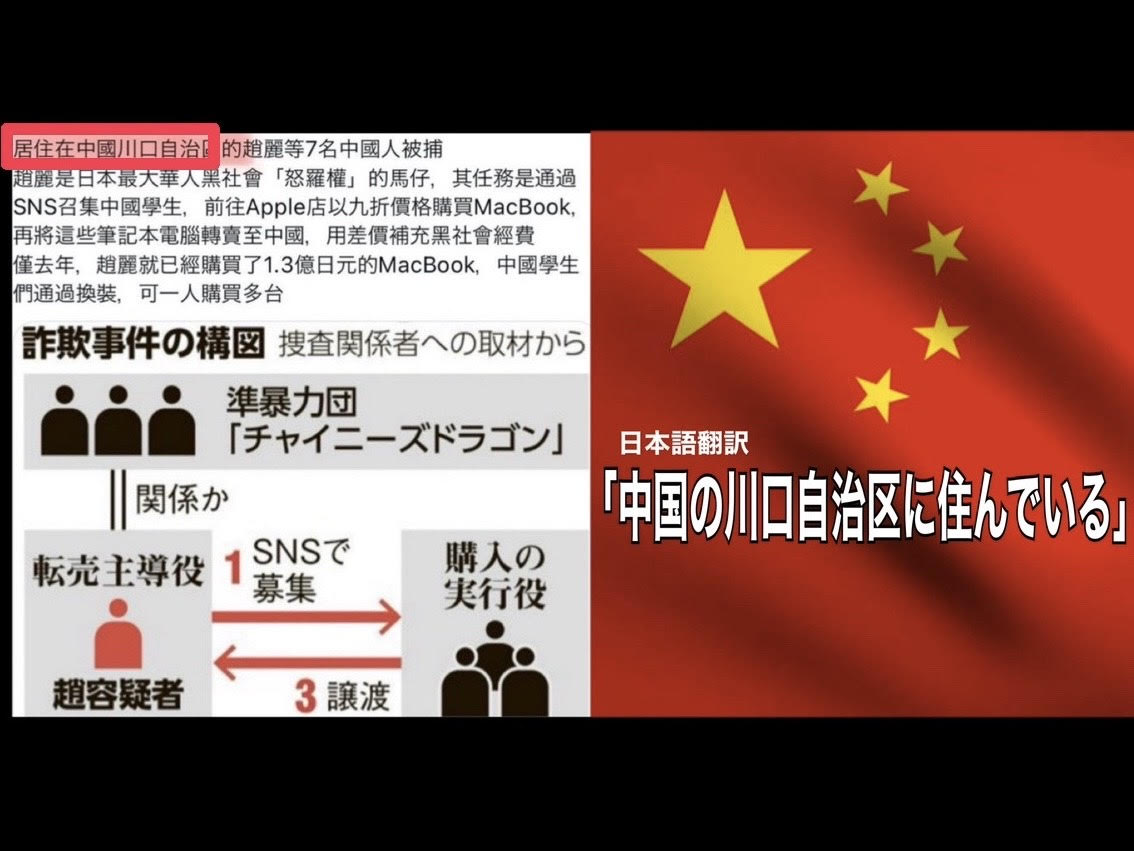
 [Sad news] He has finally started writing that he lives in the Kawaguchi Autonomous Region of China. Japan is now treated as an autonomous region by the Chinese.
- It really hurts to be called a racist for simply tweeting a population figure...
- [Breaking News] Iwaya X deletes and escapes
- It seems that TV stations want to regulate SNS, but I'm glad that Elon Musk bought X. If it was a Japanese SNS, it would be over.
- TV Tokyo reporter warns: "I feel a strong sense of discomfort and contempt for using the occupational discriminatory term 'mass garbage' to refer to the people involved" → What else should we call them? 2000+ comments
- [Video] A large-scale "solar flare" occurred on Earth after midnight on the 10th. →The Ministry of Internal Affairs and Communications has stated that in the worst case scenario, a large-scale solar flare, which occurs less than once every 100 years, could cause mobile phones to be unusable for up to two weeks.
- [Korean TV Station] "Do you know that the pattern resembles the rising sun flag, a symbol of Japanese imperialism?" Protest against the pattern on a top Australian surfer's surfboard → Australia withdraws use
- [Illegal Kurdish Resident] "I'm in a hurry. I can't speak Japanese at all, and I'm not good at English either. I want to settle in Japan and work. Someone please help me!"
- [Saitama Prefectural Police] "In Kawaguchi City, a man (unknown characteristics) slashed a man with what appeared to be a bladed object and then fled the scene." → Hidden social media calls for reports that the man was a foreigner
- [Takashimaya] Repeated duty-free sales to foreigners living in Japan that are not normally permitted → 5 million yen in additional tax
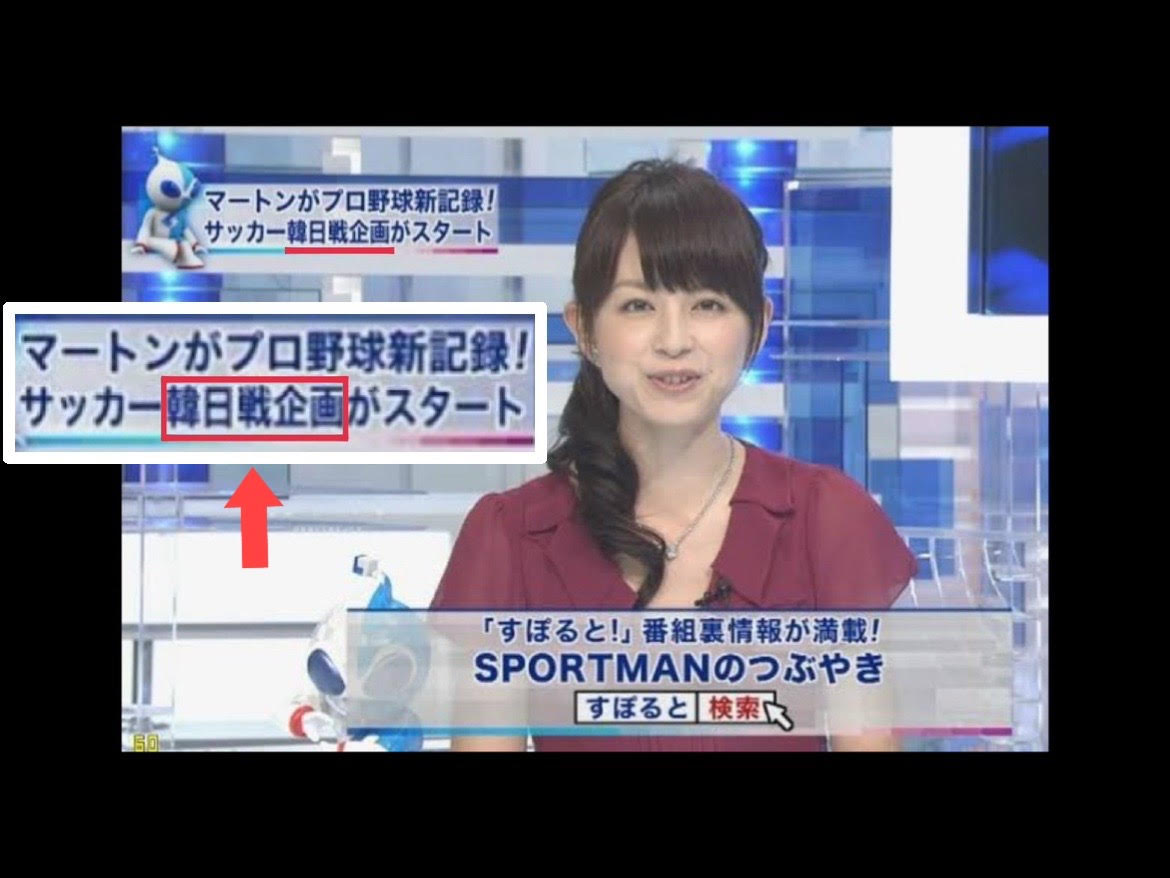
 [Fuji TV] It was discovered that the show had previously been written as "Korea-Japan Match"
- [Nippon Ham] Manager Tsuyoshi Shinjo: "Don't let Korea in" "There are too many dead balls" - Refuses to play a game against the Korean professional baseball team
- Elementary school student karate tournament: Athlete's association apologizes for dangerous behavior, announces punishment for second, suspends indefinitely, and covers medical expenses
- [Video] Ohtani stubbornly refuses to speak English when asked to do so in an interview, but speaks fluent English in his speech to all Dodgers fans at the victory parade
- [Video] Otani refuses to be interviewed by Fuji TV after his house was exposed lol
- Shohei Ohtani achieves his long-awaited first World Series victory! The Dodgers defeat the Yankees to become world champions for the 4th time in 8 years. In his first PS, he played in every game and hit 3 home runs.
- [Breaking News] Dodgers win, moving on to a dream showdown with the Yankees in the World Series!
- [Video] Chinese manager headbutts referee
- [Chinese soccer supporters] Shouting "Kill them! Kill them! Kill them!" during a match against Japan
- Video [Breaking News] Ohtani becomes the first player in history to hit 50 home runs and steal 50 bases with home runs in two consecutive at-bats -- Major League Baseball
 A Korean player elbows a Japanese player and breaks his front tooth. It is up to you to decide whether it was intentional or not.
- [Flooded with criticism!] Japan national team victim of laser pointer attack... Bahraini spectators' malicious disruption → "Disgusting behavior" and "Low level of civility" trend on X - World Cup Asian final qualifying round


 [Fifi] It is not Japan's fault that illegal immigrant children find themselves in difficult situations, but the fault of their parents. I also want the organizations that defend them to feel responsible for creating a cycle of misfortune.NEW
- Kumamoto city employee dismissed for gambling with welfare recipient's cash, saying "I can pay it back with the winnings"; 3 others dismissed or suspended
- [Kotoe Hashimoto] Japan is the only country on earth that imposes the same consumption tax on milk and diapers as other countries. This is objective evidence that the Ministry of Finance is planning to exterminate the Japanese people.
- Video [Kishida Fumio] Doesn't this sound like he's saying, "Japanese people are racist"?
- [Increase in number of missing technical intern trainees] It's time to ban Vietnamese
- [Topic] Lump-sum childbirth and childcare allowance to be increased from 42 to 50 (from 5) - Foreigners are also eligible, and will be paid even if they give birth overseas. National health insurance available for those residing in Japan for 3 months or more
- Three female TV announcers "entertained like hostesses" with top athlete...Anonymous TV announcer reveals shocking revelation on TBS "Special Report"
- [Video] Kuniko Yamada: "It's not good to call all illegal immigrants criminals"
- "Korean high school student commits sex crime in Japan"... Even the "bothered" Korean scholar demands severe punishment, saying "it's a disgrace to the whole country!"
- Sapporo's birth rate in 23 reaches record low of 0.96, falling below 18 for the first time in 1.0 years

 [Fuji TV] Can't pay just 5000 million yen? Possibility of bankruptcy as "FNS Song Festival" with production costs of 5000 million yen is canceled
- "If water privatization continues, sinkhole accidents will occur all over Japan" - Posted by X-min
- [Seventh arrest] A 27-year-old Chinese graduate student was arrested on suspicion of fraud. He used another person's electronic payment code on his smartphone, causing losses of approximately 3000 million yen. Kawagoe, Saitama
- Foreign workers reach record high of 230 million, up 12.4%, with more than 20 specific skilled workers
- Governor Yamashita: Nara K-POP concert "will not be canceled" - Will donations be collected? Will it be scaled down and held indoors? Plans to meet with South Korean Governor Kim in February
- [Topic] "Consideration of tax on commuting allowances" becomes a hot topic again, with complaints such as "Does this mean I shouldn't commute?" and "Working is stupid"
- [This year's Setsubun is February 2nd, beware of beans]
- Video [Road collapse accident in Yashio City, Saitama Prefecture] The video of the moment the collapse occurred is too scary
- [Sad news] The Japanese government announces that about 17 tons of rice (equivalent to 26 billion rice bowls) are missing
- Video [Chinese man who just arrived in Japan] "My biggest goal in life is to marry a Japanese woman." "In Shanghai, it's hard to get married unless you have a house or a car." "I prefer high school girls around 18 years old."

 Video [Mr. Shiba] Not only young people but people living today are suffering... Now is the time to cut taxes, increase take-home pay, and get the economy going. I can't work with people who disagree with that.NEW
- Ishiba: "Even if the number of children increases, it will be 18 years before they will be able to vote. By then, we won't be politicians anymore." ← The reason why politicians are uninterested in measures to combat the declining birthrateNotice
- Should Kiyomi Tsujimoto, who has a criminal record, remain a member of the Diet?
- Video [Mr. Mihara, Child and Family Agency] Are you worried or anxious about something? We want to work with you to create a society where people can feel that there are adults they can trust.
- [Sad news] Japan is promoting tax increases such as childcare support subsidy (single tax) +12,000 yen per year, tobacco tax (+1 yen per pack), income tax (+30%), mileage tax (under consideration), retirement allowance tax (reduced deduction amount), commuting allowance tax (under consideration), and pension insurance premium (+1 yen).
- [Sad news] Japan may provide 7 trillion yen in aid to the US
- Minister Iwatake Naotoshi, ahead of the summit, said, "Both the prime minister and Trump were elected by the people in difficult times. I hope they will demonstrate proper leadership."
- WHO (World Health Organization) in trouble! USA, Malaysia, Argentina, Kenya, Italy, and India announce their intention to withdraw from the organization
- Communist Party: "We should seriously consider the issue of a female imperial family, a female emperor, and an emperor through the female line"
- LDP official: "Rather than a fun Japan, a strong Japan is the first priority, Mr. Ishiba."
 Minister of Internal Affairs and Communications Murakami: "There is no such thing as amakudari!" "There is no such thing as amakudari!" ← "I've never heard of such a thing... (confused)"
- President Trump to meet with Prime Minister Ishiba next week to confirm cooperation against China
- "The matter has been settled," says PM, backtracking on investigation into secret funds; Constitutional Democratic Party "has not responded"
- [Video] LDP Secretary-General Hiroshi Moriyama revealed to be a second-generation Korean resident of Japan
- "They collect tax money endlessly. They create slush funds. But they won't tell you how they spend it. That's the Liberal Democratic Party." Posted by X-member
- Constitutional Democratic Party's Sakai: "Expanding the use of maiden names as common names will not resolve the problem"
- [About 70 people including Hagiuda, Inada, and Noda attend Ishihara's apology] Former Secretary-General Motegi may be starting a study group! The power structure within the LDP is in chaos!
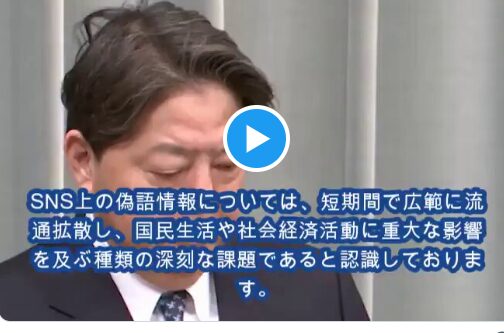
- [Fake and misinformation on social media] Chief Cabinet Secretary Hayashi: "We will take comprehensive measures while also considering freedom of expression" The Ministry of Internal Affairs and Communications is preparing to formulate guidelines for illegal information
- [Economy] The real trump card to save the lives of the people is not "tax cuts"... Why "wage increases" hold the key to Japan's fate - [Newsweek]
- [Prime Minister Ishiba] US withdrawal from WHO "is not welcomed by our country"
 White House confirms COVID-19 started after leak from laboratory in Wuhan, China
- [Updated regularly] Trump signs executive orders one after another - A list of policies at a glance
- President Trump: "DEI was going to destroy our country. But now it's over." (DEI = respect for diversity, providing equal opportunities, and creating an environment where everyone can thrive)
- Trump: "We'll do something important" in meeting with Putin
- [USA] Forced deportation of illegal immigrants begins, affecting Korean residents in the US
- Trump administration responds to Selena Gomez's protests over deportation of illegal immigrants by releasing video of crime victim's mother
- Brazil court officially registers one child with three fathers and one mother
- Elon Musk: "About 80% of refugees are just on vacation..."
- Trump administration to detain 3 immigrants at Guantanamo Bay
- Cyber attack on DeepSeek: Chinese media says 'it all came from the US'

 Deepseek leaks confidential data online for a short time - US company
- [X-min] Perhaps due to the influence of US President Trump, an order was issued in the NT in Australia to remove the rainbow flags that were displayed at public hospitals. The end of the LGBTQ movement is near.
- "Japanese people are afraid of Chinese youth" post receives positive response from Chinese internet users - "That's exactly the situation" and "There's not even a hair's worth of admiration for Japan"
- Germany passes motion to expel illegal immigrants; Merkel makes rare criticism
- [President Trump] Signed the Laken Riley Act. This means that illegal immigrants will be detained even for minor crimes. Shouldn't Japan also do this instead of allowing married couples to have different surnames?
- Indian article: "WHO has lost its independence. The Indian government should withdraw from the global health organization" [2023]
- [Italy] DeepSeek cannot be downloaded, request for explanation
- Meta will pay President Trump $2,500 million to settle a lawsuit filed after the company suspended his account.
- "How many illegal immigrants in the US are criminals?" - 27-year-old new White House press secretary: "They're all illegal immigrants"
- [Kenya] Wants to withdraw from WHO: "We can no longer trust WHO" Supreme Court also suspends Bill Gates' immunity from prosecution

 Earn money through self-affiliation! Only these 5 ASPs have self-packs
- To make money with FX, it's important to know which company to use! 7 FX company comparison rankings
- Earn tons of extra money with point activities! 8 recommended points sites
- Earn money through surveys! How to choose a site? 7 recommended survey sites
- Earn money easily with game apps! 7 recommended and fun smartphone games

 Samsung plans to release new folding models, including a tri-fold smartphone, in 2025
- Osaka Prefecture to implement fourth round of "Rice Coupons" - Increased to 4 yen due to rising rice prices
- Keidanren: "6% wage increase for small and medium-sized companies is tough" - Comments on Rengo's demands
- [Ishiba Administration] EV purchase subsidy to be increased by up to 5 yen
- [Ministry of Health, Labour and Welfare] 5600 billion yen in living expenses loans waived during the COVID-XNUMX pandemic
- Government and ruling parties adjust plan to raise "103 million yen annual income barrier" to 150 million yen
- [Analysis by Heizo Takenaka] With President Trump inaugurated, the world economy "cannot improve" and "the standard of living of the American people will decrease"
- [Breaking News] Bank of Japan to decide on additional interest rate hike
- Minister of Economy, Trade and Industry Akazawa criticized the Democratic Party for the People, saying, "It is not as simple as just returning the increased tax revenue to the people."
- [Governor Kuroda, a former Finance Ministry employee] Lifetime salary of over 12 billion yen? He bought a multi-million-yen mansion with cash! It's an amazing system that increases the finance ministry's coffers when the consumption tax is raised!

 Tamogami: "Japan's total assets will be 2024 trillion yen by the end of 1!"
- "The dollar will be worth 1 yen" - Former Morgan Bank Tokyo branch manager gives final warning to Japan! "The day will soon come when banknotes will be worthless" - The yen's depreciation cannot be stopped any longer
- [Prime Minister Ishiba] Request for cooperation in passing on price hikes to ensure wage increases that do not fall behind inflation
- Chief Cabinet Secretary Yoshimasa Hayashi: "There is no such thing as tax revenue that can be lost"... Discusses the 103 million yen barrier and the provisional gasoline tax rate
- [Sad news] The number of bankruptcies in November 2024 will be 11, the highest annual total since 834 → "The government has no policy. Politicians can live comfortably."
- [China] Imports of Japanese seafood to resume ← The timing makes it seem like the only way to settle the "death of a male student at a Japanese school" issue...
- [The reality of the weak yen] Foreign tourists "enjoy 42 days for 10 yen" while Japanese "live on 15 yen a month..." What is the difference?
- [Constitutional Democratic Party of Japan, Kazuhiro Haraguchi] "Finally, Japan is ranked 10th in high-tech exports! It's time to wake up. Japan's decline! Let's put a stop to it. Japan's decline!"
- Toyota's Mirai to be used as official vehicle for Paris Olympics; academics and engineers demand withdrawal
- [The flat-rate tax cut was meaningless] Real wages have fallen for 26 consecutive months… This year too, ordinary people will definitely have a “summer of saving”
 [Sad news] Nakai Masahiro may be bankrupt due to numerous damages
- [Breaking News] Nakai Masahiro announces retirement from showbiz
- [Takafumi Horie] There was a tip-off that a Fuji TV executive forced him onto the set, saying, "You'll be able to see AKB48 in their underwear, right?"
- [All six of Nakai's regular shows are gone] TV Asahi announces the cancellation of "Masahiro Nakai's Saturday Gathering"
- [Breaking News] Request to suspend broadcast of "Kuishinbo! Banzai" / Kikkoman has been asked by Fuji Television to suspend the broadcast of the long-running program, which has been sponsored by only one company for 1 years, from the 50th.
- Come to think of it, back then I always felt uncomfortable seeing a group of women in red clothes and miniskirts just sitting in a row behind the MC of the show, not doing anything.
- Former female announcer Kanon Aoki said, "The production staff at Fuji TV are aggressive in a bad way. When I was an announcer, I couldn't get out of a Fuji production staff member's car until I kissed him and touched him, and when I refused, he got angry. I was mentally cornered and started taking drugs."
- [Yuta Misaki] I might get in trouble for saying this, but pensions are an investment product that you are forced to join and will definitely result in a loss. It's so crazy. Namu Amida Butsu.
- [Fifi] What was the real meaning behind calling Fuji TV's female announcers by adding "~pan~pan" to their names?
- Masahiro Nakai's case featured in Bloomberg
 Kyoko Koizumi: "Sigh... I guess tax returns are stupid. You should have paid your taxes first and then said this" - angry at politicians and the government for their secret funds
- [Fifi] If the number of foreigners who don't follow the rules increases, the impression of foreigners will get worse and they will become a nuisance, so I want them to be strictly regulated. Foreigners are the ones raising their voices in this regard, so this isn't exclusionary or anything.
- The information program desk said, "We were criticized for asking her sister, Shinobu Nakayama, for a comment, but the scene was orderly, and Shinobu's comments were not forced and were in accordance with the rules." → No regrets
- [Video] Katayama: "(SNS) is true and false. There is no punishment or check. You can say whatever you want and whoever says it first wins." Higashino: "It's the same on TV." → Higashino is stating a very reasonable opinion.
- Megumi Toshiaki's personal opinion on the results of the Hyogo Prefectural Governor election: "When I see a delinquent kid walking around with his grandma on his back, I think he might actually be a good guy." "He was a total bad guy..."
- A Korean copyright management organization revealed that "K-POP is not selling at all overseas," and calculated the amount of tax collected in each country...
- Hollywood celebrities who said they would leave the US if Trump was re-elected are actually fleeing the US
- Matsumoto Hitoshi is a total winner! He will be returning to his seven regular shows from the beginning of the new year!
- [Breaking News] Matsumoto Hitoshi's side to withdraw lawsuit and apologize for defamation lawsuit over weekly magazine article
- Matsuko: The reason why it's hard to find the "egg section" in supermarkets... "It's scary..." to the unexpected truth. Ariyoshi: "That's an amazing reason."

Everyone's comments
- This is supposed to be a measure to combat Japan's declining birthrate, so I don't understand why foreigners are also being targeted. Shouldn't we support Japanese families first?
- The increase in the maternity allowance is a good thing, but it is strange that it is paid even if the mother gives birth overseas. This will only lead to abuse of the system.
- Japan's national health insurance is supposed to be a system for people who live in Japan. However, the system that allows foreigners to join if they stay in Japan for only three months is problematic no matter how you look at it.
- In the end, it's because of this system that foreigners keep coming to Japan, which ends up increasing the burden on Japanese people. I wonder if the government is really thinking about its citizens.
- I don't understand why the taxes paid by hard working Japanese people are being used to support foreigners who don't live in Japan. I want the opinions of taxpayers to be respected more.
- If we are to take measures against the declining birthrate, we should provide generous support to children born and raised in Japan. I don't understand why we have to give money to foreigners who don't even live in Japan.
- It would be too irresponsible to expand the lump-sum childbirth allowance to the current problem of unpaid medical expenses for foreigners. After all, it is the Japanese who will bear the increased burden.
- If we are going to increase childbirth benefits, shouldn't we first use them to create an environment in which it is easier for young people in Japan to get married and raise children?
- It's one thing if the foreigners are working in Japan and paying taxes, but I think it goes against the purpose of the system to target people who aren't.
- It is certain that an increasing number of foreigners will abuse this system by staying in Japan for only a short period of time to receive childbirth expenses. Is the government properly considering the risks?
- It is said that the financial resources of the National Health Insurance System are tight, so why are they spreading the burden to foreigners as well? Won't this only make things even harder for Japanese people?
- The government always says it doesn't have enough funds, yet it seems contradictory to immediately provide money for such preferential treatment for foreigners.
- There are many Japanese who cannot have children even after getting married because of the financial difficulties. Instead of providing support for them, giving lump-sum childbirth benefits to foreigners seems out of place.
- If you can get money under the Japanese system even if you give birth overseas, it is obvious that more and more foreigners will do so. The system is too lenient.
- If Japan is really thinking about how to combat the declining birthrate, it should first strengthen support for Japanese people to have more children, and there is no reason to give preferential treatment to foreigners.
- How long do they intend to continue this lenient policy towards foreigners? The burden on Japanese people is only increasing, and I don't know why I am paying taxes.
- Originally, Japan's social security system was created for the benefit of Japanese people. Expanding it to foreigners is a sign of the country's direction being taken.
- If things continue as they are, the number of foreigners will continue to increase and Japan's social security system will collapse. The government should immediately review the system.
- The increase in the allowance itself is a good thing, but it should be limited to cases where the child is born in Japan. Paying it for births abroad will only invite abuse of the system.
- I want the government to seriously consider how these preferential treatment measures for foreigners will be detrimental to Japanese people in the future when there will be insufficient budgets to raise Japanese children.
Editor A's opinion
The increase in Japan's maternity allowance to 50 yen and the fact that foreigners will also be eligible has become a hot topic. The amount has been increased from 42 yen to 50 yen, and foreigners who have been enrolled in the National Health Insurance for more than three months will be eligible to receive the allowance. Furthermore, it is said that the system will be in place to provide benefits even if you give birth overseas. There are pros and cons to this decision, but I believe that it should be a system for Japanese people.
Increasing the lump-sum childbirth allowance may be necessary as a measure to combat Japan's declining birthrate. However, I find it difficult to understand why it is necessary to include foreigners. It is hard to accept that taxes paid by Japanese people should be used to cover the childbirth expenses of foreigners who are not even living in Japan. The purpose of the system is to create an environment in which it is easy to give birth, but in its current state it seems to be straying from its original purpose.
Even more problematic is the fact that a lump sum payment is given even if you give birth overseas. Originally, Japan's medical system is for people living in Japan. Despite this, if you are enrolled in the National Health Insurance for more than three months, you will be paid 3 yen even if you give birth overseas. Doesn't this increase the possibility of foreigners taking advantage of the Japanese system to obtain illegal benefits?
For example, there may be a case where a woman comes to Japan just before giving birth, joins the National Health Insurance, and then returns to her home country to give birth. In that case, she is able to receive a lump sum payment even though she is not paying taxes in Japan and is not giving birth in Japan. This type of system could end up only increasing the burden on Japanese people.
First of all, Japan's social security system should exist for Japanese people. Considering Japan's current financial situation, the first priority should be to create an environment in which Japanese people can give birth and raise children with peace of mind. Under the current system, insurance premiums and taxes paid by Japanese people are also paid to foreigners who give birth overseas. Won't this end up encouraging abuse of the system?
The government has indicated a policy to expand the scope of social security coverage in response to the increase in the number of foreign residents. However, at the same time, there are increasing cases of young Japanese people giving up on marriage and childbirth for economic reasons. Given this reality, shouldn't we prioritize Japanese people's childbirth and child-rearing?
In addition, there are cases of foreigners living in Japan giving birth while receiving welfare. The rate of foreigners receiving welfare is higher than that of Japanese people, and many of them use Japanese social security despite not paying taxes. In such a situation, would expanding the scope of recipients of the lump-sum maternity allowance really be in Japan's national interest?
I support the increase in the lump-sum childbirth allowance itself, but I think it is problematic to expand the scope of recipients too easily. In order to maximize the effectiveness of this measure to combat the declining birthrate, shouldn't priority be given to Japanese families and it be limited to births in Japan? If it is to be paid to foreigners, there should be conditions such as limiting it to those who have worked in Japan for a certain period of time and paid taxes.
On the other hand, it is also true that Japan's measures to combat the declining birthrate are insufficient. More comprehensive support is needed, including not only an increase in the lump-sum childbirth allowance, but also expanded childcare assistance, improved daycare facilities, and reduced education costs. Creating an environment in which Japanese people can build families with peace of mind would be the most effective way to combat the declining birthrate.
Under the current system, the taxes paid by hard working Japanese people are also paid by foreigners who are not living in Japan. Isn't this an unfair system for Japanese people? If the government is serious about tackling the declining birthrate, it should first prioritize strengthening support for Japanese people in raising children.
If things continue as they are, the burden on Japanese people may increase even more as foreigners use the system. With problems of unpaid medical expenses and public assistance already being pointed out, it seems unwise to further increase the burden on social security. There is a need to review the system and establish a mechanism for providing benefits appropriately to those who truly need them.
I would like to keep a close eye on how the government responds to this issue. I hope that they will carefully consider how our taxes are being used and take necessary measures for the future of Japan.
Written by: Editorial Department A
Recent Posts
-
Video [Mr. Shiba] Not only young people but people living today are suffering... Now is the time to cut taxes, increase take-home pay, and get the economy going. I can't work with people who disagree with that.
-
Video [Sad news] Assassin's Creed Yasuke "can attack Japanese people as much as he wants" but can't attack white people, sparking outrage lol
-
[Sad news] Freedom in Japan is about to disappear due to SNS and speech restrictions... The government can decide whether information is correct or not. However, TV is not subject to this, so the government can freely broadcast any information that suits its needs, even if it is a lie.
-
[Fifi] It is not Japan's fault that illegal immigrant children find themselves in difficult situations, but the fault of their parents. I also want the organizations that defend them to feel responsible for creating a cycle of misfortune.
-
Kumamoto city employee dismissed for gambling with welfare recipient's cash, saying "I can pay it back with the winnings"; 3 others dismissed or suspended
Comment