This study extends the analytic approach conducted by Wattset al2018 to examine the long-term predictive validity of delay of gratification. Participants (n = 702; 83% White, 46% male) completed the Marshmallow Test at 54 months (1995–199629ya) and survey measures at age 26 (2017–2018).
Using a preregistered analysis, Marshmallow Test performance was:
not strongly predictive of adult achievement, health, or behavior. Although modest bivariate associations were detected with educational attainment (r = 0.17) and body mass index (r = −0.17), almost all regression-adjusted coefficients were non-statistically-significant. No clear pattern of moderation was detected between delay of gratification and either socioeconomic status or sex.
Results indicate that Marshmallow Test performance does not reliably predict adult outcomes. The predictive validity & construct validity of the ability to delay gratification are discussed.
This paper studies important determinants of adult self-control using population-representative data and exploiting Germany’s division as quasi-experimental variation. We find that former East Germans have substantially more self-control than West Germans and provide evidence for government surveillance as a possible underlying mechanism. We thereby demonstrate that institutional factors can shape people’s self-control. Moreover, we find that self-control increases linearly with age. In contrast to previous findings for children, there is no gender gap in adult self-control and family background does not predict self-control.
This paper assesses the impact of general intelligence, as well as specific personality traits, and aspects of motivation, on performance, potential, and advancement of senior leaders. A questionnaire survey was conducted on the full population of 381 senior officers in the Royal Navy with an 80% response rate.
Performance, potential, and rate of advancement were established direct from the organization’s appraisal system; intelligence, personality traits, and motivation were assessed, at the time of the study, using the Verify G+ Test, Occupational Personality Questionnaire, and Motivation Questionnaire.
Findings: suggest differences in motivation are more important than differences in general intelligence or personality traits in predicting assessed performance, potential within, and actual rate of advancement to senior leadership positions.
This is a rare example of a study into very senior leaders, validated against both formal appraisal data and actual rates of advancement. As a consequence of this study, the Royal Navy has started to use psychometric-based assessments as part of the selection and development of its most Senior Officers.
[Keywords: motivation, performance, potential, rate of advancement, military command, leadership and management, senior leaders]
…With the DV performance, the G+ scale’s multiple correlation is not statistically-significant. This accounts for 0.2% of the explained variance on performance; the OPQ scales’ multiple correlation is not statistically-significant. This accounts for 3.9% of the explained variance on performance; The MQ multiple correlation is also not statistically-significant. MQ, G+, and OPQ account cumulatively for 12.4% of the variance on performance. The MQ augmentation of 8.2% to the total variance is statistically-significant. From the standardized Beta weights in model 2, 4 scales statistically-significantly contributed to the regression function: one OPQ scale (Conscientious) and 3 MQ Scales: Fear of Failure, Ease and Security and Affiliation.
…Against the DV rate of advancement, the G+ scale’s multiple correlation is not statistically-significant. This accounts for 0.006% of the explained variance; the OPQ scales’ multiple correlation is highly statistically-significant. Combined G+ and OPQ scales account for 9.8% of the explained variance on rate of advancement. The MQ multiple correlation is highly statistically-significant. Adding MQ to the G+ and OPQ scales accounts for 20.1% of the explained variance. This augmentation by the MQ scales of 10.3% to the total variance is highly statistically-significant. From the standardized Beta weights, 3 scales statistically-significantly contributed to the regression function: OPQ Behavioral and MQ Progression and Status (both highly statistically-significant).
In the above hierarchical regression analyses personality and intelligence, even when not statistically-significant, were left in the final models to illustrate how motivation augments these characteristics. This approach was adopted because a key aim of the study is to explain to practitioners how the interplay of intelligence, personality, and motivation affects positive career outcomes—not just establish the most parsimonious academic representation of the relationship.
[OSF, supplement] Personality and cognitive ability are consequential domains of human individuality. More than 100 years of research has examined their connections, and yet most ability-personality relations remain unknown. We quantitatively synthesized 1,325 studies including millions of individuals from more than 50 countries to identify novel, considerable ties between personality traits and cognitive abilities.
Neuroticism facets (eg. suspiciousness, depression) were negatively related to most cognitive abilities including non-invested (eg. fluid reasoning) and invested abilities (eg. knowledge). Extraversion’s activity facet had sizable, positive relations with several non-invested (eg. retrieval fluency and processing abilities) and invested abilities. Conscientiousness’ industriousness and agreeableness’ compassion aspects positively related to most invested abilities.
The previous focus on high-level relations obscured understanding of individual differences and their applications.
Cognitive ability and personality are fundamental domains of human psychology. Despite a century of vast research, most ability-personality relations remain un-established.
Using contemporary hierarchical personality and cognitive abilities frameworks, we meta-analyze unexamined links between personality traits and cognitive abilities and offer large-scale evidence of their relations. This research quantitatively summarizes 60,690 relations between 79 personality and 97 cognitive ability constructs in 3,543 meta-analyses based on data from millions of individuals. Sets of novel relations are illuminated by distinguishing hierarchical personality and ability constructs (eg. factors, aspects, facets).
The links between personality traits and cognitive abilities are not limited to openness and its components. Some aspects and facets of neuroticism, extraversion, and Conscientiousness are also considerably related to primary as well as specific abilities.
Overall, the results provide an encyclopedic quantification of what is currently known about personality-ability relations, identify previously unrecognized trait pairings, and reveal knowledge gaps.
The meta-analytic findings are visualized in an interactive webtool. The database of coded studies and relations is offered to the scientific community to further advance research, understanding, and applications.
This manuscript was initially based on the first author’s doctoral dissertation advised by the second author and Prof. Matt K. McGue. The database and analyses have all been updated. Therefore, the results and findings here supersede those.
This study addressed a gap in the research literature by evaluating the validity of general mental ability (g) and personality test scores for prediction of firearms proficiency via shooting range performance, an entirely objective task-based criterion. It was hypothesized that mental ability test scores would be positively related to firearms proficiency based on past research in related areas (eg. g predicts skill acquisition and training performance) and conceptual similarities between firearms proficiency and cognitive tasks.
Using 4 datasets with a combined sample size of 22,525 individuals, this hypothesis was:
confirmed: g had operational validities ranging 0.162–0.188 and logical reasoning had operational validities ranging 0.179–0.268 after correcting for range restriction and criterion unreliability. Mental ability test scores predicted an entirely psychomotor criterion task: use of firearms to hit targets at a pre-determined level of accuracy. Most of the validity appears to be attributable to g, but a post hoc analysis indicated that writing ability acted as a suppressor (ie. the validity of g increased when writing ability was included in a regression model).
Conscientiousness was hypothesized to have a positive relationship with firearms performance and emotional stability was hypothesized to have positive linear and quadratic relationships. In contrast, it was observed that Conscientiousness had a negative operational validity (−0.079) and emotional stability lacked validity relative to the firearms proficiency criterion.
The implications for individual differences research and practice are discussed. [cf. military research like Project A or McNamara’s Morons]
[Keywords: firearms proficiency, general mental ability, criterion validity, test development and validation]
Transcript of famous & widely-quoted 1986-03-07 lecture by Turing-Award mathematician Richard Hamming about how to do scientific research & development based on his life, antecedents of eminence, people he knew, the growing use of computers in science, navigating bureaucracy, maintaining creativity, and running Bell Labs.
This talk centered on Hamming’s observations and research on the question “Why do so few scientists make significant contributions and so many are forgotten in the long run?” From his more than 40 years of experience, 30 of which were at Bell Laboratories, he has made a number of direct observations, asked very pointed questions of scientists about what, how, and why they did things, studied the lives of great scientists and great contributions, and has done introspection and studied theories of creativity.
The talk is about what he has learned in terms of the properties of the individual scientists, their abilities, traits, working habits, attitudes, and philosophy.
Technology startups are essential to the global economy. Yet, predicting their short & long-term outcomes remains difficult. This is particularly true in the early stages of a venture’s lifecycle when little to no performance data are available. We offer large-scale, ecologically valid evidence for the importance of a startup feature that is available from the moment of startup conception: founder personality.
Our findings suggest that while some Big 5 personality traits consistently predict startup outcomes across all stages (ie. emotional stability), others reverse their associations with entrepreneurial outcomes as the startup matures from conception to exit (ie. Conscientiousness).
By doing so, they offer novel insights into the role of founder personality in technology startups.
Technology startups play an essential role in the economy—with 7⁄10 largest companies rooted in technology, and venture capital investments totaling ~$300B annually. Yet, important startup outcomes (eg. whether a startup raises venture capital or gets acquired) remain difficult to forecast—particularly during the early stages of venture formation.
Here, we examine the impact of an essential, yet underexplored, factor that can be observed from the moment of startup creation: founder personality. We predict psychological traits from digital footprints to explore how founder personality is associated with critical startup milestones. Observing 10,541 founder-startup dyads, we provide large-scale, ecologically valid evidence that founder personality is associated with outcomes across all phases of a venture’s life (ie. from raising the earliest funding round to exiting via acquisition or initial public offering).
We find that Openness and Agreeableness are positively related to the likelihood of raising an initial round of funding (but unrelated to all subsequent conditional outcomes). Neuroticism is negatively related to all outcomes, highlighting the importance of founders’ resilience. Finally, Conscientiousness is positively related to early-stage investment, but negatively related to exit conditional on funding. While prior work has painted Conscientiousness as a major benefactor of performance, our findings highlight a potential boundary condition: The fast-moving world of technology startups affords founders with lower or moderate levels of Conscientiousness a competitive advantage when it comes to monetizing their business via acquisition or IPO.
…For the purpose of this study, we predict founders’ personality from the language extracted from their Twitter tweets in the 2 years prior to founding (see Methods for details on the predictive models).
In a second step, we link these personality profiles to the following startup outcomes across all stages of the entrepreneurial life cycle: (1) whether the startup raised funding, (2) the amount it raised in the earliest funding round, (3) the number of investors it included in the earliest funding round, and (4) whether it exited [via acquisition or initial public offering (IPO)]. The data were accessed using Crunchbase’s research application programming interface (API)19. The final dataset includes 10,541 US-based founder-startup pairs, their predicted personalities, and their startups’ outcomes (Figure 1).
…Results: Figure 2 displays the results of a series of logistic and linear regression analyses predicting startup outcomes from Big 5 personality traits and controls (see SI Appendix, Table S1 for full model output and SI Appendix, Table S2 for the variable means and zero-order correlations). To facilitate the interpretation of effects, the personality estimates were z-standardized. All analyses control for the year the company was founded, the number of founders, the gender of the founder, US state, and industry-fixed effects.
Figure 2: Relationships between founders’ Big 5 personality traits (z-standardized) and startup outcomes.
(A) %-Change in the likelihood of raising funding.
(B) Change in the dollar amount raised in the first round (in Millions).
(C) Change in the number of investors in the first round.
(D) %-Change in the likelihood of exiting (via IPO or acquisition). ✱p < 0.05, ✱✱p < 0.01, ✱✱✱p < 0.001.
Whether a startup raised initial funding (Figure 2A, logistic regression) was positively related to Openness and Agreeableness. An increase of 1 SD in Openness and Agreeableness was associated with a 5% higher likelihood of attracting funding. For those startups that raised initial funding, the amount they raised during the startups’ earliest funding round (Figure 2B, linear regression) was statistically-significantly related to Conscientiousness and Neuroticism. An increase of 1 SD in Conscientiousness was associated with an additional $170,000 raised, while an increase of 1 SD in Neuroticism was associated with a drop of $90,000. Similarly, the number of investors included in the first round of funding (Figure 2C, linear regression) was statistically-significantly related to Conscientiousness and Neuroticism. A 1 SD increase in Conscientiousness and Neuroticism was associated with having 0.21 and 0.20 fewer investors, respectively. Finally, whether the startup exited (via acquisition or IPO; Figure 2D, logistic regression) was negatively related to Conscientiousness and Neuroticism. A 1 SD increase in Conscientiousness and Neuroticism was associated with a 15% and 16% lower likelihood of exiting, respectively. Taken together, the results suggest that founder personality plays an important role across the different phases of a new venture’s development, from initial fundraising to exit.
…Extraversion was the only personality trait that did not show any statistically-significant relationships with startup outcomes. This finding stands in contrast to prior literature which has found a weak relationship between founder extraversion and startup performance6. However, the difference might be explained by our focus on technology startups. The public depiction of technology founders as “introverted geeks” (eg. the TV series Silicon Valley) and the prominence of many successful introverted tech founders (eg. Bill Gates, Mark Zuckerberg, or Steve Jobs) might offset any positive effect extraversion typically has51. [That seems extremely unlikely, given how causally weak such stereotypes or expectations are.]
The associations between morningness-eveningness, conscientiousness, and religiosity have not been investigated to date. The aim of the present research was to provide evidence for the relationships between these dimensions.
Moreover, we tested whether the well-established link between morningness and life satisfaction could be explained by elevated religiosity of morning-oriented individuals and whether this relationship may be mediated by Conscientiousness. The investigation was conducted on two independent samples of Polish adults (n = 500 and n = 728).
Our results corroborated earlier findings that morningness was positively associated with both Conscientiousness and satisfaction with life. We also found evidence for a statistically-significant positive association between morningness and religiosity.
Moreover, controlling for age and gender, we obtained statistically-significant mediation effects showing that the association between morningness-eveningness and satisfaction with life might stem, at least in part, from the higher religiosity among morning-oriented individuals, also when Conscientiousness was included in the model.
It means that more morning-oriented individuals may benefit from higher psychological well-being thanks to both personality characteristics and attitudes towards religion.
[Twitter] Noncognitive skills such as motivation and self-regulation, predict academic achievement beyond cognitive skills. However, the role of genetic and environmental factors and of their interplay in these developmental associations remains unclear.
We provide a comprehensive account of how cognitive and noncognitive skills contribute to academic achievement ages 7–16 in a sample of >10,000 children from England and Wales.
Results indicated that noncognitive skills become increasingly predictive of academic achievement across development. Triangulating genetic methods, including twin analyses and polygenic scores (PGS), we found that: the contribution of noncognitive genetics to academic achievement becomes stronger over development. The PGS for noncognitive skills predicted academic achievement developmentally, with prediction nearly doubling by age 16, pointing to gene-environment correlation (rGE). Within-family analyses indicated both passive and active/evocative rGE processes driven by noncognitive genetics.
By studying genetic effects through a developmental lens, we provide novel insights into the role of noncognitive skills in academic development.
The article by Wooet al2022 reviews the existing research on graduate-school admissions measures. The goal of this commentary is to expand on their review and suggest several ways of supplementing the Graduate Record Examination (GRE) to both increase the predictive validity of admissions decisions and improve the diversity of a graduate program.
We rely on several decades of research to suggest assessing both conscientiousness and vocational interests and combining the scores from these predictors with the GRE to inform admissions decisions.
In addition, we also propose several ways of expanding recruitment efforts to attract qualified underrepresented minority applicants to improve the diversity of the applicant pool.
What is it about? Special forces operators perform in mentally and physically tough environments. For instance, they need to complete high-stakes missions, such as saving a hostage, successfully even when dehydrated or sleep deprived. As a consequence, the special forces training is very challenging and the great majority of recruits drop out during the selection period.
In order to find out which types of people become successful commandos, we examined whether (1) Dutch commandos differ in their personality traits from a matched group of “normal” Dutch men, and (2) recruits who graduate from the selection program differ in their personality traits from the dropouts.
Differences between commandos the matched group of Dutch men, and between the recruits were indeed found. Amongst others, commandos and successful recruits were relatively less neurotic and more conscientious.
Dutch special forces operators, also known as commandos, perform in mentally and physically tough environments. An important question for recruitment and selection of commandos is whether they have particular personality traits.
To answer this question, we first examined differences in personality traits between 110 experienced Dutch male commandos and a control sample of 275 men in the same age range. Second, we measured the personality traits at the start of the special forces selection program and compared the scores of candidates who later graduated (n = 53) or dropped out (n = 138).
Multilevel Bayesian models and t-tests revealed that commandos were less Neurotic (d = −0.58), more Conscientious (d = 0.45), and markedly less Open To Experience (d = −1.13) than the matched civilian group. Furthermore, there was a tendency for graduates to be less Neurotic (d = −0.27) and more Conscientious (d = 0.24) than dropouts.
For selection, personality traits do not appear discriminative enough for graduation success and other factors need to be accounted for as well, such as other psychological constructs and physical performance. On the other hand, these results provide interesting clues for using personality traits to recruit people for the special forces program.
[OSF] In a longitudinal sample of 2,593 individuals from Minnesota, we investigated whether individuals with IQs ≤ 90 who completed college experienced the same social and economic benefits higher-IQ college graduates did. Although most individuals with IQs ≤ 90 did not have a college degree, the rate at which they completed college had increased ~6× in men and 10× in women relative to rates in the previous generation.
The magnitude of the college effect on occupational status, income, financial independence, and law abidingness was independent of IQ level, a finding replicated using the nationally representative NLSY97 sample. Additional analyses suggested the association of college with occupational status was consistent with a causal effect and that the educational success of individuals with low-average IQs may depend in part on non-ability factors, family socioeconomic status and genetic endowment.
We discuss our finding in the context of the recent expansion in college attainment as well as the dearth of research on individuals with low-average IQs.
[Keywords: low-average IQ, returns to college, non-ability contributors to educational attainment, general cognitive ability]
…The final stage in our analysis involved using the cotwin control (CTC) method to assess whether the college effects identified at the first stage were consistent with a causal effect (McGue et al 201015ya). As is true with any method for analyzing observational data, CTC analysis does not purport unequivocally to establish causality. Rather, it seeks to determine whether an association is consistent with causality using a test that is more stringent than the standard approach of statistically correcting for measured confounders. The CTC method derives its rationale from the counterfactual model of causality. By comparing outcomes in twins discordant on exposure (here completion of college), CTC analysis in effect uses one twin (ie. the college-completing twin) as an approximation to the counterfactual for the cotwin (ie. the non-college-completing twin.) The power of the CTC approach is a consequence of the matching of the twins. In our application of the CTC method, we investigated only monozygotic (MZ) twin pairs discordant for college completion, which controls for confoundingdue to genetic and rearing environmental factors because MZ twins are perfectly matched on these factors even when they are discordant for college completion. The use of the CTC method to assess the returns to education has a long history in economics and psychology (Ashenfelter & Krueger1994;Stanek et al 201114ya).In implementing the CTC analysis here, we followed the procedures described by Saunderset al2019 for covariate adjustment.
Figure 4: Standardized mean difference (95% CI) between College and Non-College samples in the MTFS for 4 social outcomes.Total gives mean difference adjusted only for the demographic factors of Age, Sex, Ethnicity and Birth Year. Base is the marginal estimate (ie. averaged across General Cognitive Ability groups), and so further adjusts for GCA. Adjusted gives the fully adjusted estimate from the model that also included the Personality and Family SES composites and the PGS as covariates. W/i MZ gives the mean difference within monozygotic twin pairs discordant for college completion.
[That’s quite a bit of confounding, and a far smaller causal effect…]
…Results of the CTC analyses are summarized in Figure 4 & Table S9 (SOM). College-completing MZ twins had higher means on all 4 outcomes than their non-college completing cotwins, although this difference was generally modest in magnitude (d < 0.25) and non-statistically-significant except for occupational status (χ2 = 33.6, p < 0.001, d = 0.54, 95% CI = 0.36–0.72). The college-completing twin also scored on average higher on IQ (mean difference of 1.8 IQ points, 95% CI = 0.4–3.2) and the Personality composite (d = 0.49, 95% CI = 0.32–0.67), although adjusting within-pair differences on social outcomes for these potential confounders had minimal effect on estimates (Table S9).
…Consistent with earlier research, we found that completing a college degree was associated with all 4 social outcomes, with the magnitude of the college effect being large for occupational status, moderate for income and financial independence, and modest, but still statistically-significant, for legal problems. Importantly, the magnitude of the college effect on these outcomes did not vary statistically-significantly by GCA level. College was neither the great equalizer (ie. it did not reduce GCA differences, Torche2011) nor a producer of a Matthew effect(ie. it did not expand differences, Damianet al2015). Those with low levels of GCA appeared to benefit from college to the same degree as those high in ability. Importantly, we were able to replicate this key finding from the Minnesota sample in the independent NLSY97 sample.
…Limitations: …Second, the social and economic outcomes we investigated might be considered a low bar for assessing the benefits of higher education. We believe it likely that our results would have been different had our focus been on the extremes of intellectual achievement (eg. patents, scientific publications) shown in previous research to be associated with very high GCA (Parket al2008). Our results may also look quite different in 10 years, when the sample reaches their prime career years [measurement error].
[A more qualitative comparison would have made this much more interesting: how did they get degrees? Which degrees? What do their colleagues think? What do they think? etc.]
Antecedents of educational attainment of great interest
Dominant paradigm focuses on SES of children.
Cognitive ability and conscientiousness have stronger record in research findings.
Using new UK MCS longitudinal survey data, GCSE state exam performance assessed
Cognitive ability and Conscientiousness explained far more than SES measures
The influences on children’s success in education remain a profoundly important topic of enquiry. The dominant view is that socioeconomic background (SES) is critical.
This study examines the influences on student performance in the General Certificate of School Education (GSCE) taken at age 16 in England, Wales and Northern Ireland analysing data from the Millennium Cohort Study. The GSCE results of 8,303 students were converted to a numerical score.
2 psychological factors—cognitive ability and their level of Conscientiousness—could explain almost as much of the variation in exam attainment as all measures, and far more than a model of socio-economic factors.
The power of psychological traits in influencing key educational outcomes is underestimated.
[Keywords: SES Individual traits, intelligence, Conscientiousness, educational attainment]
Personality and cognition are heritable mental traits, and their genetic determinants may be distributed across interconnected brain functions. However, previous studies have employed univariate approaches which reduce complex traits to summary measures.
We applied the “pleiotropy-informed” multivariate omnibus statistical test (MOSTest) to genome-wide association studies (GWAS) of 35 item and task-level measures of neuroticism and cognition from the UK Biobank (n = 336,993). We identified 431 genetic loci and found evidence of abundant pleiotropy across personality and cognitive domains. Functional characterisation implicated genes with tissue-specific expression in all tested brain tissues and enriched in brain-specific gene-sets.
We conditioned independent GWAS of the Big 5 personality traits and cognition on our multivariate findings, which boosted genetic discovery in other personality traits and improved polygenic prediction. These findings advance our understanding of the polygenic architecture of complex mental traits, indicating a prominence of pleiotropic genetic effects across higher-order domains of mental function.
The niche-diversity hypothesis proposes that personality structure arises from the affordances of unique trait combinations within a society. It predicts that personality traits will be both more variable and differentiated in populations with more distinct social and ecological niches.
Prior tests of this hypothesis in 55 nations suffered from potential confounds associated with differences in the measurement properties of personality scales across groups. Using psychometric methods for the approximation of cross-national measurement invariance, we tested the niche-diversity hypothesis in a sample of 115 nations (n = 685,089). We found that an index of niche diversity was robustly associated with lower inter-trait covariance and greater personality dimensionality across nations but was not consistently related to trait variances.
These findings generally bolster the core of the niche-diversity hypothesis, demonstrating the contingency of human personality structure on socioecological contexts.
This paper systematically revisits prior meta-analytic conclusions about the criterion-related validity of personnel selection procedures, and particularly the effect of range restriction corrections on those validity estimates. Corrections for range restriction in meta-analyses of predictor-criterion relationships in personnel selection contexts typically involve the use of an artifact distribution.
After outlining and critiquing 5 approaches that have commonly been used to create and apply range restriction artifact distributions, we conclude that each has large issues that often result in substantial over-correction and that therefore the validity of many selection procedures for predicting job performance has been substantially overestimated.
Revisiting prior meta-analytic conclusions produces revised validity estimates. Key findings are that most of the same selection procedures that ranked high in prior summaries remain high in rank, but with mean validity estimates reduced by 0.10–0.20 points. Structured interviews emerged as the top-ranked selection procedure. We also pair validity estimates with information about mean Black-White subgroup differences per selection procedure, providing information about validity-diversity tradeoffs.
We conclude that our selection procedures remain useful, but selection predictor-criterion relationships are considerably lower than previously thought.
[Keywords: selection procedures, validity, meta-analysis, range restriction, artifact distribution]
…Before reviewing approaches to generating artifact distributions, there is a critical observation we need to make and elaborate, namely, that meta-analyses of selection procedure validity to date have assumed that the artifact distribution applies to all studies used in the meta-analysis. In the context of analyzing intercorrelations among predictors (as opposed to selection method validation, which focuses on predictor-criterion relationships), Sackettet al2007 and Berryet al2007noted that the application of the same correction factor (or artifact distribution correction factor) to all studies can be seriously misguided. Berryet al2007 focused on the relationship between cognitive ability and employment interviews. Some studies administered the 2 measures to all applicants; in this setting there was no range restriction whatsoever. Others screened initially on ability, and only interviewed a subset; in this case there was direct restriction on ability and indirect restriction on the interview. Others administered both predictors to current employees; in this case there was indirect restriction if the selection method used to select current employees was correlated with the interview, with ability, or with both. detailed additional scenarios beyond these 3, but for our purposes the point is simply that applying a uniform correction across all studies makes no sense. separated the available research studies into subsets based on information about range restriction mechanisms in each subset, and applied appropriate corrections within each subset. Conceptually, one could apply appropriate corrections to subsets, and combine the subsets for an estimate of the parameter of interest (eg. mean operational validity).
This review discusses evidence across a number of popular brief interventions designed to enhance cognitive abilities and suggests that these interventions often fail to elicit reliable improvements. Consequences of exaggerated claims are discussed, together with a call for constructive criticism when evaluating this body of research.
A number of popular research areas suggest that cognitive performance can be manipulated via relatively brief interventions. These findings have generated a lot of traction, given their inherent appeal to individuals and society. However, recent evidence indicates that cognitive abilities might not be as malleable as preliminary findings implied and that other more stable factors play an important role.
In this article, I provide a critical outlook on these trends of research, combining findings that have mainly remained segregated despite shared characteristics.
Specifically, I suggest that the purported cognitive improvements elicited by many interventions are not reliable, and that their ecological validity remains limited.
I conclude with a call for constructive skepticism when evaluating claims of generalized cognitive improvements following brief interventions.
Occupational characteristics moderate relations of personality and performance in major occupational groups.
Personality-occupational performance relations differ considerably across 9 major occupational groups.
Traits show higher criterion-related validities when experts rate them as more relevant to occupational requirements.
Moderate occupational complexity may be a “Goldilocks range” for using personality to predict occupational performance.
Occupational characteristics are important, if overlooked, contextual variables.
Personality predicts performance, but the moderating influence of occupational characteristics on its performance relations remains under-examined. Accordingly, we conduct second-order meta-analyses of the Big Five traits and occupational performance (ie. supervisory ratings of overall job performance or objective performance outcomes).
We identify 15 meta-analyses reporting 47 effects for 9 major occupational groups (clerical, customer service, healthcare, law enforcement, management, military, professional, sales, and skilled/semiskilled), which represent n = 89,639 workers across k = 539 studies. We also integrate data from the Occupational Information Network (O✱NET) concerning 2 occupational characteristics: (1) expert ratings of Big Five trait relevance to its occupational requirements; and (2) its level of occupational complexity.
We report 3 major findings:
First, relations differ considerably across major occupational groups.
Conscientiousness predicts across all groups, but other traits have higher validities when they are more relevant to occupational requirements: Agreeableness for healthcare; Emotional Stability for skilled/semiskilled, law enforcement, and military; Extraversion for sales and management; and Openness for professional.
Second, expert ratings of trait relevance mostly converge with empirical relations.
For 77% of occupational groups, the top-2 most highly rated traits match the top-2 most highly predictive traits.
When groups are ranked by complexity, multiple correlations generally follow an inverse-U shaped pattern, which suggests that moderate complexity levels may be a “Goldilocks range” for personality prediction.
Altogether, results demonstrate that occupational characteristics are important, if often overlooked, contextual variables. We close by discussing implications of findings for research, practice, and policy.
Duckworth & Seligman2005’s seminal work found that self-discipline (self-control) was more salient for academic achievement than intelligence. Very little replication work exists, including in different cultures; the current study addressed these gaps.
Data were collected from 6th and 7th grade cohorts of early adolescents [Brno Longitudinal Study of Youth (BLSY), an accelerated longitudinal study of 6th and 7th grade Czech adolescents] (n = 589; age: Mean = 12.34 years, and SD = 0.89; 58% female) over 2 years. The study tested whether self-control was a stronger predictor than intelligence in explaining academic performance 2 years later as well as in explaining developmental changes over the course of 2 years.
Path analyses provided evidence that both self-control and intelligence longitudinally predicted teacher-reported academic competence as well as school-reported grades; however, intelligence was a substantially stronger predictor than self-control. In addition, only intelligence predicted developmental changes in each measure of academic performance over time, self-control did not.
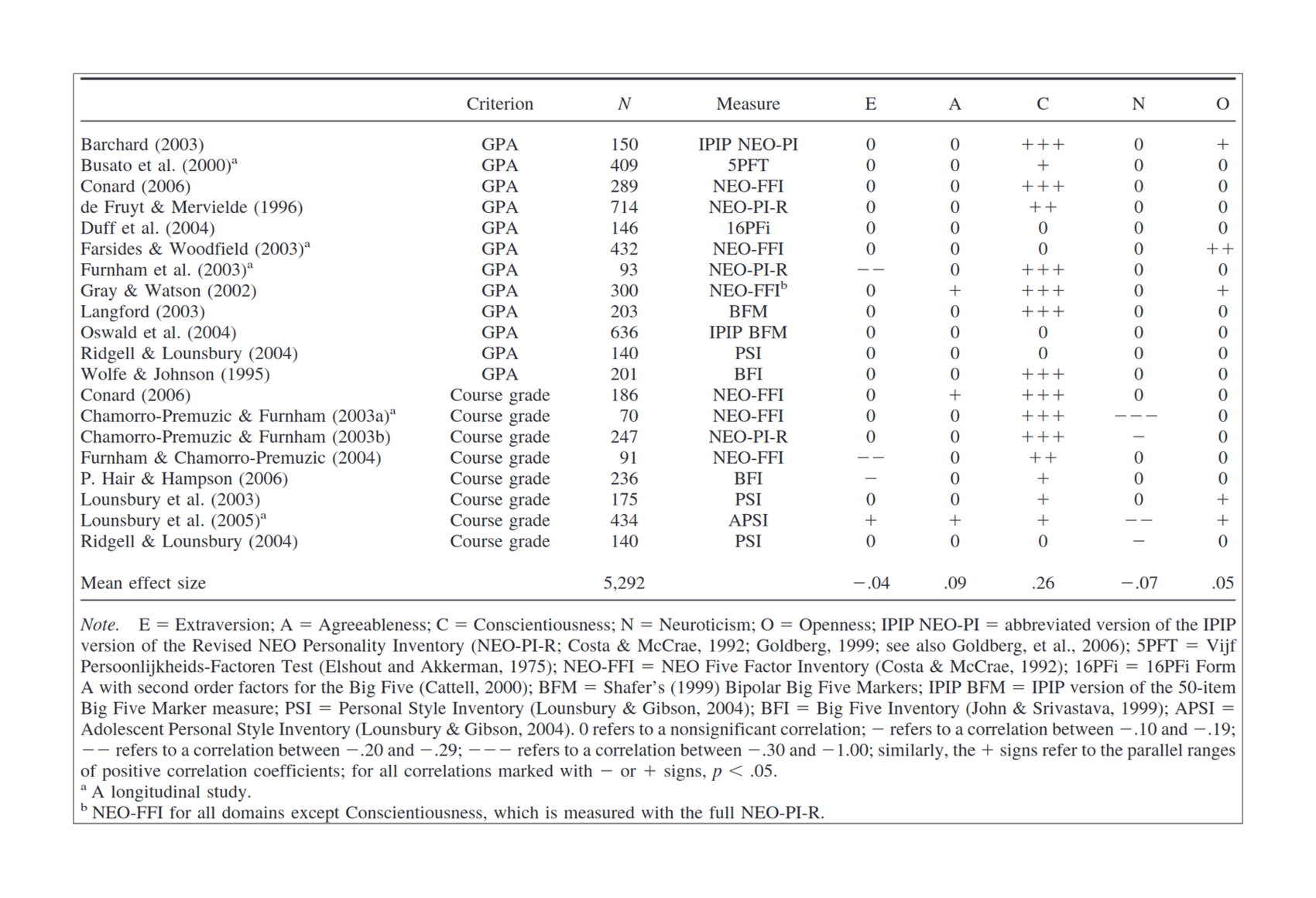
Objective: The connection between personality traits and performance has fascinated scholars in a variety of disciplines for over a century. The present research synthesizes results from 54 meta-analyses (k = 2,028, n = 554,778) to examine the association of Big Five traits with overall performance.
Method: Quantitative aggregation procedures were used to assess the association of Big Five traits with performance, both overall and in specific performance categories.
Results: Whereas Conscientiousness yielded the strongest effect (ρ = 0.19), the remaining Big Five traits yielded comparable effects (ρ = 0.10, 0.10, −0.12, and 0.13 for Extraversion, Agreeableness, Neuroticism, and Openness). These associations varied dramatically by performance category. Whereas Conscientiousness was more strongly associated with academic than job performance (0.28 vs 0.20), Extraversion (−0.01 vs 0.14) and Neuroticism (−0.03 vs −0.15) were less strongly associated with academic performance. Finally, associations of personality with specific performance outcomes largely replicated across independent meta-analyses.
Conclusion: Our comprehensive synthesis demonstrates that Big Five traits have robust associations with performance and documents how these associations fluctuate across personality and performance dimensions.
Annotations sorted by machine learning into inferred 'tags'. This provides an alternative way to browse: instead of by date order, one can browse in topic order. The 'sorted' list has been automatically clustered into multiple sections & auto-labeled for easier browsing.
Beginning with the newest annotation, it uses the embedding of each annotation to attempt to create a list of nearest-neighbor annotations, creating a progression of topics. For more details, see the link.