BMC’s plan to close Mulund dump finds no takers
The civic body’s project to dispose waste and close the 40-year-old Mulund dumping ground seems to have run into trouble even before it can take off. Even after extending the deadline for a response to the tenders, the civic body did not receive a single bidder for this project.
With no firms willing to take up the project, the Brihanmumbai Municipal Corporation (BMC) has extended the deadline a second time, to the end of this month.
“If we do not get any bidder even after this extension, we will be forced to relook at the conditions of the tender. At present, we will wait till September 30 before taking any decision,” said Vijay Balamwar, deputy municipal commissioner, solid waste management department.
After a delay of two months, the final tenders for the project were issued in May. Except for four companies that downloaded the tender forms, the interest in the project has been slim.
The illegal dumping of debris at the Mulund landfill, is also a reason behind no response for the project, sources said. Derivable from biodegradable waste, for example, compost has higher resale value as compared to inert waste (debris).
Calorific value (CV) is the energy contained in a fuel or food, determined by measuring the heat produced by the complete combustion of a specified quantity of it. The debris leads to a reduction in the final product and thus a loss to the contractor. The companies will be sole owner of the final product obtained from processing the waste. The BMC can buy the final product, which can be anything from electricity to compost from the companies.
According to a contour survey carried out last year, the total volume of the existing solid waste management at the Mulund landfill is 5.35 million cubic metres.
After the discussions with companies and tender committee, it was decided that 30 lakh metric tonnes of waste will be processed over three years, compared to 60 lakh metric tonnes, as the civic body feared that contractors will not be able to process that huge amount of waste and will not bid.
The closure plan came up after repeated fires at Deonar and Mulund dumping grounds earlier this year that highlighted the civic body’s faulty waste management procedure.
A panel of six members -- three civic officials, a financial advisor and one representative each from IIT-B and NEERI -- framed the standards for the scientific closure. Based on the committee’s recommendations, changes were made to the conditions for tenders, delaying the process by a month.
The processing plant will be built on 4 hectares within one year, while the processing of waste is distributed over the next three years. In the second year, 35% of waste i.e. 10,50,000 metric tonnes will be processed at the ground, while the remaining 12 lakh metric tonnes will be taken up in the third waste.
Stay updated with all the Breaking News and Latest News from Mumbai. Click here for comprehensive coverage of top Cities including Bengaluru, Delhi, Hyderabad, and more across India along with Stay informed on the latest happenings in World News.
Rail welding begins for Mumbai-Ahmedabad bullet train project in Gujarat
The project utilises 25-metre rails imported from Japan, which are joined using advanced fusion welding machines to create 200-metre rail panels
Mumbai: The National High Speed Rail Corporation Limited (NHSRCL) has commenced the critical phase of rail welding for the Mumbai-Ahmedabad bullet train project in Gujarat, marking the final stage before track laying for the 508-kilometre route designed for speeds of 320 kilometres per hour.
"The track construction work for the Gujarat portion of the bullet train project is progressing swiftly with the commencement of welding of rails on the viaduct in Gujarat," an NHSRCL spokesperson said.
The project utilises specialised 25-metre rails imported from Japan, which are joined using advanced fusion welding machines to create 200-metre rail panels. The operation has already produced 298 panels, equivalent to approximately 60 kilometres of track.
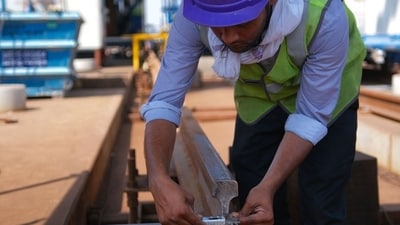
The welding process begins with grinding the rail ends for surface preparation. "Once the rails are perfectly aligned, they are joined together using flash butt welding technology. The weld is inspected by using magnetic particle and ultrasonic testing for detection of flaw and if any flaw is detected in the weld the same is replaced by new weld," the spokesperson explained.
Following the welding, rail alignment undergoes verification using specialised Japanese rail tread measuring equipment. A purpose-built rail feeder car distributes the 200-metre panels along the route for track laying. The rails are then secured to the track slab using fasteners for the final installation.
The project currently operates four track construction bases in Gujarat: two between Surat and Bilimora, and two between Vadodara and Anand. Construction teams have completed 64 kilometres of reinforced concrete track bed, with more than 23,000 track slabs cast at facilities in Kim (near Surat) and Anand, covering 118 track kilometres.
The bullet train route, which is 90 per cent elevated, will serve 12 stations: Mumbai, Thane, Virar, Boisar, Vapi, Bilimora, Surat, Bharuch, Vadodara, Anand, Ahmedabad and Sabarmati. Mumbai's station at Bandra Kurla Complex will be the sole underground facility.
Launched in 2017 with an estimated cost of ₹1,08,000 crore and an initial completion target of December 2023, the project has faced delays due to land acquisition challenges in Maharashtra and the Covid-19 pandemic.
NHSRCL now aims to inaugurate the complete 508-kilometre route in the latter half of 2028, though officials suggest the Gujarat section might open in 2027. Once operational, the high-speed rail service will reduce the journey time between Mumbai and Ahmedabad to approximately three hours, significantly faster than the current fastest option, the Vande Bharat Express, which takes about five and a half hours.
Stay updated with all the Breaking News and Latest News from Mumbai. Click here for comprehensive coverage of top Cities including Bengaluru, Delhi, Hyderabad, and more across India along with Stay informed on the latest happenings in World News.
Police seize 14 debris-laden dumpers in Ulwe
The Anti-Debris squad of CIDCO, accompanied by police, conducted an inspection after receiving the alert
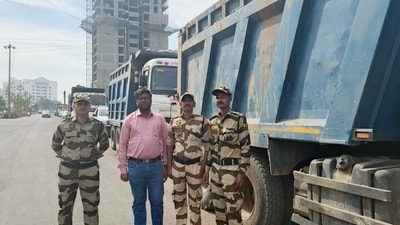
Navi Mumbai: Nhava-Sheva police intercepted 14 dumpers attempting to illegally dispose of debris in the Ulwe node following an alert from the traffic control room about suspicious vehicle movement across the Atal Setu bridge.
The Anti-Debris squad of CIDCO, accompanied by police, conducted an inspection after receiving the alert. The authorities intercepted all dumpers as they entered sector 12 of Ulwe node and proceeded to examine their cargo.
"Each of the 14 dumpers were laden with debris and had come from Mumbai with the intention of disposing of the debris in and around Ulwe node. The drivers were questioned about the permission given for the disposal, but they had none as dumping of debris is not permitted as it is hazardous to health," a CIDCO officer said.
Authorities have registered a case against the 14 drivers under section 271 (negligent action to spread infection) and section 62 of the Bharatiya Nyaya Sanhita (BNS). The dumpers have been confiscated and are currently stationed at Ulwe police station pending further legal proceedings.
Stay updated with all the Breaking News and Latest News from Mumbai. Click here for comprehensive coverage of top Cities including Bengaluru, Delhi, Hyderabad, and more across India along with Stay informed on the latest happenings in World News.
Mumbai court approves monetisation of ₹2,565.9 crore in properties in Choksi fraud case
The court's decision followed an application from the victim banks, Punjab National Bank and ICICI Bank, backed by the ED to strengthen the plea
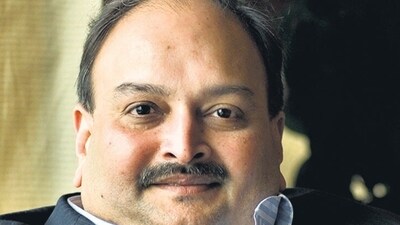
Mumbai: A special court in Mumbai on Tuesday permitted the monetisation of properties worth ₹2,565.9 crore that were attached or seized by the Enforcement Directorate (ED) since 2018 as part of its money laundering investigation against fugitive diamantaire Mehul Choksi in the alleged Punjab National Bank fraud.
The court's decision followed an application from the victim banks, Punjab National Bank and ICICI Bank, backed by the ED to strengthen the plea. Following the order, the handover of assets has begun, with properties exceeding ₹125 crore, including Mumbai flats and two factories/godowns in SEEPZ, Andheri (east), being transferred to the liquidator of Choksi's Gitanjali Gems Ltd. The restitution of remaining properties is underway, according to ED sources.
Choksi is believed to be residing in Antigua and Barbuda after departing India in January 2018, shortly before the scam was discovered and the Central Bureau of Investigation (CBI) registered FIRs. India has sought Choksi's extradition from Antigua and Barbuda, which he has contested in local courts.
The application aimed to expedite property restitution to the victim banks. The ED and banks adopted a unified position, approaching the Special PMLA (Prevention of Money Laundering Act) court in Mumbai with a "Joint Application."
Tuesday's court order on the Joint Application directed the ED to assist banks and liquidators of various Gitanjali Group companies in valuing and auctioning the attached or seized properties. The proceeds would be deposited as fixed deposits with PNB and ICICI Bank, according to agency sources.
This development continues the ED's efforts to restore properties to rightful owners and victims of money laundering, whilst enabling financial institutions to monetise assets secured by the ED. The agency collaborated closely with PNB and ICICI Bank to file the restitution application in the Choksi case.
Thus far, six properties have been restored to the Gitanjali Gems Ltd liquidator: flats in Kheni Tower, Santacruz, collectively worth approximately ₹27 crore, and two properties comprising land and buildings at plots 61 and 16 in SEEPZ, Andheri east, jointly valued at ₹98.03 crore. The remaining assets are being transferred to the liquidator/banks as per the PMLA court's directive.
ED's investigation revealed that Choksi allegedly conspired with associates and PNB officials between 2014 and 2017 to fraudulently obtain Letters of Undertaking and Foreign Letters of Credit, subsequently defaulting and causing a loss of ₹6,097.63 crores to the public-sector bank. Choksi had also allegedly defaulted on a loan from ICICI Bank.
The ED initiated its money-laundering investigation in 2018 following a CBI case registration. Their investigation included searches at over 136 locations across India, seizing valuables and jewellery worth ₹597.75 crores from Choksi's Gitanjali Group firms. The agency also attached immovable/movable assets worth ₹1,968.15 crores, including properties in India and overseas, vehicles, bank accounts, factory, shares, and jewellery.
In total, the ED attached or seized assets worth ₹2,565.90 crores and filed three chargesheets in Mumbai court against various accused parties, including Choksi.
Choksi's nephew, fugitive diamond merchant Nirav Modi, a principal co-accused in the PNB scam, also departed India in January 2018 before the scam's discovery. Based on ED intelligence, Modi was apprehended in London in March 2019, where extradition proceedings are ongoing.
Stay updated with all the Breaking News and Latest News from Mumbai. Click here for comprehensive coverage of top Cities including Bengaluru, Delhi, Hyderabad, and more across India along with Stay informed on the latest happenings in World News.