


Cubs Video
Given the enormity of the cultural and linguistic barriers Japanese players often face when they arrive in the United States for the first time, it can be very hard for them to adjust at the speed required by the modern game. The league starts working to figure you out the moment you show up for spring training, and because it's often hard to talk as freely with teammates and coaches when one is living in a new country and learning a new language, sometimes, the league does figure you out, and you struggle to adjust back.
That's the first thing that made Shota Imanaga special, when he became a Cub. It's not his marvelous splitter or the vertical approach angle on his fastball; it's his personality. It takes a certain level of competitive intensity and risk appetite to cross an ocean to play against the best competition in the world, but that doesn't always pair with the fearless extroversion required to cross a room or a ball field to talk to someone from whom there's something valuable to be learned--especially when doing so means bringing along an interpreter.
In Imanaga's case, though, both sets of traits are present. He wanted to prove himself in the United States, and he wasn't afraid of the logistical hurdles he had to clear in order to do so. He came over with a unique pairing of fastball shape and release point, with a splitter that made him unusual and briefly unsolvable even for MLB batters. Those two pitches carried him through the first two months of the season; the competitive intensity and his sheer talent got him that far with gaudily impressive numbers.
Since then, though, the league has figured out his initial tricks, and that's where the fearlessness and extroversion have factored in. At almost every stop the Cubs have made over the second half of the season, cameras have caught Imanaga in pre-game conversations with prominent members of the other team. Paul Skenes of the Pirates is one very visible example, but far from the only one. Although he's developed solid English skills, it's not really that aptitude that has allowed Imanaga to soak up new information from all kinds of sources throughout the league. Rather, it's been his willingness to have in-depth conversations, even when they have to be mediated. He's picked up things from opponents, from teammates, and from coaches, and as the season winds down, he's implementing all that learning in remarkable fashion.
In his 11-strikeout gem Monday night against the Athletics, Imanaga threw eight sinkers, tying for a second time his season high in that regard. He also threw a season-high 19 changeups, though--that's 19 of his Vulcan-grip changeups, not to be confused with the 23 splitters he also threw. At this point, he's not only not reliant on the four-seamer and splitter, but has widened and reshaped his arsenal to include five different offerings: four-seamer, splitter, changeup, sweeper, and sinker. He uses all five regularly, right now, even though he's largely shelved the curveball and cutter with which he tinkered earlier in the year.
Look at the way his approach to batters of each handedness has changed, from month to month. Against fellow lefties, he's become a thing one could hardly have imagined of him early in the season: a sweeper-first guy.
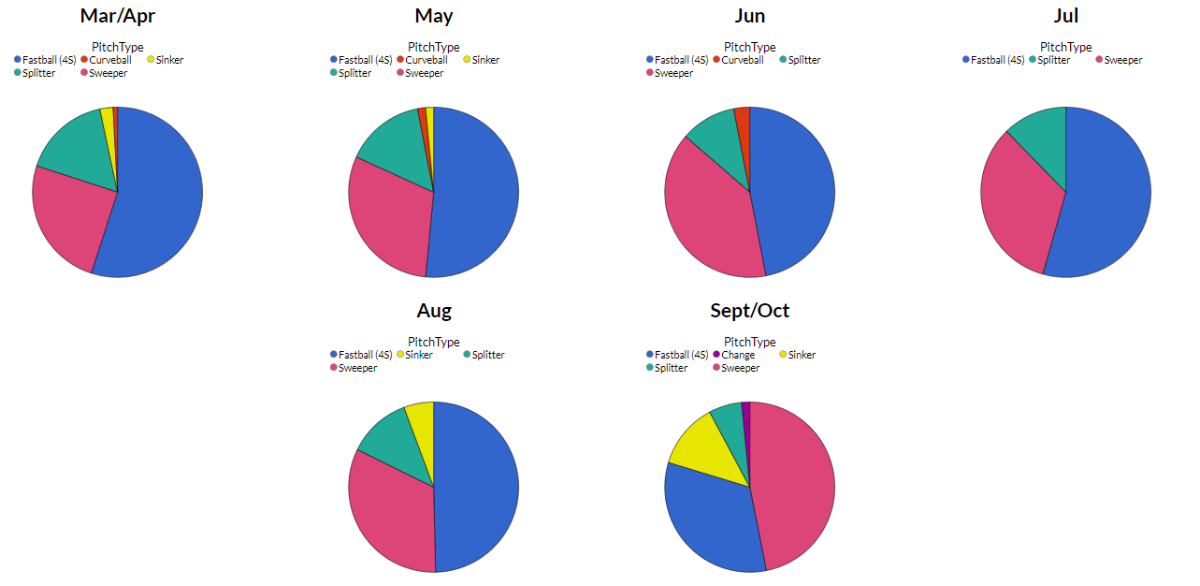
Part of the growth of his sweeper and its utility against lefties has been introducing that sinker more often, because the latter pitch runs in on the hands of lefty batters more and forces them to cover the inner edge, setting them up for the sweeper away.
Just as eye-opening, though, is the way Imanaga has varied and updated his arsenal against righties. Most notably, it's against them that he's become a two-changeup hurler, with both the splitter and his Vulcan change.
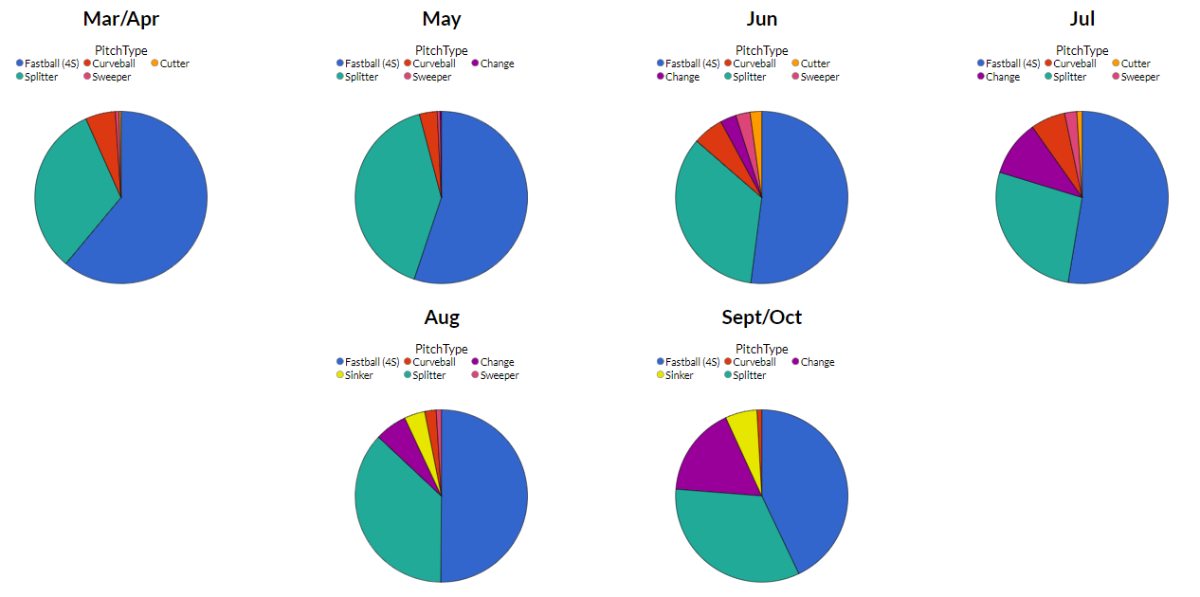
Crucially, it's not as though Imanaga is carving his Vulcan change usage out of the bloc previously dedicated to the splitter. Rather, he's paring down his fastball usage, to accommodate both changeups. Nor is the difference between the two purely about matching one offering's movement to an opponent's bat path. He's stumping hitters more by giving them both looks within the same game, and sometimes within the same at-bat. Here he is throwing a splitter to Enrique Hernández in the third inning of his start against the Dodgers last week:
And here he is victimizing him for a strikeout with the changeup, two innings later.
This isn't a classification fluke. If you watch the videos above carefully, especially slowed down, you can see the difference in his grip on the two pitches. There are also characteristic differences. The Vulcan change is about 1.3 miles per hour slower, on average, with a bit more armside run but considerably less downward movement. His splitter involves more deadening of the spin out of his hand, which makes it a more variable offering with greater depth and more deceptive movement. It's the pitch that will get more whiffs and more ground balls, but having the Vulcan change in the mix makes both pitches play up. If a hitter has to try to handle both, in addition to the fastball and whatever other pitches he's playing with in a given outing, they're much less likely to time up the splitter or the four-seamer, which reduces his vulnerability both to power hitting and to the times-through-the-order penalty.

These improvements and new pitches haven't made Imanaga an untouchable ace. Whatever he and Skenes talked about a few weeks ago, the younger rookie wasn't able to convey to the elder one the ability to throw 100 miles per hour. Imanaga still gives up home runs, and will still have to work around that weakness going into next season. So be it. The thrilling thing about the recent changes Imanaga has made is that they affirm that fearlessness and adaptability. He will keep exploring new paths to success and absorbing new information, because he has a joyful and tenacious approach to the competitive act of pitching. That both makes him more likely to succeed in his sophomore MLB campaign and beyond, and increases his watchability. He's a delightful player to watch, and the brightest spot in a largely disappointing Cubs season. Seeing him transform from a two-pitch pitcher to a five-pitch master manipulator has been a pleasure, and there are more in store from him.
Think you could write a story like this? North Side Baseball wants you to develop your voice, find an audience, and we'll pay you to do it. Just fill out this form.
MORE FROM NORTH SIDE BASEBALL
— Latest Cubs coverage from our writers
— Recent Cubs discussion in our forums
— Follow NSBB via Twitter, Facebook or email
— Become a North Side Baseball Caretaker
 1
1


Recommended Comments
Create an account or sign in to comment
You need to be a member in order to leave a comment
Create an account
Sign up for a new account in our community. It's easy!
Register a new accountSign in
Already have an account? Sign in here.
Sign In Now