The Sporting Life: It’s time for India to do better, says Rudraneil Sengupta
Why are other countries racing ahead of us, even in arenas where we excel? Why is cricket, still, so many leagues ahead?
What makes a country dominate a sport?
Such a brief question, but the answer is complex enough to fill a tome.
The good news is, we have the answers. They have been clearly visible for decades. We have watched, haven’t we, as countries vastly differing in size, population, economy and culture learnt from each other and found success in sports in which they were not historically strong? We’ve seen how they did it.
Broadly, there are four key drivers. One is cultural significance: think of cricket in India; football in most of Latin America, Europe and Africa; distance running in Kenya, Ethiopia and Uganda; judo in Japan; table tennis in China, and so on.
The second is a business ecosystem. Is the sport commercially viable, such that a large number of people in a given country could reasonably turn to it as a career? Alternatively, is there enough state funding at all levels of competition?
Third: Is there a pyramidal system that allows for development of the sport, the base of that pyramid being the availability of playing and coaching facilities for lots and lots of children? Is there a scouting system that identifies talent at the school and college levels (the middle of the pyramid)? And is there a peak of elite professionalism to aim for?
The fourth requirement is coaching. Does the country have access to world-class expertise, in the form of a team of people constantly pushing the line of peak performance through mentorship, innovation and technology?
It’s simple enough to recognise that, in India, we have all of these things in abundance for cricket, and almost none of these things available at scale for any other sport.
The question that plagues me is, why? These are all things that are easy to put in place. We saw Japan do it with women’s wrestling.
Perhaps you read about Yui Susaki, the four-time world champion and Tokyo Olympics champion who had been unbeaten in over a decade (in 82 matches, to be precise) and was defeated by Vinesh Phogat in their first-round encounter at the Paris Olympics.
Susaki finally ended with bronze after that terrible saga that saw Phogat disqualified for being 100 gm overweight. But Japanese women wrestlers also won four of the six gold medals on offer at the Paris Games, and this is not even an extraordinary feat for them.
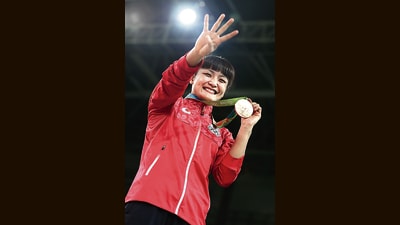
Japan has swept up medals at every Olympics since women’s wrestling made its debut in 2004. Kaori Icho is the only woman wrestler in the world to win four Olympic golds (2004, 2008, 2012, 2016; she is also a 10-time world champion); Saori Yoshida has three Olympic golds and 13 world championship titles.
Though this kind of wild dominance cannot entirely be explained, Japan did everything right from the moment it was announced in 1998 that women’s wrestling would be part of the Olympic programme in 2004.
The country already had a strong culture of martial sports, from judo to sumo wrestling and karate. Its male wrestlers had dominated, alongside the then USSR, in the ’50s, ’60s and ’70s. Japan had great coaching systems and facilities in place, as a result.
The government then committed to spending what was necessary to extend facilities and access to women; so did some of the country’s biggest companies and universities.
What unfolded was what we tend to call a “miracle”. In just one example, a former world championship medallist named Kazuhito Sakae was appointed head coach of a women’s programme at Shigakkan University that produced both Icho and Yoshida.
In India, wrestling once enjoyed great cultural significance. This was admittedly a long time ago. Today, the sport is celebrated in just a few pockets, mainly in Haryana, Punjab and Maharashtra. The latter two states practise the traditional style of wrestling in earthen pits, which does not translate well to the Olympic mat. So India’s talent pool for Olympic wrestling is essentially the tiny state of Haryana.
Here, as in so many sports across so much of the country, government support is blighted by corruption, mismanagement, political tussles and apathy. Despite this, the women wrestlers of Haryana have managed to burst their way through to the world stage.
Somehow — and this is the real miracle — the state has turned out women of the likes of Sakshi Malik and Vinesh Phogat.
Imagine what it could do if its women were given the kind of support that the average teenage wrestler gets in Japan?
(To reach Rudraneil Sengupta with feedback, email rudraneil@gmail.com)


 60% OFF
amazon basics 5W Bluetooth 5.3 Speaker, Upto 36 Hrs Playtime, True Wireless Technology, Built in Mic, Multiple Connectivity Modes (Grey)
Rs. 599 Rs. 1499 51% OFF
boAt Stone 352 Bluetooth Speaker with 10W RMS Stereo Sound, IPX7 Water Resistance, TWS Feature, Up to 12H Total Playtime, Multi-Compatibility Modes and Type-C Charging(Raging Black)
Rs. 1699 Rs. 3490 50% OFF
MurtiHome Mahayogi Shiva Sculpture Small 3.5 Inch Height Black 3D Printed UV Resin Shiv Shankar Bholenath Mahadev Statue
Rs. 1499 Rs. 2999 64% OFF
Go Hooked Plastic Hanging Pot, Multicolour, Pot Diameter -7.1 Inch, Pot Height -4.8 Inch, Pot Thickness -3 mm, Chain Length -13 inch Approx., 5 Pieces
Rs. 364 Rs. 999 31% OFF
Pikify Brown Planters with Bottom Plates - 12 Pcs, Gamla Pots for Home, Plant Containers, Indoor Outdoor Balcony Flower Pots, Drip Tray Pots with Plates (8 inch, 12 PC)
Rs. 584 Rs. 849 74% OFF
URBAN SENSE™ | Couple Family Statue | Ceramic Thinker Sculpture | Home Decor Items for Living Room Show Piece | Table Artifact | (White | Set of 3)
Rs. 790 Rs. 2990 55% OFF
MUDDSTYLES Plastic Tower Pot Plant14 inch Flower Pots for Home Office Garden Balcony Plant Container Set Pack 2
Rs. 723 Rs. 1599 56% OFF
Amazon Brand - Solimo Round Pots for Plants with Bottom Tray | Modern Design | Indoor and Outdoor Flower Pot for Home/Office/Table/Garden/Balcony Decoration | 12 inch (Set of 10)
Rs. 789 Rs. 1799 45% OFF
Zebronics ZEB-COUNTY 3W Wireless Bluetooth Portable Speaker With Supporting Carry Handle, USB, SD Card, AUX, FM & Call Function. (Black)
Rs. 549 Rs. 999 46% OFF
PIXERDOT SET of 5 | 9 Inch Big Flower Pots for Home Decoration, Indoor Plant Pots, Gardening Pots, Big Pots for Plants, Plastic Flower Pot, Pots for Plants Big Size, Flower Pots for Garden Plants
Rs. 699 Rs. 1299