Patent SUN Profile picture
3h 5 tweets 3 min read Read on X
少し調べてみました。今後の調査の参考になればと思いますが、不明な点だらけですので軽い気持ちでお読み下さい。

1.論文

2.治験概要資料

3.論文補足資料

4.PMDA資料


論文で死亡例が言及された「フェーズ3b」は、第1シリーズ(1日・29日の2回接種)と第2シリーズ(92日・120日の2回接種)に分かれていて、第1と第2で接種対象が入れ替わるようです。

第1シ:ワクチン2回→第2シ:プラセボ2回
第1シ:プラセボ2回→第2シ:ワクチン2回

イメージはPMDA資料と治験概要資料からnature.com/articles/s4146…
classic.clinicaltrials.gov/ct2/show/NCT05…
static-content.springer.com/esm/art%3A10.1…
pmda.go.jp/drugs/2023/P20…Image
Image
論文では、フェーズ3bで、ワクチン接種者5名、プラセボ接種者16名の計21名が死亡したと報告されています。これは、第1シリーズ後の結果で、第2シリーズの結果は含まれていないようです。

21件のうち10件がCOVID-19による感染死です。

内訳
ワクチン接種者:5人中1人が感染死、4人は別死因
プラセボ接種者:16人中9人が感染死、7人は別死因

治験(フェーズ3b)での死亡の定義は、「治験概要」に記載されているのですが、この定義通り運用されているのかは、確信を持てません。

治験概要


副次的結果の評価
9. COVID-19による死亡者の参加者数[期間:37日目から92日目]
プールされたフェーズ1/2/3a/3bフェーズ3b参加者:研究ワクチンの2回目投与の7日後を起点に、以前の感染の証拠がない参加者におけるCOVID-19による死亡が発生した参加者数。

この定義で運用される場合、第1シリーズの2回接種を1セットとして7日後から感染死のカウントがスタートすると解釈されます。除外された感染死者が存在する場合、別の死因に分類されるのでしょうか?

(1)36日までの感染死は除外?
(2)37日から92日で既感染者の感染死は除外?
(3)2回目投与から7日までの感染死は除外?
(4)1回目接種後の感染死は除外?
(5)92日以降は未カウント?classic.clinicaltrials.gov/ct2/show/NCT05…Image
Image
論文の補足資料を見ると、1日目~35日目までのCOVID-19の感染死は0人でした。一方、36日目~92日目では10人になっています。つまり、ワクチン接種者での感染死1名と、プラセボ接種者での感染死9名が36日目~92日目の間で発生したことになります。

デルタ株が流行していたようですが、1日目~35日目までの感染死が0人である理由が、本当に0人であったのか、定義上の理由で0人であったのかまでは不明です。

論文補足資料
static-content.springer.com/esm/art%3A10.1…Image
PMDAの資料を見ると、死因の内訳が記載されています。

◆1日目~92日目における死亡例◆
(1)ワクチン接種群:5/8059 例(=0.1%)
低血糖、膵炎、肺の悪性新生物、咽頭癌転移、COVID-19 各1例

(2)プラセボ接種群:16/8041 例(0.2%)
COVID-19(9例)、リンパ節腫脹、肝硬変、肝癌、大動脈解離、肺炎、アシネトバクター性肺炎、敗血症性ショック(各1例)

ここでの死亡者数とCOVID-19感染者数は、論文に開示された数値と一致しています。ここでは、1日目~92日目と記載されていますが、COVID-19感染死の定義は36日目~92日目の間の既感染者の死亡以外の感染死なのではないかと思われます。

◆92日目~210日目における死亡例◆
(1)ワクチン2回→プラセボ2回接種群:9/7458 例(0.1%)
事故死、他の特定できない死亡(各2例)、急性心筋梗塞、敗血症性ショック、外傷、口唇がん/口腔がん、悪性肺新生物(各1例)

(2)プラセボ2回→ワクチン2回接種群:4/7349 例(0.1%)
COVID-19(2例)、頭蓋脳損傷、脳血管発作(各1例)

ここの210日目は120日目の間違いでしょうか?

現時点では、COVID-19の感染死の定義の部分に疑問があります。上述の死亡例に除外された感染死者が含まれているのか、いないのかは不明です。

以上になります。私の記述に囚われず、何かしらの調査のご参考になればと思います。Image
@hudikaha この下側の図を見ると、「36日目~92日目のCOVID-19感染」と記載されているので、35日目までの感染者(感染死)は考慮されていないかもですね。
見落としていました。 Image

• • •

Missing some Tweet in this thread? You can try to force a refresh
 

Keep Current with Patent SUN

Patent SUN Profile picture

Stay in touch and get notified when new unrolls are available from this author!

Read all threads

This Thread may be Removed Anytime!

PDF

Twitter may remove this content at anytime! Save it as PDF for later use!

Try unrolling a thread yourself!

how to unroll video
  1. Follow @ThreadReaderApp to mention us!

  2. From a Twitter thread mention us with a keyword "unroll"
@threadreaderapp unroll

Practice here first or read more on our help page!

More from @Patent_SUN

May 10
@Kevin_McKernan, @DJSpeicher, @Jikkyleaks
This time, I newly discovered BioNTech patent regarding a relationship between GTP/UTP concentrations and dsRNA, and hence I would like to report this here (#PlasmidGate, #BlotGate, #HumpGate, #PrionGate).

I previously reported BioNTech patent US20230183769A1 regarding the ATP and CTP concentrations in connection with the Process 2 (ref. 1). Reference links will be attached at the end of this series of posts.

To briefly summarize this, by adjusting the ATP and CTP concentrations, BioNTech increased the yield of RNA, decreased the amount of the dsRNA contamination, and increased the amount of the residual DNA contamination. That is, their vaccine is a product full of compromises.

The patent publication number this time is WO2022122689A1 (ref. 2).

This would be a successor patent to the above patent US20230183769A1. The patent filing date is December 7, 2021, and the patent publication date is June 16, 2022. The family of this patent is as attached. This patent have not discovered for about two years after its publication, and thus this shows how difficult it is for the public outside the patent field (even me) to search for the specific patent.

This patent discloses contents that support the contents of the EMA document (ref. 3) and that are along with the paper including Katalin Karikó as the one of authors (ref. 4).

Furthermore, this patent also mentions the production of abnormally long mRNA due to an "RNA backfolding", which is not disclosed in those documents. Further verification of the "RNA backfolding" will be required.

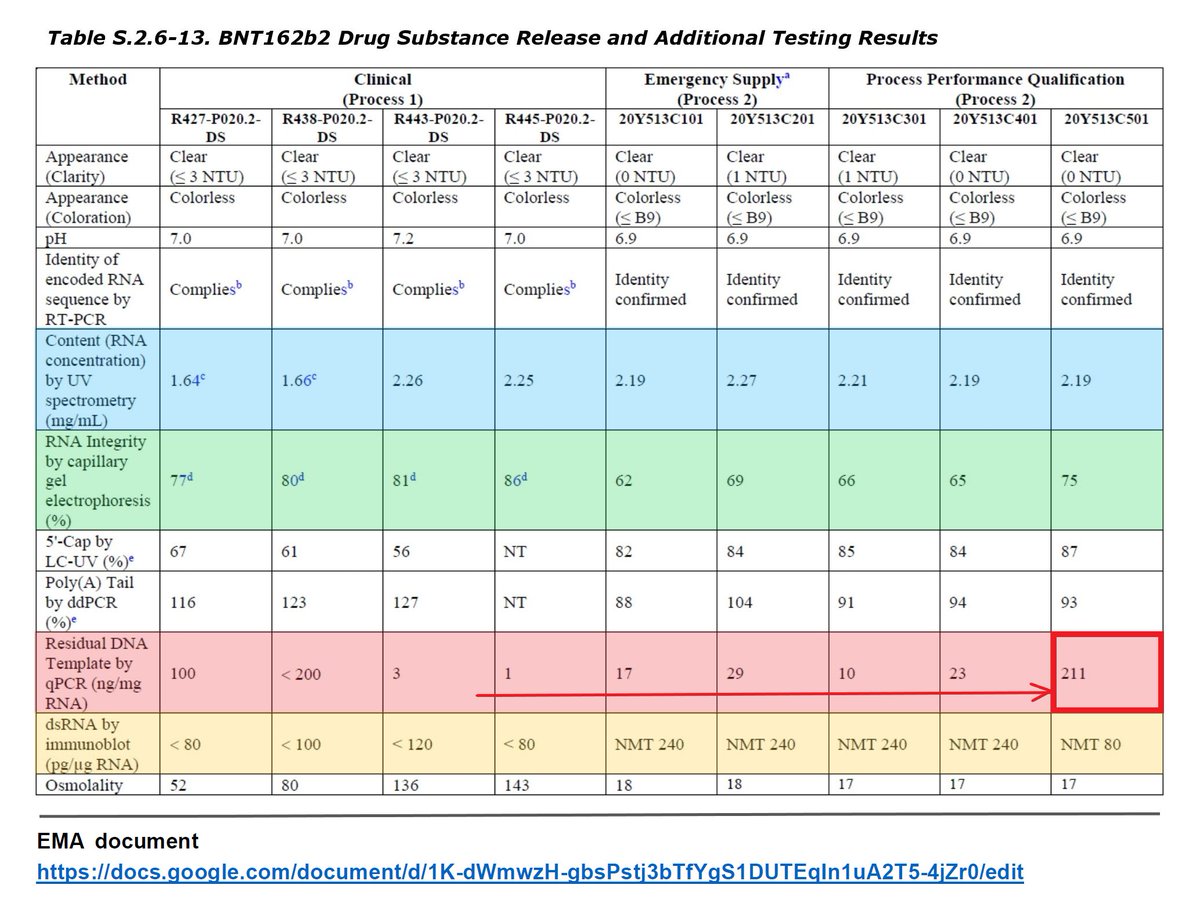
This patent primarily teaches risks associated with the dsRNA and a method for reducing the dsRNA. Note that the mRNA vaccine with a relatively large amount of the dsRNA contamination had been actually introduced into the human body in the early stages (Emergency Supply, etc.), as shown in the attached Table. S 2.6-13.

Surprisingly, the Table 5-1 attached in the patent is the completely same as the Table S. 2.4-1 attached in the EMA document (see attached image), and therefore, first of all, the relevant parts of the EMA document are picked up as noteworthy points.

The tagline "safe and effective" has been used for the mRNA vaccine since its introduction. Please think about why it was necessary to reduce the amount of the dsRNA contamination after its introduction, even though the mRNA vaccine is "safe and effective," through this post.

1/12Image
Image
Image
Image
Regarding the relationship between the GTP and UTP concentrations and the dsRNA, the EMA document states as follows:

For the current process, linearized plasmid DNA template was chosen for scalability in order to feasibly supply the current vaccine needs. The GTP and N1-methylpseudo UTP starting concentrations are controlled at a low target and these solutions are delivered as bolus feeds. These ribonucleotides were chosen to be limiting reagents to aid in capping and to reduce potential dsRNA impurities. The 5’-cap is in stoichiometric excess to the GTP to enable the preferential incorporation of the 5’-cap as the first addition to the RNA transcript. Dditionally, controlling the N1-methylpseudo UTP concentration in the reaction is proposed to reduce the dsRNA impurities.

That is, it is understood that BioNTech (Pfizer) set the GTP and UTP concentrations in relatively low values to reduce the amount of the dsRNA contamination. The production mechanism of the dsRNA and its composition are unknown here.

Note that the EMA has sharply pointed out to BioNTech (Pfizer) for not adequately explaining the lower limits of the ATP and CTP concentrations.

Initially, addition volumes for ATP and CTP were identified as non-CPPs as both were supplied in theoretical excess. Following the Pfizer GMP campaigns and additional smalls cale studies it was shown that these volumes could be limiting and the ranges were widened at the higher end. The approach to only change the higher end of the ranges is not understood. It is also noted that after the adjustment of these volumes the RNA integrity levels increased (see also discussion below in relation to the comparability study).

・It is noted that the ranges studied for addition volumes for CTP and ATP as stated in 3.2.S.2.6 are 81.0-143.8 and 90.0-135.1 mg/L respectively and that the acceptable ranges proposed are 85.4-143.8 and 85.4-135.1 mg/L. It seems as if the lower acceptable range of 85.4 mg/L proposed for ATP volume have not been studied, this needs to be clarified. In addition, it needs to be justified why the lower end of the ranges for both CTP and ATP volumes remained unchanged although the target ranges were increased (from 90 to135.1 and 107.9 mg/L respectively), to avoid that these nucleotides will be limiting in order to increase the percentage of the RNA integrity.
These ranges need to be further justified and clarified and the dossier updated accordingly.

2/12Image
Image
The main points of this invention are extracted from the descriptions of the Claim section (Claims 1 to 3 are described here for convenience), and they are specifically as follows:

(A) This is a method of producing a composition comprising RNA having a reduced double-stranded (ds) RNA content.

(B) The starting concentration of UTP, or a functional analog thereof, is lower than the starting concentration of CTP and/or ATP, or a functional analog thereof.

(C) The method comprises supplementing the reaction mix during the course of the transcription reaction with a composition which comprises UTP, or a functional analog thereof, and is substantially free of CTP or ATP, or a functional analog thereof.

These points (A) to (C) are consistent with the disclosures in the EMA document. And these specific conditions are disclosed in the Table 5-1 of the patent which is identical to the Table S. 2.4-1 of the EMA document.

3/12Image
Read 13 tweets
Apr 30
Here is a List of "Insertional mutagenesis" patents of Moderna. The patents are categorized by patent family.

NOTE:
For convenience, I have extracted the International patents (WO), the European patents (EP), and the United States patents (US), and other patent families including Australian patent (AU), Japanese patent (JP), Chinese patent (CN), etc., are excluded from this list.

The patent search requires an advanced know-how (unfortunately I don’t have), so there is no guarantee that all patents are correctly extracted, and there may be patents missing from this list. If you find a Moderna patent relating to "Insertional mutagenesis," please let me know to create a list that serves the public interest. That will be reflected in the following list.Image
@zombiemommy Image
@zombiemommy Image
Read 15 tweets
Apr 18
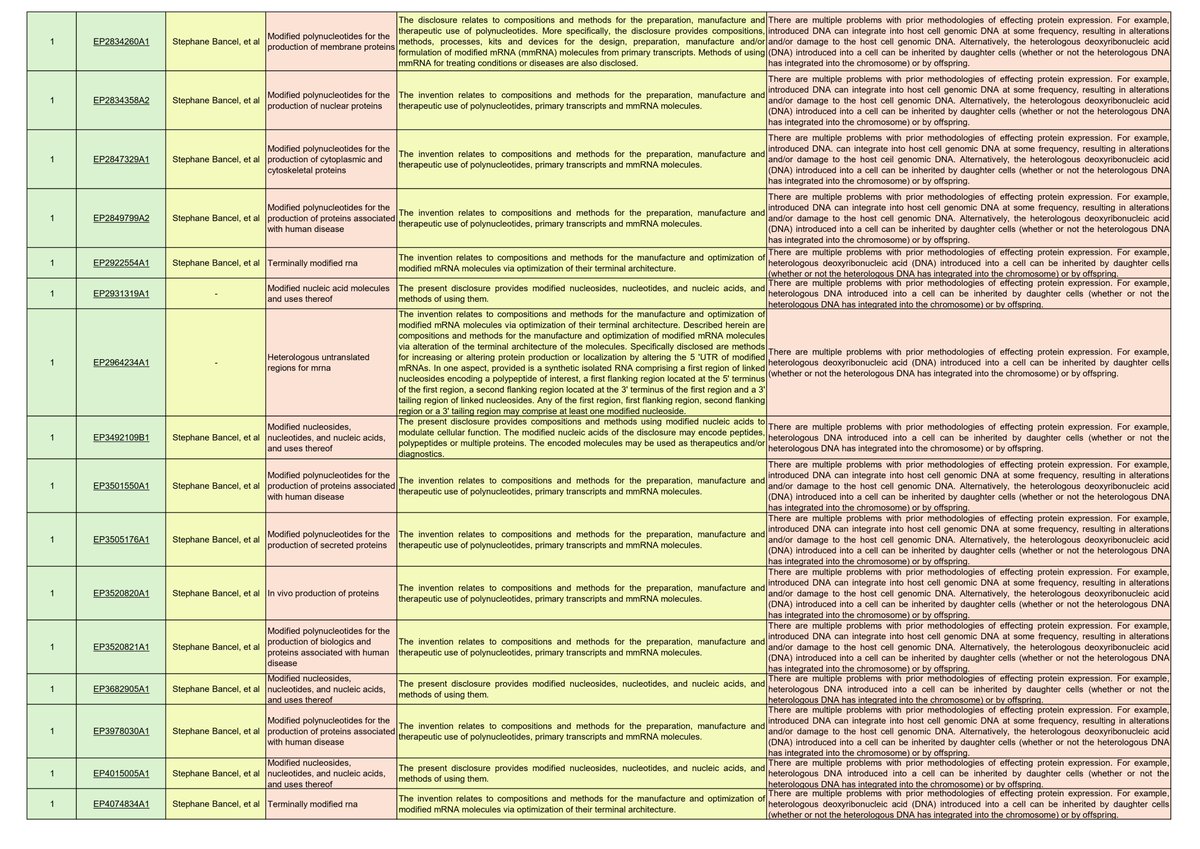
UPDATE: Patents of Stephane Bancel, Moderna CEO
I further searched for his patents and categorized them by patent family. Some patents do not include him as an inventor although they belong to the patent family. The patent families I'm interested in are highlighted by markers, etc.

For convenience, I have extracted the International patents (WO), the European patents (EP), and the United States patents (US), and other patent families including Australian patent (AU), Japanese patent (JP), Chinese patent (CN), etc., are excluded from the list.

NOTE: The patent search requires an advanced know-how (unfortunately I don’t have), so there is no guarantee that all patents are correctly extracted. Therefore, there may be patents missing from this list. If you find a patent of Stephane Bancel, please let me know to create a list that serves the public interest. That will be reflected in the following list.Image
Image
Image
Read 26 tweets
Apr 9
I extracted 67 patent applications that contain at least one term of BNT162b1, BNT162b2 and BNT162b3 from BioNTech patent applications, and categorized them based on the patent families (see the attached list). From the number of the patents, the families 1 to 3 seem to be comparatively important.

Since these patents relate to the implemented products, they may disclose matters that are not disclosed in the examination documents, the EMA document and the TGA document. The list includes the patents I have already mentioned, such as the patent regarding the late migrating species and the patent regarding the CTP/ATP concentrations.

Patent families do not necessarily disclose the same content, and some patents within a patent family do not include BNT162b1, BNT162b2 and BNT162b3. Also, some of the patents in the list include BNT162a and/or BNT162c as well.

FYI:
BioNTech is developing five types COVID-19 mRNA vaccines:
(1) BNT162b1: Nucleoside-modified mRNA (secretory spike RBD)
(2) BNT162b2: Nucleoside-modified mRNA (transmembrane prefusion spike)
(3) BNT162b3: Nucleoside-modified mRNA (transmembrane spike RBD)
(4) BNT162a1: Unmodified mRNA
(5) BNT162c2: Self-amplified mRNA (next generation replicon vaccine)

For convenience, I have extracted the International patents (WO), the European patents (EP), and the United States patents (US), and other patent families are excluded from the list.

The patent search requires an advanced know-how (unfortunately I don’t have), so there is no guarantee that all patents are correctly extracted. Therefore, there may be patents missing from this list. If you find a patent containing at least one term among the BNT162b1, the BNT162b2 and the BNT162b3, please let me know to create a list that serves the public interest.Image
Image
Image
Read 11 tweets
Apr 4
I extracted 109 Moderna patents including Stephane Bancel as one of inventors through a patent search. In reality, I only briefly checked it and didn't examine the contents carefully, so I look forward to further verification by volunteers. There were also some slightly unusual patents.

Although I couldn't find any particularly new findings, let me report this as one result (see attached list). The patent publication numbers in the list are shown in chronological order from No. 1 to No. 109.

So far, we have found the following (1) to (3) Stephane Bancel patents.

(1) The inheritance of the DNA integrated into the genome to offspring
(2) The endotoxin
(3) The residual DNA fragment (underestimation in the qPCR)

According to the list, the patents related to (1) occupy approximately 2/3 of the total, making up the majority. So, this indicates that Stephane Bancel concerned about the integration of the DNA into the genome.

We may consider these patents (1) to (3) to be patents with fatal confessions from Stephane Bancel.

However, the patent search doesn't guarantee that all patents including Stephane Bancel as an inventor are properly extracted, so the possibility that there are patents omitted from the search cannot be ruled out.

Also, some of the 109 patents are considered to constitute patent families derived from the same patent applications (particularly the patent group (1)). In order to exceed the realistic work time, I didn't go as far as checking the patent families in this work. Therefore, it is possible that other patents including Stephane Bancel as an inventor exist.

If you find any Stephane Bancel patent that is not in this list attached here, please let us know.Image
Image
Image
Read 24 tweets
Feb 1
Theme: Masterpiece of craftsmanship and Sleeping lions

Regarding BioNTech's patent US2023/0183769A1 I previously posted, which admittedly increases the residual DNA, I would like to emphasize another point here.

Please compare the descriptions of the patent and the EMA document as reproduced below. The two documents say almost same thing, but ''something'' is missing from the EMA document.

EMA document (P. 44)
In parallel, small scale studies were conducted to understand the impact of a wider range of CTP and ATP, since ATP was identified as the next potential limiting nucleotide. Results showed that increasing the volumes of both CTP and ATP not only mitigated these nucleotide limitations, as measured at the end of the proteinase K step, but also increased integrity and yield and decreased dsRNA. Therefore, ATP and CTP volumes were identified as CPPs prior to the Pfizer PPQ3 batch. As a result of the small scale studies, acceptable ranges for ATP and CTP volumes were widened at the higher end from 99.0 to 143.8 mL/L starting IVT volume for CTP and 99.0 to 135.1 mL/L starting IVT volume for ATP.…

Patent (para [0437])
[0437]
The present example demonstrates additional exemplary assessment of IVT reactions mixtures. FIG. 16 summarizes exemplary IVT reaction mixtures assessed and exemplary characterization of produced RNAs when CTP in the IVT reaction mixture is increased. Both RNA yield and integrity increased with higher CTP starting concentrations, while dsRNA content decreases with higher CTP concentration. Residual DNA was increased with higher CTP starting concentration (FIG. 16 ). Without wishing to be bound by any one theory, residual DNA may have increased with higher CTP starting concentration due to activity of DNAse I being decreased from, for example, lower free magnesium cation levels.

-1-Image
Pfizer (BioNTech) states in the EMA document the benefits of improving the RNA yield and integrity and decreasing the dsDNA by increasing CTP and ATP concentrations. Despite this, Pfizer (BioNTech) concealed the fact that "residual DNA increases" in it.

In the EMA document, comparing the batch C501 with the previous batches C101 to C401, it can be seen that the residual DNA amount has increased nearly 10 times. However, from only the EMA document, it is not possible to understand whether this was due to the variations between batches or whether this was just coincidentally increased.

However, by touching this patent disclosure, it can be understood that this increase in the residual DNA is the intended result based on the design of Pfizer (BioNTech).

Why is the residual DNA amount of the Pfizer higher than that of the Modelna?
One of the answers may be the fact that they concealed in the EMA document.

They already knew that the residual DNA would be high at the time of manufacturing. And knowing this, they introduced the vaccine into the society and vaccinated many citizens.

If they had conscientious moral principles based on the medical philosophy, then they would have designed the product to minimize the residual DNA. But not only did they not do that, they concealed the fact in the EMA document.

The qPCR they employed to measure the residual DNA amount underestimates it by its nature. That is, with the qPCR, they underestimated the increased residual DNA due to the manufacturing process.

Their actions like this are truly a masterpiece of craftsmanship.

This kind of the attitude from a pharmaceutical company should not be tolerated, and EMA should also be blamed for its thoughtless attitude in overlooking this.Image
There are many researchers who oppose the mRNA but do not address the issue of the residual DNA for some reasons. Despite they cannot deny the possibility that the residual DNA may cause fatal side effects, they have even refused to call for verification of the risks posed by the residual DNA.

They are neglecting everything they should be doing now. If this continues, they may end up stating in the future, just like pharmaceutical companies, "I did not anticipate that the residual DNA would cause major harm." Or they may state "I thought the risk or probability was small."

In any case, these statement are supporting the evidence that current research in the mRNA is insufficient, and thus there does not become a reason not to publicly call for verification of the problems hidden in the mRNA.

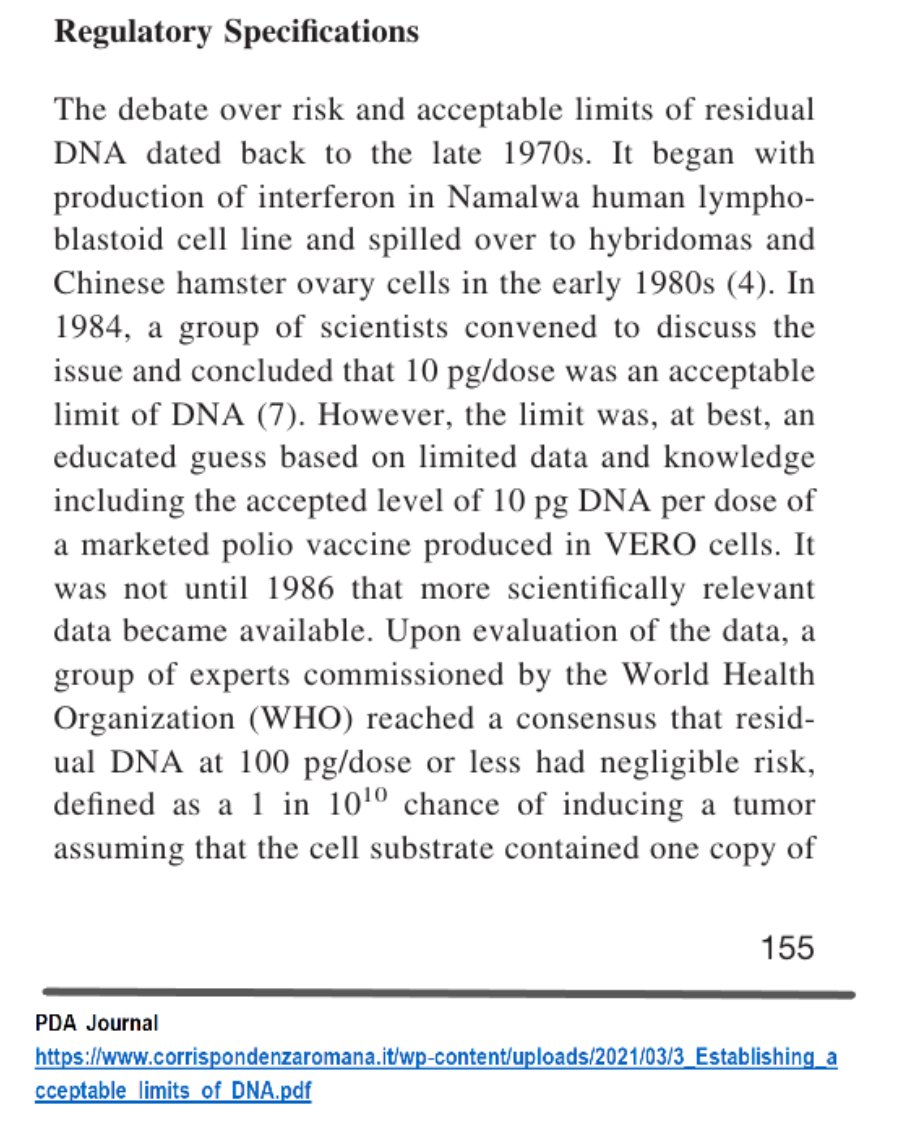
The multiple risks due to the residual DNA, such as oncogenesis, insertional mutagenesis, integration into the genome, and inheritance to offsprings, have been discussed since the 1970s (see attached), judging from trends in the standard values for residual DNA. This is a problem that anyone in this field have already been aware of now.

To make matters worse, this mRNA has a design concept that allows the residual DNA to be wrapped in LNP and promptly delivered into cells. It goes without saying that such technology increases the risk of the residual DNA, which has been discussed so far, and is a far cry from what has been discussed so far.

This patent should be understood as one piece of evidence that determines that BioNTech and Pfizer are dishonest to citizens and an unethical company, and this concept should be shared by as many people as possible.

The documents disclosed by BioNTech and Pfizer are in full of deceptive and not trustworthy. Therefore, there is no reason for us citizens to put our trust in such companies, and their actions must be strictly investigated.

The government and pharmaceutical companies should immediately disclose to the public the fact that the mRNA vaccines are contaminated with the residual DNA and make them aware of the risks.

If they fail to do this, they will only increase the number of sleeping lions in vain.

Thank you.

-3 (END-)Image
Read 5 tweets

Did Thread Reader help you today?

Support us! We are indie developers!


This site is made by just two indie developers on a laptop doing marketing, support and development! Read more about the story.

Become a Premium Member ($3/month or $30/year) and get exclusive features!

Become Premium

Don't want to be a Premium member but still want to support us?

Make a small donation by buying us coffee ($5) or help with server cost ($10)

Donate via Paypal

Or Donate anonymously using crypto!

Ethereum

0xfe58350B80634f60Fa6Dc149a72b4DFbc17D341E copy

Bitcoin

3ATGMxNzCUFzxpMCHL5sWSt4DVtS8UqXpi copy

Thank you for your support!

Follow Us!

:(