

Take advantage of 50% OFF on your first month.
50% OFF and access to ALL our articles and insights.

- GBP/USD retreated slightly after touching its highest level in over two weeks.
- The technical outlook suggests that the bullish bias remains intact.
- 1.2530 and 1.2560 align as key resistance levels for the pair.
After reaching its highest level since April 12 near 1.2550 at the beginning of the week, GBP/USD lost its traction and erased a portion of its daily gains. Nevertheless, the pair manages to hold above 1.2500, supported by the selling pressure surrounding the US Dollar (USD). The near-term technical outlook suggests that the bullish bias remains intact but buyers could remain hesitant unless the pair clears 1.2560.
The suspected in the foreign exchange market by Japan triggered a selloff in the USD during the Asian trading hours on Monday. The USD Index, which gauges the USD's valuation against a basket of six major currencies, was last seen losing 0.3% on the day. However, GBP/JPY is also down nearly 1.5% on the day, suggesting the Japanese Yen (JPY) captures capital outflows out of Pound Sterling as well. In turn, GBP/USD's upside remains capped.
Meanwhile, US stock index futures trade modestly higher on Monday. In case risk mood continues to improve in the American session, the USD could stay under pressure, given the lack of high-tier macroeconomic data releases.
On Wednesday, the Federal Reserve (Fed) will announce monetary policy decisions. Later in the week, the US Bureau of Labor Statistics will publish April jobs report, which will include the Unemployment Rate and Nonfarm Payrolls figures. Ahead of the Fed meeting, investors could refrain from taking large positions.
GBP/USD Technical Analysis
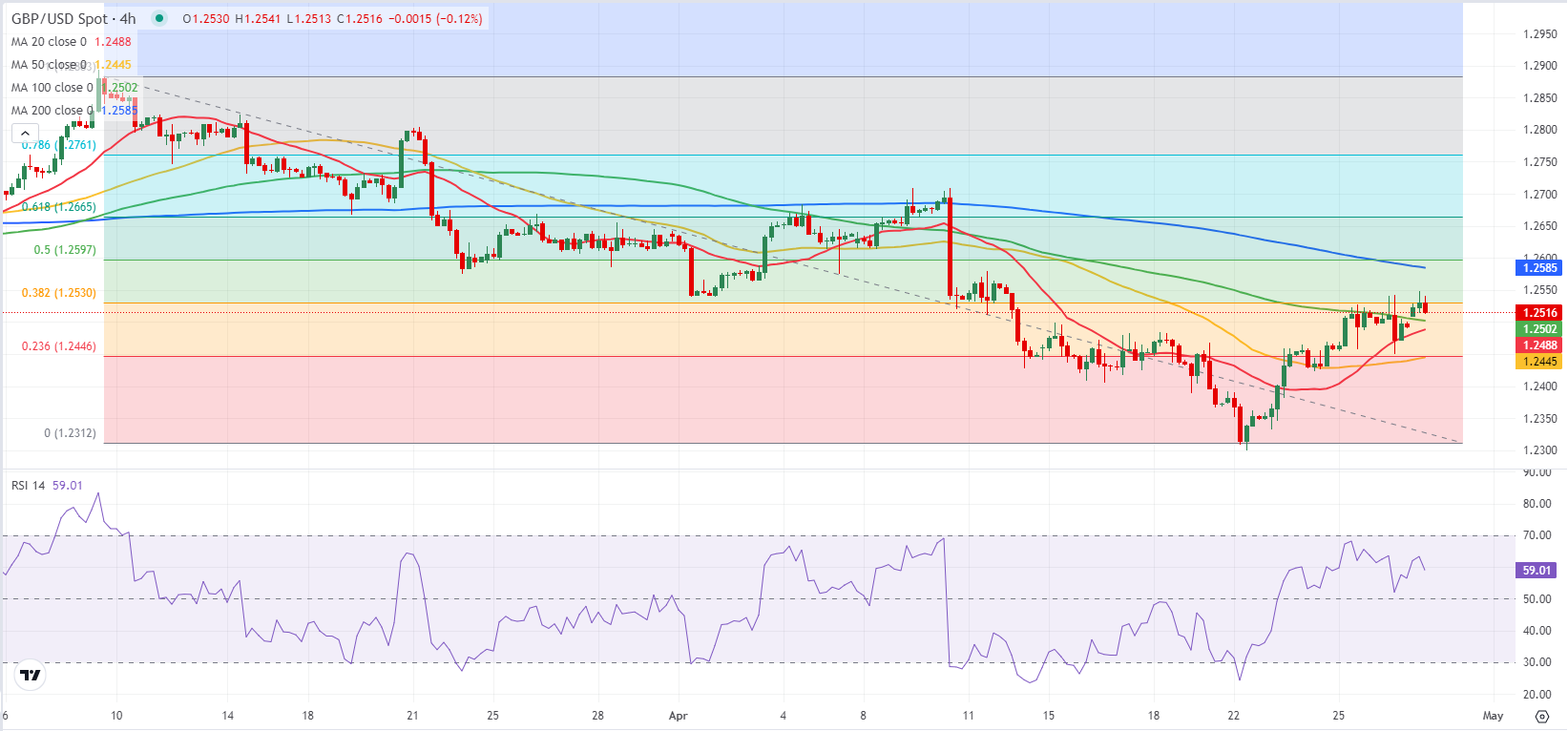
The Relative Strength Index (RSI) indicator on the 4-hour chart stays near 60 and GBP/USD continues to trade above the 100-period Simple Moving Average (SMA), currently located at 1.2500.
On the upside, 1.2530 (Fibonacci 38.2% retracement of the latest downtrend) aligns as interim resistance before 1.2560, where the 200-day SMA is located. A daily close above the latter could attract buyers and open the door for another leg higher toward 1.2600.
First support is located at 1.2500 (100-period SMA) ahead of 1.2450 (Fibonacci 23.67% retracement, 50-period SMA).
Pound Sterling FAQs
The Pound Sterling (GBP) is the oldest currency in the world (886 AD) and the official currency of the United Kingdom. It is the fourth most traded unit for foreign exchange (FX) in the world, accounting for 12% of all transactions, averaging $630 billion a day, according to 2022 data. Its key trading pairs are GBP/USD, aka ‘Cable’, which accounts for 11% of FX, GBP/JPY, or the ‘Dragon’ as it is known by traders (3%), and EUR/GBP (2%). The Pound Sterling is issued by the Bank of England (BoE).
The single most important factor influencing the value of the Pound Sterling is monetary policy decided by the Bank of England. The BoE bases its decisions on whether it has achieved its primary goal of “price stability” – a steady inflation rate of around 2%. Its primary tool for achieving this is the adjustment of interest rates. When inflation is too high, the BoE will try to rein it in by raising interest rates, making it more expensive for people and businesses to access credit. This is generally positive for GBP, as higher interest rates make the UK a more attractive place for global investors to park their money. When inflation falls too low it is a sign economic growth is slowing. In this scenario, the BoE will consider lowering interest rates to cheapen credit so businesses will borrow more to invest in growth-generating projects.
Data releases gauge the health of the economy and can impact the value of the Pound Sterling. Indicators such as GDP, Manufacturing and Services PMIs, and employment can all influence the direction of the GBP. A strong economy is good for Sterling. Not only does it attract more foreign investment but it may encourage the BoE to put up interest rates, which will directly strengthen GBP. Otherwise, if economic data is weak, the Pound Sterling is likely to fall.
Another significant data release for the Pound Sterling is the Trade Balance. This indicator measures the difference between what a country earns from its exports and what it spends on imports over a given period. If a country produces highly sought-after exports, its currency will benefit purely from the extra demand created from foreign buyers seeking to purchase these goods. Therefore, a positive net Trade Balance strengthens a currency and vice versa for a negative balance.
Information on these pages contains forward-looking statements that involve risks and uncertainties. Markets and instruments profiled on this page are for informational purposes only and should not in any way come across as a recommendation to buy or sell in these assets. You should do your own thorough research before making any investment decisions. FXStreet does not in any way guarantee that this information is free from mistakes, errors, or material misstatements. It also does not guarantee that this information is of a timely nature. Investing in Open Markets involves a great deal of risk, including the loss of all or a portion of your investment, as well as emotional distress. All risks, losses and costs associated with investing, including total loss of principal, are your responsibility. The views and opinions expressed in this article are those of the authors and do not necessarily reflect the official policy or position of FXStreet nor its advertisers. The author will not be held responsible for information that is found at the end of links posted on this page.
If not otherwise explicitly mentioned in the body of the article, at the time of writing, the author has no position in any stock mentioned in this article and no business relationship with any company mentioned. The author has not received compensation for writing this article, other than from FXStreet.
FXStreet and the author do not provide personalized recommendations. The author makes no representations as to the accuracy, completeness, or suitability of this information. FXStreet and the author will not be liable for any errors, omissions or any losses, injuries or damages arising from this information and its display or use. Errors and omissions excepted.
The author and FXStreet are not registered investment advisors and nothing in this article is intended to be investment advice.
 newsletter
 Don’t miss out!
Stay up to speed with our latest news and analysis. Get exclusive content directly to your inbox in one easy step.
7Newsletters selected 
By subscribing you agree to our Terms and conditions
Recommended Content
Editors’ Picks
AUD/USD retargets the 0.6600 barrier and above

AUD/USD extended its positive streak for the sixth session in a row at the beginning of the week, managing to retest the transitory 100-day SMA near 0.6580 on the back of the solid performance of the commodity complex.
EUR/USD finds support near 1.0720 after slow grind on Monday

EUR/USD jostled on Monday, settling near 1.0720 after churning in a tight but lopsided range as markets settled in for the wait US Fed outing. Investors broadly expect US rates to hold steady this week, but traders will look for an uptick in Fed guidance for when rate cuts could be coming.
Gold advances for a third consecutive day

Gold fluctuates in a relatively tight channel above $2,330 on Monday. The benchmark 10-year US Treasury bond yield corrects lower and helps XAU/USD limit its losses ahead of this week's key Fed policy meeting.
Will Bitcoin ignore major macro market developments this week?

Bitcoin price will be an interesting watch this week, with increased volatility expected amid crucial events lined up in the macro market. On Tuesday, Hong Kong will be debuting its BTC and ETH ETFs while the next day will see FOMC minutes make headlines.
Gearing up for a busy week: It typically doesn’t get any bigger than this

Attention this week is fixated on the Federal Reserve's policy announcement scheduled for Wednesday. While the US central bank is widely expected to remain on hold, traders will be eager to discern any signals from the Fed regarding the possibility of future interest-rate cuts.