mastodon.social is part of the decentralized social network powered by Mastodon.
The original server operated by the Mastodon gGmbH non-profit

Administered by:

Server stats:

270K
active users

Learn more

actually, the number of natural, integer, and rational numbers are all the same.

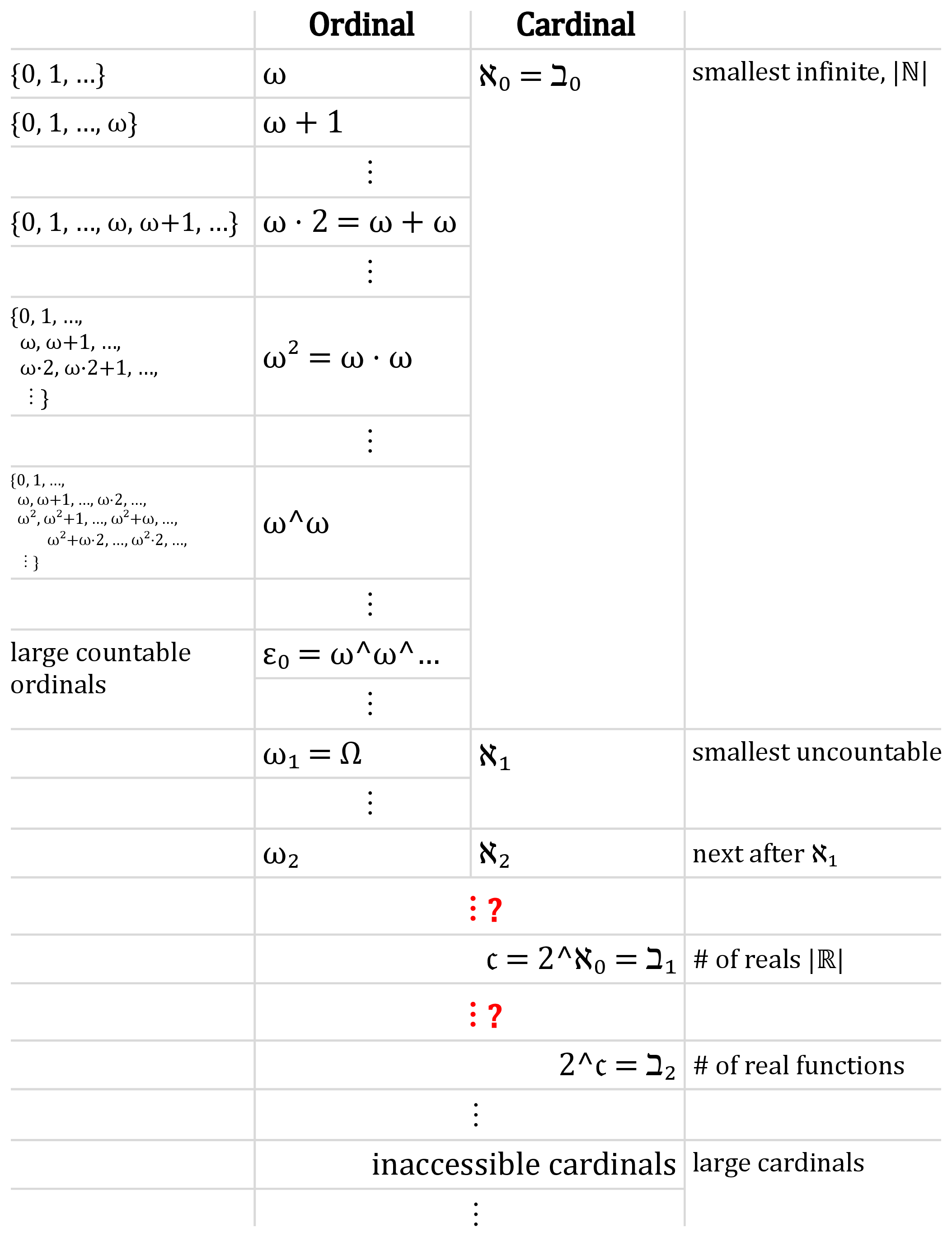
that infinite number is called ℵ₀ (aleph zero) or ℶ₀ (beth zero).

Cantor (1874) proved that the number of reals is larger than that.¹
that is called 𝔠 = 2^ℵ₀ = ℶ₁ (beth one).

the idea that having the same number is the same as having a 1-1 correspondence is called
• Hume's principle.¹

¹ neither Hume nor Galileo thought it applied to ♾, tho (unlike Cantor).

♾ is such a strange thing.
the whole and part can be the same size.¹
cf.
• Galileo's paradox.

¹ contrary to Euclid's 5th Common Notion (300 BC).
although some say that some CNs are by, e.g., Theon of Alexandria (4c).

mathematically, the answer is A✔
they're the same.
(even tho evens are part of integers.)

this is bc one integer corresponds to one even.
1 ↦ 2
2 ↦ 4
3 ↦ 6
4 ↦ 8
5 ↦ 10

n ↦ 2n

yuuki ゆうき(金野裕希)<p>let me explain from scratch.</p><p>Q: which is greater,<br />• the number of all integers<br />• the number of all even numbers</p><p>both are infinite.<br />there&#39;s many ways to think abt it.</p>
yuuki ゆうき(金野裕希)<p>mathematicians consider infinity a number.</p><p>this is bc in the 19c, a man named Cantor found that there are &quot;multiple infinities&quot;.<br />i.e., infinity 1, infinity 2, infinity 3, ….</p><p>just like 1, 2, 3, ….<br />can also do arithmetic with ♾.</p>
yuuki ゆうき(金野裕希)<p>im summarizing my tweets here rn<br /><a href="https://min.togetter.com/kb628xT" target="_blank" rel="nofollow noopener noreferrer" translate="no"><span class="invisible">https://</span><span class="">min.togetter.com/kb628xT</span><span class="invisible"></span></a></p>
yuuki ゆうき(金野裕希)<p>The largest number is a &quot;contradiction&quot;.<br />let me explain this.</p><p>u may be reminded of a googolplex or graham&#39;s number.<br />the problem is: graham&#39;s number+1 is larger.</p><p>they&#39;re still finite.</p>
yuuki ゆうき(金野裕希)<p>i forgot dominoes</p>
yuuki ゆうき(金野裕希)<p>what&#39;s tricky is numbers go on forever.<br />1, 2, 3, 4, … is only the beginning.<br />large numbers beyond graham&#39;s number are still &quot;natural numbers&quot;.</p><p>(ultrafinitists deny the existence of numbers that are too large.)</p>
yuuki ゆうき(金野裕希)<p>note commutativity, distributivity etc can be proved by a method called induction (other than using lego).</p>
yuuki ゆうき(金野裕希)<p>philosophically, there can be 2 ways of thinking:<br />• numbers are such code in reality<br />• no, such code are just a miniature model of numbers</p><p>i stand with the former,<br />but on 2nd thought the latter may be more rational.</p>
yuuki ゆうき(金野裕希)<p>sounds like there&#39;s a kinda programming language within math.<br />numbers can be programmed/coded with it.</p><p>there could also be implementations on a computer, such as Lean.</p>
yuuki ゆうき(金野裕希)<p>just as atoms are made of elementary particles, it seems that numbers can be made from sets, functions (church encoding), or categories (or topoi).</p><p>as sets:<br />0 = {}<br />1 = {{}}<br />2 = {{}, {{}}}<br />3 = {{}, {{}}, {{}, {{}}}}</p>
yuuki ゆうき(金野裕希)<p>there&#39;s a definition of numbers called<br />• Peano axioms.<br />i haven&#39;t figured it out yet.</p>
yuuki ゆうき(金野裕希)<p>when we ask smtg like &quot;why does 1+1=2?&quot;, it is said that we face the so-called<br />• Münchhausen trilemma.</p>