We use cookies to personalise content and ads, to provide social media features and to analyse our traffic. We also share information about your use of our site with our social media, advertising and analytics partners who may combine it with other information that you’ve provided to them or that they’ve collected from your use of their services.
Necessary cookies help make a website usable by enabling basic functions like page navigation and access to secure areas of the website. The website cannot function properly without these cookies.
__jidUsed to add comments to the website and remember the user's Disqus login credentials across websites that use said service.
Expiry: 1 dayType: HTTP
disqusauthRegisters whether the user is logged in. This allows the website owner to make parts of the website inaccessible, based on the user's log-in status.
test_cookieUsed to check if the user's browser supports cookies.
Expiry: 1 dayType: HTTP
rc::aThis cookie is used to distinguish between humans and bots. This is beneficial for the website, in order to make valid reports on the use of their website.
Expiry: PersistentType: HTML
rc::cThis cookie is used to distinguish between humans and bots.
Expiry: SessionType: HTML
rc::eThis cookie is used to distinguish between humans and bots.
mDetermines the device used to access the website. This allows the website to be formatted accordingly.
Expiry: 399 daysType: HTTP
__stripe_midThis cookie is necessary for making credit card transactions on the website. The service is provided by Stripe.com which allows online transactions without storing any credit card information.
Expiry: 1 yearType: HTTP
__stripe_sidThis cookie is necessary for making credit card transactions on the website. The service is provided by Stripe.com which allows online transactions without storing any credit card information.
__cf_bm [x2]This cookie is used to distinguish between humans and bots. This is beneficial for the website, in order to make valid reports on the use of their website.
CONSENT [x2]Used to detect if the visitor has accepted the marketing category in the cookie banner. This cookie is necessary for GDPR-compliance of the website.
wordpress_test_cookieUsed to check if the user's browser supports cookies.
Expiry: SessionType: HTTP
Preference cookies enable a website to remember information that changes the way the website behaves or looks, like your preferred language or the region that you are in.
disqus_uniqueCollects statistics related to the user's visits to the website, such as number of visits, average time spent on the website and loaded pages.
Expiry: 1 dayType: HTTP
juggler/event.gifIdentifies the visitor across devices and visits, in order to optimize the chat-box function on the website.
vuidCollects data on the user's visits to the website, such as which pages have been read.
Expiry: 399 daysType: HTTP
Marketing cookies are used to track visitors across websites. The intention is to display ads that are relevant and engaging for the individual user and thereby more valuable for publishers and third party advertisers.
badges-messageUsed in context with the website’s pop-up questionnaires and messengering. The data is used for statistical or marketing purposes.
Expiry: PersistentType: HTML
juggler/stat.gifCollects data on the visitor’s use of the comment system on the website, and what blogs/articles the visitor has read. This can be used for marketing purposes.
IDEUsed by Google DoubleClick to register and report the website user's actions after viewing or clicking one of the advertiser's ads with the purpose of measuring the efficacy of an ad and to present targeted ads to the user.
Expiry: 1 yearType: HTTP
NIDRegisters a unique ID that identifies a returning user's device. The ID is used for targeted ads.
Expiry: 6 monthsType: HTTP
pcs/activeviewUsed by DoubleClick to determine whether website advertisement has been properly displayed - This is done to make their marketing efforts more efficient.
Expiry: SessionType: Pixel
__gadsUsed to register what ads have been displayed to the user.
Expiry: 1 yearType: HTTP
__gpiCollects information on user behaviour on multiple websites. This information is used in order to optimize the relevance of advertisement on the website.
Expiry: 1 yearType: HTTP
GoogleAdServingTestUsed to register what ads have been displayed to the user.
WIDGET::local::assignmentsUsed by audio-platform SoundCloud to implement, measure and improve their embedded content/service on the website - The collection of data also includes visitors’ interaction with embedded content/service. This can be used for statistics or marketing purposes.
sp_landingUsed to implement audio-content from Spotify on the website. Can also be used to register user interaction and preferences in context with audio-content - This can serve statistics and marketing purposes.
Expiry: 1 dayType: HTTP
sp_tUsed to implement audio-content from Spotify on the website. Can also be used to register user interaction and preferences in context with audio-content - This can serve statistics and marketing purposes.
List of domains your consent applies to: [#BULK_CONSENT_DOMAINS#]
Cookie declaration last updated on 2023/05/10 by Cookiebot
[#IABV2_TITLE#]
[#IABV2_BODY_INTRO#]
[#IABV2_BODY_LEGITIMATE_INTEREST_INTRO#]
[#IABV2_BODY_PREFERENCE_INTRO#]
[#IABV2_BODY_PURPOSES_INTRO#]
[#IABV2_BODY_PURPOSES#]
[#IABV2_BODY_FEATURES_INTRO#]
[#IABV2_BODY_FEATURES#]
[#IABV2_BODY_PARTNERS_INTRO#]
[#IABV2_BODY_PARTNERS#]
Cookies are small text files that can be used by websites to make a user's experience more efficient.
The law states that we can store cookies on your device if they are strictly necessary for the operation of this site. For all other types of cookies we need your permission.
This site uses different types of cookies. Some cookies are placed by third party services that appear on our pages.
You can at any time change or withdraw your consent from the Cookie Declaration on our website.
Learn more about who we are, how you can contact us and how we process personal data in our Privacy Policy.
Please state your consent ID and date when you contact us regarding your consent.
In January, the company launched its ‘Roster’ business, which for the first time has seen it investing significant sums in selected talent, while ‘signing’ said talent’s recorded music for a licensed term.
Deals struck under ‘Roster’ so far include JV partnerships with two Atlanta-born companies: Kevin “Coach K” Lee and Pierre “P” Thomas’ Solid Foundation, plus Kei Henderson’s Third & Hayden.
In addition, this year has seen SoundCloud revamp its ‘Repost’ distribution and services operation for independent artists into the new ‘SoundCloud for Artists’ platform, a development project led by ex-Spotify and ex-Twitch exec, Tracy Chan. (SoundCloud For Artists is a centralized hub for distribution to SoundCloud and other streaming platforms, promotion, monetization and more.)
There’s been less triumphant news, too: In August, SoundCloud confirmed it was cutting 20% of its global workforce – a now-familiar headline from global tech companies in the current macroeconomic environment.
But perhaps the biggest announcement from SoundCloud this year was its deal with Warner Music Group to pay the major’s artists via ‘Fan Powered Royalties’ (also known as ‘User Centric Royalties’).
Over 100,000 independent artists have been paid via ‘Fan-Powered Royalties’ (FPR) since last year, with a Midia Research report published in the summer suggesting that 56% of these acts are now being paid more via FPR on SoundCloud rather than they were via the ‘pro-rata’ model still adopted by the likes of Spotify and Apple Music.
According to Eliah Seton, President of SoundCloud, the biggest future opportunity for SoundCloud’s ‘Fan Powered Royalties’ (FPR) lies in what he calls ‘Fan Powered Insights’ (FPI) – information and analytics accessible to artists about their most fervent fans on the platform.
This, says Seton, will inform artists about the fans most likely to spend money on concerts, merchandise, digital goods and other income sources outside of mere streaming. (More information on ‘FPI’ is expected to emerge from SoundCloud in the coming months.)
“We really believe the next big format for the music business is fandom.”
Eliah Seton, SoundCloud
“We really believe the next big format for the music business is fandom,” Seton tells MBW. “Today’s music business doesn’t work for most artists; streaming alone is not enough [financially] for most artists. Optimizing and commercializing fandom is going to be all-important to unlocking a music business that does work for most artists.
“To do that, artists need a direct relationship with their listeners, and SoundCloud is a unique platform where artists/creators [who use SoundCloud for Artists] and over 100 million fans can develop that direct relationship.”
The ‘100 million fans’ stat there is an official one. MBW has this week obtained SoundCloud’s financial results for the calendar year of 2021, as recently published by parent company SoundCloud Holdings GmbH in Germany.
It shows that, at the close of 2021, SoundCloud’s platform was used by 130 million ‘fans’ alongside 40 million artists.
That artist stat is impressive in terms of the volume of creators on the SoundCloud platform: for context, Spotify confirmed earlier this year that its service hosted content from just 11 million ‘creators’ at the close of 2021 – around a quarter of the size of SoundCloud’s equivalent artist pool.
There were also 320 million tracks on SoundCloud at the close of 2021 – a year-on-year increase of around 20 million tracks.
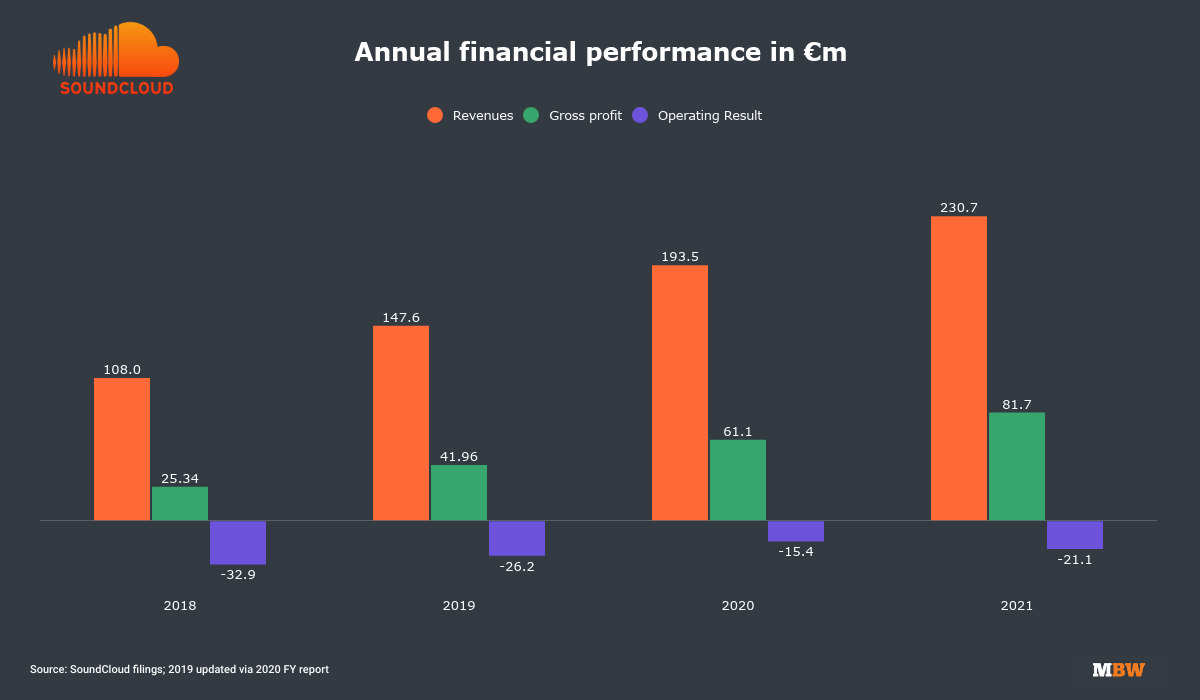
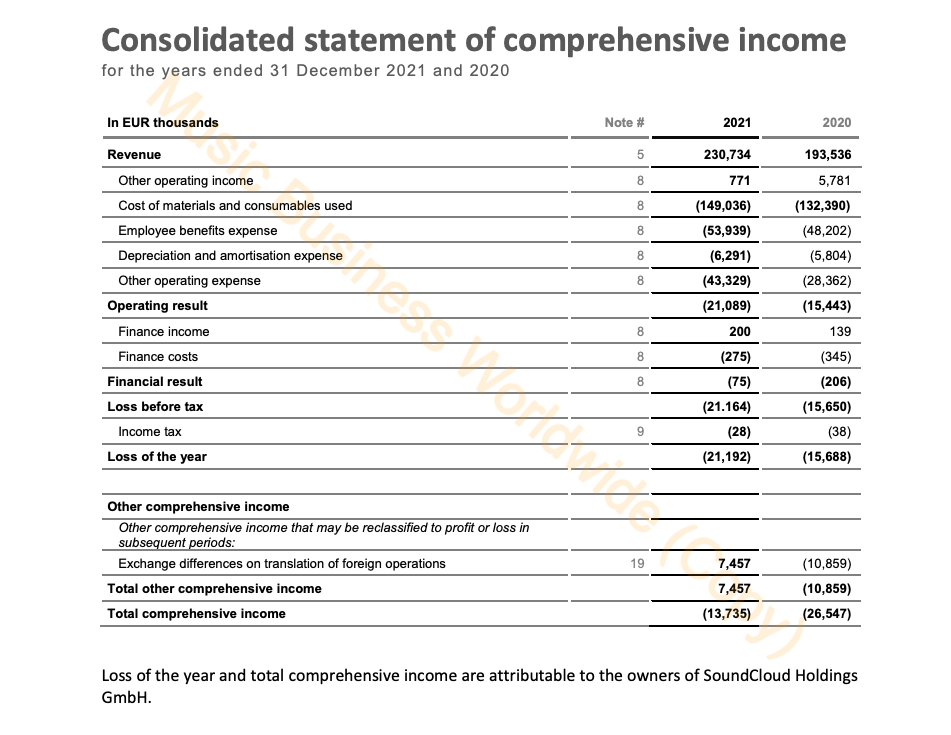
According to its financial report, SoundCloud saw its global revenues grow 19.2% YoY to EUR €230.7 million (USD $273m) in 2021, as the firm’s gross profit grew by 33.7% to €81.7 million ($97m).
That represented the third consecutive year of double-digit revenue growth across SoundCloud’s business, and the first year in which its annual revenues topped a quarter of a billion dollars.
SoundCloud’s operating loss widened in 2021, to €21.1 million ($25m) from €15.4 million in the prior year.
The company largely pins that widening of operating loss on a significant increase (+70% YoY) in marketing costs – particularly utilized, it’s understood, to push ‘SoundCloud For Artists’ to prospective independent artist clients. There were also ‘Roster’-related costs spent in 2021, in the lead-up to that business’s launch in Q1 2022.
The 2021 SoundCloud filing explains: “Significant investments were made in our operating infrastructure in 2021, including a reconstitution of the executive team with new experienced executives from the music and entertainment industries. Further, marketing spend was increased substantially (+70%) to drive targeted revenue growth, but [that spend] was slightly under plan.”
SoundCloud ended 2021 with €42.2 million ($50m) in cash and cash equivalents, down from €78.5 million in FY 2020, according to the document.
SoundCloud: ‘Fans’ vs. ‘Creators’ business
In 2021, SoundCloud divided its business into two simple categories:
(i) Fans – covering ad sales monetization of music streaming, plus payments from listeners who subscribe to SoundCloud’s paid-for subscription streaming offering; and
(ii) Creators – covering fees paid by artists for access to distribution and tools (SoundCloud For Artists) to market and monetize their music.
‘Roster’ has now added another dimension to this ‘Creators’ section’, with SoundCloud paying out advances and generating money from artist royalties on its and other platforms.
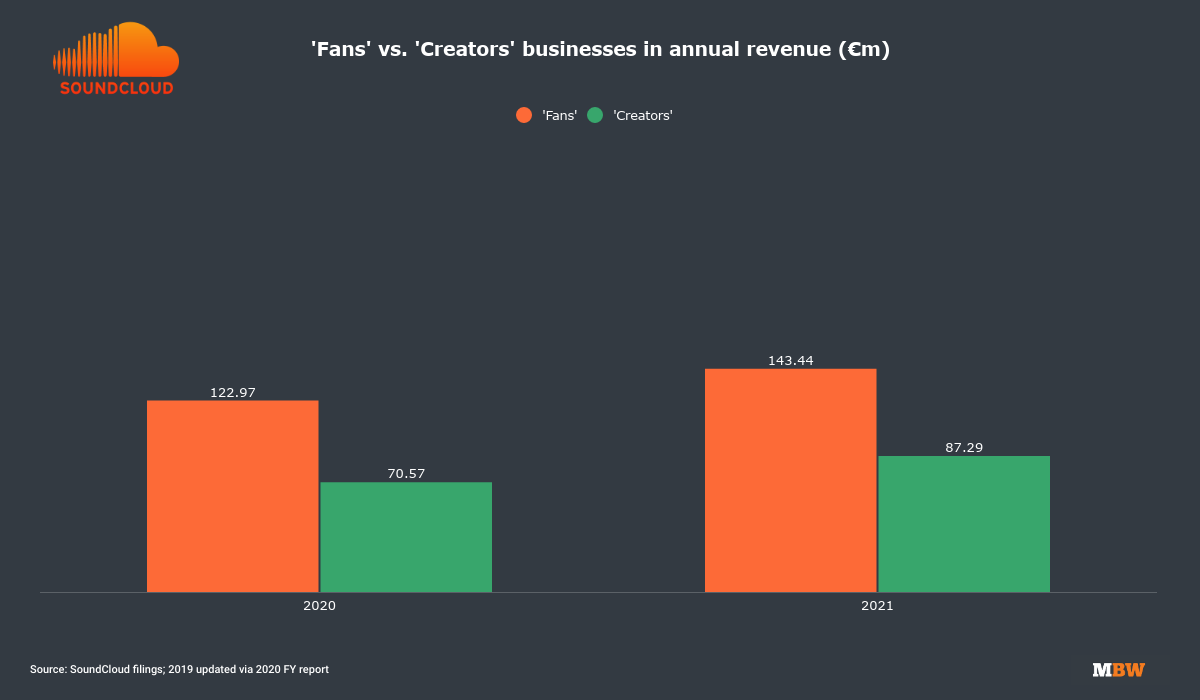
According to SoundCloud’s 2021 fiscal filing, its ‘Fans’ business saw revenues grow by 16.6% YoY to €143.4 million ($170m) last year.
Its ‘Creators’ business, meanwhile, grew faster in percentage terms – up by 23.7% YoY to €87.3 million ($103m).
As SoundCloud further adjusts its business with ‘Roster’ to increasingly focus on servicing and striking deals with ‘Creators’, it will be interesting to see if the gap in annual revenue between these two business segments narrows in the years ahead.
Sources close to the company suggest that, via this dual ‘Fans’ and ‘Creators’ strategy, it is now looking to achieve run-rate profitability at some point in 2023.
SoundCloud: Headcount
As mentioned, one of SoundCloud’s most important moves this year was the trimming of its global headcount by 20% in the summer.
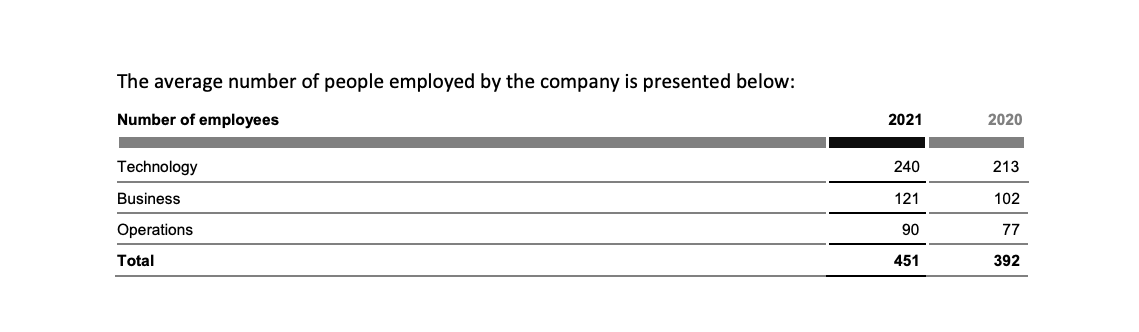
The company’s 2021 financial document shows the size that the firm’s global headcount had reached at the close of last year, months before the company made its lay-off round in summer 2022.
According to the document, the average number of people employed by SoundCloud in 2021 was 451, up from 392 in 2020.
If that 451 headcount held into H1 2022, then SoundCloud would have cut around 90 roles during its round of redundancies this summer.
SoundCloud: Acquisition of Musiio
SoundCloud’s big announcements this year didn’t stop at new launches and ‘Fan Powered Royalties’: in May, it also confirmed its acquisition of artificial intelligence-driven platform Musiio Pte Ltd.
SoundCloud’s 2021 financial filing confirms that it acquired 100% of Musiio Pte Ltd in April 2022, and that the purchase price consisted of approximately USD $7 million in cash, plus equity components.
Musiio´s technology focuses on B2B audio reference search (AI that can “listen” to music), automated tagging, and playlisting tools for the music industry.
SoundCloud says that, as part of its company, Musiio will now “add to the unique portfolio of fan and creator products at SoundCloud”.
All 2021 currency exchanges from EUR to USD in this article have been calculated at the average annual rate published by the US’s Internal Revenue Service (IRS).Music Business Worldwide