

The story of antivirals against influenza Part 4


Discover more from Trust the Evidence
The story of antivirals against influenza Part 4
Haunting by a ghost writer



The news we were updating our Cochrane review got around, and the media looking for a story offered to help. So we asked Roche whether they could release the data from the Kaiser et al. review to verify the findings and answer Hayashi’s comment.
Nothing was forthcoming from Roche, who later used the early media involvement as a sign of a plot against them when all we were trying to do was get to the data (see below).
The next drama came in 2009 when Tom’s phone rang, and a voice said: “Hello, Dr Jefferson, I am the person who wrote the Treanor and Nicholson trials”.
Tom was flabbergasted and asked this person for more detail. She said a “writing agency had recruited her” and gave her ready-compiled data tables, which she had to use to ghost craft manuscripts around several key messages and the compiled data tables.
Around this time, most publishers considered ghost authorship in medicine a minor problem and relatively uncommon. However, a 2007 survey comparing protocols and corresponding publications for 44 industry trials in Denmark found evidence of ghost authorship in 75 per cent of the studies. In 31 trials, the ghost authors were statisticians.
In 2008, further evidence based on court documents obtained during rofecoxib litigation (remember Vioxx?) showed that clinical trial manuscripts authored by employees were often attributed to academics who were paid basically to put their names first on the papers. Academics also often didn’t disclose such financial support. Furthermore, in 2009 the Wall Street Journal revealed that GlaxoSmithKline, the makers of Relenza, organised a ‘Friendly Ghostwriting Program’ for the drug Paxil. The “Case Study Publications for Peer Review” CASPPER, for short, was something of a standing joke at GSK, given they named the program after the friendly ghost cartoon.

The notion of ghostwriters fitted with the responses of the Kaiser “authors” having never seen the entire dataset. Tom found the whole thing so weird that after discussing it with his co-authors, he asked for advice from Fiona Godlee, the Editor in Chief of the BMJ, a person of common sense he knew.
At the time, The BMJ differed from the other big generalist journals as they published very few industry-funded trials. However, after sharing the emails and the information in our possession, the BMJ offered to partner with ITN Channel 4 to do the investigation while we were left to decide what to do next.
Documents given to the BMJ and Channel 4 News showed what the medical writer's job involved beyond the requirement to “ghost write”; it included “edits of original articles/editorials/letters” and “producing abstracts, posters, and slides for conferences.”
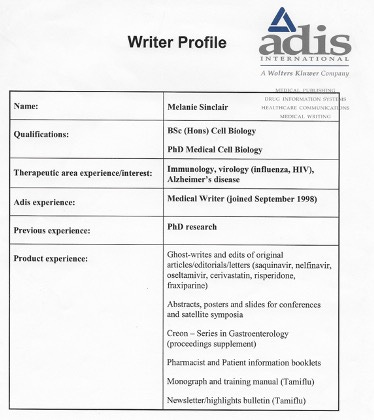
Adis employees were ‘under pressure to get messages out.’ The BMJ’s investigation revealed they had ‘to come to the conclusion that Tamiflu was the answer.’ Roche denied it ever put pressure on writers to include particular messages; yeah, yeah. But as it turned out, Dr Sinclair had ghostwritten just about every leaflet, paper, pamphlet and poster advertising Tamiflu, something that became clearer as the BMJ investigation progressed.
Part of the BMJ investigation by Deborah Cohen questioned who conceived the project. Kaiser responded in his email that - ‘The original idea, the main question, the selection of the published and unpublished studies and the design of the analysis have been elaborated by Fred [Hayden] and I.
However, the BMJ indicated that Roche had already set out the idea in an investigators brochure from 2000.
‘the dataset for the Kaiser analysis was conceived two years before the paper was accepted for publication in 2002. Roche had conceived the idea by December 2000. A Roche investigator's brochure from June 2009 features a table of "Summary of Secondary Illnesses Associated with Antibiotic Use (ITTI Population, Pool of Studies)". The dataset is dated 18th December 2000 and is the same as included in the review published in Archives in 2003. It included trials: “M76001, WV15670, WV15671, WV15707, WV15730, WV15812, WV15819, WV15872, WV15876, WV15978”’
Our grant to update the review had a termination date of 31 December 2009, so with two months to go, we concentrated on trying to obtain the data from the eight unpublished Kaiser trials. We say eight because, at that stage, we still thought that the two trials published in 2000 (Treanor et al. and Nicholson et al.) were OK, having undergone peer review.
At the time, Tom talked to Channel 4 health correspondent Tom Clarke, who considered Channel 4 News might be able to get the data. Producer Philip Carter went on to contact Roche’s press office and explained ‘that Kaiser and Hayden had suggested that Jefferson contact Roche, as they couldn’t locate the relevant files.”
In a 2009 letter to the BMJ, James Smith, international medical leader for Tamiflu, said they “were concerned that the Cochrane review team, led by Dr T Jefferson, chose to follow-up their inquiries through a television company rather than by approaching the manufacturer directly and obtaining data under a standard agreement—a move that questioned whether the motives for inquiries were truly for clarity and scientific validation”.
The mainstream and scientific media enquiries were underway, and Roche was feeling the heat. It wouldn't be long before they made the first move to offer up the Kaiser data - well, at least some of it.


My recollection is that, when I started work as a hospital medical librarian forty years ago, most papers published in scientific medical journals had one or two authors - and this had been so since time immemorial. Thus this famous example:
Fleming A. On the antibacterial action of cultures of a Penicillium with special reference to their use in the isolation of B. influenza. Br J Exp Pathol. 1929;10:226–36
Admittedly, by the 1940s, there had already been warning signs that important papers might result in multiple authorship:
Chain E, Florey HW, Gardner NG, Heatley NG, Jennings MA, Orr-Ewing J, Sanders AG. Penicillin as a chemotherapeutic agent. Lancet. 1940;236:226–8
Yet even when, by the 1980s, it was possible to find papers with literally dozens of authors, the assumption was that each of them had contributed in some meaningful way to the work. A claim of authorship was presumed to imply not only a measure of expertise in the subject area, but also some significant contribution to the original intellectual content of the publication.
Ghost writing, to me, is akin to fraud. Not only because the actual writer may not be named, but more so because the named authors may not in fact have contributed meaningfully to the work. This is especially egregious when academic and professional standing is as closely tied to the individual's publication history as it is today.
Every new instalment, I think the mendacious deceptions have peaked, but no, we just keep descending further. No respectable journal should be publishing ghost written medical literature, especially when it’s not merely possible to incidentally influence government policy, but specifically produced for that purpose.
Ghost writers are surely only fit for the level Katie Price’s 6 autobiographies, not professional medical literature.
I read part of the Cochrane study in the seasonal influenza vaccine earlier and I’m still shell shocked at how useless it is for most applications. My trust in physicians is evaporating seek on week but the evidence, or absence of evidence is what it is.