


Rape of Nanking: where were the civilians?
The key point of the Nanking Massacre in the English version of the Wiki is the massive killing of [civilians].
What differs from Japan in the definition is not the importance of killing actions against Chinese soldiers, but the importance of killing actions against civilians.
In Japan, this is already an impossible argument to make, but since this does not seem to be the case in the international community, we will focus a little on civilians.
I suspect that this information is not often taken into account in Western discussions.
I will present and discuss some basic historical sources when considering the population outside and inside the walls of Nanjing just prior to the start of the 1937 Battle of Nanjing.
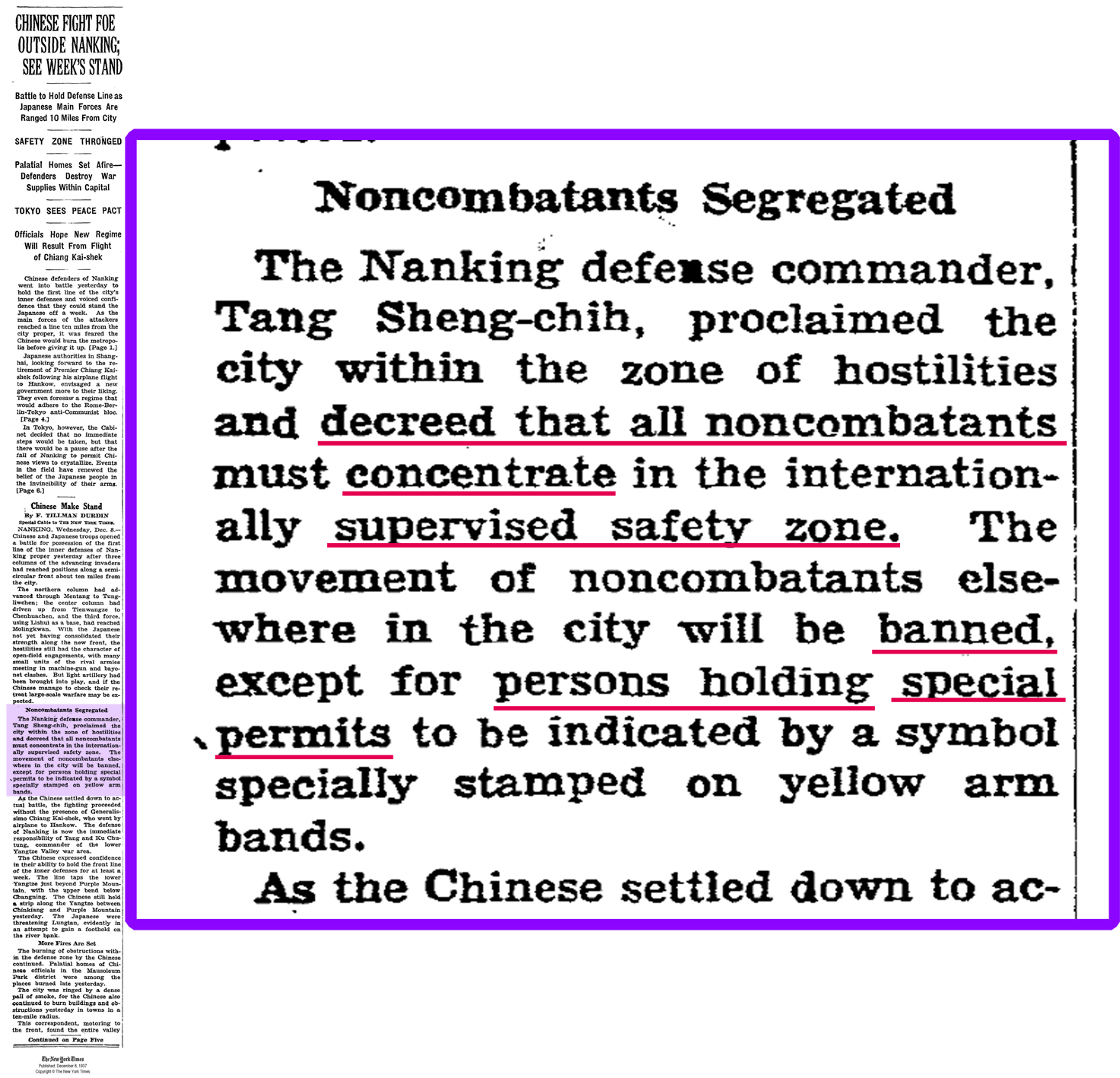
An important historical source is a December 8 article in the NYT.


In the December 8 article, Chinese troops incinerated and destroyed infrastructure 10 miles outside the city walls prior to the arrival of Japanese troops. They then evacuated the residents outside the walls to inside the walls.
The Chinese military ordered all [[civilians]] inside the city walls to evacuate to [[the Nanking Safety Zone]], which was chaired by Rabe of Nazi Germany and effectively run by American missionaries.

On December 12, at midnight, the Chinese forces were in full retreat and began fleeing within the city walls toward the port on the Yangtze River in the north.
However, they were blocked by Chinese troops guarding the Yangtze River Gate in the north, and Chinese soldiers fought each other inside the city walls. A building in the traffic section near the safe zone burst into flames, killing many Chinese soldiers.


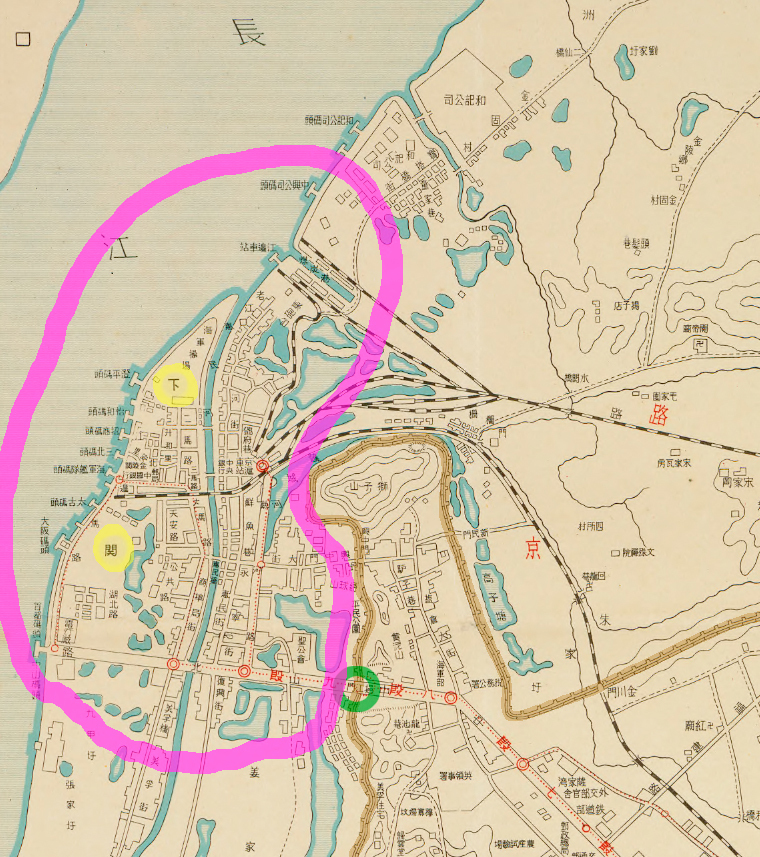
This can be seen in a top-secret US Navy document that entered Nanjing the following year.
Japan was defeated in WW2, and the Allies held the Tokyo Trials in 1946, charging Japan with war crimes under the title of the Nanking Massacre.
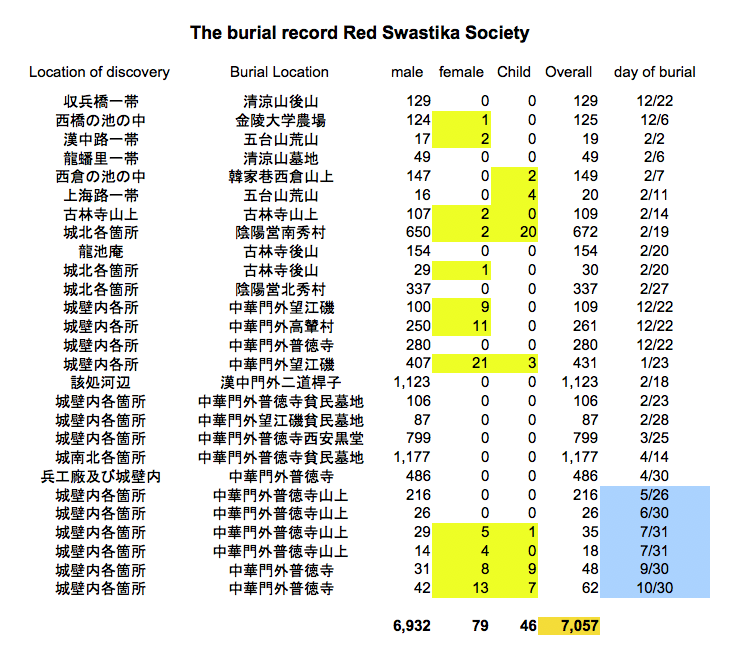
The Chinese burial records submitted at that time are as follows.
- Su Zen Do(崇善堂) 112,266.
- Red Swastika Society 43,071.
- 3,000 burials by people commissioned by the government (details unknown) as ordered by Gao Guanwu, the head of the temporary administrative organization in Nanjing.
There is also a figure of 92,500 people in total based on personal information, but it is unclear how this was measured and is excluded.
The total number of burials submitted was 250,837.
The total number of burials submitted was 250,837.
Regarding Su Zen Do(崇善堂), in an August 10, 1985 article in the Sankei Shimbun, researcher Kenichi ARA(阿羅健一) proved from Chinese historical records that at that time [Su Zen Do was not engaged in burial activities]. According to the postwar testimony of another Japanese military official who was negotiating with the Red Swastika Society in Nanjing at the time, the organization was commissioned by the Red Swastika Society, and other organizations mentioned that there were several charitable organizations that were subcontractors of the Red Swastika Society. In other words, the organizations that conducted burial activities are included in the Red Swastika Society's figures.

Also, Rabe's diary shows that although he had requested the Japanese to bury the abandoned bodies near his residence, he did not mention in his diary the burial activities of Su Zen do that were taking place near the site when he was inspecting the area after the Japanese set fire to it.
Considered together, this means that 112,266 people are not established as evidence.
In Japan, this figure is excluded.
An examination of the number of bodies found inside the city walls in the remaining burial records of the Red Swastika Society puts the number within 10,000.
Bodies do not move of their own accord, and there is no record of Japanese troops taking tens of thousands of bodies outside the city walls according to the historical records of Westerners, including those of the International Security Committee.
The bodies were found inside the city walls, possibly due to combat or other health reasons. The aforementioned fighting between Chinese troops. Even Iris Chang's book describes it.
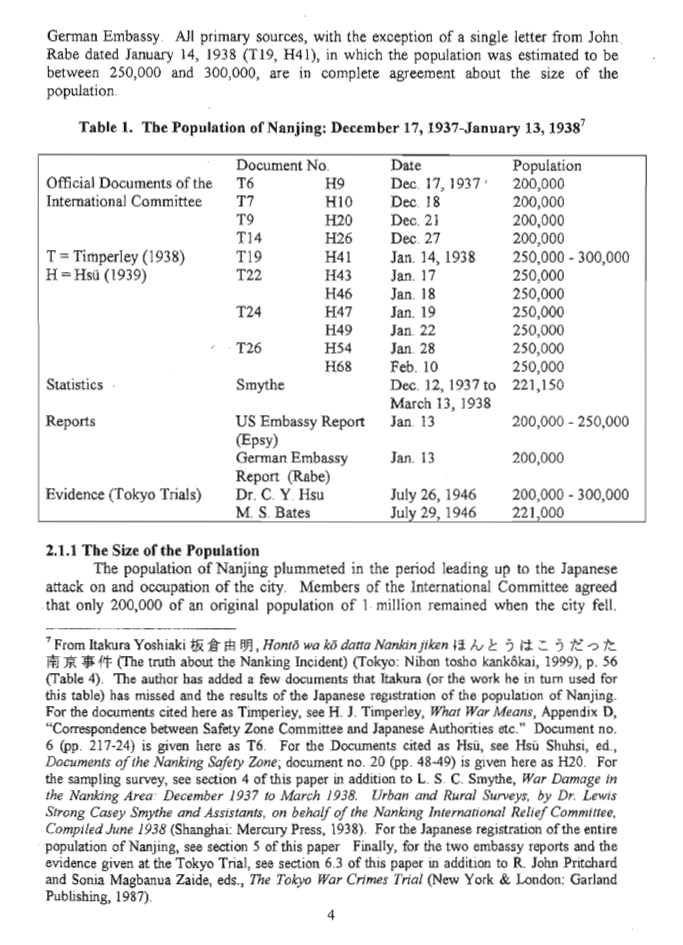
The numbers of civilians who assembled in the safe zone of Nanking based on the aforementioned military orders, etc., are as shown in the following table from historical records.
The Japanese military's special agency also surveyed the population. (Table from a paper by an Australian scholar at Ritsumeikan University)
Inside the city walls, the places where the civilians were found are not only in the safe zone, but also in various other places.
Gender is also almost exclusively male.
Burial records do not distinguish between soldiers and civilians; 98% of the 10,000 corpses are male, which would suggest that there were few [[civilians]], given that they were mostly soldiers.
As for the murders in the Documents of the Nanking Safety Zone, the number of bodies reported in 26 cases is 53.
However, these cases, too, lack detailed evidence to prove the crimes, and as reported by the NYT, include the possibility that the murders were committed by remnants of the Chinese military in hiding.
However, these cases, too, lack detailed evidence to prove the crimes, and as reported by the NYT, include the possibility that the murders were committed by remnants of the Chinese military in hiding.
It is impossible that tens of thousands or hundreds of thousands of civilians were killed, as the Wiki (Nanjing Massacre) states.


この記事へのコメント