Arizona Capitol

Arizona Legislature Was Warned Ban on Filming Cops Was ‘Unconstitutional’ Before Passing Law

Arizona Governor Doug Ducey signed a bill into law on July 6 that makes it a crime to film police officers from within eight feet of them.
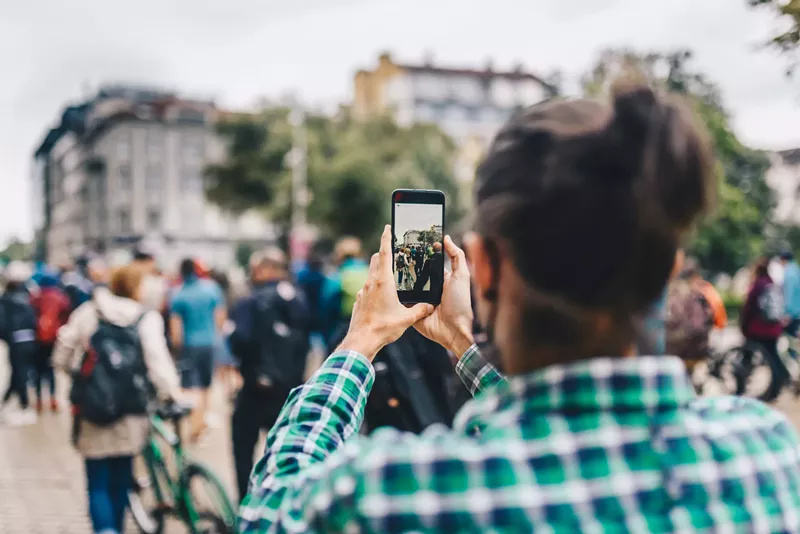
Arizona Governor Doug Ducey signed a bill into law on July 6 that makes it a crime to film police officers from within eight feet of them. Vasil Dimitrov / E+ / Getty Images

Arizona Governor Doug Ducey signed a bill into law on July 6 that makes it a crime to get within eight feet of police officers and film them.

Earlier this year, attorneys for the Arizona Legislature warned lawmakers that the bill could be unconstitutional, previously unreleased audio uncovered by Phoenix New Times reveals.


The measure passed anyway — not because lawmakers were oblivious to the fact that it could likely get shot down in the courts, but because they’re emboldened to let it escalate to the Supreme Court “because they can,” state senate staffers with inside knowledge told New Times.

On February 22, the Arizona House Rules Committee convened to discuss House Bill 2319, which would make it a crime to film police officers within 15 feet. It was sponsored by Representative John Kavanagh, a Fountain Hills Republican and outspoken “back the blue” supporter.


But the bill “presents some First Amendment issues,” House Rules Attorney Jennifer Holder advised the seven-member committee.


State Representative Domingo DeGrazia, a Tucson Democrat who is also an attorney, echoed that “there are some issues with the First Amendment” when casting one of two dissenting votes.


The bill was amended to include an exception if a driver is filming a traffic stop, and the “bubble” was whittled down to eight feet before it reached the senate. Additionally, there’s an exception for those filming on their own property, but an officer can still order the person recording to leave the area if the "law enforcement officer determines that the person is interfering in the law enforcement activity."


Despite these amendments, inside counsel aspersed the bill as unconstitutional.

Arizona_Senate_Rules_Committee_Audio_March_21_2022.mp3

“This does bring up questions relating to First Amendment and freedom of expression,” Senate Rules Attorney Chris Kleminich is heard saying on a March 21 recording obtained by New Times. “Recording of law enforcement activity has been recognized by federal courts as following within that First Amendment right.”


Kleminich told lawmakers that there are “reasons to be concerned about how a court will ultimately rule on this measure.”


On a slim, 31-27 party-line vote, House Republicans sent the bill to Ducey's desk.

The new law states, "It is unlawful for a person to knowingly make a video recording of law enforcement activity if the person making the video recording is within eight feet of where the person knows or reasonably should know that law enforcement activity is occurring."


“Law enforcement activity” refers to questioning a suspicious person, handling an “emotionally disturbed or disorderly person,” conducting an arrest, or simply, “enforcing the law.”


Film too close to the cops and a person could get tossed in jail for 30 days, plus face $500 in fines and a year of probation.


Critics of the new law call it threadbare and ambiguous. They claim it doesn’t take into account what happens if a person who’s already filming is approached by a police officer.


Others are concerned that protesters or citizen journalists using a camera phone to capture audio within 8 feet of cops, or carrying a camera that isn’t turned on or shooting video, may still be arrested.

Kavanagh, a 20-year cop himself, countered that only people making video recordings cause agitation not because of the action of filming, but because of who they are. He said they're usually part of organized "cop chaser" groups with a "rub it in your face" attitude.

"If the people doing audio were doing this, I would have expanded the bill," Kavanagh told New Times on Tuesday. "But I don't want to impose restrictions on people who are not a problem."
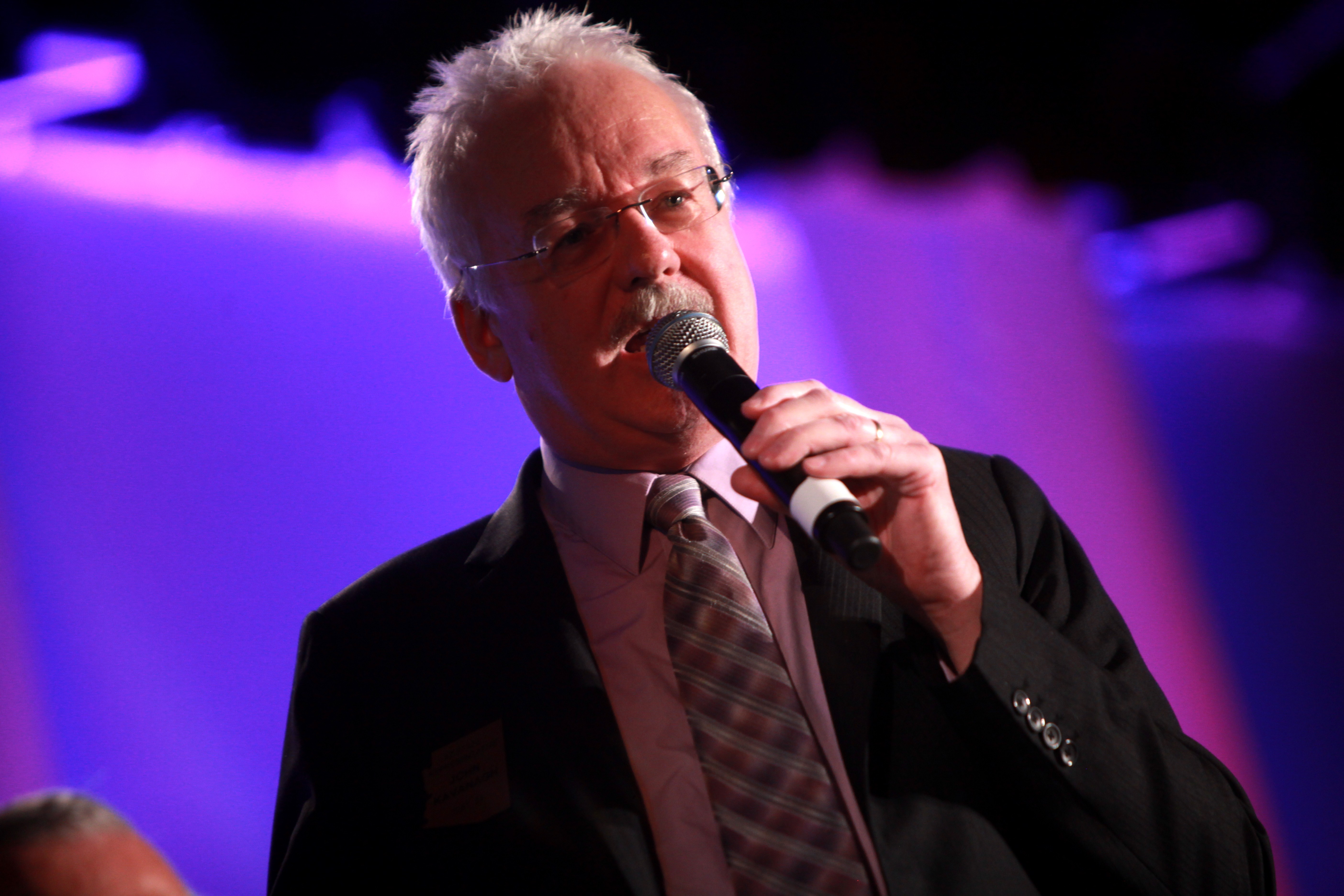
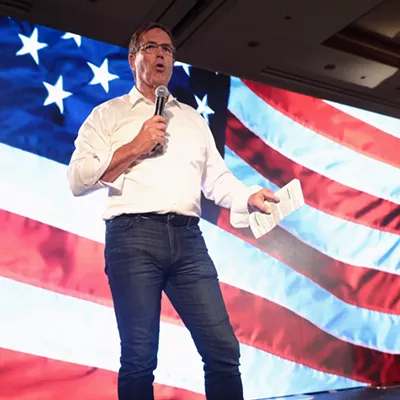
click to enlarge State Representative John Kavanagh speaks at the 2014 Western Conservative Conference at the Phoenix Convention Center. - GAGE SKIDMORE
State Representative John Kavanagh speaks at the 2014 Western Conservative Conference at the Phoenix Convention Center.
Gage Skidmore

Critics also doubt that any cop can accurately and consistently tell the difference between eight or nine feet — the difference between a crime and lawfulness.

"They don't know how far away you were until they have you in handcuffs," Robbie Sherwood, a spokesperson for the House Democrats, told New Times on Monday.


Kleminich makes an analogy: He and his buddy are walking down the street, focusing on their cellphones, when they pass a cop questioning a suspicious person. One of the friends is recording video as they walk past while the other is checking basketball scores.


“That creates a constitutional tension that is difficult to overcome,” Kleminich said.


It does not follow that one is obstructing police and the other is not, all other things being equal, Kleminich said.


Other attorneys agree.


“This law is blatantly unconstitutional,” First Amendment attorney Dan Barr told New Times. “I’m tired of this legislature passing bills that they know are unconstitutional. The legislative council surely said it was unconstitutional. They went ahead and they passed it anyway.”

Kavanagh, however, has no qualms about the constitutionality of his newly codified law.

"The problem that the rules people had … I think we got that taken care of," he said.


A dozen community members officially supported the bill. More than 600 people and groups opposed it.


Officially, not a single police group supported the bill.


True police supporters would be gung-ho on accountability to weed out the bad cops, Barr and others argued.


“We believe that this bill stacks the deck against the public check on officer misconduct,” Timothy Sparling, of Arizona Attorneys for Criminal Justice, told the Senate Judiciary Committee in March.


The National Press Photographers Association also sent Kavanagh a letter in February opposing the measure.


“We are extremely concerned that this language violates not only the free speech and press clauses of the First Amendment, but also runs counter to the ‘clearly established right’ to photograph and record police officers performing their official duties in a public place,” the letter reads.


The new law is reminiscent of questionable legislation introduced by Arizona Republicans in the past.


In 2017, Scottsdale Republican Jay Lawrence floated a ban on wearing masks at public events, but it failed to account for events where disguises may be expected, such as a Halloween festival.

The bill was introduced soon after the Phoenix Police Department tear-gassed a crowd of thousands protesting former President Donald Trump's rally downtown. Some of the provocateurs wore masks to disguise their identities and protect against the noxious fumes.


That bill, also deemed unconstitutional by its skeptics, was gutted and later died in the Senate.


“Kavanagh dreams up these bills that are not based on any real-world activity,” Barr said.


Kavanagh, the fourth-term senator, argued that filming close to a police encounter creates safety concerns for all involved, but did not bring up a specific incident. He also believes there’s no justifiable reason to record video at a distance of eight feet, a stance opposed by the National Press Photographers Association.


"Nobody walks up to a cop when he is questioning a suspicious person or arresting somebody and stands one or two feet away,” Kavanagh said on Arizona PBS. "Common sense says you’re asking for trouble.”

In fact, Kavanagh told New Times that "footage taken from 8 feet is actually better than footage from three feet."

Nobody is buying Kavanagh's claims about trouble-making videographers, Barr says. And there’s already a law on the books in Arizona stating it’s illegal to interfere with police work.


Kavanagh claims that the old law isn't sufficient to stall the camera-wielding agitators who routinely antagonize the Phoenix Police Department.

"'Interfere’ means to physically obstruct," he said. "Standing nearby isn't interfering, so the law is necessary."

The preexisting law defines obstruction as "using or threatening to use violence or physical force" to hinder police activity.

But redefining interference wasn't the true motivation behind HB 2319, Barr speculated.


“Internally, it doesn’t make any sense,” Barr said. “You don’t have to be an expert in constitutional law to see that they’re criminalizing protected First Amendment activity to discourage people from taking videos. The motivation behind the bill, frankly, is for these videos to not exist.”


It’s an accountability concern that comes as law enforcement agencies in Arizona face mounting scrutiny and lawsuits.


Last year, the U.S. Department of Justice launched a sweeping investigation into the Phoenix Police Department and the city of Phoenix for a series of alleged police misconduct issues, including excessive force and retaliation against protesters.


More than 100 demonstrators in Phoenix were corralled and arrested with a copy-and-paste probable cause statement during protests in the wake of the killing of George Floyd in 2020, sparking an active lawsuit.


Cops in Arizona also have killed more people this year than any other state except California and Texas, according to Mapping Police Violence, a research collaborative that keeps tabs on police-involved deaths around the country.

The new law is bound for the courts, where the outcome is anyone's guess.

KEEP PHOENIX NEW TIMES FREE... Since we started Phoenix New Times, it has been defined as the free, independent voice of Phoenix, and we'd like to keep it that way. With local media under siege, it's more important than ever for us to rally support behind funding our local journalism. You can help by participating in our "I Support" program, allowing us to keep offering readers access to our incisive coverage of local news, food and culture with no paywalls.
Elias Weiss is a staff writer at the Phoenix New Times. A native of Charlotte, North Carolina, he reported first for the Northwest Arkansas Democrat-Gazette and was editor of the Chatham Star-Tribune in Southern Virginia, where he covered politics and law. In 2020, the Virginia Press Association awarded him first place in the categories of Government Writing and Breaking News Writing for non-daily newspapers statewide.
Contact: Elias Weiss

Politics

Congressional Hearing Reveals More About Arizona’s Role in January 6 Attack

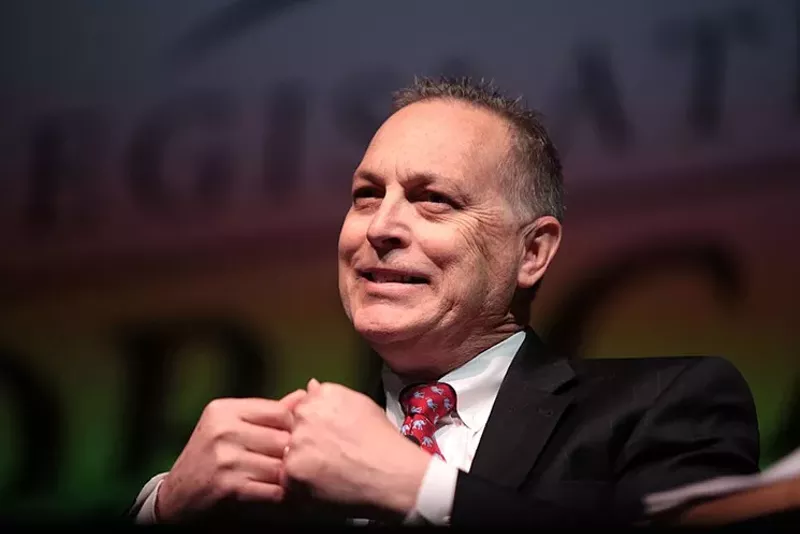
Arizona Congressman Andy Biggs
Arizona Congressman Andy Biggs Gage Skidmore

Familiar names and faces continue to pop up in public hearings of the House select committee investigating the January 6, 2021, attack on the U.S. Capitol, as federal prosecutors continue to slowly peel the curtain back on Arizona’s integral role in the unrest.


On Tuesday, in the seventh public hearing, U.S. Representative Stephanie Murphy, a Florida Democrat, revealed new information about the part Arizona Republicans played in the insurrection.


Lawmakers from close to home played a significant role in former President Donald Trump’s failed plot to overturn the election, even after the Electoral College affirmed President Joe Biden's victory.

Oval Office Meeting

One revelation centered around a strategy meeting at the White House on December 21, 2020, in which Republican members of Congress gathered to discuss then-Vice President Mike Pence’s role in tabulating electoral votes, the committee reported on Tuesday.


“According to White House visitor logs obtained by the committee, members of Congress present at the White House on December 21 included Congressmen Andy Biggs … and Paul Gosar,” Murphy said.

In closed-door testimony, former White House aide Cassidy Hutchinson said that members of Congress "felt that [Pence] had the authority to ... [send] the electors back to the states," according to an April court filing.


Biggs and Gosar, the representatives from Gilbert and Mohave County, respectively, sought presidential pardons along with the state’s two other Republican reps, David Schweikert and Debbie Lesko, five days after the riot.  Biggs specifically sought one for himself, according to material released by the committee last month.


Biggs has denied that.


Still, he and Gosar delivered speeches on the floor to decertify the 2020 general election result in Arizona, where Biden defeated Trump by the narrowest margin of any state.


“We know that the president met with various members about January 6 beforehand,” Murphy said, referring to Biggs and Gosar, among others.


Trump’s private schedule confirmed the December 21 meeting with Congress. Pence, Chief of Staff Mark Meadows, and Trump attorney Rudy Giuliani were in attendance, Murphy said.


The committee obtained an email from Alabama Republican Representative Mo Brooks with the subject line: “White House Meeting December 21 Regarding January 6.”


In the email, Brooks said he didn’t recruit other lawmakers to join in the “January 6 effort” because “only citizens can exert the necessary influence on senators and congressmen to join this fight against massive voter fraud and election theft.”


In an earlier hearing, it was revealed that Trump told acting U.S. Deputy Attorney General Richard Donoghue to “just say the election was corrupt. Leave the rest to me and the congressmen,” presumably referring, in part, to Biggs and Gosar.


“President Trump was trying to convince Vice President Pence to do something illegal,” Murphy said. “White House counsel confirmed all of that in testimony last week.”


The committee probe requested cooperation from Biggs, who made it clear in a written statement that he refused to assist the committee, dismissing it as a mainstream media-fueled "sham" aimed at disgracing Republicans on the national stage.


Even Lesko Was Worried

Lesko, who did not attend the December 21 meeting, was concerned on the eve of the January 6 riot, the committee also revealed on Tuesday.


On January 5, 2021, Lesko said in a video released by the House committee that she “asked leadership to come up with a safety plan for members.” 


“I’m actually very concerned about this because we have who knows how many hundreds of thousands of people coming here,” Lesko said. “We have Antifa. We also have, quite honestly, Trump supporters who actually believe that we are going to overturn the election, and when that doesn’t happen, most likely, they are going to go nuts.”


“Stop the Steal” architect Ali Alexander also tied himself to Gosar in recent testimony to the House committee. He touted that he and Gosar planned the event, calling Gosar his “spirit animal” at a 2020 rally in Phoenix.


Alexander went on to testify in federal court that he and Gosar had "a few phone conversations” ahead of the onslaught. He also coordinated the deadly riot with Arizona State Representative Mark Finchem, text messages released last year show.


Finchem and Arizona State Representative Anthony Kern, a Glendale Republican who’s also tied to Alexander, fraternized with rioters on the Capitol steps ahead of the attack, the texts and social media posts confirmed.


In earlier hearings, the House committee noted that Arizona’s faction of the alt-right domestic terrorism group Proud Boys pushed the raring crowd toward violence in front-line exchanges with Capitol police.


The U.S. Department of Justice also subpoenaed Arizona Republican Party Chairwoman Kelli Ward and her husband, Michael, for phone records the agency believes contain evidence of their involvement in a plot to send fake electors to Congress.

The Wards, as well as Kern, Arizona State Representative Jake Hoffman, and U.S. Senate candidate Jim Lamon declared themselves electors for Trump. Finchem, who is running for Arizona Secretary of State, was a key figure in coming up with the list of fake electors, it's been widely reported.


The Wards sued the House committee in federal court in Phoenix to keep the records mum. That lawsuit is pending.


Arizona House Speaker Rusty Bowers, a Republican from Mesa, changed the tenor of the state GOP’s 2020 election narrative when he testified that Giuliani admitted lacking evidence of sweeping election fraud last month.


As federal prosecutors continue to release their findings, Arizona’s central role in last year’s attack on the nation’s capital will become clearer.


KEEP PHOENIX NEW TIMES FREE... Since we started Phoenix New Times, it has been defined as the free, independent voice of Phoenix, and we'd like to keep it that way. With local media under siege, it's more important than ever for us to rally support behind funding our local journalism. You can help by participating in our "I Support" program, allowing us to keep offering readers access to our incisive coverage of local news, food and culture with no paywalls.
Elias Weiss is a staff writer at the Phoenix New Times. A native of Charlotte, North Carolina, he reported first for the Northwest Arkansas Democrat-Gazette and was editor of the Chatham Star-Tribune in Southern Virginia, where he covered politics and law. In 2020, the Virginia Press Association awarded him first place in the categories of Government Writing and Breaking News Writing for non-daily newspapers statewide.
Contact: Elias Weiss

Police

City of Phoenix Sued Over Police Killing of Disabled Man

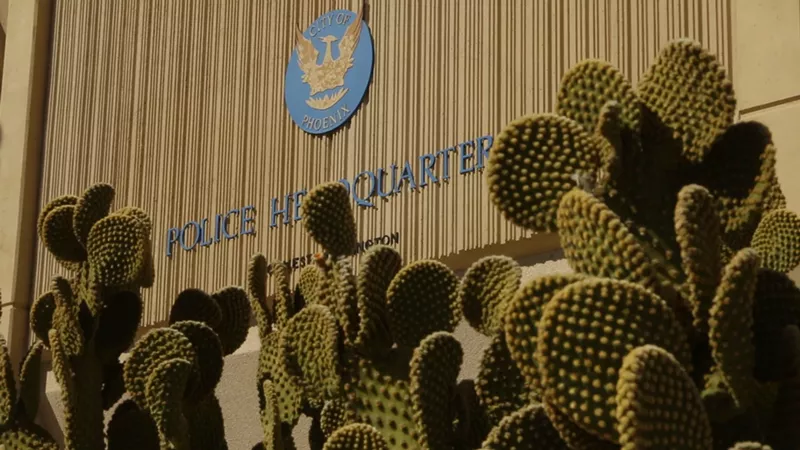
Phoenix Police Department headquarters.
Phoenix Police Department headquarters. Sean Holstege
On July 8, 2021, the night of his death, Stanley Howard called the Phoenix Police Department at least 15 times, asking for help.

By the end, Howard, a 64-year-old man with mental health issues and a water gun, was shot 10 times by Phoenix police officers.

Now, Howard's family is suing the city of Phoenix, alleging that officers violated his civil rights when they shot him.

The lawsuit was filed on the one-year anniversary of Howard's death in the U.S. District Court of Arizona on behalf of his estate and his brother, John Howard. It alleges that Phoenix officers used excessive force against Howard and violated his civil rights by failing, throughout the course of the night, to accommodate his serious disability.

It’s just the latest civil rights lawsuit that the embattled department is facing.

"The officers' failures resulted in Howard, who was unarmed, being gunned down by the defendant police officers," attorneys alleged in the complaint. Howard's death, attorneys wrote, was "unreasonable and conscience-shocking."

Reached Tuesday morning, Elizabeth Tate, a civil rights attorney representing Howard’s family, said she had no further comment aside from the allegations raised in the lawsuit. Howard’s brother and sister, she said, did not yet want to speak publicly.

Phoenix police did not return requests for comment from Phoenix New Times. The city has not yet filed any response in court.

At the time of his death, Stanley Howard lived in a home at 27th and Augusta avenues in Phoenix. Howard, the complaint notes, had a history of interactions with the department. He suffered from severe schizophrenia and depression. "His condition was chronic/permanent, and it limited, among other things, his ability to communicate and interact with other persons and periodically affected his will to live," attorneys explained.

Police were called to Howard's home before the day of his death. His family members, who lived out of state, occasionally asked for the department to perform welfare checks on Howard.

On July 8, 2021, Howard was in crisis. Starting at around 8 p.m., Howard began calling 911 multiple times. A team of officers was initially dispatched. When the first officers arrived, Howard punched his front window, breaking it and injuring his hand. Despite this, the officers left the scene, "leaving Howard ranting, raving, and bleeding, alone in his home," attorneys wrote in the lawsuit.

Over the course of the next hour, officers and a team from the fire department returned to attempt to provide medical aid, after Howard called 911 to report that he was bleeding, as he swore and threatened the emergency dispatcher. Howard refused their help. The cops and firefighters left, and he called 911 once again. A third team of officers was dispatched to his home.

At no point, attorneys note, did the 911 operator allow Howard to speak to a crisis counselor, or deploy any crisis assessment team to Howard's residence.
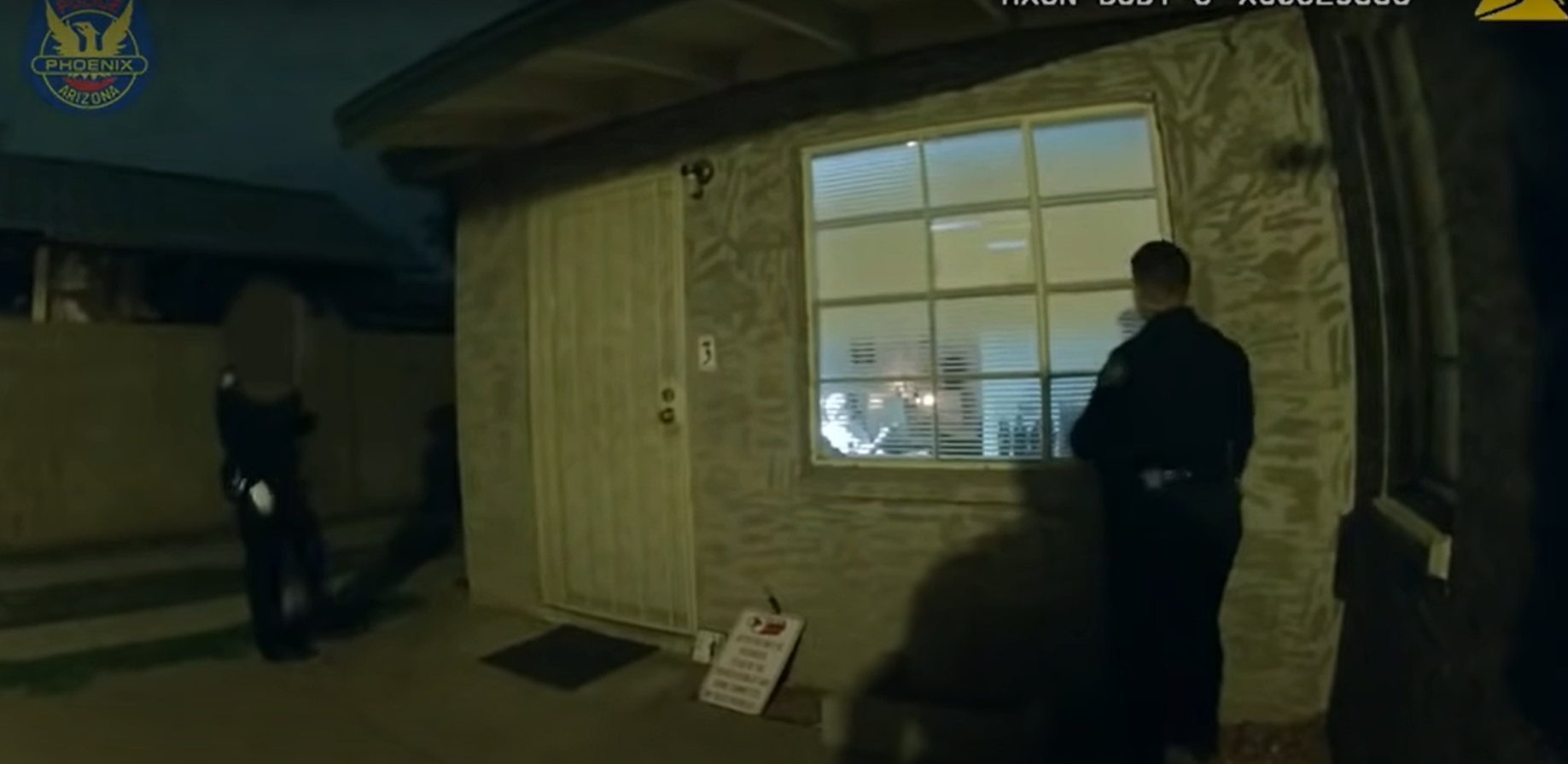
click to enlarge Officers approach Stanley Howard's home the night of the shooting. - CITY OF PHOENIX
Officers approach Stanley Howard's home the night of the shooting.
City of Phoenix
On July 22, 2021, in its initial press briefing about the incident, the Phoenix Police Department noted that the first officer to engage Howard, as well as a sergeant who was on scene, were both "crisis intervention certified officers," meaning that they had received training on how to approach people with mental illness.

All four officers who arrived at Howard's home are named in the lawsuit. They are Sergeant Jeremiah Fiola, who has spent more than a decade with the department, and officers Rayonte Benson, Ali Alkarawi, and Jennifer Rich.

A Phoenix police spokesperson did not answer questions about whether the internal investigation of the shooting had yet been concluded, and whether the officers involved received any discipline. The status of the officers on the force was not clear from court records.

A spokesperson with the Maricopa County Attorney's Office did not immediately answer questions about whether the county was considering charges in the case.

Edited bodycam footage that the Phoenix Police Department released of these four officers approaching Howard's home shows what occurred in the moments before his death.

In the video, the four officers stand outside Howard's door, asking if he wants to be seen by medical staff. Howard denies calling 911 and opens the door, telling officers: "I have a gun." He was holding a "plainly visible, large, red, water gun," attorneys wrote.

At the same moment that one officer shouts at Howard to drop the gun, another fires. Attorneys for the family wrote that he was shot "more than ten" times by three of the officers. While Howard is lying in the doorway, officers continue to shoot stun bags at him from behind a shield. At this point, police said in their press briefing about the incident, officers "believed Howard was still armed with a gun."

After officers determined that Howard was unarmed, medical aid was called.

Attorneys argued that officers had no legal justification for the shooting, and that in their response to Howard, they failed to provide him with any accommodations for his disability.

The case is one that could come to the attention of the U.S. Department of Justice, which is currently investigating the department for misconduct. One of the investigation’s primary areas of focus is Phoenix officers’ treatment of people with disabilities, particularly in cases of violent or deadly force. So far in the investigation, investigators have requested more than 1 million pages of internal documents for review.

In 2021, the year Howard was killed, the Phoenix police shot fewer people than in previous years — certainly less than in 2018. That year, the department carried out more police killings than any other agency in the country.

No hearings have been set yet in the case. The city has three weeks to reply to the complaint.
KEEP PHOENIX NEW TIMES FREE... Since we started Phoenix New Times, it has been defined as the free, independent voice of Phoenix, and we'd like to keep it that way. With local media under siege, it's more important than ever for us to rally support behind funding our local journalism. You can help by participating in our "I Support" program, allowing us to keep offering readers access to our incisive coverage of local news, food and culture with no paywalls.
Katya Schwenk is a staff writer for Phoenix New Times. Originally from Burlington, Vermont, she now covers issues ranging from policing to far-right politics here in Phoenix. She has worked as a breaking news correspondent in Rabat, Morocco, for Morocco World News, a government technology reporter for Scoop News Group in Washington, D.C., and a local reporter in Vermont for VTDigger. Her freelance work has been published in Business Insider, the Intercept, and the American Prospect, among other places.
Contact: Katya Schwenk

Join the New Times community and help support independent local journalism in Phoenix.

Get the latest updates in news, food, music and culture, and receive special offers direct to your inbox.

Become a member and go ad-free!