Roe v Wade: US Supreme Court leak suggests abortion law repeal
- Published
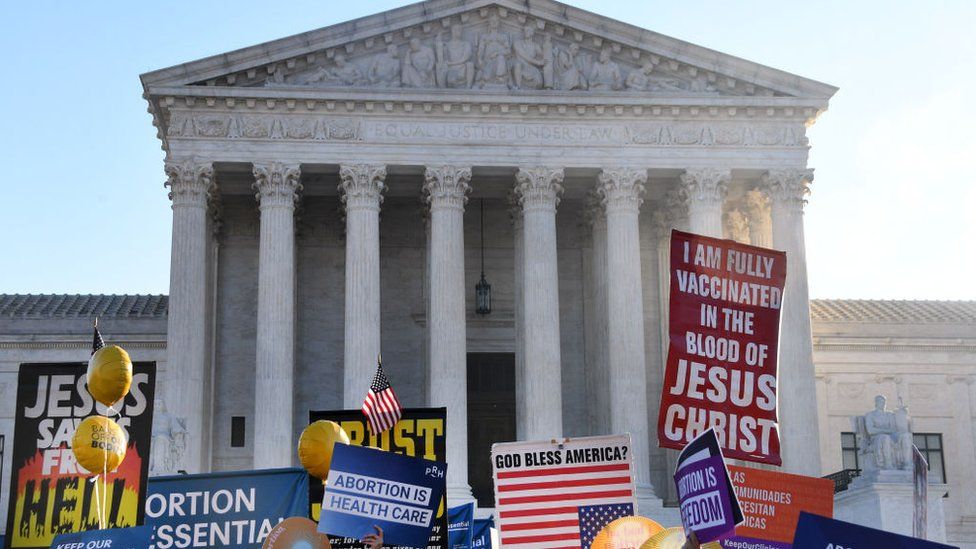 Image source, Getty Images
The US Supreme Court could be about to overturn the nationwide legal right to abortion, according to a leaked draft opinion that has stunned the country.
Politico reports that Justice Samuel Alito writes in the document that the landmark 1973 Roe v Wade decision is "egregiously wrong".
If verified, the leaking of the document would be unprecedented in the court's modern history.
The justices are expected to issue their ruling on the case by early July.
Neither the Supreme Court nor the White House wished to comment on the leak on Monday night.
"Roe was egregiously wrong from the start," the draft opinion reportedly states.
The opinion adds: "It is time to heed the Constitution and return the issue of abortion to the people's elected representatives."
Justice Alito also reportedly writes that Roe v Wade's reasoning was "exceptionally weak" and has had "damaging consequences".
"The inescapable conclusion is that a right to abortion is not deeply rooted in the Nation's history and traditions," the conservative's opinion reportedly says.
Speaker of the House of Representatives Nancy Pelosi and Senate Majority Leader Chuck Schumer - both Democrats - issued a joint statement reacting to the leak.
"If the report is accurate, the Supreme Court is poised to inflict the greatest restriction of rights in the past 50 years", the statement read.
It adds that the decision by "Republican-appointed Justices" would go down as an "abomination, one of the worst and most damaging decisions in modern history".
According to Politico, the leaked document is marked as a "1st Draft" and it was circulated in February. The votes of justices have been known to switch during the drafting process.
This is not the first time the Supreme Court has ruled on the case. In 1992, Justice Anthony Kennedy had a last-minute change of heart, refusing to provide the key fifth vote and join the majority to overturn Roe v Wade.


Assume for a moment that this draft opinion becomes the law of the land. In an instant - because of statutes already on the books and "trigger" laws designed for such an occasion - abortion would be illegal in 22 states.
The legality of the procedure would become a vicious political battleground in the midst of an election year.
This is the significance of what may be unfolding in the Supreme Court.
Draft opinions, however, are just that - drafts. And there have been accounts of justices shifting their views as the opinion-drafting process unfolds within the cloistered court chambers. This unprecedented leak short-circuits all that.
For most of US history, the Supreme Court has operated like Mount Olympus, handing down opinions from on high. That opacity has been shattered perhaps for good, as the leaking spreads.
What it will mean for the legitimacy of the judicial process in the US remains to be seen, but within the institution itself it seems safe to assume that all trust between the judges, a collegial group once referred to as "the brethren", is gone.
In an era when political norms have been broken like pottery in an earthquake, another big piece has fallen.
Six of the nine current justices on the court were appointed by Republican presidents. The other three were picked by Democratic presidents.
Politico reports that Justice Alito and four other Republican-appointed justices - Clarence Thomas, Neil Gorsuch, Brett Kavanaugh and Amy Coney Barrett - were in favour of the move. It is not clear how Chief Justice John Roberts will vote.
The three Democratic-appointed justices - Stephen Breyer, Sonia Sotomayor and Elena Kagan - are working on at least one dissent, reports Politico.
If issued as a majority ruling, Justice Alito's opinion would overturn the constitutional right to abortion in the US, paving the way for individual states to ban the procedure altogether, or place more restrictions on it.
The American Civil Liberties Union said that if confirmed, the decision "would deprive half the nation of a fundamental, constitutional right that has been enjoyed by millions of women for over 50 years".
The case involves a challenge to Mississippi's ban on abortion after 15 weeks, which the justices heard in December.
According to the BBC's US partner CBS News, the leak will cause tremendous damage to one of America's most respected institutions.
Chief Justice Roberts will probably order a full-blown investigation, involving the FBI, to unmask the source, reports CBS.
Such a leak did not even happen when the US presidency hung in the balance in 2000 in the disputed election between George W Bush and Al Gore.
Roe v Wade in 1973 gave women in the US an absolute right to an abortion in the first three months of pregnancy, and limited rights in the second trimester.
In 1992, in Planned Parenthood v Casey, the court ruled that states could not place an "undue burden" on women seeking abortions before a foetus could survive outside the womb, at about 24 weeks.
There were about 630,000 reported abortions in the US in 2019, according to the US Centers for Disease Control. This was an 18% decrease compared with 2010.
Women in their 20s account for the majority of abortions - in 2019 about 57% were in this age group.
Black Americans get abortions at the highest rate - 27 per 1,000 women aged 15-44.