
A new study suggests that dark energy might not be real after all. But other scientists have found major flaws with this bold claim.
Dark energy is a mysterious and hypothetical form of energy that is used to explain the accelerating expansion of our universe. One way that scientists have provided evidence of dark energy and its influence on the universe comes from measuring the redshift (a phenomenon in which the light coming from objects moving away from us appears red) of type Ia supernovas (SN Ia).
In other words, by measuring how the light that these supernovas emit changes as they move away from us, scientists can show how far they are and therefore how the universe is "pushing out" or expanding over time. This evidence depends on the assumption that supernova luminosity, or brightness, doesn't evolve with redshift, or vary over cosmic time.
Related: The History & Structure of the Universe in Pictures
If dark energy is real, as many scientists expect it to be, the universe will continue to expand faster and faster. But, if it turns out that dark energy doesn't exist after all, the expansion of the universe will eventually slow down and the universe could even start shrinking.
A bold claim
In a new study, published to the pre-print server arXiv and accepted for publication in The Astrophysical Journal, researchers from Yonsei University in Seoul, South Korea, along with collaborators at Lyon University and the Korea and Space Science Institute claim that they have found proof that dark energy might not exist at all. They studied a small sample of galaxies hosting about 30 type Ia supernovas and claim to have disproven the assumption that supernova luminosity evolves.
"Quoting Carl Sagan, extraordinary claims require extraordinary evidence, but I am not sure we have such extraordinary evidence for dark energy. Our result illustrates that dark energy from SN cosmology, which led to the 2011 Nobel Prize in Physics, might be an artifact of a fragile and false assumption," professor Young-Wook Lee of Yonsei University, who led the study, said in a statement.
"Taken at face values, our result suggests that ~100% of the evidence for dark energy simply goes away. This will be confirmed by future observations," Lee and co-author Yijung Kang told Space.com in an email.
To come to such a bold conclusion, the researchers observed the spectra — bands of colors that can be produced when matter interacts with or emits electromagnetic radiation — of the stars in nearby galaxies that host these supernovas. Studying the light coming from these galaxies helped them to determine the ages of the stars in those galaxies.
The team found what they reported as a significant correlation between the luminosity of these supernovas and the ages of the stars in these galaxies. They found that supernovas in younger galaxies are fainter than in older galaxies, which would upend the assumption that supernova luminosity doesn't evolve over cosmic time. So, because they found fault with one of the main pieces of evidence for dark energy, they concluded that there is a likelihood that dark energy may not exist at all.
Flawed science
Taking this study at face value, it seems probable that, if the researchers' work is correct, it could throw a huge wrench into our understanding of dark energy. However, in speaking with Adam Riess, a professor of physics and astronomy at Johns Hopkins University in Baltimore, and looking a bit closer at the study, it became clear that this study likely does not discredit the existence of dark energy.
"I think that it's flawed," Riess said about Lee's study. The findings from Lee's team are "at odds with what's been seen with larger samples of supernovae," he added.
Riess pointed out a few inconsistencies with the figures that the researchers published. For instance, one figure (below) plots galaxies with their brightness on the y-axis and their stellar population age on the x-axis. The green line (added by Riess) shows the beginning of our universe. So the figure plots galaxies as older than our universe.
"Some models overestimate ages for older galaxies," Lee and Kang said.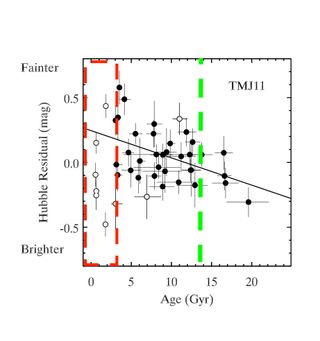
Additionally, while the study already uses a small sample of galaxies, you can see points in the same figure (above); the empty points were galaxies not included in the overall conclusion. So, just off the bat, there are a few things that seem strange about this study, as Riess pointed out.
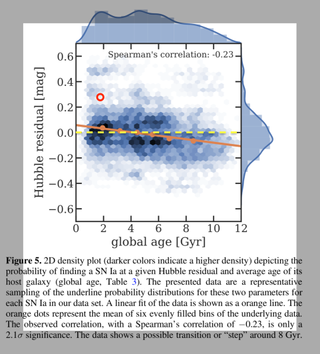
Riess explained further how the data collected by other studies that have used much larger samples and seem to have delved deeper into the issue, is in direct contrast with what Lee and Kang's team found. Riess pointed to the study "Think Global, Act Local: The Influence of Environment Age and Host Mass on Type Ia Supernova Light Curves," which was led by astrophysicist Benjamin Rose. In a figure from that study (below), Riess added a red circle where a plot point from Lee and Kang's figure would fall, and it is clear that in Rose's study, that point would not exist.
It can be kind of confusing to get "into the weeds" of studies like this, but it's important that extraordinary claims provide extraordinary evidence, as Lee noted.
Lee's team does acknowledge that their claims require further observations to prove, but it seems, as Riess described, that their conclusion has some flaws.
Alternative explanations
In addition to the possible errors in this conclusion is the fact that the luminosity and changing distance of supernovas is not the sole evidence for dark energy.
While Lee's team asserts that the redshift of these supernovae is the strongest evidence for dark energy (and that additional evidence for dark energy is flawed), it is not the only evidence.
Two other main sources of evidence are cosmic microwave background (CMB) and baryon acoustic oscillations (BAO).
According to scientists, a universe without dark energy would have a lot of structure, which would change the way that CMB photons act. However, observations of CMB have remained consistent with predictions about what CMB would look like in a universe with dark energy. Observations of BAO also align with the current understanding of what the universe would look like with dark energy.
- Know Your Novas: Star Explosions Explained (Infographic)
- Watch As a Supernova Morphs and Its Speedy Shock Waves Reverse
- Dark Matter and Dark Energy: The Mystery Explained (Infographic)
Follow Chelsea Gohd on Twitter @chelsea_gohd. Follow us on Twitter @Spacedotcom and on Facebook.



Good report. Dark energy is debated like this recent report, https://phys.org/news/2020-01-evidence-key-assumption-discovery-dark.html or this report from 2016, http://phys.org/news/2016-10-universe-rateor.html Building a database of Type Ia SN spectrums and...
I am new here so forgive me if I appear shy.
Dark Energy and Matter does exist however we seem to be looking for the evidence the wrong way. First, is isn't dark we just cannot see it as it does not come directly into our sensors in the limited forms we are observing with them. Dark...
https://www.scientificamerican.com/article/particles-found-to-travel/https://bigthink.com/dr-kakus-universe/what-travels-faster-than-the-speed-of-lighthttps://phys.org/news/2019-04-researchers-develop-way-to-control.htmlhttps://bigthink.com/surprising-science/astrophysicists-gamma-ray-jets-speed-of-lighthttps://futurism.com/the-byte/scientists-make-light-travel-fasterAlso I keep forgetting how much of a big deal...