SAN FRANCISCO—Hello Games, the makers of beleaguered space-exploration game No Man's Sky, announced a new initiative on stage at this year's Game Developers Conference: Hello Labs. As announced by studio founder Sean Murray, the company is setting aside money to fund multiple projects—one of which is already in development—that focus on "procedural [world] generation and experimental games research."
Murray made the announcement at the end of a discussion about the use of mathematic formulas to generate the quadrillions of planets in No Man's Sky. This discussion largely avoided talking about the game's mixed critical reception. Still, Murray did point out a few new details about the end of development.
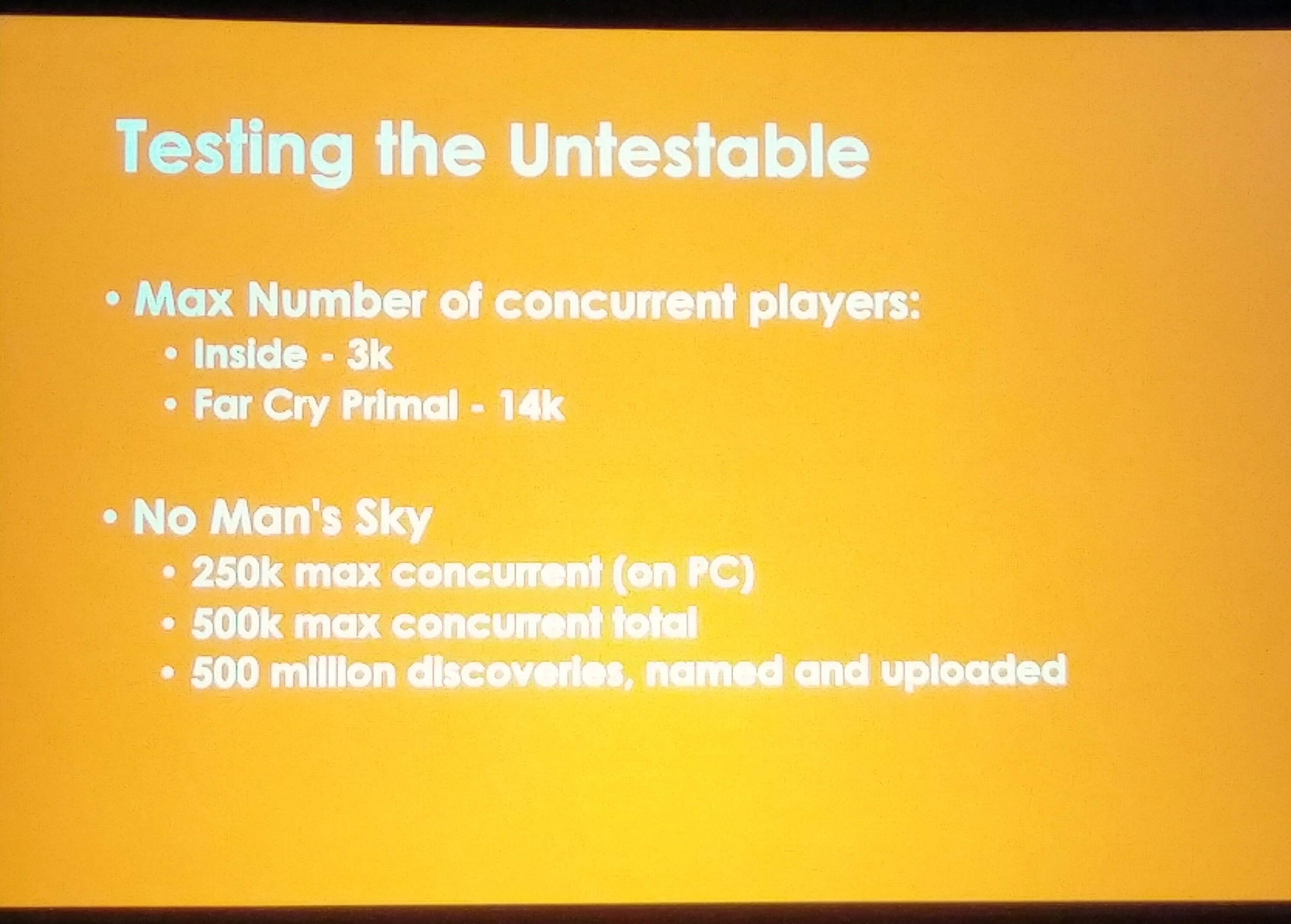
For starters: Murray and his team made an astonishingly low-ball prediction about how many players would boot the game on its first day. As in, less than 14,000. The team considered that number a high-end estimate of concurrent players, because staffers saw that number attached to recent Steam-use data for the game Far Cry: Primal, which launched shortly before No Man's Sky. "It's a huge game, obviously," Murray said. "That [number] made us a little bit nervous about servers, and the sheer number of people booting the game up day one." (The team was tempted to estimate even lower, at around the 3,000-player count of indie game Inside, but staffers at Sony warned Murray to estimate something befitting "a triple-A product.")
Turns out, the game wound up with 500,000 concurrent players on day one, and 250,000 of those were playing on a wide range of PCs. The total number overwhelmed the staff's "networking team," which Murray said consisted of solely one staffer ("and that was only one of his jobs... and we had half a billion discoveries uploaded [by players]"). Also, of those quarter-million PC players, roughly one percent had crash dump data reporting back to Hello Games. "It was on par with games I'd launched before, like Burnout, but we were just operating at a different scale," Murray said. "It was far beyond what I'd experienced before, in terms of people playing a game."
"Running out of money"
While describing the company's history, Murray admitted that Hello Games was "running out of money" while making No Man's Sky, all while juggling the challenge of "trying to finish something you care about really creatively." He also noted that Hello Games' staff had an average of nine employees over the past five years and confirmed that the actual world-building data of No Man's Sky was pretty tiny: 300MB. The rest of the game's 2GB size at launch consisted of audio and pre-baked UI assets.
The game's recent "Foundation" update, meanwhile, has reached one million players, Murray said, but he didn't clarify whether that number was a concurrent or combined count, nor whether that was split between PC and console. Still, he insisted that reported crashes for the update have plummeted to the 0.01 percent level, and he said most of those are due to players running beneath minimum PC specifications.
The panel focused largely on newer mathematical formulas and noise-generation systems used to generate planet terrain in No Man's Sky's Foundation update, and Murray pointed to player feedback as a sign of the patch's success—especially since it completely wiped the entire game's universe and rebuilt it from scratch.
"Something we kept hearing [about the Foundation update] was, the game feels a little bit more epic, or, there's a different feel to it," Murray said. "That is the terrain. I know because when our changes went in, everyone on our team started saying [the same thing]. It's hard to put your finger on exactly why, but you know you're seeing more interesting places and things you haven't seen before."
Murray pledged to continue developing new mathematical content-generation systems, both for No Man's Sky and for new games. He also told the GDC crowd that Hello Games is hiring. Procedural generation "is a big part of our future," Murray said in his pitch to game developers. "Making really neat, weird engine decisions, and letting them dictate a cascade of problems: it's cool for me to be able to stand up and say to talented people like yourselves, we're looking for that kind of thing."
The Hello Games team did not attend Wednesday night's Game Developers Choice Awards, where No Man's Sky beat the likes of The Witness, Pokémon Go, and Inside to win the Innovation Award. At Thursday's panel, Murray did facetiously whine about losing in other categories to Inside before praising it as a "great game."
This post originated on Ars Technica
37 Reader Comments
Anyways, the tech definitely has some interesting applications, but the man and the company have lost a lot of goodwill.
The roguelike, extremely popular two years ago, heavily relies on procedural generation.
Sadly, they want to infect the gaming world with even more PG games. Oh well, I won't buy any of them. Not until someone comes up with a solution to the massive boredom that isn't so obviously just another variable that was tweaked by the RNG. Bleah.
The Elite series has done this since 1984 and to this day the galaxy is still procedurally generated (they just procedurally generated the map once). Same with Eve Online (who used 42 as the RNG seed). The Diablo series does randomly generated maps which heavily leverages this kind of technology.
I also recall demo scene contests of writing a fully 3D first-person shooter with 64KB of code. They heavily leveraged procedural generation and the fact it didn't have to actually run inside of 64KBs.
I believe that would be procedural generation and then a lot of hand-polishing, which is something NMS lacks by necessity of scale.
where did they get this number? didn't they have pre-order numbers available to them? for a game that was ludicrously over hyped by the fan base. that number should have been WAY higher then that.
Sadly, they want to infect the gaming world with even more PG games. Oh well, I won't buy any of them. Not until someone comes up with a solution to the massive boredom that isn't so obviously just another variable that was tweaked by the RNG. Bleah.
What, exactly, makes a procedurally-generated game inherently non-AAA? Even if they typically don't fall into that category, there's no unwritten rule that procedural generation can't be sophisticated enough to warrant AAA status.
I mean, I totally agree that No Man's Sky wasn't AAA, but coming down on the procedurally-generated component of it and acting like that's the reason it wasn't AAA seems misguided to me.
...unless it's Blizzard or Valve
Sadly, they want to infect the gaming world with even more PG games. Oh well, I won't buy any of them. Not until someone comes up with a solution to the massive boredom that isn't so obviously just another variable that was tweaked by the RNG. Bleah.
What, exactly, makes a procedurally-generated game inherently non-AAA? Even if they typically don't fall into that category, there's no unwritten rule that procedural generation can't be sophisticated enough to warrant AAA status.
I mean, I totally agree that No Man's Sky wasn't AAA, but coming down on the procedurally-generated component of it and acting like that's the reason it wasn't AAA seems misguided to me.
Some of my favorite games have been procedurally generated. And it's a pretty diverse list of games.
Binding of Isaac, Dark Cloud, Elite: Dangerous, Don't Starve, Dwarf Fortress...
Nobody can write a FPS in only 64KB of code... it took 96KB:
https://en.wikipedia.org/wiki/.kkrieger
...kkrieger makes extensive use of procedural generation methods. Textures are stored via their creation history instead of a per-pixel basis, thus only requiring the history data and the generator code to be compiled into the executable, producing a relatively small file size. Meshes are created from basic solids such as boxes and cylinders, which are then deformed to achieve the desired shape - essentially a special way of box modeling. These two generation processes account for the extensive loading time of the game — all assets of the gameplay are reproduced during the loading phase.
Also, there's an RPG that has a procedurally generated, infinite world:
https://en.wikipedia.org/wiki/Malevolen ... f_Ahkranox
Now, I was never particularly involved with it pre-launch, but the game that was delivered on launch day was pretty much exactly what I was expecting. I find it fun to dip into for 30 minutes to an hour every so often, and it's just neat to poke about exploring.
I get the feeling that people convinced themselves that there would be content that wasn't promised, coupled with some misunderstandings. That doesn't reflect super-well on Hello Games for perhaps being unclear, but it's also not really the ultimate betrayal I see it being cast as?
The one thing that inevitably gets brought up is that they promised you could interact with other players and so far no one has been able to. I admit, I never got this. If you look at the claims made about the number of planets vs. the number of players, the number of people ever in the same solar system, never mind the same planet, at the same time should've been 0. Even with the Birthday Paradox in force there was a sub-0.001% chance of any two people ever meeting. The fact that it apparently did happen once or twice and they couldn't see each other is bizarre in multiple ways (how did anyone ever meet up? Why couldn't they see each other? Why was multiplayer interactivity ever a feature in the game given these odds?) but it doesn't seem like it should've had that much impact on anyone's playthrough just because no one should ever have expected to meet anyone else.
I mean, don't get me wrong, NMS is not a perfect game by any means. It's repetitive and it really needs more pieces to assemble plants and animals from, but it's not some grand betrayal of the entire gaming community.
So according to Hello Games, they only figured out how big to make the game off one dataset in Feb 2016, 6 months before release. They had better numbers 2-3 months later, but ignored those and decided that less than 10% of preorders in the US alone would play the game.
These guys are about as good at lying as they are at making games.
https://www.youtube.com/watch?v=3Wgolc1rRro
where did they get this number? didn't they have pre-order numbers available to them? for a game that was ludicrously over hyped by the fan base. that number should have been WAY higher then that.
In the article it says they got it from Steam user data. I would agree and think they should have been studying the launches of Diablo 3 and Sim City 5, since both seem more similar to NMS than Far Cry Primal, namely in how server data plays such a heavy role in content. Even more troubling is that they were scared that 14,000 was going to be rough. They were obviously incredibly out of touch.
You have to realize this was a developer conference, so they're going to be looking at things differently. Despite the failure as a game, their procedural generation tech was actually pretty innovative and interesting. You can debate the merits of it being worthy to win such an award for that aspect, but it's not like there wasn't some reason there were such high expectations for this game.
I actually think that given a much much larger studio, one that would have been able to create far larger and more varied assets (ships, creatures, textures, etc), and more buildup of the ancillary components (gameplay for instance, also networking or at least actually providing the potential interaction between players that was claimed to exist), No Man's Sky would be considered a resounding success. The tech is actually pretty good, they were just too focused on that and did not get enough actual game development help to make the game they were trying to make.
I'm still completely baffled since Sony had input and surely they were telling them that they needed to hire a bigger team. It really is a case of they effectively killed a franchise that would have been huge. It would be like if Microsoft had let Bungie push out that wonky half-baked RTS version of Halo. Since they didn't they ended up with a major multi-billion dollar franchise. If No Man's Sky had come anywhere close to living up to the hype it would have been as big as Destiny, and could have potentially been Minecraft level.
Actually that's another game they should have been studying and taking lessons from, and it likewise had many of the same issues that NMS did (does still really). And, IIRC they had put hundreds of millions of dollars of development into Destiny. They had to know they were looking at an unmitigated failure to release the game in the state they did. I know they were basically going broke, so they probably figured if they didn't release it then that was it and their tech would likely go under with the game, but I think if they'd just taken a step back and realized, and then went to Sony and said "help!" it would have had the opportunity to live up to the game it was supposed to be. It could have even been transcendent, imagine if they put in the effort to develop PS VR support.
Now, I was never particularly involved with it pre-launch, but the game that was delivered on launch day was pretty much exactly what I was expecting. I find it fun to dip into for 30 minutes to an hour every so often, and it's just neat to poke about exploring.
I get the feeling that people convinced themselves that there would be content that wasn't promised, coupled with some misunderstandings. That doesn't reflect super-well on Hello Games for perhaps being unclear, but it's also not really the ultimate betrayal I see it being cast as?
The one thing that inevitably gets brought up is that they promised you could interact with other players and so far no one has been able to. I admit, I never got this. If you look at the claims made about the number of planets vs. the number of players, the number of people ever in the same solar system, never mind the same planet, at the same time should've been 0. Even with the Birthday Paradox in force there was a sub-0.001% chance of any two people ever meeting. The fact that it apparently did happen once or twice and they couldn't see each other is bizarre in multiple ways (how did anyone ever meet up? Why couldn't they see each other? Why was multiplayer interactivity ever a feature in the game given these odds?) but it doesn't seem like it should've had that much impact on anyone's playthrough just because no one should ever have expected to meet anyone else.
I mean, don't get me wrong, NMS is not a perfect game by any means. It's repetitive and it really needs more pieces to assemble plants and animals from, but it's not some grand betrayal of the entire gaming community.
I dunno. Maybe when Sean Murray continually lied in interviews about it being multi-player.
I'm rather tired of people making excuses such as, people just misinterpreted statements or expected things that were never promised. Murray lied about multi-player continuously. Used a custom made hand created demo to show off all that wondrous footage that was routinely showed. And people still make excuses for him when you can demonstrably show him lying repeatedly.
https://www.youtube.com/watch?v=AE0nuW-mQ8A
Anyways, the tech definitely has some interesting applications, but the man and the company have lost a lot of goodwill.
Simple, number of players that are using the servers at the same time.
If players don't intersect with each other just means that the it's much easier to create a server that is horizontally scalable.
I'd say my team at work would be capable of creating something that scales for that. But we'd certainly be VERY afraid of serving over 10k users with no beta test or rollout, much less over 100k.
Now, I was never particularly involved with it pre-launch, but the game that was delivered on launch day was pretty much exactly what I was expecting. I find it fun to dip into for 30 minutes to an hour every so often, and it's just neat to poke about exploring.
I get the feeling that people convinced themselves that there would be content that wasn't promised, coupled with some misunderstandings. That doesn't reflect super-well on Hello Games for perhaps being unclear, but it's also not really the ultimate betrayal I see it being cast as?
The one thing that inevitably gets brought up is that they promised you could interact with other players and so far no one has been able to. I admit, I never got this. If you look at the claims made about the number of planets vs. the number of players, the number of people ever in the same solar system, never mind the same planet, at the same time should've been 0. Even with the Birthday Paradox in force there was a sub-0.001% chance of any two people ever meeting. The fact that it apparently did happen once or twice and they couldn't see each other is bizarre in multiple ways (how did anyone ever meet up? Why couldn't they see each other? Why was multiplayer interactivity ever a feature in the game given these odds?) but it doesn't seem like it should've had that much impact on anyone's playthrough just because no one should ever have expected to meet anyone else.
I mean, don't get me wrong, NMS is not a perfect game by any means. It's repetitive and it really needs more pieces to assemble plants and animals from, but it's not some grand betrayal of the entire gaming community.
I dunno. Maybe when Sean Murray continually lied in interviews about it being multi-player.
I'm rather tired of people making excuses such as, people just misinterpreted statements or expected things that were never promised. Murray lied about multi-player continuously. Used a custom made hand created demo to show off all that wondrous footage that was routinely showed. And people still make excuses for him when you can demonstrably show him lying repeatedly.
https://www.youtube.com/watch?v=AE0nuW-mQ8A
...and?
Again, the apparent lack of multiplayer is bizarre but, frankly, less bizarre than ever including it in the first place, given the odds of ever meeting someone else. Hello Games was actually quite clear on that: Their statements were, essentially, that two people might, might, conceivably stumble upon each other at some point in the game's life. That people somehow read this to mean full co-op multiplayer support confuses me.
I also admit that I haven't been paying attention to any experiments around the multiplayer (last I heard it could actually be implemented, but using instanced servers, so even if people do happen to be at the same place at the same time they'd also have to be on the same server. From a mathematical perspective, even if there are 1 000 servers that doesn't meaningfully impact the odds of such an encounter actually happening, because the starting odds are so incredibly low) but, well, the game was pitched as having a nigh-uncountable number of planets and, at most, a few million players online at once. There was simply no way meeting other people would ever have been a realistic expectation.
Which does mean that I remain confused as to why multiplayer was ever pitched as part of it. Netcode is difficult, so why spend the dev time on that when the odds of it ever paying off across the lifetime of the game is effectively zero?
Now, I was never particularly involved with it pre-launch, but the game that was delivered on launch day was pretty much exactly what I was expecting. I find it fun to dip into for 30 minutes to an hour every so often, and it's just neat to poke about exploring.
I get the feeling that people convinced themselves that there would be content that wasn't promised, coupled with some misunderstandings. That doesn't reflect super-well on Hello Games for perhaps being unclear, but it's also not really the ultimate betrayal I see it being cast as?
The one thing that inevitably gets brought up is that they promised you could interact with other players and so far no one has been able to. I admit, I never got this. If you look at the claims made about the number of planets vs. the number of players, the number of people ever in the same solar system, never mind the same planet, at the same time should've been 0. Even with the Birthday Paradox in force there was a sub-0.001% chance of any two people ever meeting. The fact that it apparently did happen once or twice and they couldn't see each other is bizarre in multiple ways (how did anyone ever meet up? Why couldn't they see each other? Why was multiplayer interactivity ever a feature in the game given these odds?) but it doesn't seem like it should've had that much impact on anyone's playthrough just because no one should ever have expected to meet anyone else.
I mean, don't get me wrong, NMS is not a perfect game by any means. It's repetitive and it really needs more pieces to assemble plants and animals from, but it's not some grand betrayal of the entire gaming community.
I dunno. Maybe when Sean Murray continually lied in interviews about it being multi-player.
I'm rather tired of people making excuses such as, people just misinterpreted statements or expected things that were never promised. Murray lied about multi-player continuously. Used a custom made hand created demo to show off all that wondrous footage that was routinely showed. And people still make excuses for him when you can demonstrably show him lying repeatedly.
https://www.youtube.com/watch?v=AE0nuW-mQ8A
...and?
Again, the apparent lack of multiplayer is bizarre but, frankly, less bizarre than ever including it in the first place, given the odds of ever meeting someone else. Hello Games was actually quite clear on that: Their statements were, essentially, that two people might, might, conceivably stumble upon each other at some point in the game's life. That people somehow read this to mean full co-op multiplayer support confuses me.
I also admit that I haven't been paying attention to any experiments around the multiplayer (last I heard it could actually be implemented, but using instanced servers, so even if people do happen to be at the same place at the same time they'd also have to be on the same server. From a mathematical perspective, even if there are 1 000 servers that doesn't meaningfully impact the odds of such an encounter actually happening, because the starting odds are so incredibly low) but, well, the game was pitched as having a nigh-uncountable number of planets and, at most, a few million players online at once. There was simply no way meeting other people would ever have been a realistic expectation.
Which does mean that I remain confused as to why multiplayer was ever pitched as part of it. Netcode is difficult, so why spend the dev time on that when the odds of it ever paying off across the lifetime of the game is effectively zero?
And?
Then don't fucking lie about it being implemented! It amazes me the mental gymnastics people will perform to excuse being blatantly lied to. Even down to saying you could have human compatriots as wing-men or multiplayer space battles. It was all bullshit. Liars deserve to be lambasted. I don't care if they're politicians, businessmen, or game developers. A liar is a liar.
NMS doesn't "grab" me. I don't have issues with grinding per se but in NMS I got to the point where I just couldn't be arsed. I dislike the visual style and I find the planet visuals tiring to look at for extended periods.
When Elite: Dangerous came out on Xbox, I was all over it. Way more engaging. Lots of stuff ostensibly going on in the wider universe. Ship combat that is engaging, fun and challenging.
I get what NMS is trying to do but it just doesn't seem to be for me.
NMS doesn't "grab" me. I don't have issues with grinding per se but in NMS I got to the point where I just couldn't be arsed. I dislike the visual style and I find the planet visuals tiring to look at for extended periods.
When Elite: Dangerous came out on Xbox, I was all over it. Way more engaging. Lots of stuff ostensibly going on in the wider universe. Ship combat that is engaging, fun and challenging.
I get what NMS is trying to do but it just doesn't seem to be for me.
That's pretty much my take on it. I played NMS obsessively when it came out (PS4) and it basically owned me for about a month, or 6 weeks. Then, having got the centre of about three galaxies I put it away and don't feel any real need to play it again.
I did download the Foundation update, but of the three modes it now gives you, hard mode is basically insta-kill, and the building mode is badly needing to be fleshed out.
Elite:Dangerous, on the other hand, I bought going on two years ago now, and I'm still playing it and having huge amount of fun in it.
To me the main problem was that for a game that sold itself on the infinite variety you could encounter, there wasn't much in the way of actual variety. Planets were one of a few basic types (ice ball, dust ball, lush greenery) and most of the animals were coming off of a few basic templates. They were also environment locked: you'd never see land animals wading, flying critters never landed, etc.
Buildings were all of the same type, despite supposedly being built by three different races. That's just lazy.
And they should have left the space combat out entirely, because holy balls that was bad.
Now, I was never particularly involved with it pre-launch, but the game that was delivered on launch day was pretty much exactly what I was expecting. I find it fun to dip into for 30 minutes to an hour every so often, and it's just neat to poke about exploring.
I get the feeling that people convinced themselves that there would be content that wasn't promised, coupled with some misunderstandings. That doesn't reflect super-well on Hello Games for perhaps being unclear, but it's also not really the ultimate betrayal I see it being cast as?
The one thing that inevitably gets brought up is that they promised you could interact with other players and so far no one has been able to. I admit, I never got this. If you look at the claims made about the number of planets vs. the number of players, the number of people ever in the same solar system, never mind the same planet, at the same time should've been 0. Even with the Birthday Paradox in force there was a sub-0.001% chance of any two people ever meeting. The fact that it apparently did happen once or twice and they couldn't see each other is bizarre in multiple ways (how did anyone ever meet up? Why couldn't they see each other? Why was multiplayer interactivity ever a feature in the game given these odds?) but it doesn't seem like it should've had that much impact on anyone's playthrough just because no one should ever have expected to meet anyone else.
I mean, don't get me wrong, NMS is not a perfect game by any means. It's repetitive and it really needs more pieces to assemble plants and animals from, but it's not some grand betrayal of the entire gaming community.
I dunno. Maybe when Sean Murray continually lied in interviews about it being multi-player.
I'm rather tired of people making excuses such as, people just misinterpreted statements or expected things that were never promised. Murray lied about multi-player continuously. Used a custom made hand created demo to show off all that wondrous footage that was routinely showed. And people still make excuses for him when you can demonstrably show him lying repeatedly.
https://www.youtube.com/watch?v=AE0nuW-mQ8A
...and?
Again, the apparent lack of multiplayer is bizarre but, frankly, less bizarre than ever including it in the first place, given the odds of ever meeting someone else. Hello Games was actually quite clear on that: Their statements were, essentially, that two people might, might, conceivably stumble upon each other at some point in the game's life. That people somehow read this to mean full co-op multiplayer support confuses me.
I also admit that I haven't been paying attention to any experiments around the multiplayer (last I heard it could actually be implemented, but using instanced servers, so even if people do happen to be at the same place at the same time they'd also have to be on the same server. From a mathematical perspective, even if there are 1 000 servers that doesn't meaningfully impact the odds of such an encounter actually happening, because the starting odds are so incredibly low) but, well, the game was pitched as having a nigh-uncountable number of planets and, at most, a few million players online at once. There was simply no way meeting other people would ever have been a realistic expectation.
Which does mean that I remain confused as to why multiplayer was ever pitched as part of it. Netcode is difficult, so why spend the dev time on that when the odds of it ever paying off across the lifetime of the game is effectively zero?
Well as it turned out the odds were much higher than they claimed. This was both because players weren't started in totally random locations, because they needed to be far from the center. On top of that, once you've found something discovered by someone else, it creates the possibility of finding that person, either in game, or out of band, especially early on when people hadn't moved around so much.
The Internet might not but the general public does.
You're only ever as good as your last review. If he comes out with something stellar, no-one will care about the tech-stumble that was NMS.
Now, I was never particularly involved with it pre-launch, but the game that was delivered on launch day was pretty much exactly what I was expecting. I find it fun to dip into for 30 minutes to an hour every so often, and it's just neat to poke about exploring.
I get the feeling that people convinced themselves that there would be content that wasn't promised, coupled with some misunderstandings. That doesn't reflect super-well on Hello Games for perhaps being unclear, but it's also not really the ultimate betrayal I see it being cast as?
The one thing that inevitably gets brought up is that they promised you could interact with other players and so far no one has been able to. I admit, I never got this. If you look at the claims made about the number of planets vs. the number of players, the number of people ever in the same solar system, never mind the same planet, at the same time should've been 0. Even with the Birthday Paradox in force there was a sub-0.001% chance of any two people ever meeting. The fact that it apparently did happen once or twice and they couldn't see each other is bizarre in multiple ways (how did anyone ever meet up? Why couldn't they see each other? Why was multiplayer interactivity ever a feature in the game given these odds?) but it doesn't seem like it should've had that much impact on anyone's playthrough just because no one should ever have expected to meet anyone else.
I mean, don't get me wrong, NMS is not a perfect game by any means. It's repetitive and it really needs more pieces to assemble plants and animals from, but it's not some grand betrayal of the entire gaming community.
I dunno. Maybe when Sean Murray continually lied in interviews about it being multi-player.
I'm rather tired of people making excuses such as, people just misinterpreted statements or expected things that were never promised. Murray lied about multi-player continuously. Used a custom made hand created demo to show off all that wondrous footage that was routinely showed. And people still make excuses for him when you can demonstrably show him lying repeatedly.
https://www.youtube.com/watch?v=AE0nuW-mQ8A
...and?
Again, the apparent lack of multiplayer is bizarre but, frankly, less bizarre than ever including it in the first place, given the odds of ever meeting someone else. Hello Games was actually quite clear on that: Their statements were, essentially, that two people might, might, conceivably stumble upon each other at some point in the game's life. That people somehow read this to mean full co-op multiplayer support confuses me.
I also admit that I haven't been paying attention to any experiments around the multiplayer (last I heard it could actually be implemented, but using instanced servers, so even if people do happen to be at the same place at the same time they'd also have to be on the same server. From a mathematical perspective, even if there are 1 000 servers that doesn't meaningfully impact the odds of such an encounter actually happening, because the starting odds are so incredibly low) but, well, the game was pitched as having a nigh-uncountable number of planets and, at most, a few million players online at once. There was simply no way meeting other people would ever have been a realistic expectation.
Which does mean that I remain confused as to why multiplayer was ever pitched as part of it. Netcode is difficult, so why spend the dev time on that when the odds of it ever paying off across the lifetime of the game is effectively zero?
Players went out of their way to meet up in the same area, on the same platform, and could not see one another.
where did they get this number? didn't they have pre-order numbers available to them? for a game that was ludicrously over hyped by the fan base. that number should have been WAY higher then that.
Did you read the article? It explained exactly where they got the number.
Not that I'm aware of, no.
Not that I'm aware of, no.
ah not reinstalling then, i wish nms would add co-op play of like 2 to 8 people like l4d but with up to 8 instead of 4 and no dummy ai either.
where did they get this number? didn't they have pre-order numbers available to them? for a game that was ludicrously over hyped by the fan base. that number should have been WAY higher then that.
Did you read the article? It explained exactly where they got the number.
I still wouldn't call that a rational estimate tbh. Far Cry Primal was a B-list AAA game. The kind of product that a company like Ubisoft will build primarily using old assets to keep revenue coming in until their next big hitter, avoid any staff downtime/layoffs, or to recoup losses on a previous big project that didn't meet with projections.
NMS was touted for years as being a huge deal in the games industry space. It was a big console exclusive for Sony and was heavily marketed on Steam. The problem was that Hello Games repeatedly played the indie card as a means to excuse delays, avoid showing any real footage and ultimately, for the disappointing final product.
Well I'm sorry but your game stops being indie when you affix a full AAA $60 retail price to it. Hello Games can whine about being a "small team" as often as they like but when you price your game at $60, you're game sits alongside the likes of Skyrim, GTA V and The Last of Us. Only NMS didn't sit alongside those games because it wasn't as good as any of them. It was worse. Much, much worse.
The fact that they also compared their game to Inside also illustrates just how greedy and deluded Hello Games really were.
Sadly, they want to infect the gaming world with even more PG games. Oh well, I won't buy any of them. Not until someone comes up with a solution to the massive boredom that isn't so obviously just another variable that was tweaked by the RNG. Bleah.
What, exactly, makes a procedurally-generated game inherently non-AAA? Even if they typically don't fall into that category, there's no unwritten rule that procedural generation can't be sophisticated enough to warrant AAA status.
Also what exactly constitutes a AAA game these days? It certainly isn't quality...
I mean, I totally agree that No Man's Sky wasn't AAA, but coming down on the procedurally-generated component of it and acting like that's the reason it wasn't AAA seems misguided to me.
You must login or create an account to comment.