Investment Highlights:
- Institutional interest in PLX shares is at an all-time high as new positions increased to over 30% of the total outstanding shares.
- The largest institutional owner is now UBS-O'Connor with a total 9.5% stake in the company.
- The company reported successful Phase 2 data for its Fabry drug candidate in three presentations last week.
- Investors will be closely watching for the release of full Phase 2 data for its Cystic fibrosis drug candidate AIR DNAse in March, 2017.
Discussion:
Shares of Protalix BioTherapeutics, Inc. (NYSEMKT:PLX) are up over 100% since my last update article "Protalix BioTherapeutics Is Making Significant Progress And The Market Is Beginning To Notice," on January 31, 2017. At one point it almost reached a 200% gain having recorded a new 52-week high of $1.48 on February 13, 2017 as seen in the chart below:
(click to enlarge)
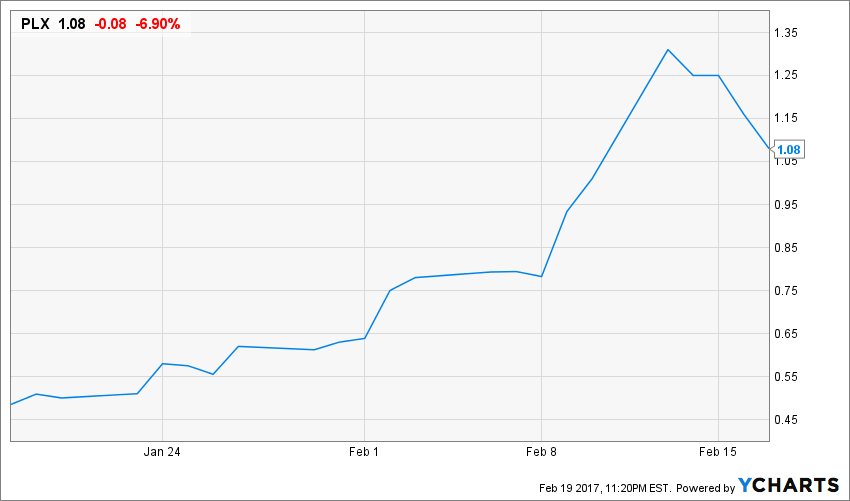
Frankly, the strong 2-week rally from 60c to $1.48/share surprised me a bit. I was expecting that price range about 2 to 4 weeks later or just ahead of the much expected release of full Phase 2 AIR DNase Cystic fibrosis data expected sometime in March, 2017. The pps has retraced a bit to close at $1.08 on Friday, February 17, 2017.
Significant New Institutional Ownership
I wrote my last Protalix article to discuss a significant new investment in the company and also to update on all planned 2017 company milestones and catalysts per the most recent company update dated January 9, 2017.
The new investment was a 6.2M share, or 5% of common stock, purchase announced by Knight BioTherapeutics of Canada. The uniqueness of this investment was the comment made by Knight, that their purchase of PLX stock was to establish a long relationship to ultimately generate Canadian and Israeli product rights derived from Protalix's promising pipeline and unique drug-discovery platform.
As mentioned in detail in my first article on Protalix, the company focuses on the development and commercialization of recombinant therapeutic proteins expressed through its proprietary plant cell-based expression system, ProCellEx drug-discovery and production platform. Through ProCellEx, the company develops tailor-made recombinant proteins aimed at treating unmet medical needs or to replace current FDA-approved therapies with more effective counterparts. The ProCellEx platform enables the production of these plant-based proteins in a cost-effective, sustainable, and efficient manner.
It appears that the current promising pipeline, and unique drug-discovery platform, is what prompted several institutions to make recent large investments to acquire Protalix common stock in recent months.
This can be seen in the following table where I list only new institutional investors in Protalix:
Institution Name |
Date |
Shares Held |
Ownership % |
Value, $1000s |
UBS (O'Connor Global) |
02/16/2017 |
12,669,785 |
New, 9.5 |
13,683 |
Knight Therapeutics |
02/1/2017 |
6,200,000 |
New, 5.0 |
6,696 |
Highbridge Capital |
12/23/2016 |
6,523,399 |
New, 5.1 |
7,045 |
Federated Investors |
02/14/2017 |
5,436,372 |
New, 4.6 |
5,871 |
Ion Asset Management |
12/31/2016 |
4,035,008 |
New, 3.8 |
4,358 |
Camber Capital |
02/14/2017 |
1,562,933 |
New, 1.3 |
1,688 |
Angelo Gordon & Co. |
12/31/2016 |
1,057,068 |
New, 0.8 |
1,143 |
Citigroup Incorporated |
12/31/2016 |
584,793 |
New, 0.44 |
632 |
Parallax Volatility |
12/31/2016 |
141,519 |
New, 0.12 |
153 |
Millennium Mgmt. |
12/31/2016 |
110,100 |
New. 0.08 |
119 |
The % shown above are based on the 123M fully-diluted shares that resulted after December 1, 2016 private placement. The most visible names in the list are UBS-O'Connor, and Citigroup Inc. (NYSE: C). Of the current names one of the best known is Pfizer (NYSE: PFE) with 5M shares. It is likely that some institutions who purchased in the last two weeks, judging by the record trading volumes, haven't filet yet.
Update on 2017 Catalysts and Milestones:
Much of the conversation in my previous articles was about the superiority (thus far) of Protalix' AIR DNase drug candidate as a therapy for Cystic fibrosis over Roche's (OTCQX:RHHBY) FDA-approved $700M/year Pulmozyme. As a reminder, Protalix will unveil full-data Phase 2 results of this potentially blockbuster drug in March, 2017 as seen in the catalyst table at the end of this section. Interim data was presented in early January and the results showed significantly improved results in all parameters tested over Pulmozyme.
As planned, the company presented results of several studies for its PRX 102 Fabry disease drug candidate entering Phase 3; one on February 14, and the other two on February 16, 2017.
PRX 102 (pegunigalsidase alfa) being developed for the treatment of Fabry disease, is a chemically-modified version of the recombinant alpha-Galactosidase-A (alpha-GAL) protein. To improve the stability, and overall activity of PRX 102, Protalix through the ProCellEX platform, found a way to covalently bind molecular sub-units of the alpha-GAL protein using PEG chains. In several studies and trials to date, PRX 102 has demonstrated enhanced circulatory half-life, increased enzyme activity and milder side-effects in target organs affected by Fabry disease than competing proteins.
Fabry disease is a rare genetic disorder caused by a defective gene (the GLA gene) in the body. In most cases, the defect in the gene causes a deficient quantity of the enzyme alpha-galactosidase A. This enzyme is necessary for the daily metabolism of a category of lipids in the body called globotriaosylceramide (GL-3 or GB-3). When proper metabolism of this lipid and other similar lipids does not occur, GL-3 accumulates in the majority of cells throughout the body. The resulting progressive lipid accumulation leads to cell damage. The cell damage causes a wide range of mild to severe symptoms including potentially life-threatening consequences such as kidney failure, heart attacks and strokes often at a relatively early age. Fabry disease is a progressive, destructive and potentially life-threatening disease. Fabry disease can affect males and females of all ethnic and cultural backgrounds.
Symptoms of Fabry Disease can include: gastrointestinal problems, heart problems, kidney problems, skin problems, hypertension, fatigue, hearing loss, osteoporosis, neurological diseases, and gastrointestinal diseases. Because Fabry Disease is associated with such a wide range of symptoms, it often goes undiagnosed.
The addressable market for Fabry disease is estimated to exceed $1B/year. There are currently two drugs available to treat Fabry Disease, but only one of them is FDA approved:
- Agalsidase Beta (Fabrazyme) - Manufactured by Genzyme, a division of Sanofy (NYSE:SNY). FDA approved in 2001
- Agalsidase Alfa (Replagal) - Manufactured by Shire PLC (NASDAQ:SHPG). Approved elsewhere, but denied approval in the US in February of 2012.
Just like the company is going head-to-head against giant Roche's $700M/year Pulmozyme with its Cystic fibrosis drug candidate, it plans to go head-to-head against $600M/year Fabrazyme.
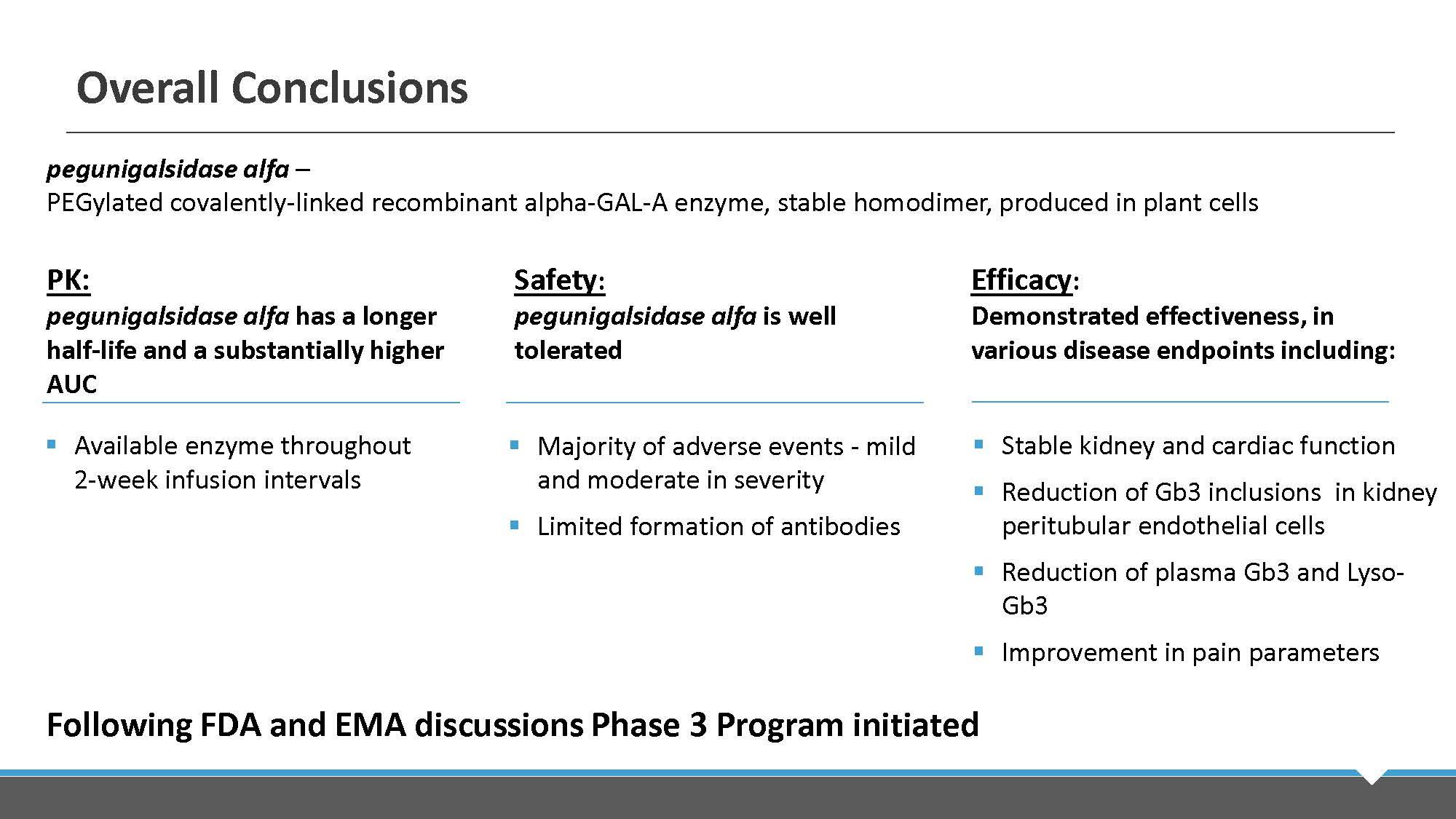
Of all presentations last week, the most relevant results were given during the February 16, 2017 Presentation by Dr. Derralynn Hughes: "One-year follow up of Fabry disease patients treated by IV administration of a plant derived alpha-Gal-A enzyme: safety and efficacy."
The following slide shows the impressive conclusions of that study on all three evaluation categories :
(click to enlarge)
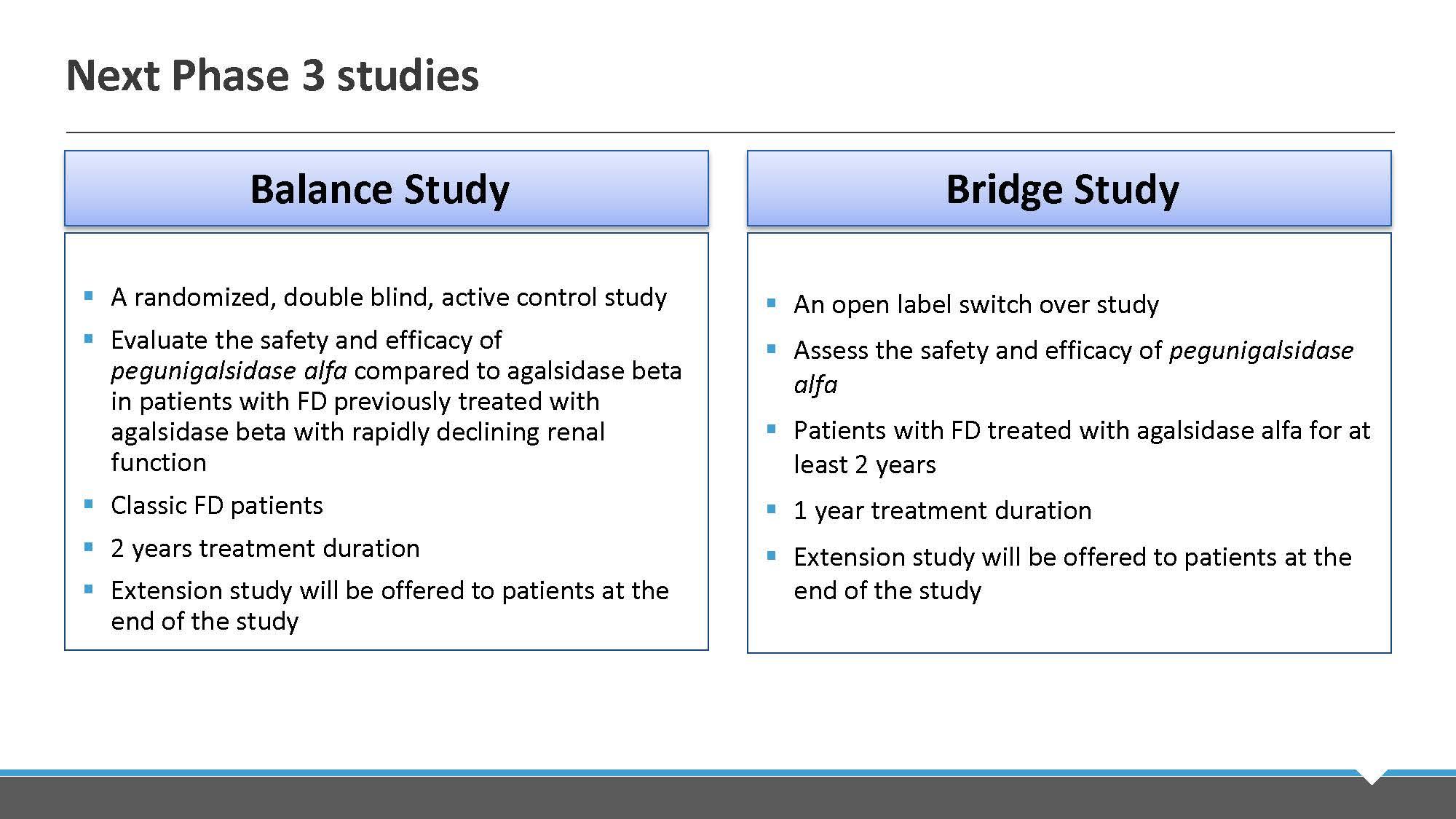
The following is the path forward for PRX-102. Also please refer to the related milestones in the table at the end of this section:
(click to enlarge)
2017 Milestone and Catalyst Table:
The next major milestone is the reporting of full results of AIR DNase for Cystic fibrosis in March, 2017:
Date in 2017 |
Milestone/Catalyst |
Drug Candidate |
Condition |
February 13 - 17 |
Presentations @ Scientific Conferences by key opinion leaders (KOLs) |
PRX-102 |
Fabry Disease |
1Q 2017 |
Report full results of Phase II clinical trials for cystic fibrosis |
AIR DNase or PRX-110 |
Cystic Fibrosis |
April 2017 |
Update 5th Nephropathy: Biomarkers, Progression, and Treatment Opportunities |
PRX-102 |
Fabry Disease |
June 2017 |
Full Data Phase 2 Presentation @ Unnamed Scientific Conference |
AIR DNase or PRX-110 |
Cystic Fibrosis |
November 2017 |
Full Data Phase 2 Presentation @ Cystic Fibrosis Conference |
AIR DNase or PRX-110 |
Cystic Fibrosis |
Second Half 2017 |
Publish Phase 2 clinical trial results for first oral drug for ulcerative colitis |
OPRX-106 |
Ulcerative Colitis |
Undetermined |
Partnership announcement related to cystic fibrosis drug |
AIR DNase or PRX-110 |
Cystic Fibrosis |
Undetermined |
Partnership announcement related to ulcerative colitis drug |
OPRX-106 |
Ulcerative Colitis |
Undetermined |
Announcement of collaboration/funding with the Cystic Fibrosis Foundation |
AIR DNase or PRX-110 |
Cystic Fibrosis |
Throughout 2017 |
Sales of the company's FDA-approved alfataliglicerase to Brazil |
ELELYSO |
Gaucher Disease |
Undetermined |
Completion of enrollment for Phase 3 clinical trials |
PRX-102 |
Fabry Disease |
Undetermined 2018 |
Interim Phase 3 data analysis |
PRX-102 |
Fabry Disease |
Rumors and Innuendo Ahead of Major Catalysts:
As I mentioned before, the torrid trip to $1.48 surprised me a bit. I was expecting the pps to be in that area two to three weeks later, or right before the release of Phase 2 Cystic fibrosis data. And as expected, the pps retreated slowly to the $1.2 area until Thursday, February 16, 2016. But during the AH session of the 16th the stock begun acting very erratically. After having closed at $1.16, I saw trades in the 80's and low 90's, or a sudden drop of up to 30%. I quickly looked for news, new AH filings, called and e-mailed my contacts in Israel, and there was nothing that could justify the way the stock was acting. I then went to check in StockTwits, and as expected, many retail investors were in panic. I've seen that type of behavior before, and I expected a bumpy Friday trading session. However, those wanting to lower the pps found a strong resistance at 95c and in the end the stock rallied strongly to close at $1.08.
It did not surprise me to see a Friday 7:44AM article by notorious short-ally TheStreet's Adam Feuerstein entitled "Biotech Stock Mailbag: Bulls Love a Distracted Trump, Protalix, Acadia, Sarepta." Was this a coincidence? I personally believe that it wasn't. But I can not prove it. As usual, Mr. Feuerstein article was heavy on innuendo and errors and light on facts and substance. Let me show you what I mean.
Erroneous statement No.1 by Mr. Feuerstein:
"Protalix's drug manufacturing platform is capable of making real drugs, but it has not proven adept at selling them. To me, that's the biggest risk factor with the stock."
"The company's commercial track record is poor. Elelyso was the first protein replacement therapy developed by Protalix. The drug secured U.S. approval for Gaucher's disease in 2012, but sales through Pfizer are negligible next to its competition, Sanofi's (SNY) Cerezyme/Cerdelga."
"The pharma giant doesn't break out Elelyso sales. Sales of "other rare disease drugs" (of which Elelyso is one) totaled $22 million in 2016, according to Pfizer's annual report."
I have news for him, Protalix sold Elelyso to its partner Pfizer in October 2015. Per the agreement, Pfizer is now entitled to all of the revenues, globally for ELELYSO, excluding Brazil, where Protalix is now responsible for all expenses and retain all revenues. Enough said on that.
Erroneous statement No. 2 by Mr. Feuerstein:
Mr. Feuerstein further commented:
"Next up in Protalix's pipeline is a protein replacement therapy for Fabry disease, known as PRX-102. The drug is basically a plant cell-based copy of Sanofi's Fabrazyme. Protalix has two phase III studies of PRX-102 in Fabry disease underway with interim results expected in 2018."
Wrong again, Mr. Feuerstein, PRX 102 is not a "copy" of Fabrazyme. PRX 102 is a ProCellEx-engineered molecule whereby its physical and chemical properties have been enhanced by crosslinking molecular sub-units of the alpha-GAL protein using PEG chains. As a simple example, a "copy" can not possibly reduce Fabrazyme's 89% formation of treatment-induced antibody formations to PRX 102's 19%. Lower antibody formation enhances the ability of the drug to fight the disease. This was demonstrated in Phase1/2 clinical studies.
I could go on, but I won't waste my time doing that since it is widely recognized that Mr. Feuerstein is known for doing things like this, at very suspicious times like Friday the 17th. In fact, you might want to read a few more examples of this despicable behavior in the article entitled: "Citizens for Responsibility and Ethics in Washington (CREW) Requests Securities and Exchange Commission (SEC) Investigate Adam Feuerstein."
Risks and uncertainties:
Please refer to this section of my last update article on Protalix
Conclusions:
Protalix was one of the best-performing biotech stock this year as seen in the over 200% gain since the start of the year. It appears that this is because of renewed investor interest in the company due to its powerful plant cell-based protein drug manufacturing technology platform (ProCellEx).
Even more amazing is the over 30% increase in new institutional ownership in recent weeks, with UBS-O'Connor becoming the largest owner with a 9.5 stake in the company.
The company is systematically delivering on the catalysts and milestones they have set for 2017, per the January 9, 2017 company update. The next major milestone is the report of full Phase 2 data of its AIR DNase Cystic fibrosis drug candidate in March 2017.
Efforts by financial media to derail Protalix' 2017 rally have failed thus far. It is likely that the stock will continue to move North ahead of the much anticipated Phase 2 Cystic fibrosis full data release, and encouraged by the substantial new institutional interest.
Investors interested in PLX shares are encouraged to do extensive due diligence starting by evaluating all the risks and uncertainties as detailed in the company's filings with the SEC.
Disclosure: I am/we are long PLX.