Live Blog

Trump and Clinton Enter the Homestretch: The Latest Updates

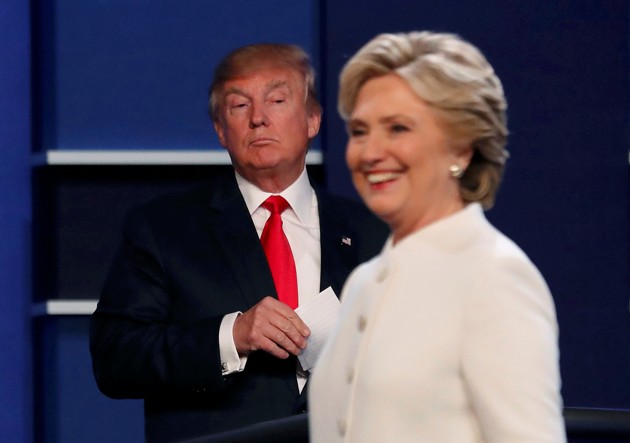
The candidates are back on the campaign trail, following the third, and final, debate on Wednesday night.

Lucy Nicholson / Reuters

It’s Thursday, October 20—the election is now less than three weeks away. Donald Trump and Hillary Clinton are returning to the campaign trail to deliver their final pitch to voters, ahead of Election Day. We’ll bring you the latest updates from the trail, as events unfold. Also see our continuing coverage:

Updates

No new updates

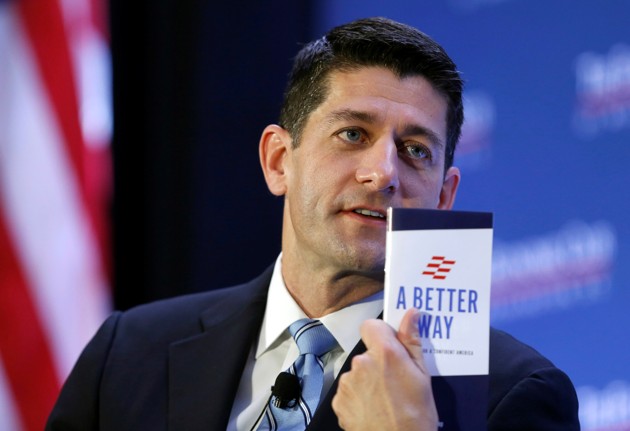
Paul Ryan Could Lose His Job Over Trump

Gary Cameron / Reuters

This time last year, Paul Ryan was a white knight for congressional Republicans. Now, his job could be at risk.

An anti-Ryan insurgency seems to be forming while Congress is on recess, North Carolina Representative Mark Meadows told a local radio station in his state. “At this point, it is picking up some steam, only because a lot of the people who believe so desperately that we need to put Donald Trump in the White House, they question the loyalty of the speaker,” Meadows, a Trump supporter and Freedom Caucus member, told The Tyler Cralle Show. “I probably have had more calls about the speaker and where he is and why he’s not getting behind the nominee than any other call in the last week or so.”

Meadows’ statements might seem like those of a disgruntled colleague. But they aren’t to be taken lightly. There was chatter in the summer about the Wisconsin Republican losing his job. Ryan only assumed the speakership after the retirement of John Boehner, who was essentially forced out of office by Meadows and other members of his ultraconservative caucus. Months before Boehner announced his retirement, Meadows filed an unusual motion to remove Boehner from his position. Though his fellow conservatives didn’t fully support that move, they eventually came around to his thinking. If members of Congress really are serious about ousting Ryan from the speaker’s post, Meadows would perhaps be the most natural leader of the effort.

In the radio interview, Meadows said the calls from frustrated Republicans have come since the “infamous Monday conference call” last week, which followed the release of the 2005 Access Hollywood tape in which Trump is heard making lewd comments about women. That’s when Ryan told his fellow House Republicans he would no longer publicly defend or campaign alongside his party’s standard-bearer. As The New York Times reported, “the reaction from hard-liners was swift and angry.”

If Ryan does face an insurrection ahead of the speaker’s election in 2017, it would be the capper on a difficult tenure. Though he assumed the speakership with broad support among Republicans—he had to be convinced to take the position on—his plans for the House were largely obscured by Trump’s over-the-top campaign.  

And what of Ryan’s hypothetical replacement? The Washington Post’s Robert Costa was given three names by Fox News’ Sean Hannity:

In the interview with Tyler Cralle Thursday, Meadows demurred: “I’m flattered that Sean Hannity would mention me as a possible speaker replacement. I don’t know that my colleagues would see it in the same way,” he said. Still: “I do think there will be real discussions after November 8 on who our leadership will be and what that will look like going forward.”
Trump Says He'll Accept Election Results—If He Wins

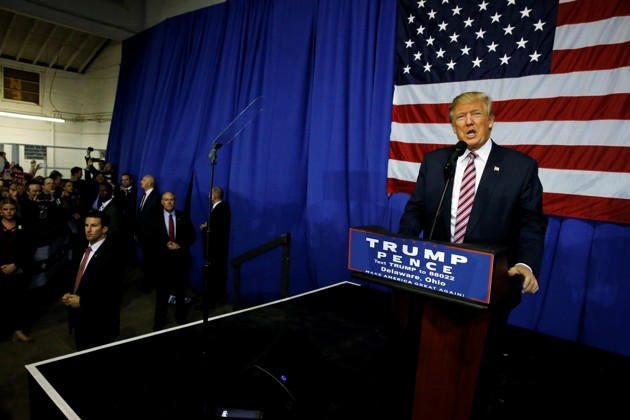
Trump in Delaware, Ohio
Jonathan Ernst / Reuters

For a brief, shining moment this afternoon, Donald Trump seemed to change his mind.

It seemed Trump could reform—and, perhaps for the first time this campaign, redeem himself after violating a time-tested political norm. “Ladies and gentlemen, I want to make a major announcement today. I would like to promise and pledge to all of my voters and supporters and to all of the people of the United States that I will totally accept the results of this great and historic presidential election,” the Republican nominee said at a rally in Ohio, before pausing a single beat. “If I win.”

Trump was clearly kidding around as he delivered the line. Or, if not kidding, intentionally trying to rile up his audience. He quickly explained that he only wants the election to be clean. “This is having nothing to do with me, but having to do with the future of our country,” he said. “We have to have fairness.”

Donald Trump’s refusal last night to say whether he’d accept the election results in November dishonored a central tenet of American democracy: the peaceful transition of power. “I will look at it at the time,” he told moderator Chris Wallace, referring to the voter tallies. “I’ll keep you in suspense.” His answer was widely panned by debate-watchers and political professionals, and inspired even the mild-mannered Associated Press to go nuclear in its coverage.  

Trump may have been joking this afternoon, but that won’t mean much if any of his supporters take him at his word. Trump is the one and only candidate many of them even considered supporting this election, and they’ve adopted his claim that the election is “rigged” as a talking point of their own. Once November 8 comes and goes, it will matter far more to the stability of the U.S. political system that his supporters can accept defeat if he loses—and less that Trump himself can reckon with a loss.

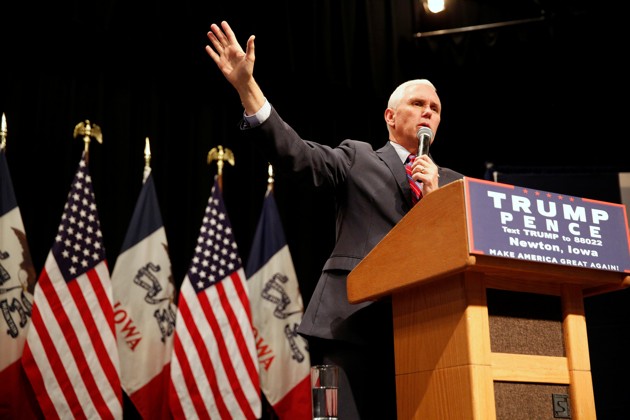
Mike Pence Is Winning the Ryan-Trump Cold War

Scott Morgan / Reuters

Who will lead the Republican Party if Donald Trump loses the election in November? Assuming there’s even a single, coherent party to lead after a fractious fall that has seen internal divisions, the #NeverTrump movement, endorsements and unendorsements, and the moderate success of two conservative-leaning third-party candidates, that question will be vital for the identity of the Republican Party moving forward.

The factions vying to take that lead fall roughly along the sides of the simmering cold war between House Speaker Paul Ryan and the Republican nominee. In other words, between a more traditional Republican conservatism and Trump’s firebrand approach. A new Bloomberg poll brings some bad news for the Ryan side of that divide, as only 33 percent of the Republican-leaning registered voters surveyed said that Ryan’s views most closely match their own. Half of those polled found that Trump’s views most closely matched their own, a view that undermines the assertion of the #NeverTrump movement that Trump does not represent the true identity of the GOP.

This poll isn’t exactly roses for Trump’s future in the party, though. When asked which leader should be the face of the GOP if Clinton wins on November 8, a plurality of Republican-leaning likely voters picked Trump’s running mate Mike Pence, with Pence polling at 27 percent and Trump trailing at 24 percent. While the gap is probably too small to make any definitive conclusions, it can’t be great for what appears to be a growing rhetorical rift within the ticket, and Pence’s penchant for modifying—if not directly contrasting—Trump’s policy views with his own. Pence seems to be positioning himself as well as he can for a future in the party after an increasingly likely Trump defeat.

As for the ideological future of the GOP, it’s important that the three people who placed the highest on Bloomberg’s poll were Pence, Trump, and Trump’s primary challenger Ted Cruz, all of whom represent a right-wing faction of the party that has been at odds with the establishment. Ryan and Ohio Governor John Kasich, both seen as more moderate voices in party leadership, trailed each of them considerably.

Karena Virginia Is the Latest Woman to Accuse Trump of Sexual Misconduct

Carlo Allegri  / Reuters

Karena Virginia publicly accused Donald Trump of sexual misconduct at a press conference on Thursday in New York City with attorney Gloria Allred.

According to Virginia, Trump approached her while she was waiting for a car to pick her up from the U.S. Open tennis tournament in New York City in 1998. She claims overhearing him say “Hey, look at this one, we haven’t seen her before,” in reference to her. She says Trump then approached her, grabbed her arm, and touched her breast. Virginia said she “knew who he was, but I had never met him” and felt shocked after the encounter. “’Don’t you know who I am?’ that’s what he said to me,” Virginia said at the press conference, describing the alleged encounter.

Before detailing her allegations, Virginia said “no one has asked me to come forward, in fact many people advised me not to speak publicly about what Donald Trump did to me” elaborating that “Mr. Trump will probably call me a liar just as he called all the other women ‘liars’ who have made accusations against him.” She added: “Or perhaps he will label me as just another nasty woman.”

At the press conference, Allred declared Trump’s assertion at Wednesday’s debate that he respects women “ludicrous” in light of the sexual assault allegations he faces.

Allred, who supports Hillary Clinton, appeared alongside Summer Zervos, a former Apprentice contestant, at another press conference last week. Zervos alleged that Trump once made unwanted sexual advances toward her.

A number of women have come forward to claim that Trump sexually assaulted them following the release of a 2005 Access Hollywood recording wherein Trump brags about using his celebrity status to grope women. Virginia said that Trump showed his character when he made the remarks on that tape, and that the public should take him at his word. “We should … believe him,” she said.

At the debate on Wednesday, Trump inaccurately claimed that “those stories have been largely debunked,” when moderator Chris Wallace brought up the various sexual misconduct allegations against him. It’s true that the Trump campaign has denied the allegations, and attempted to facilitate a sort of “debunking” of some of the claims, but the charges have by no means been definitively debunked.

The Trump campaign shot down the allegations and accused Allred of collusion with the Clinton campaign. “Discredited political operative Gloria Allred, in another coordinated, publicity seeking attack with the Clinton campaign, will stop at nothing to smear Mr. Trump,” Jessica Ditto, a deputy communications director for the campaign said in a statement. “Give me a break. Voters are tired of these circus-like antics and reject these fictional stories and the clear efforts to benefit Hillary Clinton.” — Updated on October 20, 2016 at 2:44 p.m. ET

Trump's 'Nasty' New Insult—Here to Stay?

Mike Blake / Reuters

As we learned long ago, Donald Trump doesn’t have a problem calling his enemies names, and “nasty” holds a place of honor in his lexicon, deployed at least 40 times in the last few years.

But until recently, it wasn’t an adjective he used to describe Hillary Clinton. Trump’s interjection at the debate—“Such a nasty woman,” as Clinton poked him on Social Security—seemed off-the-cuff. In retrospect, I wonder if it was engineered. For most of the campaign, he’s been far more likely to attack Clinton’s honesty than her likability. It’s always been “Crooked Hillary,” not “Nasty Hillary.” In the closing weeks of the campaign, there’s evidence that’s changing.

On Twitter, I found only two instances where he called his opponent “nasty”: one in 2015, and one posted much more recently:

On the day of the debate, Trump’s team also posted a press release alleging Clinton was dismissive and condescending to her State Department security detail—too “nasty” to get along with. Before then, his press shop mostly focused on Clinton’s supposed corruption, rolling out statements about her deleted emails and links to the Clinton Foundation while in office.

I’m now looking at Trump’s earlier claims that Clinton “viciously attacked” her husband’s accusers in a different light. At first, it seemed to be an attempt to tie Clinton to her husband’s alleged misdeeds. Now, it also reinforces a simpler narrative—that she is just a mean person.

Clinton has taken plenty of hits over her affability. But by and large, Trump wasn’t the one explicitly delivering them. That appears to be changing.

The McMullin-mentum Continues (in Utah)

George Frey / Reuters

No third-party presidential candidate has won a statewide vote since 1968, when George Wallace captured five states in the deep south.

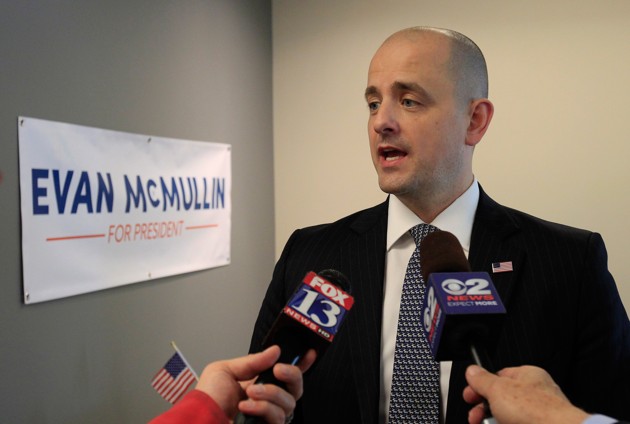
That could change this year if Evan McMullin keeps up his momentum in Utah.

The independent candidate running as a conservative alternative to Donald Trump has earned more than 20 percent support in the last five polls in Utah, and Nate Silver’s FiveThirtyEight forecast now gives him a one-in-four chance of winning the state. While Hillary Clinton and Donald Trump were preparing to debate in Las Vegas on Monday, McMullin was in Salt Lake City to accept endorsements from 11 Utah lawmakers. The most eye-popping poll came Wednesday afternoon, with an Emerson College survey giving McMullin a four-point lead over Trump, 31 percent to 27 percent, with Clinton at 24 percent. Emerson is not the most respected polling outfit because it does not call cell phones, but the trend in McMullin’s favor matches other polls that have come out this month.

A Mormon graduate of Brigham Young University, McMullin has been targeting Utah from the start of his exceedingly long-shot presidential bid, which he formally launched in Salt Lake City in August. The state’s Republican base never warmed to Trump, and several GOP leaders in Utah were among the first to abandon the party’s nominee after the infamous “Access Hollywood” tape came out. McMullin’s only path to the White House would be if he wins Utah’s six electoral votes and denies both Trump and Clinton the 270 needed to clinch the presidency. The election would then go to the U.S. House, where McMullin would hope that GOP-led state delegations abandon Trump in favor of a more traditional conservative who previously served as a staffer for the House Republican conference.

It’s not going to happen. But a McMullin win in Utah nonetheless would serve as further embarrassment to Trump and as a source of hope to critics of the two-party system. And it would simply be astonishing for a candidate who remains completely unknown to a vast majority of voters nationwide to win any state, even one as unique as Utah. Consider that the Libertarian ticket of Gary Johnson and Bill Weld have served a combined four terms as governor, are on all 50 state ballots, and yet not a single poll has shown them in as strong a position as McMullin is in Utah. McMullin could also make a strong showing in Idaho, which has the second-highest proportion of Mormons in the country. There has been sparse polling of the traditionally Republican state and no public surveys that have included McMullin. But a poll taken before the Trump Access Hollywood tape emerged found that Clinton was only 10 points behind in a state that Mitt Romney won by 32 points over President Obama in 2012. Johnson earned 10 percent, while 11 percent said they would vote for “some other candidate.”

McMullin’s success naturally leads to a series of “What if?” questions about the 2016 race. Would a more well-known and better-funded Republican or truly independent candidate have had a shot to split the Trump vote and actually win a significant number of electoral votes? The obvious possibility would be Mitt Romney, who denounced Trump early on and would have instantly been a factor in the race. But while Romney could surely have captured Utah, he would have been a ripe target for both Trump and Clinton, who have ignored McMullin. Johnson and Weld have shown the difficulty in crossing the threshold from curiosity to serious contender. The better question might be if McMullin might spawn more state-specific, “favorite son” candidacies—particularly in places that don’t draw a lot of attention from major-party candidates and in states where the political lines don’t always align with the national partisan divide. Think Alaska, Maine, Vermont, or the handful of sparsely-populated states in the Mountain West.

It may be, however, that McMullin’s unlikely surge is not a recipe that can easily be repeated, the result of a confluence of factors unique to this already unprecedented election. Just as there can only be one Donald Trump, so is there only one Evan McMullin.

New Bill Clinton Accuser Comes Forward in Breitbart

Clinton in his Arkansas governor days
Ira Schwarz / AP

Breitbart has published the account of a woman, identified as Leslie Millwee, who claims that Bill Clinton sexually assaulted her in 1980.

“I am a wife, a mother, I work for a non-profit for cancer awareness, and I was sexually assaulted by Bill Clinton,” she said in a video that accompanies the conservative website’s article.

Millwee alleges that multiple assaults occurred while she was working as a television reporter in Fort Smith and Fayetteville, Arkansas. She claims that she interviewed Clinton, then the governor of Arkansas, roughly 20 times during her time there. Here’s how she describes the alleged assaults, which she said took place in an editing room at the television station where she worked:

He came up behind me and started rubbing my shoulders, and running his hands down toward my breasts. I was just stunned. I froze. I asked him to stop, he laughed. That happened on three occasions and each time it escalated where the aggressive nature of his touch, and what he was doing behind me escalated.

According to Breitbart’s report, the second and third alleged assaults “involved Clinton rubbing his genitalia against Millwee.” In the video, Millwee said that during the second, she was “asking him the whole time, please do not do this, do not touch me.” She said that the former president later visited her apartment and tried to come inside. “I did not answer the door,” she said.

Millwee claims that she told her story to her mother, grandmother, and husband. The report also cites three other individuals that she told in the late 1990s: “Fran Kaminsky, a friend and former co-worker; Angela Malaer, a friend and Millwee’s son’s fourth-grade teacher during the Lewinsky scandal; and Ronald Scott, a Houston-based retired lawyer.”

Breitbart notes that it was not able to find any interviews Millwee said she conducted with Clinton, though the article quotes Karen Pharis, identified as “Millwee’s assignments editor,” who corroborates her claim that she interviewed Clinton.

The story also flags an inconsistency in the way Millwee describes the alleged assaults during the video interview and how she described an encounter with Clinton in a 2011 book. Millwee told Breitbart that she “decided as I wrote and organized that I would not put anything that seemed sexual in nature, as far as details, etc. I wanted to put a book on the shelf that could be read by adults, or teens, or proudly tell people about it at church.”

Millwee, whose story was reported hours before the third and final presidential debate, cited Democratic nominee Hillary Clinton in her video explanation of why she didn’t come forward earlier: “I almost came out during the Monica Lewinsky and Kathleen Willey situation; I watched that unfold a little bit. I was very prepared to go forward then, and talk about it, and I watched the way the Clintons, and Hillary, slandered those women, harassed them, did unthinkable things to them. And I just did not want to be part of that.” The Donald Trump campaign—whose CEO Steve Bannon was until recently the executive chairman of Breitbart—has targeted Hillary Clinton for allegedly mistreating women who’ve accused her husband of sexual misconduct.

When asked about the report on MSNBC, Clinton campaign spokesman Brian Fallon responded: “I don't know any of the circumstances behind those allegations. I just know … that it's been reported by Breitbart. I wouldn't be surprised if Donald Trump seeks to invoke this Breitbart report tonight or in the coming days. We expect that he'll do anything in these closing days. He has said that he's essentially practicing a scorched-Earth approach to this campaign.” A Clinton representative declined further comment.

Voter Registrations Reach an All-Time High

Sue Ogrocki / AP

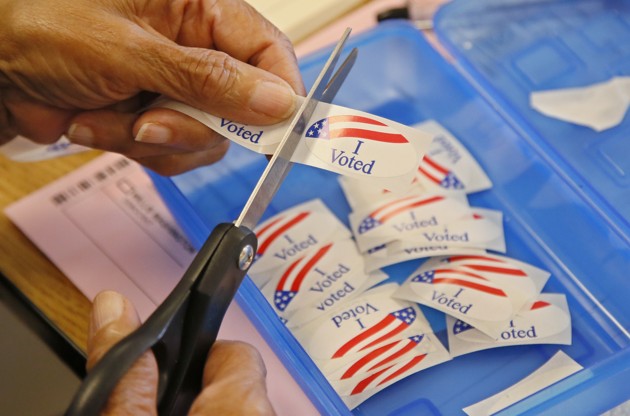
There are more than 200 million registered voters in the United States—marking an all-time high in the country’s history.

Politico reports:

There is no current national database of voter registration because each state independently runs its own election. But TargetSmart, a Democratic political data firm, told POLITICO that the country passed the 200 million threshold in recent days as North Carolina, New Hampshire, Nevada and New York reported new voter numbers.

Tom Bonier, CEO of TargetSmart, said national registration now stands at 200,081,377 voters.

The numbers indicate a surge in registrations over the past eight years. To put it in perspective, more than 146 million people were registered to vote “as recently as 2008.”

The spike is likely to benefit Democrats. According to Politico, “TargetSmart found that 42.6 percent of the new voters registered this year lean Democratic, and only 29 percent lean Republican (28.4 percent lean independent).” Across battleground states, a similar trend has unfolded—Democrats hold the advantage.

Pew Research Center predicted this year that the U.S. electorate “will be the country’s most racially and ethnically diverse ever.” Voter organizations have capitalized on this, deploying efforts to increase voter registration, particularly among Latinos. As I reported earlier this year, these outreach efforts might stand to benefit Clinton more than Donald Trump, whose inflammatory rhetoric has alienated Latino voters. The NALEO Educational Fund projected Latino voter turnout will increase by 17 percent in November.

It’s unclear whether an uptick in registration will translate to increased voter turnout. But Clinton’s campaign manager Robby Mook told reporters this week that the campaign expects “the biggest turnout in electoral history.”

Trump's Fool-Proof Method for Selecting a Cabinet

Donald Trump is fond of citing unscientific online surveys, which have been the only variety of polls that have shown him winning debates or leading in the presidential race in recent weeks. On Wednesday, the Republican Party posted a survey asking readers to nominate candidates for his cabinet. What could possible go wrong?

Well, just for starters, Trump appears to be a few cards short of a full deck. The cabinet includes the heads of fifteen executive departments, in addition to seven other cabinet-rank officials. But if you intended to nominate Boaty McBoatface for secretary of transportation, you’re out of luck—the GOP isn’t accepting suggestions. The secretary of the interior is eighth in the presidential line of succession, just ahead of the secretary of agriculture and the secretary of commerce. And all three are missing from the survey, as is the secretary of housing and urban development. Somewhat ominously, the other missing agency is the Department of Education, which Trump has previously said he intends to eliminate—perhaps the other five are in for similar treatment.

This isn’t the first time cabinet picks have been used to gin up a little publicity. Ahead of the Republican convention, Trump aides mooted announcing some names, before backing off amid questions as to whether that would be legal.

In truth, the post seems like a relatively harmless way for the GOP to harvest the contact information of supporters—and guessing cabinet picks is, in any case, a favorite Washington pastime. But when President Trump nominates Leroy Jenkins for secretary of defense? You’ll know how it happened.

How Low Can Trump Go?

A new poll finds that the Republican nominee’s support is still crumbling.

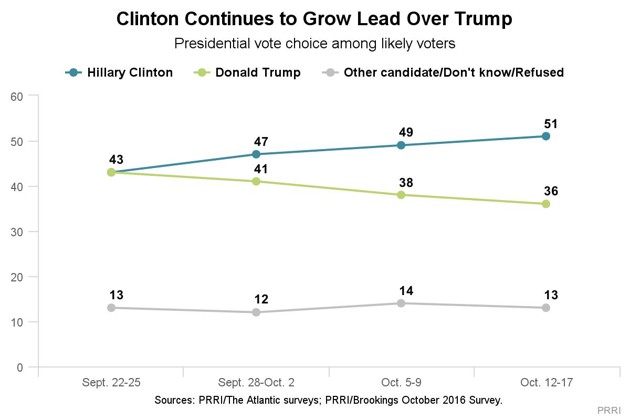
Ahead of the first presidential debate, a PRRI/The Atlantic poll found the race tied—with Clinton and Trump each drawing 43 percent support. After the debate, Clinton steadily drew ahead. One week later, she had a six-point lead; a week after that, she’d built it to 11 points, 49-38. And a PRRI/Brookings survey out Wednesday finds her extending it to a staggering 15 points.

It’s just one survey—polling averages, which are typically more reliable than any single poll, put the race at a 7 to 9 point Clinton lead. But what’s particularly striking in this instance is the trend line. Trump, in the past, has sometimes seen his support plummet after a few bad news cycles, only to recover as attention moves to some more favorable set of issues. This time, though, he’s been in steady decline for weeks.

Is that reversible? Perhaps. But Trump is out of time. More than 1.86 million votes have already been cast in the 2016 election. In the last two weeks, a disproportionate number of women have requested ballots in a couple states. In Florida, North Carolina, and Georgia, Trump appears to be underperforming Mitt Romney; in Ohio and Iowa, he may be ahead of Romney’s pace.

And if victory appears increasingly unlikely for Trump, attention may shift to Congress. The same PRRI/Brookings poll gives Democrats a 12-point lead in the congressional ballot test. That, like the main result, is an outlier. But if other polls follow the trend, Trump may end up dragging the historically large GOP congressional majority down with him.