Operation “Barbarossa”, the German invasion of the Soviet Union launched on 22nd June 1941, was one of the defining moments in modern European history. It would take the very idea of warfare, not to say the peoples of both countries, into a horrific new dimension. For the German Wehrmacht and Waffen-SS units it represented a battle for the very fabric of Western civilisation, a modern day Crusade against the evil Bolshevik hordes.
The fierce and bitter conflict on the Eastern Front, lasting four long years, would produce its own special brand of soldier, many of whom could be counted on both sides. One of these was the young assault gun commander Michael Wittmann.
The Story of “Point 65.5”
Three German Army groups were organised for the invasion; the first, Army Group North, would lead the strike for Leningrad, the second, Army Group Centre, were assigned to carry out the capture of Moscow, while the third, Army Group South, to which the LSSAH was attached, were given the task of securing the oilfields of the Caucasus region.
Although it soon became clear that Hitler and the German Army High Command (OKH) had dramatically underestimated the strength and organisation of the Soviet Red Army, the early successes were more than encouraging for the invading forces; by the beginning of July, the German divisions were careering through the Steppes of the Ukraine at a rapid rate, seemingly clearing everything that stood in its way. Playing its part in this success was the StuG III assault gun commanded by Michael Wittmann.
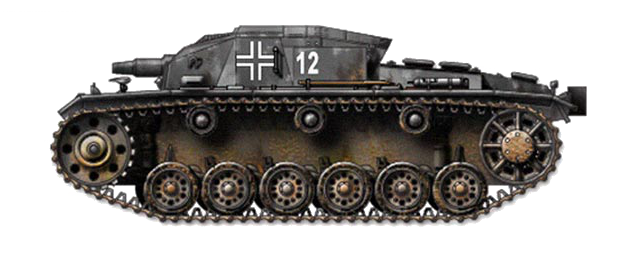
On 12th July, Wittmann’s StuG III was ordered to move to a vantage point on a hill, designated Point 65.5. After reaching their objective – after nearly running into a ditch – Rottenführer Klinck, Wittmann’s gunner, spotted a number of enemy vehicles rapidly approaching. After moving into a position offering additional visual advantage, eighteen T34/76 tanks were spotted, one group of twelve and another group of six. After ordering his driver Koldenhöff to reposition the vehicle on the left side of the hill, Wittmann prepared his crew for the onslaught, and the gun was set to take the Russian armour head-on.
After repositioning again in order to gain a view over the hill, the first of the T34/76s was quickly taken out with one round of armour-piercing shot from the 75mm KwK. As the StuG III was not equipped with a rotating turret, all of the responsibility would be placed on the driver Koldenhöff, who with consummate skill quickly rolled the vehicle into a suitable vantage point, allowing Klinck to obtain an accurate bead on a second T34/76, which was quickly engulfed in flames. Within seconds, loader Petersen had slammed the next round into the hot and oily breech. After a close escape from another T34/76 (and a Russian gunner with a very poor aim), Wittmann managed to reach the edge of a small wood in order to plan his next move.
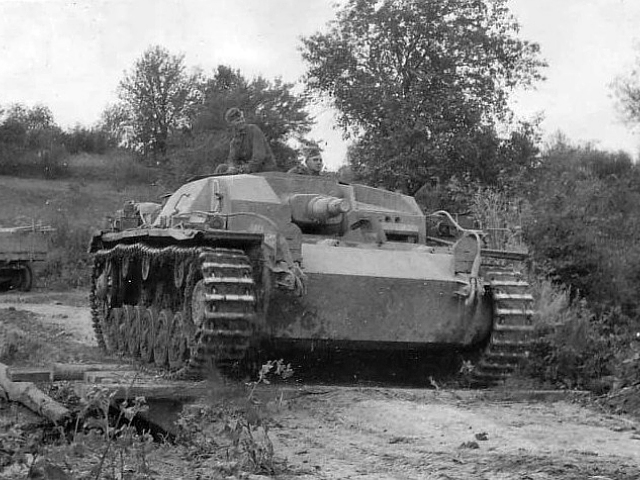
While carrying out a quick recce on foot, Wittmann spotted a third enemy vehicle. Assuming that he had not been spotted, Wittmann was rocked off his feet when a terrific crash sounded around him. After dusting himself off, he found himself looking at the destroyed T34/76, its turret completely blown off and now sticking out of the ground like a flag-pole. Klinck’s powers of observation, initiative and gunnery skills had been the obvious factor here: while both vehicles had fired simultaneously, Wittmann’s gunner had been alert enough to locate, sight and hit the target. On returning to his cupola, Wittmann was the first to praise his skillful gunner.
After another near miss, following two misplaced shots from an itinerant T34/76, Wittmann quickly spotted another Soviet vehicle. Kicking the powerful Maybach engine to life, Koldenhöff skilfully manoeuvred the StuG III to allow Klinck a shot at the enemy Panzer. In a flash, the fourth Russian tank was obliterated. After another close encounter with a rather deceptive water crossing, expertly negotiated by Koldenhöff, Wittmann set out to locate three Russian vehicles he had seen earlier. After scanning the area, he saw the three T34/76s sitting with engines running on top of a hill.
After Koldenhöff quickly moved the StuG. III to within 500 metres of the last Soviet Panzer, Klinck, quickly reacting to Wittmann’s command, let off a round of 75mm armour-piercing shot, which found its way to the Russian vehicle with a resounding crack.
The remaining T34/76s would quickly redirect their aim towards Wittman’s vehicle, and Koldenhöff desperately moved the StuG III into position. Klinck let go another round – which bounced off the enemy tank. Loader Petersen was working overtime, and Klinck evetually managed to get a shot in, which seemed to have disabled the turret of the enemy machine. While all of this was happening, the third T34/76 had decided to head for safety.
Their work seemingly done, Wittmann and his crew started to move away, only to see the turret of the second T34/76 crank back into life. Petersen quickly slammed in another round into the breech, and the resulting shot saw the Russian vehicle burst into flames, its crew desperately trying to escape the inferno. On this day, in addition to the tremendous courage shown by Wittmann and his crew in the destruction of six Soviet vehicles, the young Stug commander was to show a spirit of humanity that was otherwise lacking in this terrible conflict. Seeing three of the Russians in obvious pain, he ordered his crew to smother the flames engulfing them with their bed rolls.
The evening of 12th July 1941 saw SS-Unterscharführer Wittmann presented with the first of what would be many decorations, the Iron Cross Second Class, which he received from an elated “Sepp” Dietrich. As a testament to the humanity of this brave soldier, on being asked by Dietrich if he had a special wish, Wittmann requested that the three wounded Russians be given the best medical treatment. The newly-decorated StuG III commander was warmly received by his loyal crew – a warrior had truly been born.
(Narrative derived from a selection of reports cited in Patrick Agte’s Michael Wittmann and the Panzer Commanders of the Leibstandarte)
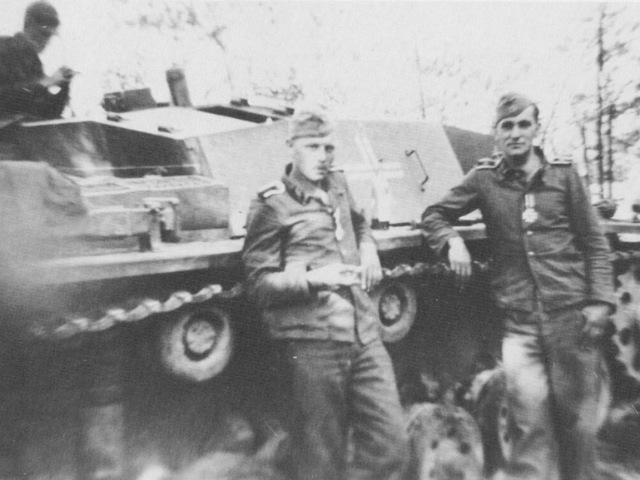
Wounded in Uman, Victorious in Nogai, Stalemate in the Crimea
The following month was to see yet more success for the German armies and the LSSAH, as the advance continued despite stiffening and unexpected resistance from the Red Army which, despite its huge number of casualties and apparent lack of leadership, seemed to be getting bigger and more threatening. Still, at this stage, everyone in the German leadership remained hugely optimistic.
By now the LSSAH had been transferred from the LIV Army Corps to the III Panzer Corps, part of Generalfeldmarschall Ewald von Kleist’s 1st Panzer Group, and would play a major part in the assault of the city of Uman in the Cherkassy Oblast. This objective was finally achieved after overcome some desperate Soviet resistance, and the crucial role played by the LSSAH in this campaign would earn the praise of the Wehrmacht Corps commander General Werner Kempf, who thanked the LSSAH for their “incomparable dash” in routing the enemy.
During the fighting in and around Uman, Michael Wittmann was wounded for the first time, suffering lacerations to his head and face. The wounds were not serious, although later that month he was awarded the Wound Badge in black. The day after Wittmann received this award, 21st August, the first advance parties made their way across the river Dniepr, and were followed by the LSSAH – now again with LIV Army Corps – during the first week of September.
After playing a significant role in the storming of the Nogai steppe having crossed the Dniepr, Wittmann was awarded the Iron Cross First Class on 8 September. It seemed that nothing could stop the victorious German armies as they stormed southwards towards the Crimea.
Wittmann and his crew were to have a lucky escape later that September; moving with Kurt “Panzer” Meyer’s unit towards the Isthmus of Perekop, they came across a herd of sheep ambling across the field. Before a word could be said, one of the animals had set off a landmine, and as a result the whole herd panicked and mass carnage ensued. Were it not for the sheep, Wittmann and his colleagues would have driven straight into the minefield.
As echoes of the last explosion ringed through the air, the Russians launched a furious attack. The LSSAH units quickly withdrew from Perekop and would set about regrouping for the next attack, a night-time surge on the city of Melitopol to the east. During this sojourn, the Russians again launched a massive counter-attack.
Wittmann’s crew once again showed their skill in difficult conditions: faced with a T34/76 that had suddenly appeared like a ghost from the darkness, driver Koldenhöff quickly assumed an attacking position, with gunner Klinck doing the rest – taking out the enemy vehicle with a clean shot which ignited its on-board ammunition. After running into a tree in the darkness, Wittmann’s vehicle raced head-on into two Soviet anti-tank guns, and, running a gauntlet of fire, preceded to run over them, scattering their panicking crews.
After linking up with Meyer’s vehicle, Wittmann and his StuG III – nicknamed Bussard or “Buzzard” – sped like demons away from the enemy fire. By now the battle was rapidly becoming more ferocious, and slowly the Russians were beaten back as another attempt was made to secure the area around Perekop. On 8th October Wittmann was wounded again during this fierce fighting, suffering injuries to his right thigh and again to his head and face, which kept him under medical observation for two days. On the following day he was promoted to SS-Oberscharführer, and was also recommended for officer training.
The Battle against General Winter
The winter of 1941-42 saw the first encounter with Russia’s hidden army – the weather. While the late autumn months had seen heavy rainfall and the creation of massive lakes of thick, viscous mud, the months after that were to see a rapid fall in temperature and the threat of blanketing snowstorms and bitter, swirling winds. As a direct result of the overconfidence of Hitler and the German leadership, the hardships that were soon to be experienced by the troops on the ground were not at all accounted for. Many German soldiers, inadequately equipped to cope with the extreme conditions, developed severe cases of frostbite, which in turn led to gangrene and in many cases, death.
Although Wittmann and his crew, as a result of their “privileged” position in their StuG III, were for the most part protected from the cold, a number of other dangers abounded – not least the threat of touching the freezing metal surface of their vehicles. In addition, there was the obvious problem with the engines, which needed more than the usual maintenance to keep them in shape. Under these conditions, the German ever-advancing juggernaut soon began to grind to a shuddering halt. Yet despite this, the forces of the LSSAH – now back again as part of Kleist’s 1st Panzer Group – were still able to assist in the capture the cities of Stalino and Taganrog in mid-October, and the city of Rostov-on-Don on 20th November.
A day after the fall of Rostov, Wittmann received yet another award, this time the Tank Assault badge in silver (Panzer-Kampfabzeichen), the result of his taking part in twenty-five acknowledged engagements. Wittmann and his colleagues continued to brave the Russian winter, and somehow managed to overcome the situation of having to take on the enemy in the face of the biting cold and the constant threat of mechanical failure and equipment malfunction. With temperatures plummeting to as low as -40 degrees Centigrade, the lack of adequate winter equipment and sufficient rations compounded the problems faced by men who were hundreds of kilometres away from home.
A Soviet counterattack resulted in Rostov falling back into the hands of the Red Army, but an effective stalemate led to both sides consolidating their positions until the following spring. The LSSAH would use this time to regroup ahead of an attempt to recapture Rostov in June 1942, but by this time Michael Wittmann was already on his way back home to Germany.
While the majority of his colleagues remained stationed in the Southern Ukraine as part of the ongoing campaign to retake Rostov and capture the oilfields of the Caucasus – operation “Case Blue” (Fall Blau) – Wittmann was heading to the Waffen-SS Junkerschule in the Bavarian spa town of Bad Tölz to commence his officer training. On his return to the Eastern Front, it would be as an officer commanding the Tiger I.