TensorFlow - Google’s latest machine learning system, open sourced for everyone
Posted:
Monday, November 09, 2015
Deep Learning has had a huge impact on computer science, making it possible explore new frontiers of research and to develop amazingly useful products that millions of people use every day. Our internal deep learning infrastructure DistBelief, developed in 2011, has allowed Googlers to build ever larger neural networks and scale training to thousands of cores in our datacenters. We’ve used it to demonstrate that concepts like “cat” can be learned from unlabeled YouTube images, to improve speech recognition in the Google app by 25%, and to build image search in Google Photos. DistBelief also trained the Inception model that won Imagenet’s Large Scale Visual Recognition Challenge in 2014, and drove our experiments in automated image captioning as well as DeepDream.
While DistBelief was very successful, it had some limitations. It was narrowly targeted to neural networks, it was difficult to configure, and it was tightly coupled to Google’s internal infrastructure -- making it nearly impossible to share research code externally.
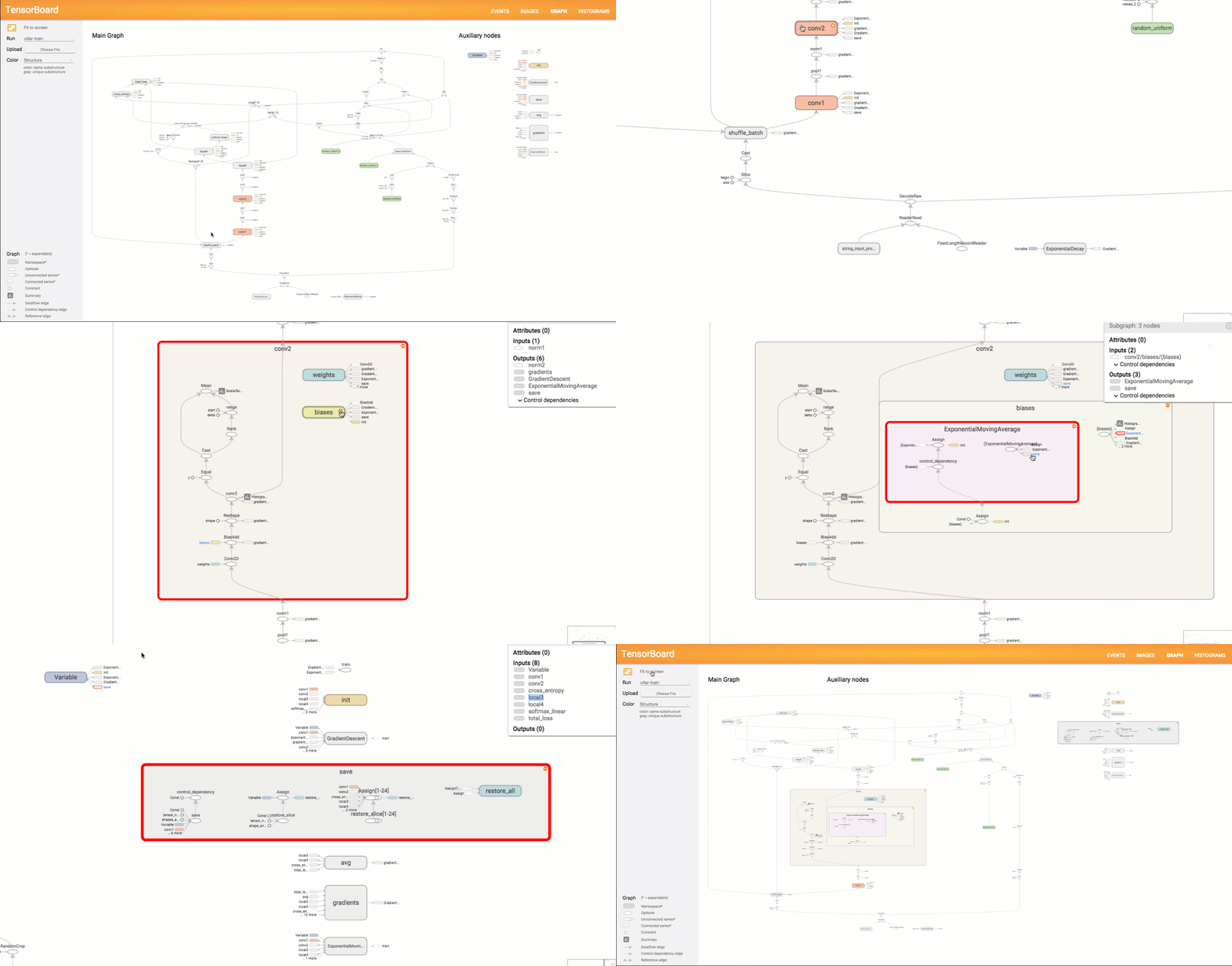 |
| Inspecting a model with TensorBoard, the visualization tool |
But the most important thing about TensorFlow is that it’s yours. We’ve open-sourced TensorFlow as a standalone library and associated tools, tutorials, and examples with the Apache 2.0 license so you’re free to use TensorFlow at your institution (no matter where you work).
Our deep learning researchers all use TensorFlow in their experiments. Our engineers use it to infuse Google Search with signals derived from deep neural networks, and to power the magic features of tomorrow. We’ll continue to use TensorFlow to serve machine learning in products, and our research team is committed to sharing TensorFlow implementations of our published ideas. We hope you’ll join us at www.tensorflow.org.